



Friday, April 5, 2019
Housing View – April 5, 2019
On cross-country:
- Affordable Housing Crisis Spreads Throughout World – Wall Street Journal
- Film Director: Don’t Just Blame Gentrification for Housing Crisis – Wall Street Journal
- Mind the data gap: commercial property prices for policy – Bank for International Settlements
On the US:
- Bank Balance Sheets and Liquidation Values: Evidence from Real Estate Collateral – SSRN
- Expectations During the U.S. Housing Boom: Inferring Beliefs from Actions – NBER
- Banks’ Real Estate Exposure and Resilience – Federal Reserve Bank of San Francisco
- American Families Can’t Afford the Rent – Harvard Joint Center for Housing Studies
- San Francisco Fed Says Banks Could Weather a Big Hit to Housing – Bloomberg
- The Link Between Local Zoning Policy and Housing Affordability in America’s Cities – George Mason University
- Wall Street Puts the Squeeze on the Housing Market – Bloomberg
- California Home Prices Are So High, Even High-Income Households Can’t Keep Up – Zillow
- What’s Keeping Lower-Income Families from Homeownership? – Freddie Mac
- Are Planners Partly to Blame for Gentrification? – Citylab
- Mapping America’s Next Tech Hubs: A Look at Housing Market and Migration Trends in Atlanta, Austin, D.C. and Other Hot Destinations for Tech Companies – Redfin
- These Low-Income Communities Should Prepare for an Influx of Cash – Zillow
- Homebuying Startups Keep Raising Money in Softer Housing Market – Bloomberg
- Housing Prices, Supply, and Innovation – Cato Institute
- Upzoning Under SB 50: The Influence of Local Conditions on the Potential for New Supply – University of California, Berkeley
- The Neighborhoods Where Housing Costs Devour Budgets – Citylab
- Available Affordable Housing Is Down Across The State, Report Finds – wbur
- The Growing Shortage of Affordable Housing for the Extremely Low Income in Massachusetts – Federal Reserve Bank of Boston
On other countries:
- [Australia] What do house prices do to jobs? – Macro Business
- [Canada] Toronto Housing Market Steadies as Sellers Bide Their Time – Bloomberg
- [Canada] Canada’s house price boom takes off – Global Property Guide
- [Czech Republic] Czech mortgage market continues to fall in February – ING
- [Indonesia] The housing market in Indonesia rarely makes big moves – Global Property Guide
- [Ireland] Ireland Property Rush Risks Repeat of Crisis – Bloomberg
- [Japan] What Housing Crisis? In Japan, Home Prices Stay Flat – Wall Street Journal
- [Japan] NIMBYs Argue New Housing Supply Doesn’t Make Cities Affordable. They’re Wrong. – Reason
- [Latvia] Latvia’s house price rises decelerating – Global Property Guide
- [New Zealand] Household Leverage and Asymmetric Housing Wealth Effects- Evidence from New Zealand – Reserve Bank of New Zealand
- [Singapore] Singapore’s house price rises accelerating – Global Property Guide
- [Switzerland] Slowdown inevitable for house prices in Switzerland – Global Property Guide
- [Switzerland] Swiss Regulator Calls for Measures to Avert Property Bubble – Bloomberg
- [United Kingdom] Should tenants fear the rise of the corporate landlord? – Financial Times
On cross-country:
- Affordable Housing Crisis Spreads Throughout World – Wall Street Journal
- Film Director: Don’t Just Blame Gentrification for Housing Crisis – Wall Street Journal
- Mind the data gap: commercial property prices for policy – Bank for International Settlements
On the US:
- Bank Balance Sheets and Liquidation Values: Evidence from Real Estate Collateral – SSRN
- Expectations During the U.S.
Posted by at 5:00 AM
Labels: Global Housing Watch
Thursday, April 4, 2019
Assessing the Risk of the Next Housing Bust
From the IMF’s latest Global Financial Stability report:
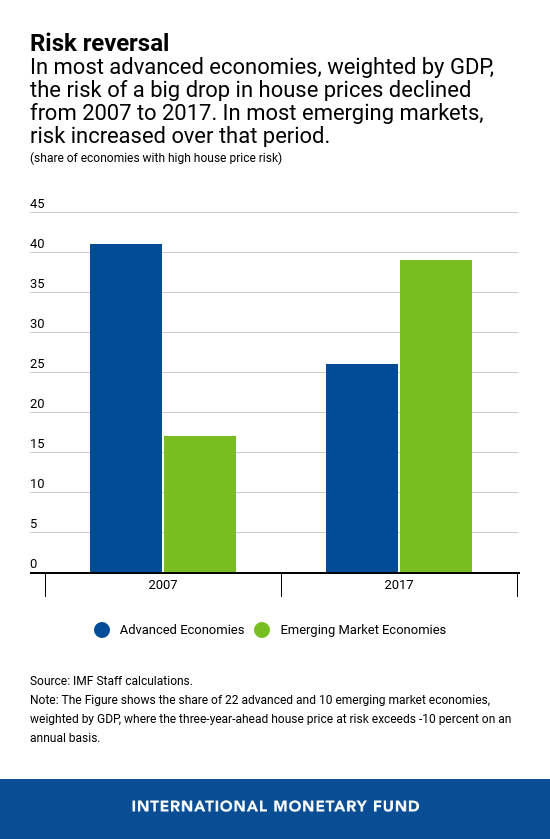
“There’s good news for people living in Las Vegas, Miami and Phoenix: the risk of a housing bust like the one they endured during the global financial crisis is fairly small. For folks in Toronto and Vancouver, however, the picture hasn’t improved since 2008, and the risk of a large decline in house prices remains elevated.
Those are among the insights generated by the IMF’s new tool for assessing the danger of a severe downturn in home prices. Homeowners, of course, are keenly interested in the value of what is probably their biggest asset. But there is also a strong link between home prices, the financial system, and the economy. The link is especially powerful when prices go down – as we explain in Chapter Two of the IMF’s twice-yearly Global Financial Stability Report.
Why do home prices matter for the broader economy? Housing construction and related spending on things like home improvements account for one-sixth of the US and euro-area economies, making them among the largest components of GDP. What’s more, mortgages and other housing-related lending are a big part of banks’ assets in many countries, so changes in house prices affect the health of the banking system.
Boom-bust cycle
It’s no surprise, then, that more than two-thirds of financial crises in recent decades were preceded by a boom-bust cycle in home prices, and that central banks in the United States, China, Australia, and elsewhere have recently expressed concern about large increases in home prices.
Fortunately, the IMF’s new tool can help policy makers gauge the likelihood of a future housing downturn and take early steps to help limit the damage. The tool, dubbed House Prices at Risk, feeds into the Fund’s growth-at-risk model, which links financial conditions to the danger of an economic downturn (see the October 2017 GFSR .)
Our study encompasses data from 22 advanced economies, 10 emerging-market economies, and the major cities in those countries. We found that in most advanced economies in our sample, weighted by GDP, the odds of a big drop in inflation-adjusted house prices were lower at the end of 2017 than 10 years earlier but remained above the historical average. In emerging markets, by contrast, riskiness was higher in 2017 than on the eve of the global financial crisis. Nonetheless, downside risks to house prices remain elevated in more than 25 percent of these advanced economies and reached nearly 40 percent in emerging markets in our study. Among them, China stands out, especially its Eastern provinces.”
Continue reading here.
From the IMF’s latest Global Financial Stability report:
“There’s good news for people living in Las Vegas, Miami and Phoenix: the risk of a housing bust like the one they endured during the global financial crisis is fairly small. For folks in Toronto and Vancouver, however, the picture hasn’t improved since 2008, and the risk of a large decline in house prices remains elevated.
Those are among the insights generated by the IMF’s new tool for assessing the danger of a severe downturn in home prices.
Posted by at 10:06 AM
Labels: Global Housing Watch
Wednesday, April 3, 2019
The missing link between income inequality and economic growth: Inequality of opportunity
From a VoxEU post by Shekhar Aiyar and Christian Ebeke:
“There are contrasting theories on the relationship between income inequality and growth, and the empirical evidence is similarly mixed. This column highlights the neglected role of equality of opportunity in mediating this relationship. Using the World Bank’s new Global Database on Intergenerational Mobility, it shows that in societies where opportunities are unequally distributed, income inequality exerts a greater drag on growth.
Despite the firm consensus that income inequality is intrinsically undesirable, its impact on economic growth is much disputed. Simon Kuznets famously argued that inequality is beneficial for economic growth at an early stage of development, since a moneyed capitalist class can undertake more investment, but is harmful at a later stage. Others have pointed to inequality as a necessary, even desirable outcome of rewards to innovation and risk-taking. But there are also numerous theories about how income inequality can reduce investment and hinder the full realisation of human potential. As a canonical example, Galor and Zeira (1993) show that if poor families are constrained to under-invest in education, aggregate growth falls.
The empirical evidence is similarly mixed. Barro (2000) finds that for developed economies income inequality raises growth. On the other hand, Berg et al. (2012, 2018) find that income inequality tends to reduce the duration of growth spells. Forbes (2000) and Panizza (2002) find no systematic effect.
The missing link: Inequality of opportunity
In recent work (Aiyar and Ebeke 2018), we point to the neglected role of equality of opportunity in mediating this relationship. Our hypothesis is simple. In societies where opportunities are unequally distributed – where the material circumstances of parents act as binding constraints on the opportunities available to their children – income inequality exerts a greater drag on growth. Any increase in income inequality tends to become entrenched, limiting the investment opportunities – broadly defined to include investment in children – available to low-income earners, thereby retarding long-term aggregate growth. On the other hand, in societies with a more equal distribution of opportunities, an increase in income inequality can be more easily reversed and need not constrain investment opportunities and growth. To the extent that inequality of opportunity matters in this way, its omission from standard regressions of growth on income inequality leads to misspecification, which can help explain the inconclusive nature of the empirical literature to date.
We measure a society’s distribution of opportunity by the economic mobility of its people across generations. The World Bank’s new Global Database on Intergenerational Mobility (GDIM) compiles cross-country estimates of the elasticity of a son’s income (or education level) with respect to the income (or education level) of their father (Narayan et al. 2018). The higher this elasticity, the lower the degree of intergenerational mobility, which we take to signal a less equal distribution of opportunity. Because each observation requires a comparison of life-cycle income over two generations, this is a slow-moving variable whose latest value says something about societal conditions over a period of several decades. For the purpose of our study and due to data availability constraints, we take this variable to be time-invariant.”
Continue reading here.
From a VoxEU post by Shekhar Aiyar and Christian Ebeke:
“There are contrasting theories on the relationship between income inequality and growth, and the empirical evidence is similarly mixed. This column highlights the neglected role of equality of opportunity in mediating this relationship. Using the World Bank’s new Global Database on Intergenerational Mobility, it shows that in societies where opportunities are unequally distributed, income inequality exerts a greater drag on growth.
Posted by at 8:43 AM
Labels: Inclusive Growth
Housing Market in Kuwait
From the IMF’s latest report on Kuwait:
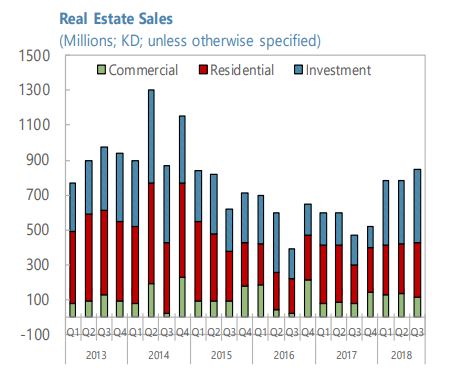
“Real estate is recovering, and equity markets have outperformed regional peers. The sales of investment and residential properties rebounded since mid-2018. Kuwaiti stocks outperformed other Gulf Cooperation Council (GCC) markets, and market capitalization rose, especially following the March 2018 announcement of Kuwait’s inclusion in the FTSE Russell Emerging Market Index.”
From the IMF’s latest report on Kuwait:
“Real estate is recovering, and equity markets have outperformed regional peers. The sales of investment and residential properties rebounded since mid-2018. Kuwaiti stocks outperformed other Gulf Cooperation Council (GCC) markets, and market capitalization rose, especially following the March 2018 announcement of Kuwait’s inclusion in the FTSE Russell Emerging Market Index.”
Posted by at 8:40 AM
Labels: Global Housing Watch
Tuesday, April 2, 2019
Monetary Policy, Growth and Employment in Developing Areas: A Review of the Literature
From a paper by P.N. (Raja) Junankar at University of Technology Sydney;
“In this paper we review the literature on the impact that monetary policy has on growth and employment in developing countries. Much of the literature focusses on the impact of monetary policy on inflation levels and inflation volatility, and sometimes on output (GDP) levels and volatility of output. This survey of the literature on Monetary policy and growth shows that money plays a small role in developing countries and that monetary policy is not a very important influence on growth but may have some impact on inflation. Although there is much discussion about the merits of keeping inflation levels and volatility low, there is very little literature on studying the impact of low rates of steady inflation on the levels of private investment and technological change and hence on economic growth and on employment. There is very little research about the direct links between monetary policy and employment. The impact of growth on employment depends on what are the main drivers of economic growth and the initial state of the economy. Although growth may lead to increasing employment (formal and informal) there is little evidence showing that growth leads to an increase in “decent employment”.”
From a paper by P.N. (Raja) Junankar at University of Technology Sydney;
“In this paper we review the literature on the impact that monetary policy has on growth and employment in developing countries. Much of the literature focusses on the impact of monetary policy on inflation levels and inflation volatility, and sometimes on output (GDP) levels and volatility of output. This survey of the literature on Monetary policy and growth shows that money plays a small role in developing countries and that monetary policy is not a very important influence on growth but may have some impact on inflation.
Posted by at 11:07 AM
Labels: Inclusive Growth
Subscribe to: Posts