



Monday, August 5, 2019
Monetary Policy, Housing Rents and Inflation Dynamics
From a paper by Daniel A. Dias and João B. Duarte:
“In this paper we study the effect of monetary policy shocks on housing rents. Our main finding is that, in contrast to house prices, housing rents increase in response to contractionary monetary policy shocks. We also find that, after a contractionary monetary policy shock, rental vacancies and the homeownership rate decline. This combination of results suggests that monetary policy may affect housing tenure decisions (own versus rent). In addition, we show that, with the exception of the shelter component, all other main components of the consumer price index (CPI) either decline in response to a contractionary monetary policy shock or are not responsive. These findings motivated us to study the statistical properties of alternative measures of inflation that exclude the shelter component. We find that measures of inflation that exclude shelter have most of the statistical properties of the widely used measures of inflation, such as the CPI and the price index for personal consumption expenditures (PCE), but have higher standard deviations and react more to monetary policy shocks. Finally, we show that the response of housing rents accounts for a large proportion of the “price puzzle” found in the literature.”
From a paper by Daniel A. Dias and João B. Duarte:
“In this paper we study the effect of monetary policy shocks on housing rents. Our main finding is that, in contrast to house prices, housing rents increase in response to contractionary monetary policy shocks. We also find that, after a contractionary monetary policy shock, rental vacancies and the homeownership rate decline. This combination of results suggests that monetary policy may affect housing tenure decisions (own versus rent).
Posted by at 4:39 PM
Labels: Global Housing Watch
Thursday, August 1, 2019
House Prices in Indonesia
From the IMF’s latest report on Indonesia:
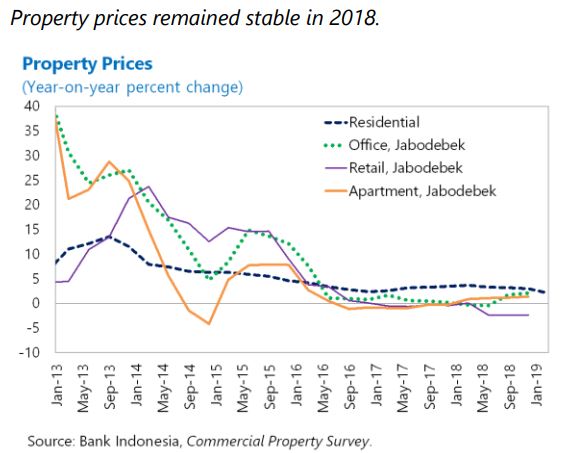
“There are no signs of asset bubbles—residential property prices grew by 3 percent (y/y) in 2018:Q4, while commercial property prices have been flat since 2017.”
From the IMF’s latest report on Indonesia:
“There are no signs of asset bubbles—residential property prices grew by 3 percent (y/y) in 2018:Q4, while commercial property prices have been flat since 2017.”
Posted by at 10:26 AM
Labels: Global Housing Watch
Wednesday, July 31, 2019
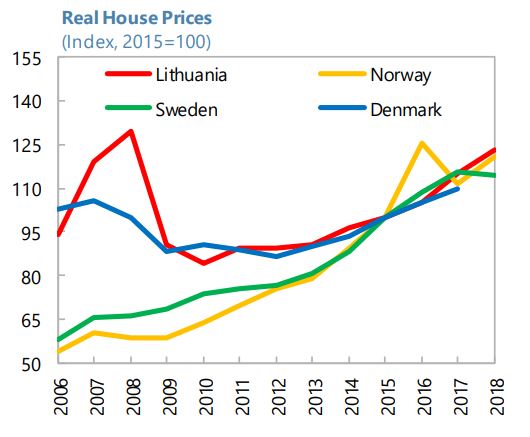
House Prices in Lithuania
From the IMF’s latest report on Lithuania:
Posted by at 2:10 PM
Labels: Global Housing Watch
Designing Good Labour Market Institutions: How to Reconcile Flexibility, Productivity and Security?
A new paper by authors Werner Eichhorst, Arne L. Kalleberg, André Portela de Souza and Jelle Visse discusses on how to design sustainable labor market institutions:
“Demographic shifts, technological innovation, institutional reforms and global economic integration affect the way people work. Technological innovations have a major impact on occupations and industries, changing the ways economies in different world regions, in both developed and developing countries, work along with new division of labour that are facilitated by global economic integration. This paper is based on the joint work within the International Panel on Social Progress. It highlights three main areas of attention: a) skill formation, d) the challenges to collective bargaining, and e) social protection and labour market policies. Based on an assessment of the existing evidence, the paper suggests some policy principles and concrete policy options that might further those objectives, not ignoring some tensions that might exist between flexibility and security in the different labour markets. The ultimate direction of reforms in line with an idea of social progress lies in institutional arrangements that facilitate the reconciliation of flexibility and productivity with access to decent jobs and social protection. We argue that distinct policy options are available that can be implemented more globally in order to achieve these goals simultaneously”
A new paper by authors Werner Eichhorst, Arne L. Kalleberg, André Portela de Souza and Jelle Visse discusses on how to design sustainable labor market institutions:
“Demographic shifts, technological innovation, institutional reforms and global economic integration affect the way people work. Technological innovations have a major impact on occupations and industries, changing the ways economies in different world regions, in both developed and developing countries, work along with new division of labour that are facilitated by global economic integration.
Posted by at 11:39 AM
Labels: Inclusive Growth
Tuesday, July 30, 2019
Residential Mobility and Unemployment in the UK
In the context of Brexit and the developments within UK, this interesting paper by Monica Langella and Alan Manning gives a perspective on the labor market in the UK:
“One of the main forces that economists expect to equalize economic opportunity across areas is migration: individuals leaving depressed areas for booming areas. There is strong evidencethat migration does respond to differences in economic opportunity (for a thorough, though early, survey see Greenwood, 1997). The classic reference for the US is Blanchard and Katz (1992) who concluded that negative local labour demand shocks cause a short-run rise in the unemployment rate but that migration causes unemployment rates to be equalized within 5-7 years, a relatively short time. However, Amior and Manning (2018) argue that for the US the migration response over decades is slower than that estimated by Blanchard and Katz (1992) and that local demand shocks are highly persistent, causing very persistent differentials in unemployment rates. The US has also had a marked fall in residential mobility in recent years that has attracted attention (Molloy, Smith and Wozniak, 2011, 2014; Dao, Furceri, and Loungani, 2017). Similar exercises for Europe (e.g. Pissarides and McMaster, 1990; Decressin and Fatas, 1995; Overman , 2002; OECD 2005) find slower adjustment processes than in the US though Amior and Manning (2019) argue that the net migration response to unemployment in the UK is higher and more similar to the US than commonly believed. Although these studies do provide convincing evidence that migration does respond to economic opportunities, there is still surprisingly little evidence on the process in recent years (the survey of Greenwood, 1997, seems to be the most recent) and considerable gaps in our knowledge“
In the context of Brexit and the developments within UK, this interesting paper by Monica Langella and Alan Manning gives a perspective on the labor market in the UK:
“One of the main forces that economists expect to equalize economic opportunity across areas is migration: individuals leaving depressed areas for booming areas. There is strong evidencethat migration does respond to differences in economic opportunity (for a thorough,
Posted by at 10:25 AM
Labels: Inclusive Growth
Subscribe to: Posts