



Friday, May 3, 2019
Housing View – May 3, 2019
On cross-country:
- Four Pillars and a Roof: Building cohesive plans for making adequate housing universal – OECD
- Urbanization and the Growth of Mega-Cities – University of Chicago
On the US:
- Preventing the Next Housing Crisis – Wharton
- California Has a Housing Crisis. The Answer Is More Housing. – New York Times
- Crises in the Housing Market: Causes, Consequences, and Policy Lessons – The Center for Growth and Opportunity
- AEI Housing Market Indicators release on January 2019 data – American Enterprise Institute
- Do you still love L.A.? The high cost of housing is testing our affections, poll shows – Los Angeles Times
- Florida Bill Would Ban Cities From Requiring Developers to Build Affordable Housing – Reason
- Eight ways state lawmakers addressed housing affordability – The Seattle Times
- A One-Stop Shop for Affordable Backyard Homes Advances in L.A. – Citylab
On other countries:
- [Australia] How Foreigners Helped Cool Australian Housing – Bloomberg
- [Brazil] Brazil’s house prices continue to fall – Global Property Guide
- [Canada] Is elevating housing prices a good way to make homes more affordable? – Globe and Mail
- [China] China developers push land prices up as credit, purchase rules ease – Reuters
- [Spain] Impact of the new law on real estate credit – Bank of Spain
On cross-country:
- Four Pillars and a Roof: Building cohesive plans for making adequate housing universal – OECD
- Urbanization and the Growth of Mega-Cities – University of Chicago
On the US:
- Preventing the Next Housing Crisis – Wharton
- California Has a Housing Crisis. The Answer Is More Housing. – New York Times
- Crises in the Housing Market: Causes,
Posted by at 5:00 AM
Labels: Global Housing Watch
Monday, April 29, 2019
Revisiting the causal effect of democracy on long-run development
From a VoxEU post by Markus Eberhardt:
“Recent evidence suggests that a country switching to democracy achieves about 20% higher per capita GDP over subsequent decades. This column demonstrates the sensitivity of these findings to sample selection and presents an implementation which generalises the empirical approach. If we assume that the democracy–growth nexus can differ across countries and may be distorted by common shocks or network effects, the average long-run effect of democracy falls to 10%.
In a recent paper, Acemoglu et al. (2019), henceforth “ANRR”, demonstrated a significant and large causal effect of democracy on long-run growth. By adopting a simple binary indicator for democracy, and accounting for the dynamics of development, these authors found that a shift to democracy leads to a 20% higher level of development in the long run.1
The findings are remarkable in three ways:
- Previous research often emphasised that a simple binary measure for democracy was perhaps “too blunt a concept” (Persson and Tabellini 2006) to provide robust empirical evidence.
- Positive effects of democracy on growth were typically only a “short-run boost” (Rodrik and Wacziarg 2005).
- The empirical findings are robust across a host of empirical estimators with different assumptions about the data generating process, including one adopting a novel instrumentation strategy (regional waves of democratisation).
ANRR’s findings are important because, as they highlight in a column on Vox, there is “a belief that democracy is bad for economic growth is common in both academic political economy as well as the popular press.” For example, Posner (2010) wrote that “[d]ictatorship will often be optimal for very poor countries”.
The simplicity of ANRR’s empirical setup, the large sample of countries, the long time horizon (1960 to 2010), and the robust positive – and remarkably stable – results across the many empirical methods they employ send a very powerful message against such doubts that democracy does cause growth.
I agree with their conclusion, but with qualifications. My investigation of democracy and growth (Eberhardt 2019) captures two important aspects that were assumed away in ANRR’s analysis:
- Different countries may experience different relationships between democracy and growth. Existing work (including by ANRR) suggests that there may be thresholds related to democratic legacy, or level of development, or level of human capital, or whether the democratisation process was peaceful or violent. All may lead to differential growth trajectories.2
- The world is a network. It is subject to common shocks that may affect countries differently. The Global Crisis is one example, as are spillovers across countries (Acemoglu et al. 2015, in the case of financial networks).”
Continue reading here.
From a VoxEU post by Markus Eberhardt:
“Recent evidence suggests that a country switching to democracy achieves about 20% higher per capita GDP over subsequent decades. This column demonstrates the sensitivity of these findings to sample selection and presents an implementation which generalises the empirical approach. If we assume that the democracy–growth nexus can differ across countries and may be distorted by common shocks or network effects, the average long-run effect of democracy falls to 10%.
Posted by at 7:27 AM
Labels: Inclusive Growth
Shadows and lights of globalization
From Branko Milanovic:
“To think correctly about globalization one needs to think of it in historical context. This means seeing today’s globalization and its effects, positive and negative, as in many ways a mirror-replay of the first globalization that took place from the mid-19th century to the First World War.
That globalization, underpinned by the Industrial Revolution in Western Europe, transformed the economic map of the world by making Europe much richer and politically and militarily more powerful than any other part of the world. It allowed European countries, and later the United States, to conquer most of Africa and significant parts of Asia, which even when they were not formally ruled by Westerners were subjected to their strong influence in terms of economic policy (opening to trade, control of custom revenues), or even juridical extraterritoriality for European citizens.
Advanced European countries became much richer, so that by 1914 the ratio of per capita income, according to the Maddison project database, between the UK and China was 8 to 1 compared to 3 to 1 one century earlier. (The figure below shows the reverse of this ratio: Chinese, Indian and Indonesian GDP per capita as percent of comparable West European GDPs per capita. It thus highlights the recent rise of Asian countries.) Moreover, the fruits of industrialization and globalization began to be spread across Western countries’ income distributions thus making even the poor people there richer than almost all Africans and most Asians. European dominance allowed it to “export” its surplus population and to blunt the edge of the incipient class conflict.
This very short sketch of the well-known effects of the first globalization allows us to remind ourselves of both its positive and negative sides: huge technological progress as against exploitation, increased incomes for many vs. grinding poverty and exclusion for others, European mastery of the world vs. a colonial status of Africa and much of Asia.
In what ways should it inform our thinking about the current globalization? First, in making us realize that broad historical movements cannot bring only benefits to everybody. Some will inevitably lose, others gains; and at times the loss of some is a condition for the gain of others. Second, thinking of the past enables us to see how the current globalization is in many respects a mirror-image of the first—but shorn of its more brutal effects of conquest and exploitation.”
Continue reading here.
From Branko Milanovic:
“To think correctly about globalization one needs to think of it in historical context. This means seeing today’s globalization and its effects, positive and negative, as in many ways a mirror-replay of the first globalization that took place from the mid-19th century to the First World War.
That globalization, underpinned by the Industrial Revolution in Western Europe, transformed the economic map of the world by making Europe much richer and politically and militarily more powerful than any other part of the world.
Posted by at 7:25 AM
Labels: Inclusive Growth
Friday, April 26, 2019
Housing View – April 26, 2019
On cross-country:
- When Birth or Death Hits Home: Demography and the Housing Market in Paris and Amsterdam, 1400-present – Maastricht University
- Housing – The Wiley Blackwell Encyclopedia of Urban and Regional Studies
On the US:
- Home Value Cooling Is More About Changes in Demand Than Supply – Zillow
- Upcoming event: Zoning, taxing, hoarding: Housing policies for the middle class – Brookings Institute
- California’s Unfixable Housing Mess Is Years in the Making – Reason
- How Single-Family Garages Can Ease California’s Housing Crisis – Citylab
- Who’s Really Buying Property in San Francisco? – The Atlantic
- Trump-Appointed Official Promises Full Push to Overhaul Plumbing of Mortgage Market – Wall Street Journal
- Punishing Housing Providers for Racial Imbalances They Didn’t Cause Will Only Lead to More Racial Bias – Cato
- Garage Conversions Could Ease California Housing Crisis – UCLA
- Why Dense Housing is Green Housing – Redfin
- Democrats Court a New Voting Bloc: People Who Don’t Own Homes – New York Times
- Baby Boomers and the Future of Homeownership in the United States – Berkeley Economic Review
- Want to Make Millions and Pay No Taxes? Try Real Estate – Bloomberg
- Young People Can’t Buy Homes Until Older Owners … Move On – Bloomberg
On other countries:
- [Chile] Can regulation on loan-loss-provisions for credit risk affect the mortgage market? Evidence from administrative data in Chile – Bank for International Settlements
- [China] Chinese slum demolitions reveal government debt strains – Financial Times
- [Germany] Rent Control and Rental Prices: High Expectations, High Effectiveness? – Leibniz Institute for Economic Research
- [Netherlands] Do house prices matter for household consumption? – Netherlands Bureau of Economic Analysis
- [Spain] The Airbnb invasion of Barcelona – New Yorker
- [United Kingdom] Credit Constraints and the Composition of Housing Sales. Farewell to First-Time Buyers? – Journal of the European Economic Association
- [United Kingdom] What the Airbnb surge means for UK cities – BBC
On cross-country:
- When Birth or Death Hits Home: Demography and the Housing Market in Paris and Amsterdam, 1400-present – Maastricht University
- Housing – The Wiley Blackwell Encyclopedia of Urban and Regional Studies
On the US:
- Home Value Cooling Is More About Changes in Demand Than Supply – Zillow
- Upcoming event: Zoning, taxing, hoarding: Housing policies for the middle class – Brookings Institute
- California’s Unfixable Housing Mess Is Years in the Making – Reason
- How Single-Family Garages Can Ease California’s Housing Crisis – Citylab
- Who’s Really Buying Property in San Francisco?
Posted by at 5:00 AM
Labels: Global Housing Watch
Thursday, April 25, 2019
Forty years of inequality in Europe: Evidence from distributional national accounts
From a new VOX post:
“Despite the growing importance of inequalities in policy debates, it is still difficult to compare inequality levels across European countries and to tell how European growth has been shared across income groups. This column draws on new evidence combining surveys, tax data, and national accounts to document a rise in income inequality in most European countries between 1980 and 2017. It finds that income disparities on the old continent have increased less than in the US and shows that this is essentially due to ‘predistribution’ policies.”
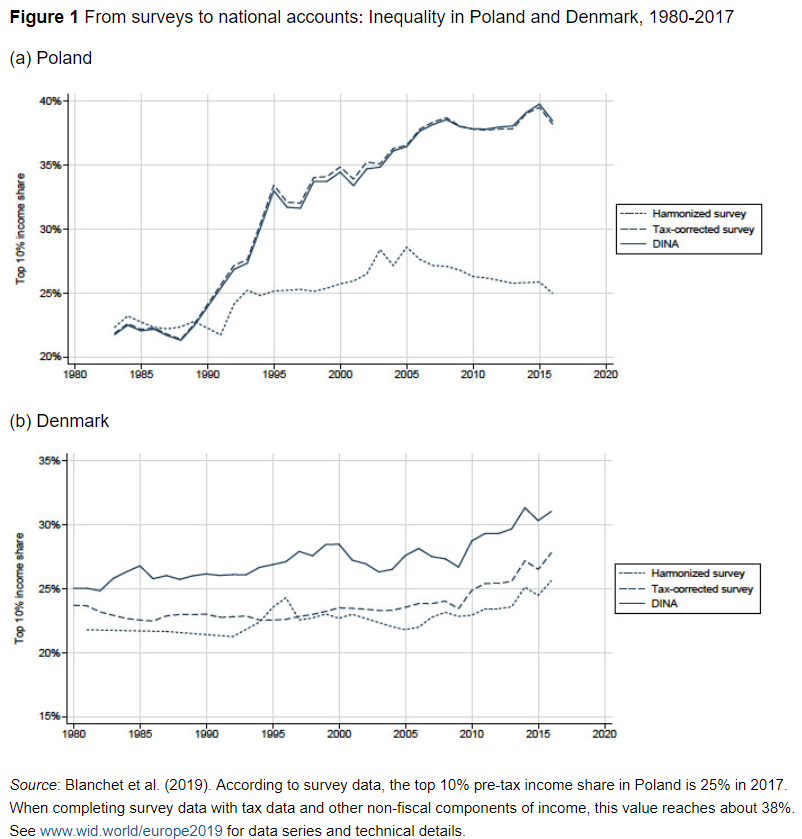
“Figure 1 shows how bringing together surveys, tax data, and national accounts can greatly improve traditional survey-based estimates. In Poland, fiscal (pre-tax) top income shares obtained from Bukowski and Novokmet (2017) reveal a large and growing underrepresentation of top incomes in surveys. After correction, the top 10% pre-tax income share appears to be underestimated by more than 10 percentage points in 2017. By contrast, surveys are more efficient at measuring top incomes in Denmark, but accounting for the large share of undistributed profits accruing to resident households (more than 8% of GDP in recent years) leads to important upward revisions of inequality at the top end.”
From a new VOX post:
“Despite the growing importance of inequalities in policy debates, it is still difficult to compare inequality levels across European countries and to tell how European growth has been shared across income groups. This column draws on new evidence combining surveys, tax data, and national accounts to document a rise in income inequality in most European countries between 1980 and 2017. It finds that income disparities on the old continent have increased less than in the US and shows that this is essentially due to ‘predistribution’ policies.”
Posted by at 10:44 AM
Labels: Inclusive Growth
Subscribe to: Posts