



Monday, November 11, 2019
Unemployment insurance schemes around the world: Evidence and policy options
From an ILO paper by Antonia Asenjo and Clemente Pignatti:
“We conduct a comparative analysis of unemployment insurance (UI) schemes in advanced and emerging economies. We find that almost all countries complement UI with severance payments, although emerging (advanced) economies rely relatively more on severance payments (UI). As a result, UI coverage rates are substantially higher in advanced than emerging economies. We also find that most countries finance their UI collectively (i.e. by workers, employers and the government), but contribution rates are higher in advanced than emerging economies. Turning to entitlement conditions, UI schemes are generally accessible only by dependent employees and formal sector workers and the stringency of qualifying conditions is similar in advanced and emerging economies. We also find that unemployment benefit generosity (i.e. in terms of both benefit level and duration) is higher in advanced than emerging economies. Finally, the integration of active measures within UI schemes is observed across most emerging and advanced economies. However, emerging economies present weaker job-search requirements but stronger sanctions for job refusal compared to advanced economies.”
From an ILO paper by Antonia Asenjo and Clemente Pignatti:
“We conduct a comparative analysis of unemployment insurance (UI) schemes in advanced and emerging economies. We find that almost all countries complement UI with severance payments, although emerging (advanced) economies rely relatively more on severance payments (UI). As a result, UI coverage rates are substantially higher in advanced than emerging economies. We also find that most countries finance their UI collectively (i.e.
Posted by at 4:26 PM
Labels: Inclusive Growth
Friday, November 8, 2019
Housing View – November 8, 2019
On the US:
- Foreclosures Can Amplify Downward Spirals of House Prices – NBER
- MoNK: Mortgages in a New-Keynesian Model – NBER
- Big Cities Are Taking on Housing Affordability, but Even the Largest Will Need Help – Harvard Joint Center for Housing Studies
- Land-Use Regulation and the Intensive Margin of Housing Supply – Journal of Urban Economics
- Is zoning a useful tool or a regulatory barrier? – Brookings
- Apple to donate $2.5 billion to combat California housing crisis – CBS
- Cities need housing. Churches have property. Can they work something out? – Washington Post
- China’s Housing Market Is Finally Cooling. Some Homeowners Are Furious. – Wall Street Journal
- Why $4.5 Billion From Big Tech Won’t End California Housing Crisis – New York Times
- How California Became America’s Housing Market Nightmare – Bloomberg
On other countries:
- [United Kingdom] Redesigning Housing Policy – National Institute Economic Review
On the US:
- Foreclosures Can Amplify Downward Spirals of House Prices – NBER
- MoNK: Mortgages in a New-Keynesian Model – NBER
- Big Cities Are Taking on Housing Affordability, but Even the Largest Will Need Help – Harvard Joint Center for Housing Studies
- Land-Use Regulation and the Intensive Margin of Housing Supply – Journal of Urban Economics
- Is zoning a useful tool or a regulatory barrier?
Posted by at 5:00 AM
Labels: Global Housing Watch
Wednesday, November 6, 2019
Who deserves the Nobel for China’s economic development?
An interesting new blogpost by Andrew Batson on the Nobel Prize in Economics and China:
“The awarding of the Nobel Prize in economics to three academics “for their experimental approach to alleviating global poverty” has prompted some caustic commentary about how much, or little, global poverty has actually been reduced by the highly targeted, small-scale policy interventions evaluated by such experiments.
It’s well known that most of the reduction in global poverty in recent decades, however it is measured, is accounted for by rapid economic growth in big Asian economies. On the World Bank’s numbers, China alone accounts for about 60% of the decline in the number of people living in extreme poverty worldwide (China’s poor population declined by 742 million people, while the world’s declined by 1.16 billion people).
The contribution of randomized controlled trials to China’s poverty reduction has been, to a first approximation, zero. Yao Yang, the dean of the National School of Development at Peking University, wrote in an English-language op-ed that “Experiments might help policymakers improve existing welfare programs or lay the foundation for new ones, but they cannot tell a poor country how to achieve sustained growth.” In a similar vein, Harvard professor Dani Rodrik tweeted: “Remarkable how little today’s development economics has to say about the most impressive poverty reduction in history ever.”
An interesting new blogpost by Andrew Batson on the Nobel Prize in Economics and China:
“The awarding of the Nobel Prize in economics to three academics “for their experimental approach to alleviating global poverty” has prompted some caustic commentary about how much, or little, global poverty has actually been reduced by the highly targeted, small-scale policy interventions evaluated by such experiments.
It’s well known that most of the reduction in global poverty in recent decades,
Posted by at 4:09 PM
Labels: Inclusive Growth
Friday, November 1, 2019
Housing View – November 1, 2019
On cross-country:
- Building Urban Resilience: An Evaluation of the World Bank Group’s Evolving Experience (2007-2017) – World Bank
On the US:
- Book Reviews: Two Histories of Financiers Profiting From Real Estate While Homeowners Go Belly Up – New York Times
- Minneapolis Saw That NIMBYism Has Victims – The Atlantic
- Business’s Growing Role In Confronting The Housing Crisis – Forbes
On other countries:
- [Canada] A New Twist on Vancouver’s Skyline – New York Times
- [China] China Now Has An Answer To Its Housing Crisis – It’s Called Rent – Forbes
- [Denmark] Blackstone Promises Supply Amid Risk of Danish Rent Controls – Bloomberg
On cross-country:
- Building Urban Resilience: An Evaluation of the World Bank Group’s Evolving Experience (2007-2017) – World Bank
On the US:
- Book Reviews: Two Histories of Financiers Profiting From Real Estate While Homeowners Go Belly Up – New York Times
- Minneapolis Saw That NIMBYism Has Victims – The Atlantic
- Business’s Growing Role In Confronting The Housing Crisis – Forbes
Posted by at 5:00 AM
Labels: Global Housing Watch
Thursday, October 31, 2019
CBO’s Economic Forecasting Record: 2019 Update
From Congressional Budget Office:
“CBO’s economic forecasts have been comparable in quality to those of the Administration and the Blue Chip consensus. Large errors in CBO’s forecasts tend to reflect challenges faced by all forecasters.
Each year, CBO prepares economic forecasts that underlie its projections of the federal budget. CBO forecasts hundreds of economic variables, but some—including output growth, the unemployment rate, inflation, interest rates, and wages and salaries—play a particularly significant role in the agency’s budget projections. To evaluate the quality of its economic projections, estimate uncertainty ranges, and isolate the effect of economic errors on budgetary projections, CBO regularly analyzes its historical forecast errors. That analysis serves as a tool for assessing the usefulness of the agency’s projections.
In this report, CBO evaluates its two-year and five-year economic forecasts from as early as 1976 and compares them with analogous forecasts from the Administration and the Blue Chip consensus—an average of about 50 private-sector forecasts published in Blue Chip Economic Indicators. External comparisons help identify areas in which the agency has tended to make larger errors than other analysts. They also indicate the extent to which imperfect information may have caused all forecasters to miss patterns or turning points in the economy.”
Continue reading here.
From Congressional Budget Office:
“CBO’s economic forecasts have been comparable in quality to those of the Administration and the Blue Chip consensus. Large errors in CBO’s forecasts tend to reflect challenges faced by all forecasters.
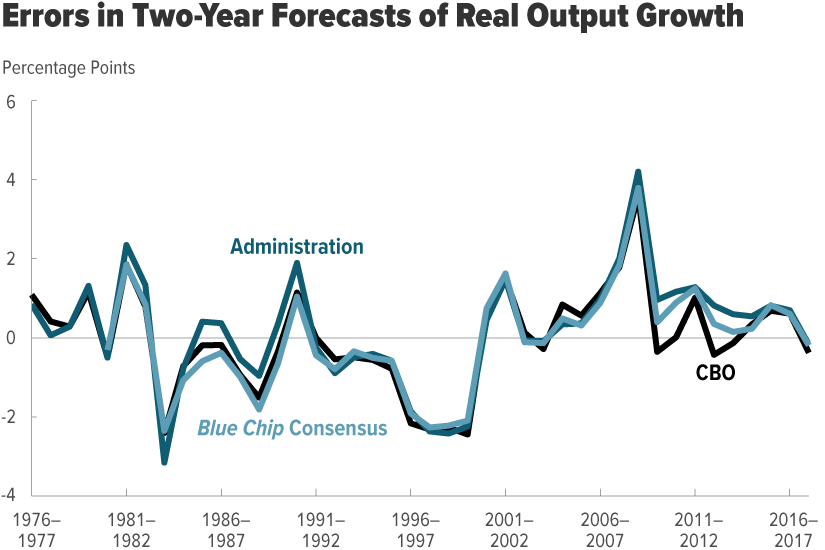
Each year, CBO prepares economic forecasts that underlie its projections of the federal budget. CBO forecasts hundreds of economic variables, but some—including output growth,
Posted by at 11:15 AM
Labels: Forecasting Forum
Subscribe to: Posts