


Inclusive Growth

Global Housing Watch

Forecasting Forum

Energy & Climate Change

Housing View – February 7, 2020

On cross-country:

  • The ECB considers counting owner-occupied housing in inflation – Economist, Financial Times, Bloomberg
  • Watch: ING International Survey: Homes & Mortgages – ING
  • Housing market polarises opinion between the haves and have-nots – ING
  • Saving priorities reflect home ownership challenge – ING


On the US:


On other countries:

  • [China] China’s property market stalls amid coronavirus outbreak – Financial Times
  • [Ireland] Irish housing crisis derails Varadkar’s re-election bid – Reuters
  • [Netherlands] Luxury Home Buyers Are Revamping Amsterdam’s Historic Housing Stock – Wall Street Journal

On cross-country:

  • The ECB considers counting owner-occupied housing in inflation – Economist, Financial Times, Bloomberg
  • Watch: ING International Survey: Homes & Mortgages – ING
  • Housing market polarises opinion between the haves and have-nots – ING
  • Saving priorities reflect home ownership challenge – ING


On the US:

Read the full article…

Posted by at 5:00 AM

Labels: Global Housing Watch

Poverty Reduction and Economic Growth

From Econofact post by Lant Pritchett:


The Issue:

Reducing poverty in developing countries has been a longstanding and central concern of development economics. Over the past two decades, there has been a noticeable shift in the approach taken by development economists to address this question. Researchers have increasingly focused their efforts on randomized controlled trials — an experimental approach commonly used in medical research — to determine the effectiveness of anti-poverty programs and interventions. This shift was highlighted by the 2019 Nobel Prize in Economics awarded to Abhijit Banerjee, Esther Duflo and Michael Kremer, which recognized their work for breaking down the issue of fighting global poverty into “smaller, more manageable, questions – for example, the most effective interventions for improving educational outcomes or child health.” One question that remains, though, is how much overall reduction in the poverty rate one can expect from projects, programs or policy interventions that raise the well-being of those in absolute poverty at a given level of income, versus how much poverty reduction comes from broad-based economic growth.

The Facts:

  • In the last quarter century 1.1 billion people, about one-seventh of the world’s population, have been lifted out of extreme poverty. Yet progress has been uneven across different regions and significant challenges remain. A dramatic reduction of extreme poverty in East Asia, particularly in China, accounts for an important share of the advances in combating global poverty, with poverty reductions in South Asia also contributing their share. In contrast, progress has been much slower in Sub-Saharan Africa (see here). The World Bank counts all persons in a household as “poor” if the household per capita daily consumption or income is below a “poverty line.” It uses three different thresholds, $1.90, $3.20, and $5.50 per person per day, where local currency values are translated into 2011 dollar values, and taking into account the fact that goods and services are cheaper in poorer countries (so-called “purchasing power parity” currency conversion rates). The World Bank notes a marked reduction in extreme poverty (less than $1.90 per day) over the past quarter century, with a decrease from 36 percent in 1990 to 10 percent in 2015. Still, over 700 million people around the world continued to live in extreme poverty in 2015.
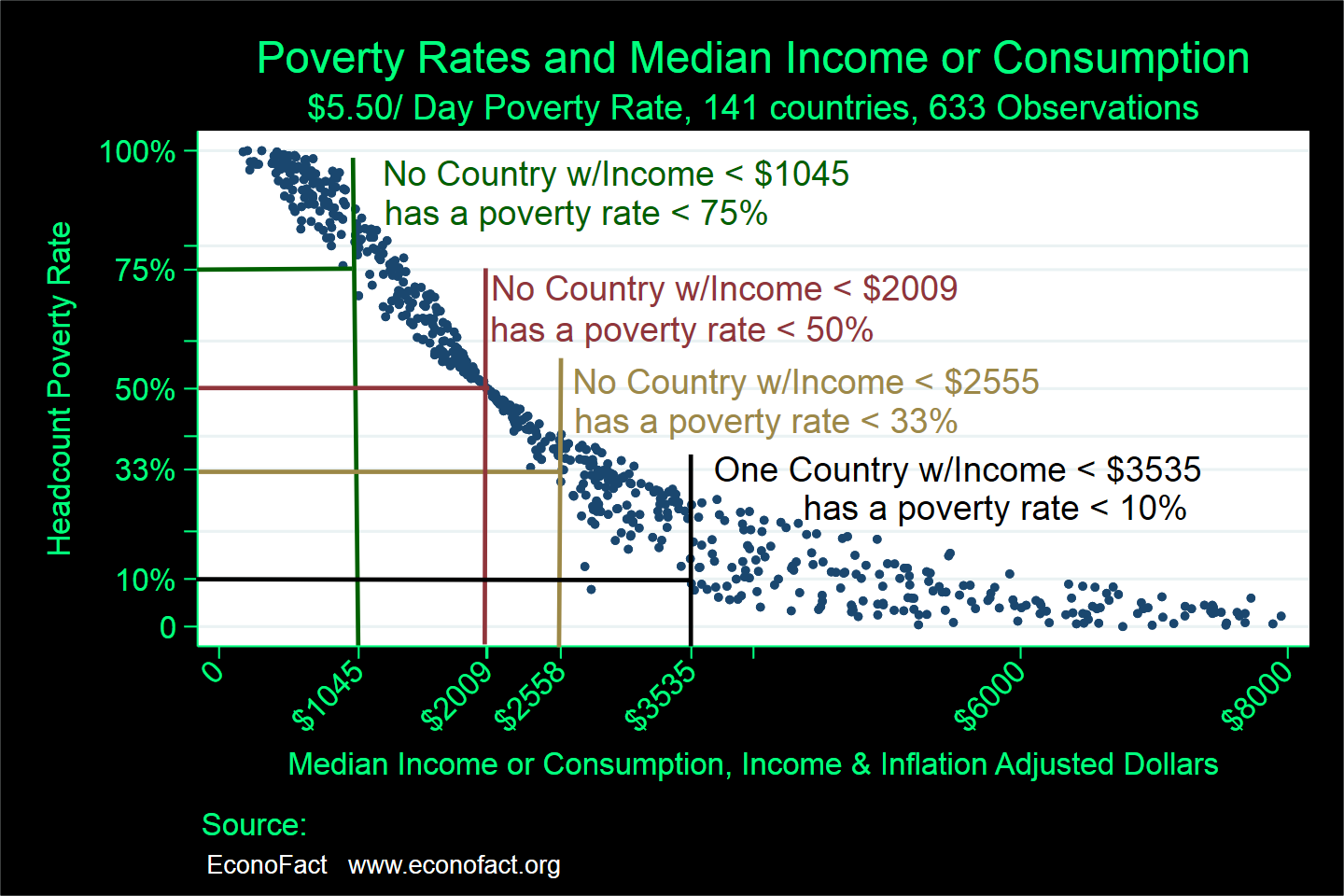
  • One way to consider the relationship between economic growth and poverty is to look across countries and compare median incomes and the share of the population living in poverty. The median income is the income level at which half the population has an income higher than this amount and half the population has an income below this amount. Statisticians focus on median income rather than average income because a small number of people with very high levels of income alter the average much more than the median and can give rise to a distorted picture of the income profile of a country.

  • In theory, two countries could have the same median income and yet have very different poverty rates. Differences in how income is distributed within countries could make it so that two countries with the same median income could have very different poverty rates. For an extreme example, consider a country with a median income of $5,000 per capita (the equivalent of about $13.70 per person per day); This country could have no one living with an income of less than $5.50 per day, effectively having a rate of zero poverty under a $5.50 dollar-a-day threshold; Alternatively, half of the population could be living with an income less than $5.50 a day (in which case no one would have an income in the range between $5.50 and $13.70) — and, in this case, there would be a 50 percent poverty rate. Thus, there is not necessarily a tight relationship between the median income in a country and its poverty rate.”

Continue reading here.

From Econofact post by Lant Pritchett:


The Issue:

Reducing poverty in developing countries has been a longstanding and central concern of development economics. Over the past two decades, there has been a noticeable shift in the approach taken by development economists to address this question. Researchers have increasingly focused their efforts on randomized controlled trials — an experimental approach commonly used in medical research — to determine the effectiveness of anti-poverty programs and interventions.

Read the full article…

Posted by at 8:57 AM

Labels: Inclusive Growth

Why Economists Should Act More Like Weather Forecasters

International Monetary Fund advisor Prakash Loungani explains why economists have such a terrible track record when it comes to predicting recessions. Plus, Noah reflects on the Washington Nationals heading to the World Series. Listen to the podcast here.

International Monetary Fund advisor Prakash Loungani explains why economists have such a terrible track record when it comes to predicting recessions. Plus, Noah reflects on the Washington Nationals heading to the World Series. Listen to the podcast here.

Read the full article…

Posted by at 4:56 PM

Labels: Forecasting Forum

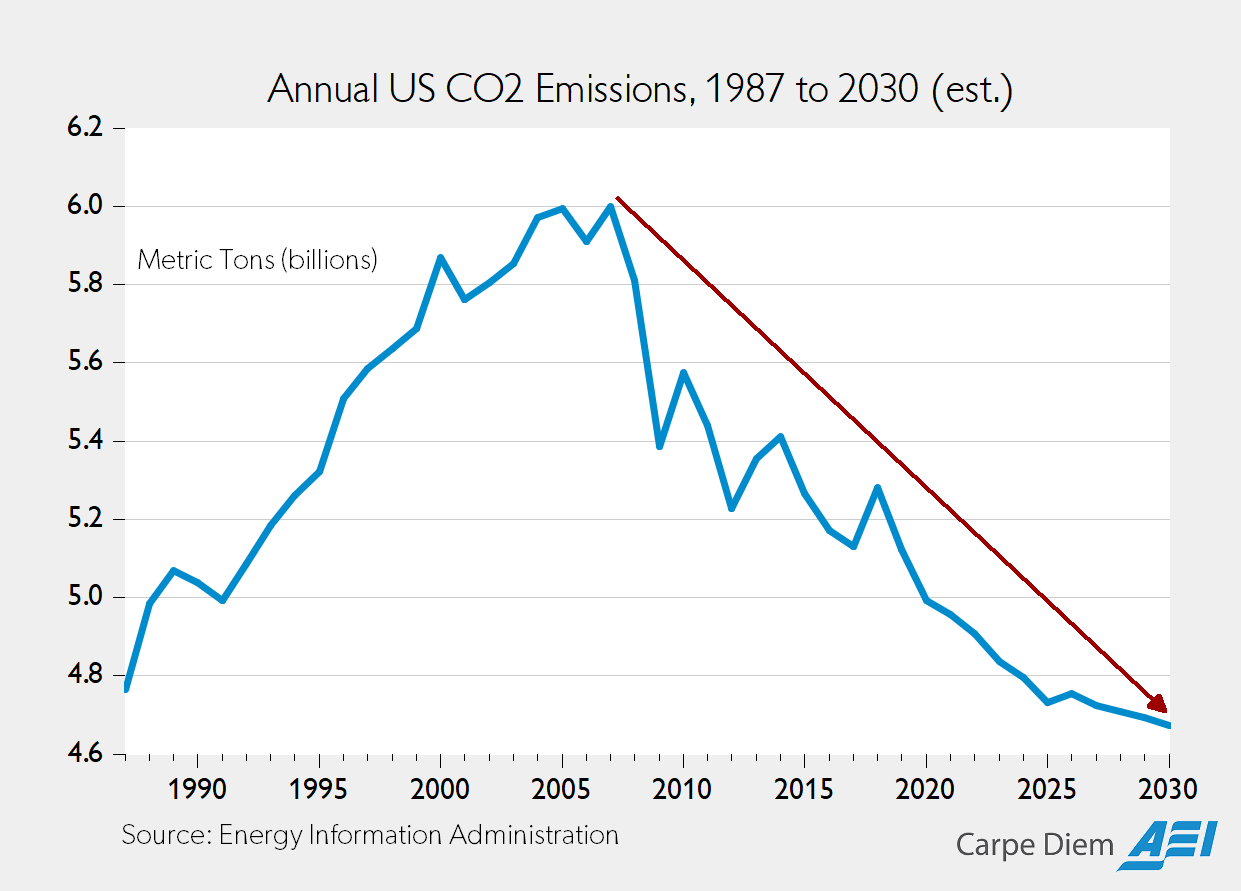
Annual US CO2 Emissions, 1987 to 2030 (est.)

From AEI:


Posted by at 11:17 AM

Labels: Energy & Climate Change

Guyana: Housing Market and Implications for Macroprudential Policies

From the IMF’s latest report on Guyana:

“Guyana’s residential real estate prices have been rising, particularly in the capital city Georgetown, following the discovery of oil in 2015. In line with the growing demand for housing, commercial banks’ housing loans have increased, prompting higher household debt. This paper presents two analyses which suggest that housing prices in Georgetown and banks’ lending to the housing sector appear to be in their early stages of growth. However, given the data limitations and caveats that underpin the analyses, the findings could also indicate early signals of possible risks. Further data collection would support surveillance and deeper studies. At the same time, enhancing prudential measures would help safeguard financial and macroeconomic stability. These include strengthening the monitoring of the housing market, bank lending practices and household debt, as well as fortifying the macroprudential framework, including with more effective toolkits for early intervention.”

From the IMF’s latest report on Guyana:

“Guyana’s residential real estate prices have been rising, particularly in the capital city Georgetown, following the discovery of oil in 2015. In line with the growing demand for housing, commercial banks’ housing loans have increased, prompting higher household debt. This paper presents two analyses which suggest that housing prices in Georgetown and banks’ lending to the housing sector appear to be in their early stages of growth.

Read the full article…

Posted by at 11:14 AM

Labels: Global Housing Watch

Newer Posts Home Older Posts

Subscribe to: Posts