



Friday, October 4, 2019
Housing View – October 4, 2019
On cross-country:
- Central banks push for action on Europe’s rising house prices – Financial Times
- Hypostat 2019 – European Mortgage Federation
- Negative interest rates are inflating real estate prices. These cities are at risk of a bubble – CNN
- The global real estate rethink – Axios
On the US:
- Stranded: Inequality, House Prices leaving People Trapped – IMF
- Opinion: Rent control is better than nothing, but it can’t fix California’s housing crisis – Los Angeles Times
- How to Kill a Housing Market – Wall Street Journal
- Bernie’s National Rent Control – Wall Street Journal
- Would AOC’s National Rent Control Solve the Housing Crisis, or Make It Even Worse? – Citylab
- How Rent Control Threatens the American Dream – Foundation for Economic Education
- Poll: 59% of Americans Favor Building More Housing in Their Neighborhood – Cato
- California’s Poorest Big City Faces a Different Kind of Housing Crisis – Citylab
- Affordable Housing – Bloomberg
- Help for California’s Housing Crisis Is in the Backyard – Bloomberg
- Mortgage Finance in the Face of Rising Climate Risk – NBER, New York Times
- Think San Francisco Housing Is Expensive? It Ranks 10th Globally. – Barron’s
On other countries:
- [Canada] To Tackle Housing Affordability in Canada, Build More Houses – IMF
- [Colombia] Building Inclusive Social Housing: Lessons from Bogota – Harvard Joint Center for Housing Studies
- [Panama] Panama’s property prices are rising strongly – Global Property Guide
- [United Kingdom] Employment and the collateral channel of monetary policy – Bank of England
- [United Kingdom] Divorce: dividing up the family home – Financial Times
- [Vietnam] Positive outlook for Vietnam’s property market – Global Property Guide
On cross-country:
- Central banks push for action on Europe’s rising house prices – Financial Times
- Hypostat 2019 – European Mortgage Federation
- Negative interest rates are inflating real estate prices. These cities are at risk of a bubble – CNN
- The global real estate rethink – Axios
On the US:
- Stranded: Inequality,
Posted by at 5:00 AM
Labels: Global Housing Watch
Thursday, October 3, 2019
Structural Reforms and Election: Evidence from a World-Wide New Dataset
From a new paper by Alberto Alesina, Davide Furceri, Jonathan D. Ostry, Chris Papageorgiou and Dennis P. Quinn:
“We assemble a unique database of reforms in domestic finance, external finance, trade, product markets and labor markets which covers 90 advanced and developing economies from 1973 to 2014. In the 66 democracies which we consider in this paper, we show that these reforms have medium run benefits thus they are electorally more successfully when introduced at the beginning of a new term of office. Liberalizing reforms shortly before elections are costly to incumbents. However, the effect depends on the state of the economy at the time of reform: reforms are sharply penalized during contractions, reforms undertaken in expansions are not punished and sometimes rewarded.”
From a new paper by Alberto Alesina, Davide Furceri, Jonathan D. Ostry, Chris Papageorgiou and Dennis P. Quinn:
“We assemble a unique database of reforms in domestic finance, external finance, trade, product markets and labor markets which covers 90 advanced and developing economies from 1973 to 2014. In the 66 democracies which we consider in this paper, we show that these reforms have medium run benefits thus they are electorally more successfully when introduced at the beginning of a new term of office.
Posted by at 12:15 PM
Labels: Inclusive Growth
Wednesday, October 2, 2019
To Tackle Housing Affordability in Canada, Build More Houses
From an IMF Blog by Michal Andrle, Cheng Hoon Lim and Troy Matheson:
“Policymakers across the world worry about affordable housing. They should. It represents the cost of a basic human need—shelter. Canada is no exception as it grapples to provide affordable housing in some cities, like Vancouver and Toronto, where rents are high, and for many, the dream of owning a home has faded.
People who can afford a down payment typically borrow as much as they can to get a foothold in the market—stretching themselves financially and contributing to Canada’s record-high levels of household debt.
So, how can governments help make housing affordable? Our latest staff report suggests boosting housing supply to meet demand.
Short-term fixes may not always work
Boosting Canada’s supply of affordable housing is no easy task. Countries like Canada, the Czech Republic, Sweden, and the United Kingdom that face problems with housing affordability in major cities have found that housing policies can quickly become politically contentious.
For this reason, policymakers often resort to short-term fixes to the problem. These include relaxing prudential regulations to enable households to borrow more (higher loan-to-income and loan-to-value ratios), increasing or introducing tax-deductibility of mortgage interest-rate costs, and subsidizing home purchases directly.
According to our research, we find that even well-meaning policies that aim to improve housing affordability by increasing households’ capacity to borrow may unintentionally raise house prices—ultimately resulting in homebuyers having to borrow more and leading to higher household debt.
Why? Because housing supply is fixed in the short term. So, any increase in households’ ability to borrow will increase demand for housing, increase house prices, and ultimately make houses less affordable than they otherwise would have been.
This is what we found when we compared the dynamics of house prices in eleven Canadian Census Metropolitan Areas with households’ ability to borrow—the so-called “attainable” house price.”
Continue reading here.
From an IMF Blog by Michal Andrle, Cheng Hoon Lim and Troy Matheson:
“Policymakers across the world worry about affordable housing. They should. It represents the cost of a basic human need—shelter. Canada is no exception as it grapples to provide affordable housing in some cities, like Vancouver and Toronto, where rents are high, and for many, the dream of owning a home has faded.
People who can afford a down payment typically borrow as much as they can to get a foothold in the market—stretching themselves financially and contributing to Canada’s record-high levels of household debt.
Posted by at 2:26 PM
Labels: Global Housing Watch
How Mexico’s Social Spending Reduced Poverty and Income Inequality
A new IMF paper by Frederic Lambert and Hyunmin Park highlights the role played by social spending to reduce poverty and inequality:
“We analyze microdata from Mexico’s survey on household income and expenditures (ENIGH) to study the evolution of income inequality in Mexico over 2004-16, identify its sources, and investigate how it was affected by government social policy. We find evidence of only a small decline in inequality over this period. The observed decline may be attributed to government transfers, notably targeted cash transfers (Prospera) and non-contributory pensions. In 2016, those two programs accounted for more than two thirds of the reduction in the Gini coefficient due to government transfers. Other transfer programs such as farmland subsidies (Proagro), government scholarships, and non-monetary transfers for medical expenditures have not been as effective.”
A new IMF paper by Frederic Lambert and Hyunmin Park highlights the role played by social spending to reduce poverty and inequality:
“We analyze microdata from Mexico’s survey on household income and expenditures (ENIGH) to study the evolution of income inequality in Mexico over 2004-16, identify its sources, and investigate how it was affected by government social policy. We find evidence of only a small decline in inequality over this period.
Posted by at 2:10 PM
Labels: Inclusive Growth
Monday, September 30, 2019
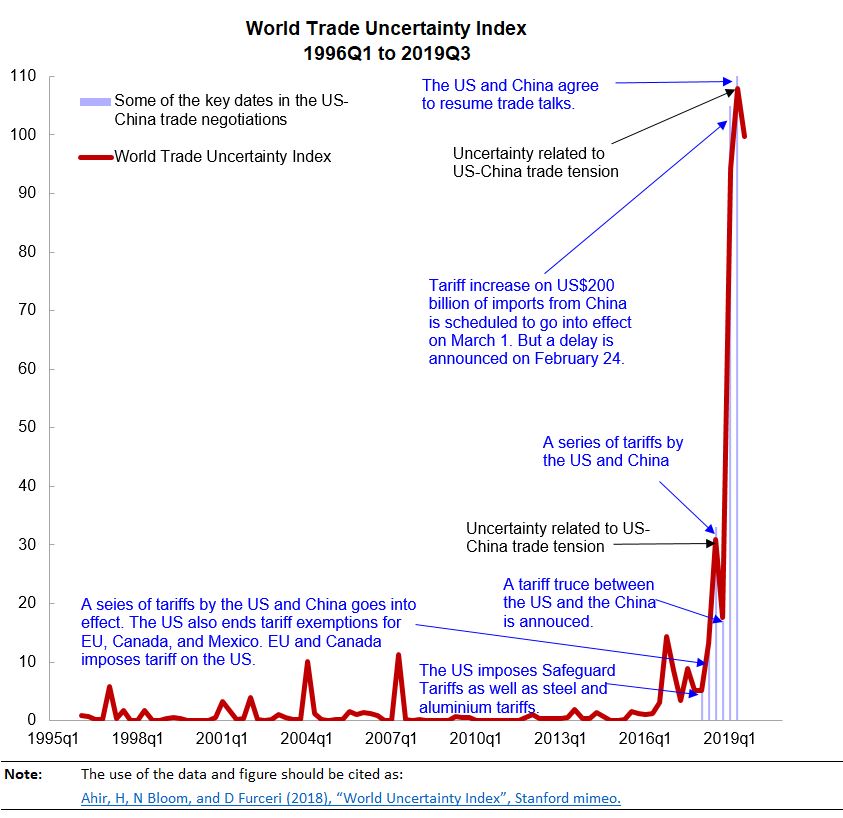
Tracking uncertainty across the globe
Below is the latest update of the World Uncertainty Index (figure 1) and World Trade Uncertainty Index (figure 2). These indexes are constructed by Hites Ahir (IMF), Nick Bloom (Stanford University) and Davide Furceri (IMF).
To read how the index is constructed, see the paper here and also see the dataset here. The dataset includes the aggregate index (the index at the global level, by income group, and by region), as well as the country specific index (143 countries) from 1996Q1 to 2019Q3. It also contains a beta version of the historical index for about 80 countries starting from the 1950s.
See the coverage of the index in the press: Bloomberg, The Economist, Financial Times, Reuters, and Wall Street Journal.
Figure 1.
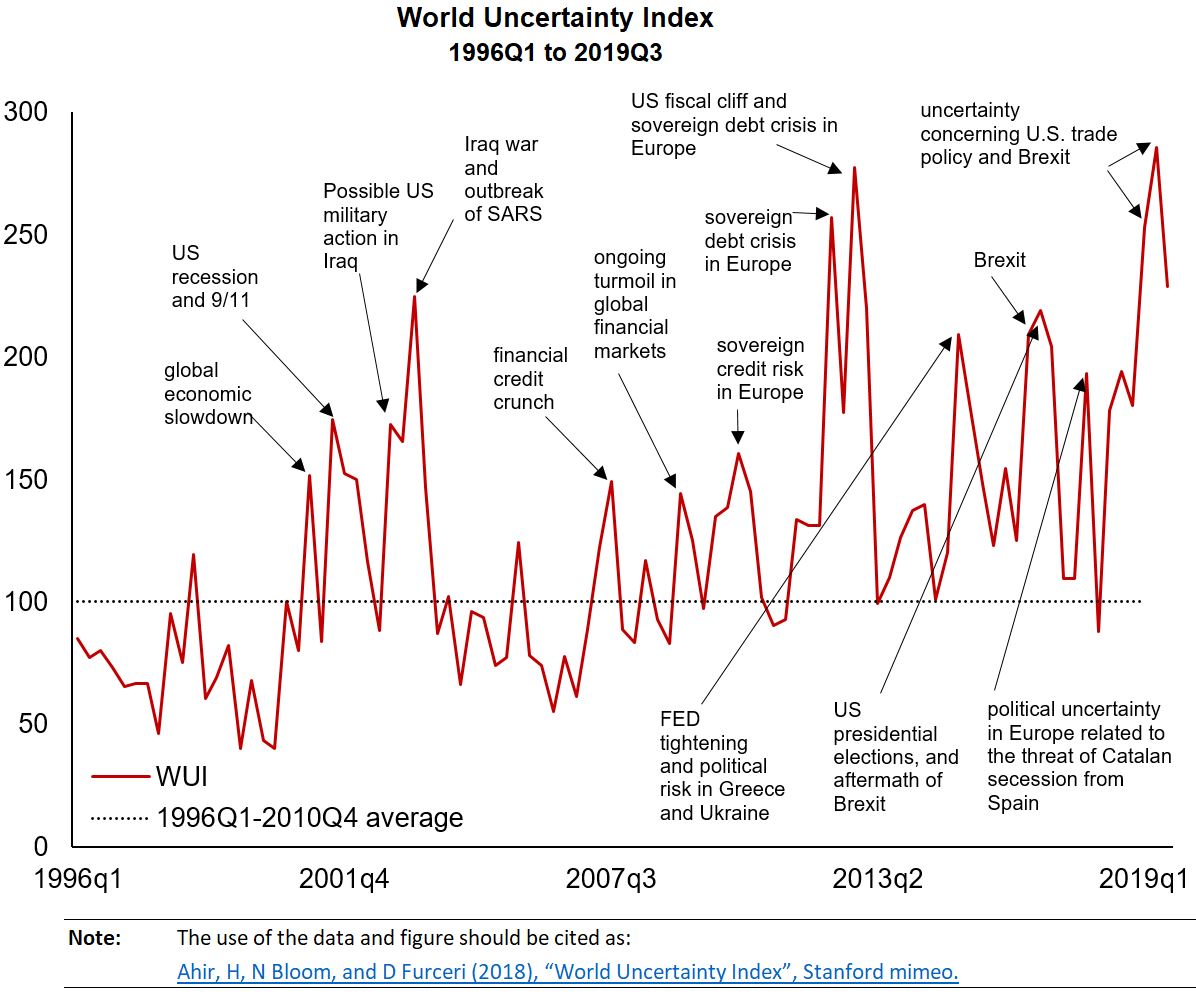
Figure 2.
Below is the latest update of the World Uncertainty Index (figure 1) and World Trade Uncertainty Index (figure 2). These indexes are constructed by Hites Ahir (IMF), Nick Bloom (Stanford University) and Davide Furceri (IMF).
To read how the index is constructed, see the paper here and also see the dataset here. The dataset includes the aggregate index (the index at the global level, by income group, and by region),
Posted by at 5:00 AM
Labels: Uncategorized
Subscribe to: Posts