



Wednesday, May 18, 2011
The Elusive Quest for Energy Security
The price and security of foreign oil has Western policymakers talking more urgently about energy independence — again. But according to Prakash Loungani, an economist and advisor to the IMF’s Research Department, to insulate themselves from the economic effects of oil spikes, countries are going to have to learn to work together.To continue reading see the recent article on the Globalist website.
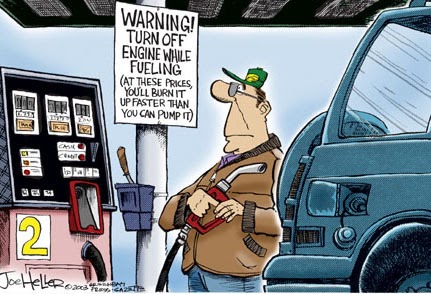
The price and security of foreign oil has Western policymakers talking more urgently about energy independence — again. But according to Prakash Loungani, an economist and advisor to the IMF’s Research Department, to insulate themselves from the economic effects of oil spikes, countries are going to have to learn to work together.To continue reading see the recent article on the Globalist website.
Posted by at 1:14 PM
Labels: Energy & Climate Change
Thursday, May 5, 2011
New Evidence on Cyclical and Structural Sources of Unemployment
My new paper on cyclical and structural sources of unemployment provides cross-country evidence on the relative importance of cyclical and structural factors in explaining unemployment, including the sharp rise in U.S. long-term unemployment during the Great Recession of 2007-09. About 75% of the forecast error variance of unemployment is accounted for by cyclical factors-real GDP changes (?Okun‘s Law?), monetary and fiscal policies, and the uncertainty effects emphasized by Bloom (2009). Structural factors, which we measure using the dispersion of industry-level stock returns, account for the remaining 25 percent. For U.S. long-term unemployment the split between cyclical and structural factors is closer to 60-40, including during the Great Recession.
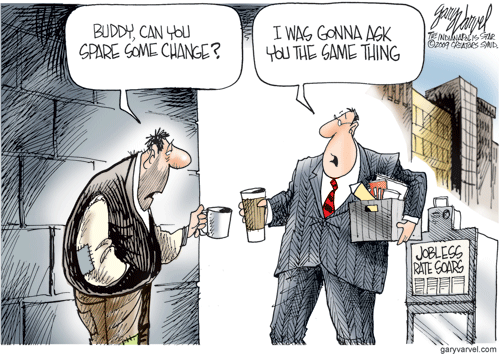
My new paper on cyclical and structural sources of unemployment provides cross-country evidence on the relative importance of cyclical and structural factors in explaining unemployment, including the sharp rise in U.S. long-term unemployment during the Great Recession of 2007-09. About 75% of the forecast error variance of unemployment is accounted for by cyclical factors-real GDP changes (?Okun‘s Law?), monetary and fiscal policies, and the uncertainty effects emphasized by Bloom (2009). Structural factors, which we measure using the dispersion of industry-level stock returns,
Posted by at 3:21 PM
Labels: Inclusive Growth
Sunday, May 1, 2011
Econbrowser on cyclical vs structural unemployment
Menzie Chinn provides a nice summary of the Madison conference on long term unemployment.

Menzie Chinn provides a nice summary of the Madison conference on long term unemployment.
Menzie Chinn Read the full article…
Posted by at 8:03 PM
Labels: Inclusive Growth
Saturday, April 30, 2011
Energy Security: Depend, but Diversify
With oil prices back above $100 a barrel, declarations of “energy independence” are back in the news. But a more reliable path to energy security lies in continuing to depend on the benefits conferred by global energy markets, while reducing reliance on any one form of energy or on any one energy supplier. And indeed, since the oil shocks of the 1970s, the actions of millions of consumers and producers have enhanced energy security in precisely this way. Read the full story on the USAEE (United States Association for Energy Economics) site.

With oil prices back above $100 a barrel, declarations of “energy independence” are back in the news. But a more reliable path to energy security lies in continuing to depend on the benefits conferred by global energy markets, while reducing reliance on any one form of energy or on any one energy supplier. And indeed, since the oil shocks of the 1970s, the actions of millions of consumers and producers have enhanced energy security in precisely this way. Read the full story on the USAEE (United States Association for Energy Economics) site.
Posted by at 6:27 PM
Labels: Energy & Climate Change
Biz Beat: No easy answers at UW conference on unemployment
Nobody needs to remind Jeanne Hime what hard times look like. After 30 years as a union electrician, Hime watched her hometown manufacturing plant close down, disrupting the lives of hundreds of working families in Darke County, Ohio. “These weren’t people who could just pick up and find a job somewhere else,” says Hime. “They had lifetime roots in the community and didn’t want to leave.” Now retired and living in Mount Horeb, Hime isn’t confident the good factory jobs will ever return. And she takes exception to those who dismiss the current unemployment situation as simply a cyclical turn of the economy. “People like me have been burned too many times,” she says. “Why should they believe anything is going to change?” Hime’s comments Thursday were directed at a panel of national economic researchers on the University of Wisconsin-Madison campus during a conference titled “Long-Term Unemployment in Industrial Countries: Causes, Consequences and Policy Responses.” Co-hosted by the La Follette School of Public Affairs, the discussion centered on whether the surge in joblessness both in the U.S. and Europe is the result of the recession or a sign of a deeper structural problem. Although the recession — defined by economists as a drop in gross domestic product over two consecutive quarters — has officially ended, the jobs recovery has been tepid at best. While a 5 percent unemployment rate is considered normal, unemployment in the U.S. remains near 9 percent. It’s even higher in Spain (20.4%), Ireland (14.6%) and Greece (14.2%), countries all hit hard by the global financial crisis. The problem is that the longer people stay out of work, the harder it is for them to find a job. For older employees, their skills deteriorate and if they do return to the workforce it’s usually at much lower pay. “The longer you fail to address cyclical unemployment the more it becomes structural,” says Prakash Loungani, an advisor to the International Monetary Fund in Washington D.C. Read full story here.
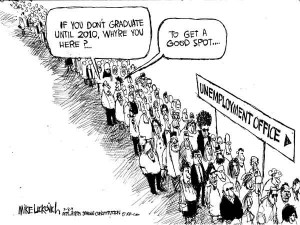
Nobody needs to remind Jeanne Hime what hard times look like. After 30 years as a union electrician, Hime watched her hometown manufacturing plant close down, disrupting the lives of hundreds of working families in Darke County, Ohio. “These weren’t people who could just pick up and find a job somewhere else,” says Hime. “They had lifetime roots in the community and didn’t want to leave.” Now retired and living in Mount Horeb, Hime isn’t confident the good factory jobs will ever return.
Posted by at 4:38 PM
Labels: Inclusive Growth
Subscribe to: Posts