



Tuesday, October 4, 2011
Invitation to an Event. Lost Decades: The Making of America’s Debt Crisis and the Long Recovery
Featuring the authors:
Menzie Chinn (University of Wisconsin, Madison; Econbrowser blog)
Jeffry Frieden (Harvard University)
Chinn and Frieden explore the origins and long-term effects of the financial crisis in historical and comparative perspective. By 2008 the United States had become the biggest international borrower in world history, with almost half of its 6.4 trillion dollar federal debt in foreign hands. The massive inflow of foreign funds financed the booms in housing prices and consumer spending that fueled the economy until the collapse of late 2008. The authors explore the political and economic roots of this crisis as well as its long-term effects. “The book is capable of dealing with some of the most complicated economic arguments about the crisis in a way that is straightforward and capable of being understood by its audience, says Mike Konczal of the Roosevelt Institute. “If you have time to read only one book on the crisis, read this,” says acclaimed economic historian Barry Eichengreen, University of California Berkeley.
Discussants:
Gail Cohen (Joint Economic Committee of the U.S. Congress)
Diane Lim Rogers (Concord Coalition)
Closing Remarks:
Simon Johnson (MIT and Peterson Institute; co-author of 13 Bankers)
Moderated by:
George Akerlof (Senior Resident Scholar, Research Department, IMF; Winner of the
2001 Nobel Prize for Economics)
IMF Book Forum
Lost Decades: The Making of America’s Debt Crisis and the Long Recovery
Friday, October 14, 1:30 to 3 pm
Events Hall, IMF, HQ1-01-704 (700 19th Street, NW, Washington, DC)
This event is open to the public and to Bank/Fund staff. RSVP here.
Featuring the authors:
Menzie Chinn (University of Wisconsin, Madison; Econbrowser blog)
Jeffry Frieden (Harvard University)
Sunday, October 2, 2011
De-Mythologizing Fiscal Consolidation
In Lost Decades, Jeffry Frieden and Menzie Chinn argue that fiscal consolidation is a necessary prerequisite for long term recovery; however, “fiscal consolidation too soon can derail the recovery, and plunge us further into debt. In contrast, some commentators have asserted that fiscal consolidation can be accomplished painlessly, or even with immediate benefits (e.g., JEC-Republicans, Rep. Paul Ryan/Heritage Foundation). Recent empirical work which carefully identifies the relevant episodes concludes that such instances of expansionary fiscal contraction are rare, and usually conducted near full employment.” Ball, Leigh and Loungani review the effects of fiscal contraction in “Painful Medicine“.
Read the rest of the story on Econbrowser.


In Lost Decades, Jeffry Frieden and Menzie Chinn argue that fiscal consolidation is a necessary prerequisite for long term recovery; however, “fiscal consolidation too soon can derail the recovery, and plunge us further into debt. In contrast, some commentators have asserted that fiscal consolidation can be accomplished painlessly, or even with immediate benefits (e.g., JEC-Republicans, Rep. Paul Ryan/Heritage Foundation). Recent empirical work which carefully identifies the relevant episodes concludes that such instances of expansionary fiscal contraction are rare,
Posted by at 12:36 AM
Labels: Inclusive Growth
Thursday, September 22, 2011
As World Leaders Meet, Global Unemployment Is Topic No. 1
The ultimate measure of economic success is not whether the stock or bond markets go up … but rather whether a society can provide decent jobs for its citizens, writes Jack Ewing in the NYT (the global edition of the New York Times).
He concludes: Mr. Loungani worries about the corrosive effects of unemployment on people and societies. “I know from my own experience the loss of confidence in your own skills that comes with the 200th job rejection letter,” he said. “That’s why it’s so important to get people back soon. You risk making a cyclical problem into a structural problem.”
Read the full article here.

The ultimate measure of economic success is not whether the stock or bond markets go up … but rather whether a society can provide decent jobs for its citizens, writes Jack Ewing in the NYT (the global edition of the New York Times).
He concludes: Mr. Loungani worries about the corrosive effects of unemployment on people and societies. “I know from my own experience the loss of confidence in your own skills that comes with the 200th job rejection letter,” he said.
Posted by at 2:12 PM
Labels: Inclusive Growth
Wednesday, September 14, 2011
New York Times, Huffington Post and the Washington Post on the recent F&D article
In the New York Times, Paul Krugman writes that “In the first half of last year a strange delusion swept much of the policy elite on both sides of the Atlantic — the belief that cutting spending in the face of high unemployment would actually create jobs. I went after this stuff early and hard (I suspect that the confidence fairy will be one of my lasting contributions to economic discourse); still, it’s good to have a steadily mounting weight of evidence about just how wrong that view was. The latest entry is a comprehensive review of past episodes of austerity by economists at the IMF, from which the figure above [below, Chart 3] is taken. Yes, contractionary policy is contractionary.”

Alexander EIchler of the Huffington Post summarizes the article: “The report, published in the new issue of Finance & Development, the IMF’s quarterly magazine, argues that moving too rapidly to enact so-called austerity measures — in other words, taking steps to shore up national finances and bring down debt by cutting spending and raising taxes — will hurt income in the short term and worsen unemployment in the long term.”
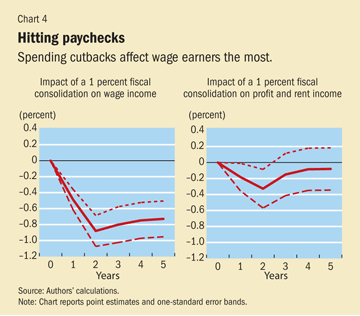
And, Brad Plumer of the Washington Post writes that “More specifically, an austerity program that curbs the deficit by 1 percent of GDP reduces real incomes by about 0.6 percent and raises unemployment by almost 0.5 percentage points. What’s more, the IMF notes, the losses are twice as big when the central bank can’t cut rates (a good description of the present.) Typically, income and employment don’t fully recover even five years after the austerity program is put in place. There’s also a class dimension here: A deficit cut of that size tends to cause real wage income, where lower-income folks get their money, to shrink by 0.9 percent, whereas rents and profits, which higher-income folks depend on, decline by just 0.3 percent. And, as the chart on the right shows [below, Chart 4], profits tend to bounce back faster than wages.”
In the New York Times, Paul Krugman writes that “In the first half of last year a strange delusion swept much of the policy elite on both sides of the Atlantic — the belief that cutting spending in the face of high unemployment would actually create jobs. I went after this stuff early and hard (I suspect that the confidence fairy will be one of my lasting contributions to economic discourse); still, it’s good to have a steadily mounting weight of evidence about just how wrong that view was.
Posted by at 12:46 AM
Labels: Inclusive Growth
Monday, September 12, 2011
Whom Will it Hurt? The Short-Run Impacts of Fiscal Consolidation
WHEN British Prime Minister David Cameron announced his government’s deficit reduction plans earlier this year he said, “Those who argue that dealing with our deficit and promoting growth are somehow alternatives are wrong. You cannot put off the first in order to promote the second” (Cameron, 2011).
The challenge facing the United Kingdom and many advanced economies is how to bring debt down to safer levels in the face of a weak recovery. Will deficit reduction lead to stronger growth and job creation in the short run?
Recent IMF research provides an answer to this question. Evidence from data over the past 30 years shows that consolidation lowers incomes in the short term, with wage-earners taking more of a hit than others; it also raises unemployment, particularly long-term unemployment.
For the advanced economies, there is an unmistakable need to restore fiscal sustainability through credible consolidation plans. At the same time, we know that slamming on the brakes too quickly will hurt the recovery and worsen job prospects. Hence the potential longer-run benefits of fiscal consolidation must be balanced against the short- and medium-run adverse impacts on growth and jobs.
Read full article on the IMF website.

WHEN British Prime Minister David Cameron announced his government’s deficit reduction plans earlier this year he said, “Those who argue that dealing with our deficit and promoting growth are somehow alternatives are wrong. You cannot put off the first in order to promote the second” (Cameron, 2011).
The challenge facing the United Kingdom and many advanced economies is how to bring debt down to safer levels in the face of a weak recovery.
Posted by at 10:42 PM
Labels: Inclusive Growth
Subscribe to: Posts