



Wednesday, January 18, 2012
Global Think Tanks Rankings
Josh Rogin at Foreign Policy reports:
The Brookings Institution was selected today as the “top think tank in the world” by an academic program that evaluated over 5,000 think tanks from across the globe.

That’s the second year in a row that Brookings has topped the “Global Go To Think Tanks Rankings,” compiled by the Think Tank and Civil Societies program at the University of Pennsylvania and published by the Diplomatic Courier. The project considered the views of 793 experts, 150 journalists and scholars, 55 current and former directors of think tank programs, 40 public and private donors, hundreds of think tanks, 25-30 intergovernmental organizations, and 120 academic institutions.
Other U.S.-based think tanks also fared well. The Carnegie Endowment for International Peace held its spot from last year, staying put at #3 on the list, while the Council on Foreign Relations (CFR) dropped two slots from last year, coming in at #4. The Center for Strategic and International Studies (CSIS) jumped up two spots to #5, the RAND Corporation held its place at #6, and the Peterson Institute for International Economics kept its #10 position.
Non-U.S. think tanks that made the top 10 were Chatham House (#2), Amnesty International (#7) , Transparency International (#8), and the International Crisis Group (#9).
Conservative and libertarian think tanks took a hit in 2011: The Heritage Foundation dropped five places since last year, coming in this year at #13. CATO dropped from #12 last year to #14 this year, and the American Enterprise Institute dropped in the rankings from #13 to #17. Meanwhile, the liberal Center for American Progress made its first appearance on the top 25, coming in at #19. Human Rights Watch was ranked #22 in the world, down six spots compared to last year.
Some U.S.-based think thanks were singled out as the best in specific regions or functions. CSIS was ranked #1 in international affairs and security research. The Carnegie Moscow Center and the Carnegie Middle East Center were ranked as the top think tanks in their region. Brookings was ranked #1 in international development research, and the Carnegie Endowment was named as the think tank with the most innovative policy ideas.
Google Ideas, the “think-do tank” led by former State Department official Jared Cohen, was named the best new think tank established in the last 18 months. CFR was named as the best think tank in the world in the use of digital and social media.
5,329 think tanks were nominated and then ranked overall and in 30 different regional and functional sub-categories. This year, the process was changed to include “expert panels” that evaluated the data, incorporate categories for smaller think tanks, and expand the participation of organizations in developing countries, especially in the BRICs (Brazil, Russia, India, and China).
The United States by far has the most think tanks in the world (1,815!), followed by China (425), India (292), Britain (286), and Germany (194). Washington alone has 393 think tanks. Other leading states include Massachusetts, with 176, and California with 170.
The think tanks were rated by their access to resources, how much content they put out, and their impact on policy and politics.
“There are a number of major political, economic, social, and technological trends that are converging at this moment in history and that have a profound impact on governments and the institutions that serve them,” reads the beginning of the report. “It is essential that think tanks understand these trends and be ahead of them so that we are all not buried by them.”
Josh Rogin at Foreign Policy reports:
The Brookings Institution was selected today as the “top think tank in the world” by an academic program that evaluated over 5,000 think tanks from across the globe.
That’s the second year in a row that Brookings has topped the “Global Go To Think Tanks Rankings,” compiled by the Think Tank and Civil Societies program at the University of Pennsylvania and published by the Diplomatic Courier.
Posted by at 10:29 PM
Labels: Uncategorized
Monday, January 16, 2012
“Treat us right, not white”: MLK Day 2012



In the 1910s, when delivering mail was a hazardous job, the post office was one of the few places where African-Americans could find work. The bulk of long-distance mail was delivered by rail; the railway cars where mail clerks worked were made of wood and were prone to falling apart—while the train was in motion.
When steel cars began to replace the wooden ones, the job of delivering mail became safer. The Railway Mail Association, a labor union which excluded blacks, began to recruit white workers to displace blacks from the postal work. In 1913, a group of African Americans formed a union of their own to protect their jobs and give blacks a voice with the postal authorities.
Against all odds, this black union survived. By 1921, it had made enough progress that a bureaucrat in the post office assured the the president of the union that the union members would be “treated white”. The president replied that he would prefer that his members just “be treated right”.
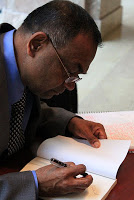
Hence the title “Treat us right, not white”, a fascinating history of this union—the National Alliance of Postal and Federal Employees (NAPFE)—written by my friend Paul Nehru Tennassee, the noted historian, political scientist and labor leader. The book is available here.
The union will mark its 100th anniversary in 2013 at the foot of Lookout Mountain, Tennessee, where it was founded. The union’s historian, Paul Nehru Tennassee, has a colorful history of his own which I hope will be told some day.


In the 1910s, when delivering mail was a hazardous job, the post office was one of the few places where African-Americans could find work. The bulk of long-distance mail was delivered by rail; the railway cars where mail clerks worked were made of wood and were prone to falling apart—while the train was in motion.
When steel cars began to replace the wooden ones,
Posted by at 12:30 AM
Labels: Inclusive Growth
Monday, January 9, 2012
How Inequality Damages Economies
Economic expansion last longer in regions with more equal income distributions, my IMF colleagues Andy Berg and Jonathan Ostry say in Foreign Affairs. The effect is large. If Latin America, for example, could bridge half of its inequality gap with East Asia, its growth spells would last twice as long as they do now. This work is part of a growing research emphasis at the IMF on the consequences and causes of income inequality. In earlier work, my colleagues and I showed that fiscal austerity leads to greater declines in wages than in profits — see this earlier post and a summary of it in the press.
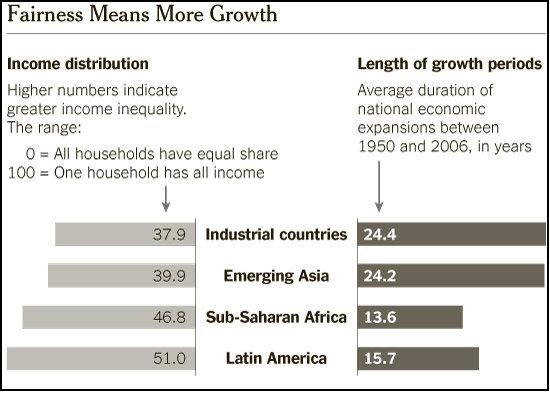
Economic expansion last longer in regions with more equal income distributions, my IMF colleagues Andy Berg and Jonathan Ostry say in Foreign Affairs. The effect is large. If Latin America, for example, could bridge half of its inequality gap with East Asia, its growth spells would last twice as long as they do now. This work is part of a growing research emphasis at the IMF on the consequences and causes of income inequality.
Posted by at 8:40 PM
Labels: Inclusive Growth
Friday, January 6, 2012
The Good, the Bad and the Ugly (Boom, Gloom or Doom?): Global GDP Outlook from Ethan Harris
The Economic Cycle Research Institute (ECRI) made a controversial call in September last year: it said a U.S. recession in 2012 was a ‘done deal’. Yesterday, Ethan Harris of BofA/Merrill Lynch was more hedged: he said there was a 40% chance of a U.S. recession but a 50% chance that U.S. growth would be 1.9%. Harris was pretty sure the eurozone was headed for a recession in 2012.

Harris, the co-head of Global Economics Research at BofA/Merrill Lynch, was speaking yesterday to the National Economists Club in Washington, D.C.
Europe: a recession, but how big? Europe is almost certainly going to go into a recession, according to Harris, and this will have an impact on the U.S. economy through banking, trade and confidence channels. For the Eurozone’s 2012 GDP growth, Harris forecast -0.6% with a 50% probability and -2.5% with a probability of 40%.
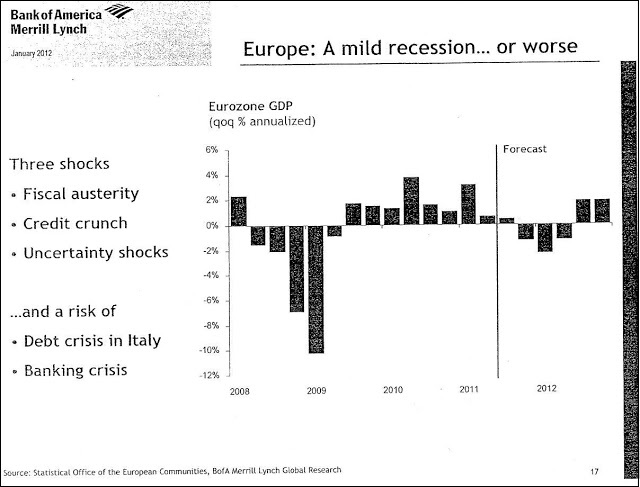
U.S. Triple Dip: in 2012, look for another soft patch. Harris said the U.S. is facing three shocks in the year ahead.
- First, the U.S. will get a downgrade. Neither party has a credible deficit reduction plan. Also, the deficit commission has no chance of success.
- Second, there will be an automatic tightening of U.S. fiscal policy. The total of programs expiring in 2012 adds up to US$225 billion (1.4% of GDP).
- And third is the post election pothole. He said that the post-election fiscal shocks adds to US$430 billion (2.9% of GDP), this include debt deal part I and II and the expiration of Bush tax cuts.
Putting all the three shocks together, he forecasts US real GDP growth of 1.9% for 2012 and 1.4% for 2013 (vs. Consensus projections of 2.1% and 2.5%, respectively). On a quarterly basis, he projects a downward path for GDP growth of 1.8% in Q1 and Q2, 1.3% in Q3 and 1% in Q4; this is in sharp contrast to Consensus, which projects an upward path.
Harris also said the housing recession in the U.S. continues, there is way too much inventory. It will take 18 months to clear the home inventory at the current sales pace. He thus projects a recovery in the housing market around the third quarter of 2013. He expects U.S. inflation to fade in the summer. He forecasts core PCE 1.5% for 2012 and 1.3% for 2013 vs. consensus projections of 1.8% for both years.
Meanwhile, ECRI seems to be sticking with its recession call for the U.S. – see the latest on their position here.
The Economic Cycle Research Institute (ECRI) made a controversial call in September last year: it said a U.S. recession in 2012 was a ‘done deal’. Yesterday, Ethan Harris of BofA/Merrill Lynch was more hedged: he said there was a 40% chance of a U.S. recession but a 50% chance that U.S. growth would be 1.9%. Harris was pretty sure the eurozone was headed for a recession in 2012.
Harris,
Posted by at 1:31 PM
Labels: Forecasting Forum
Saturday, December 31, 2011
In Memoriam: All Economists Great and Small
A brief remembrance of four economists who passed away in 2011: Anand Chandavarkar, Alan Stockman, David Aschauer and Ioannis Tokatlidis
- Anand Chandarvarkar was an illustrious Indian economist, known for his books on Keynes and on central banking in developing economies. My review of Anand’s book on Keynes gives you a flavor of Anand’s scholarship, but an excellent look back at his work and career can be found in a piece in the Economic & Political Weekly by his friend and noted economist Deena Khatkhate.

- Alan Stockman, one of my professors at Rochester, was a noted international economist and a wonderful teacher of introductory economics. I was one of the army of RAs for Alan’s principles of econ course. An obit and a nice tribute from Maury Obstfeld.

- David Aschauer was a classmate at Rochester. He and I went through the bonding experience of failing our macro qualifying exam together on our first try. He later got me into the Chicago Fed when I got tired of a being in a long-distance marriage and wanted to move from Florida to Chicago to be closer to my wife. The Boston Globe had a nice obit piece on David.
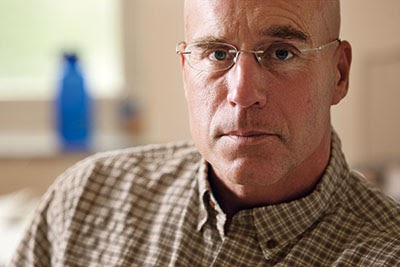
- Ioannis Tokatlidis (“Yannis”) was a colleague in the IMF’s Research Department. He served — with great distinction — several IMF chief economists, including Raghu Rajan (with whom he had co-authored some papers such as this one), Simon Johnson and Olivier Blanchard. Though a fine economist in his own right, Yannis devoted his life to making other people’s research better.
A brief remembrance of four economists who passed away in 2011: Anand Chandavarkar, Alan Stockman, David Aschauer and Ioannis Tokatlidis
- Anand Chandarvarkar was an illustrious Indian economist, known for his books on Keynes and on central banking in developing economies. My review of Anand’s book on Keynes gives you a flavor of Anand’s scholarship, but an excellent look back at his work and career can be found in a piece in the Economic &
Posted by at 1:19 AM
Labels: Profiles of Economists
Subscribe to: Posts