



Wednesday, July 30, 2014
House Prices in the United Kingdom
“(…) house prices are rising rapidly, and over an increasingly wide area. House price inflation is notably high in London, with levels now 32 percent above those before the crisis, reflecting strong foreign demand for premium properties, and demographic pressures (…). Price rises are becoming geographically more widespread, even though transaction volumes are still below historic averages overall,” says the latest IMF report on the United Kingdom.
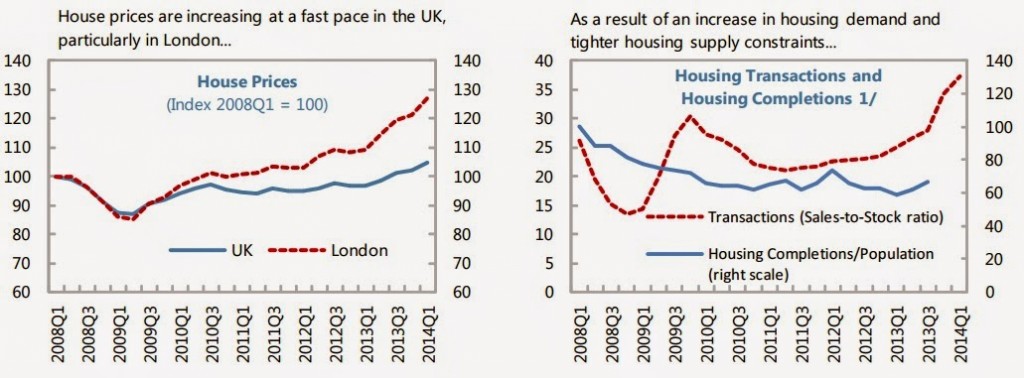
“(…) house prices are rising rapidly, and over an increasingly wide area. House price inflation is notably high in London, with levels now 32 percent above those before the crisis, reflecting strong foreign demand for premium properties, and demographic pressures (…). Price rises are becoming geographically more widespread, even though transaction volumes are still below historic averages overall,” says the latest IMF report on the United Kingdom.
Also, see a special analysis Read the full article…
Posted by at 6:33 PM
Labels: Global Housing Watch
Wednesday, July 23, 2014
House Prices in the United States
“After a promising recovery in housing activity for most of 2013, the past several months have seen a retreat characterized by weaker housing starts, declining residential investment, and subdued home sales. New mortgage origination has been particularly sluggish as credit availability remains constrained for lower-rated borrowers and mortgage rates have moved up by around 70 basis points from a year ago,” says the latest IMF’s economic report on the United States.
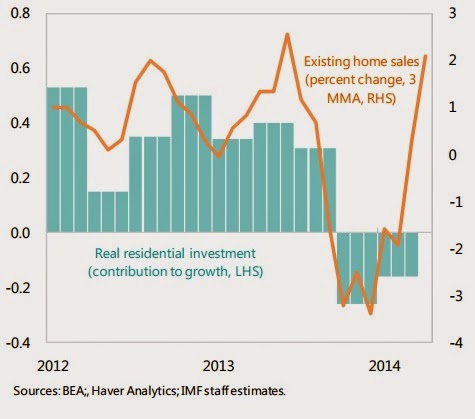
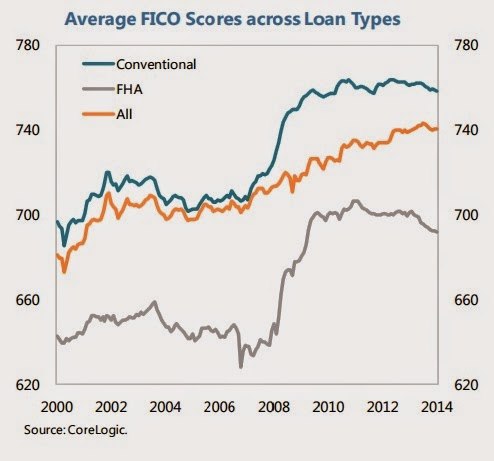
“After a promising recovery in housing activity for most of 2013, the past several months have seen a retreat characterized by weaker housing starts, declining residential investment, and subdued home sales. New mortgage origination has been particularly sluggish as credit availability remains constrained for lower-rated borrowers and mortgage rates have moved up by around 70 basis points from a year ago,” says the latest IMF’s economic report on the United States.
More specifically, Read the full article…
Posted by at 5:14 PM
Labels: Global Housing Watch
Tuesday, July 22, 2014
House Prices in Chile
“Real estate remains dynamic. Real mortgage credit expanded by 9 percent (y/y) in April, and house prices, following some deceleration, are rising again though with large regional variation,” says the IMF’s annual economic report on Chile.
Moreover, in terms of real estate exposure, the report says that “Mortgage loans represent about one-quarter of banks’ loan portfolio and the share of mortgages with elevated (80 percent or higher) loan-to-value (LTV) ratios has stabilized at a relatively high 60 percent. Prompt implementation of regulation underway linking mortgage credit provisioning to LTV levels would be important, and further action (hard limits on LTVs and debt-to-income ratios) might need to be considered. The mission also encouraged the authorities to address real estate data gaps, in particular for commercial real estate.”
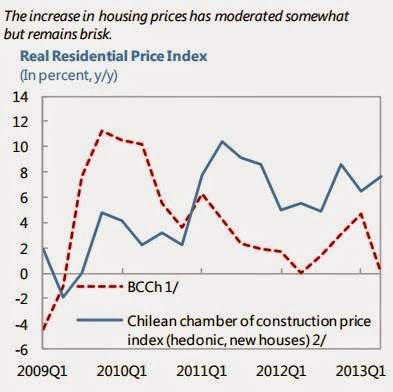
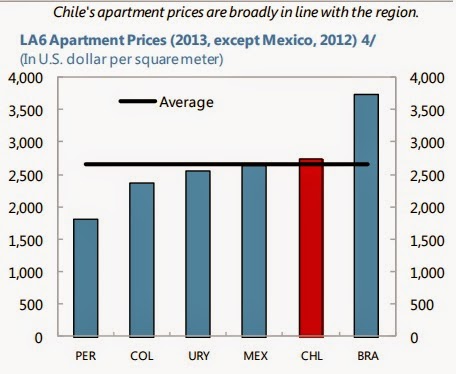
“Real estate remains dynamic. Real mortgage credit expanded by 9 percent (y/y) in April, and house prices, following some deceleration, are rising again though with large regional variation,” says the IMF’s annual economic report on Chile.
Moreover, in terms of real estate exposure, the report says that “Mortgage loans represent about one-quarter of banks’ loan portfolio and the share of mortgages with elevated (80 percent or higher) loan-to-value (LTV) ratios has stabilized at a relatively high 60 percent.
Posted by at 5:39 PM
Labels: Global Housing Watch
Monday, July 21, 2014
House Prices in Germany
“After several years of stagnation, German housing prices have been picking up, especially in large cities. They have increased by 18 percent in nominal terms since the trough of 2009:Q2 (Figure 1). Recent housing price inflation has been stronger in the largest cities, in particular Hamburg and Munich where the appreciation since early 2009 has been greater than 50 percent in the apartments segment. Simple valuation measures such as price-to-disposable-income-per-capita and price-to-rent ratios have remained almost flat, except in a few hot spots where an upward trend is evident (Steininger, 2014). Analysis by the Bundesbank suggests that housing prices in Germany as a whole are currently close to their fundamental value, but that apartment prices in large cities may be overvalued by about 25 percent (Bundesbank, 2014),” according to a new IMF report on Germany.
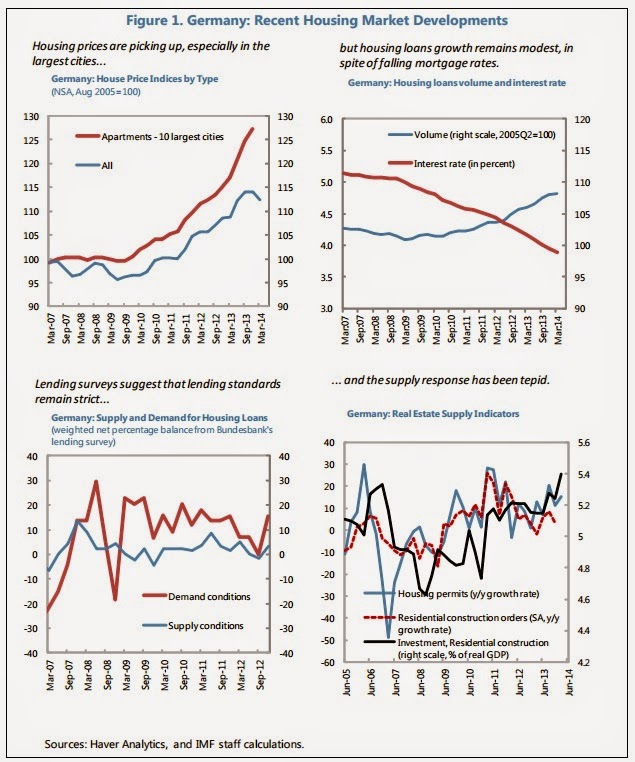
“After several years of stagnation, German housing prices have been picking up, especially in large cities. They have increased by 18 percent in nominal terms since the trough of 2009:Q2 (Figure 1). Recent housing price inflation has been stronger in the largest cities, in particular Hamburg and Munich where the appreciation since early 2009 has been greater than 50 percent in the apartments segment. Simple valuation measures such as price-to-disposable-income-per-capita and price-to-rent ratios have remained almost flat,
Posted by at 4:48 PM
Labels: Global Housing Watch
Thursday, July 10, 2014
House Prices in Iceland
House prices are starting to rise in Iceland, according to a new report by the IMF.
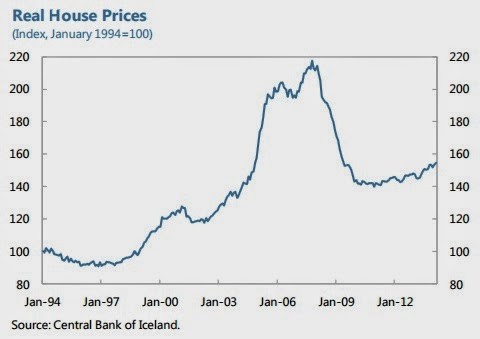
House prices are starting to rise in Iceland, according to a new report by the IMF.
Posted by at 5:11 PM
Labels: Global Housing Watch
Subscribe to: Posts