


Wednesday, August 28, 2013
Florida vs. Spain: Labor Mobility within Currency Unions
Paul Krugman has blogged extensively on how states within the US currency union have adjusted better than regions and countries within the European currency unions. My presentation at the European Regional Science Association today gives some background on this discussion and some new results.
Paul Krugman has blogged extensively on how states within the US currency union have adjusted better than regions and countries within the European currency unions. My presentation at the European Regional Science Association today gives some background on this discussion and some new results.
Posted by at 11:14 AM
Labels: Inclusive Growth
Thursday, August 22, 2013
The Driving Force behind Construction in Europe
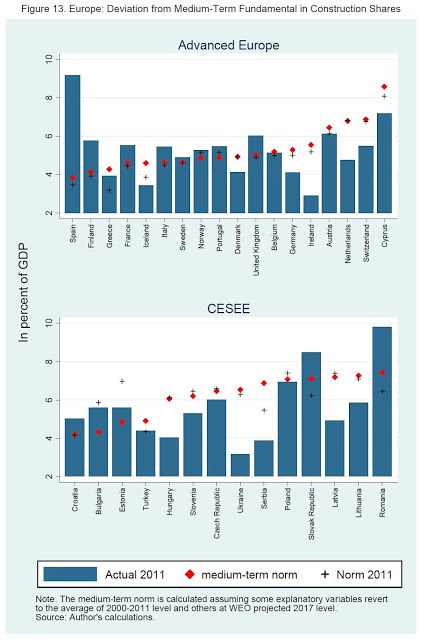
A new IMF working paper finds that a country’s geography, demographics, and economic conditions (e.g. income level, credit conditions, and stock market performance) are the driving forces behind the changes in construction shares. The results of the paper show that “During the boom, many countries overshoot the norm. After the crisis, the process has reversed and many countries have undershoot the norm. But for some countries, the adjustment has fallen short of the model’s predictions.” So, “when economic conditions normalize over the medium term, Greece, Iceland, and Ireland in advanced Europe, and Latvia, Lithuania, Hungary, and Ukraine in emerging Europe may see a recovery in their construction shares. But construction shares could decline further in Spain, the United Kingdom, Romania, and the Slovak Republic.”
A new IMF working paper finds that a country’s geography, demographics, and economic conditions (e.g. income level, credit conditions, and stock market performance) are the driving forces behind the changes in construction shares. The results of the paper show that “During the boom, many countries overshoot the norm. After the crisis, the process has reversed and many countries have undershoot the norm. But for some countries, the adjustment has fallen short of the model’s predictions.” So,
Posted by at 5:49 PM
Labels: Global Housing Watch
Friday, August 16, 2013
The Stock Market ‘Prediction Charade’
“The next time you are tempted to rely on forecasts of experts in making investment decisions, remember these words attributed to Prakash Loungani of the International Monetary Fund: “The record of failure to predict recessions is virtually unblemished.” Read the full story here.
“The next time you are tempted to rely on forecasts of experts in making investment decisions, remember these words attributed to Prakash Loungani of the International Monetary Fund: “The record of failure to predict recessions is virtually unblemished.” Read the full story here.
Posted by at 2:07 PM
Labels: Forecasting Forum
Thursday, August 15, 2013
Okun’s Law during the Great Recession: jobs and growth are still linked
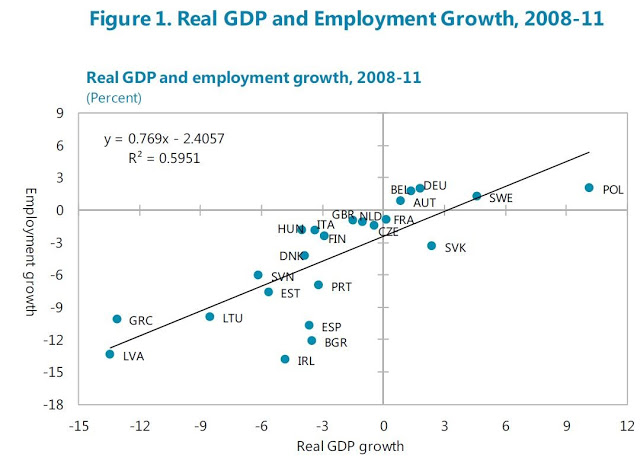
There is further evidence that employment growth is low because output growth is poor. According to a new IMF working paper, “Much of [the cross-country differences in employment growth] are the result of the differences in real GDP growth. A scatter chart of real GDP growth and employment growth between 2008 and 2011 shows a strong correlation between the two (Figure 1). Latvia, which had the largest decline in real GDP between 2008 and 2011, also experienced one of the largest reductions in employment. And Poland, which had the largest increase in real GDP during this time period, also had one of the best employment outcomes.”
Ball, Leigh, and Loungani also provide evidence on how well Okun’s Law has held up during the Great Recession.
There is further evidence that employment growth is low because output growth is poor. According to a new IMF working paper, “Much of [the cross-country differences in employment growth] are the result of the differences in real GDP growth. A scatter chart of real GDP growth and employment growth between 2008 and 2011 shows a strong correlation between the two (Figure 1). Latvia, which had the largest decline in real GDP between 2008 and 2011, also experienced one of the largest reductions in employment. And Poland,
Posted by at 8:50 PM
Labels: Inclusive Growth
Tuesday, August 6, 2013
House Prices in Germany
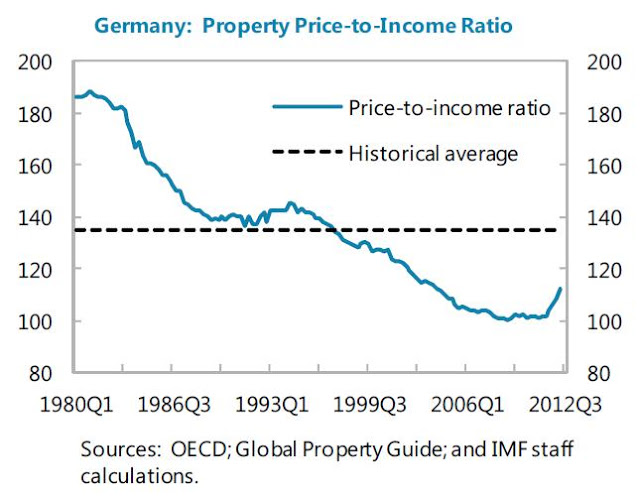
In Germany, “Nationwide property prices have continued to rise, driven mainly by stronger increases in apartment prices in some major cities. However, these prices remain below historical averages and do not appear excessive.”
In Germany, “Nationwide property prices have continued to rise, driven mainly by stronger increases in apartment prices in some major cities. However, these prices remain below historical averages and do not appear excessive.”
Posted by at 2:38 PM
Labels: Global Housing Watch
Subscribe to: Posts