



Thursday, February 2, 2017
Groundhog Day Tradition: 2017 Stekler Award for Courage in Forecasting
This year’s award is shared by Allan Lichtman and Helmut Norpoth, two political scientists, who forecasted a Trump victory in the U.S. Presidential elections. Though I started out giving the award to people who had the courage to forecast recessions, I think it is good to broaden it to recognize courageous forecasts in other areas. Both Lichtman and Norpoth described the basis on which they were making their forecasts, which is an essential consideration in who gets the award. Outrageous forecasts made without providing some reasoning don’t qualify. The 2016 award went to Michael Shedlock (“Mish”) and the inaugural 2015 award to Lakshman Achuthan.

This year’s award is shared by Allan Lichtman and Helmut Norpoth, two political scientists, who forecasted a Trump victory in the U.S. Presidential elections. Though I started out giving the award to people who had the courage to forecast recessions, I think it is good to broaden it to recognize courageous forecasts in other areas. Both Lichtman and Norpoth described the basis on which they were making their forecasts, which is an essential consideration in who gets the award.
Posted by at 9:00 AM
Labels: Forecasting Forum
Increased Social Inclusion in Uruguay– the Role of Government Policies
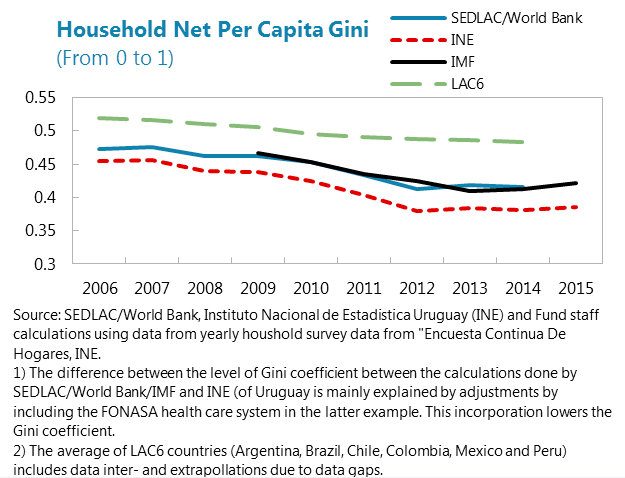
A new IMF report analyzes the lowering of the Gini coefficient in Uruguay during the last six years. Social policies and transfers have played a significant role in reducing poverty and inequality. While income dispersion has decreased across Latin America over the last decade, Uruguay stands out as the country with the largest drop in the Gini coefficient between 2009 and 2014, and to the lowest level. This reflects both government guidelines to bolster low wages, and increased redistribution through income taxes and transfers. However, looking ahead, the positive effects of further redistributive policies may be weighed against their fiscal costs and by a possible trade-off between income compression and incentives for labor supply and education and training. Work incentives among women can be strengthened further via reforms of parental leave, to reduce the remaining gender wage gap, and would diminish future pressures on public finances due to population ageing.
A new IMF report analyzes the lowering of the Gini coefficient in Uruguay during the last six years. Social policies and transfers have played a significant role in reducing poverty and inequality. While income dispersion has decreased across Latin America over the last decade, Uruguay stands out as the country with the largest drop in the Gini coefficient between 2009 and 2014, and to the lowest level. This reflects both government guidelines to bolster low wages,
Posted by at 8:42 AM
Labels: Inclusive Growth
Tuesday, January 31, 2017
The Fruits of Growth: Economic Reforms and Lower Inequality
New IMF work on inequality was showcased by IMF Managing Director Christine Lagarde in an iMFdirect post:
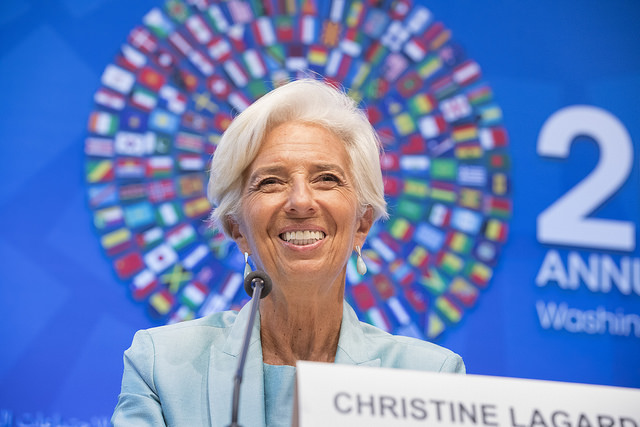
“Growth is essential for improving the lives of people in low-income countries, and it should benefit all parts of society.
Traveling through Africa in the last few days, I have been amazed by the vitality I have witnessed: business startups investing in the future, new infrastructure under construction, and a growing middle class. Many Africans are now making a better living and fewer are suffering from poverty. My current host, Uganda, for example, has more than halved its absolute poverty rate to about 35 percent from close to 90 percent in 1990.
But we have also seen a flip side. Poverty, of course, but inequality as well remain stubbornly high in most developing countries, including in Africa, and too often success is not shared by all.
We have learned, both from working with our member countries, and from our research, that sharing the fruits of growth—what we call inclusion—is key to achieving sustainable economic growth. All segments of society should feel that they have an opportunity to make a better life for themselves.
Our new staff analysis, released today, uncovers the various channels through which critical reforms that promote growth (such as those in agriculture, the financial sector, and public investment) can sometimes widen inequality in lower-income countries. The study also illustrates how additional measures can mitigate such growth and equality trade-offs.
The bottom line is this: First, pro-growth policies can be truly inclusive only if policies are designed with careful attention to the details of who gains and who loses. Second, well-targeted measures can ensure that everyone gains from essential economic reforms—and help further strengthen the case for pursuing reforms.
A look at who gains and loses
Lifting growth and reducing inequality is especially hard in countries where workers cannot relocate easily and there are big productivity differences between services, industry, and agriculture. A large informal economy, poor infrastructure and lack of financial services make the task even more difficult. Yet, in many of the IMF’s poorest member countries, this is often the case.
In sub-Saharan Africa, for example, it is more than twice as expensive to move from rural to urban areas than it is in China. Only a third of sub-Saharan African households have electricity, compared to 85 percent in the rest of the world. And in low-income countries, only about 20 percent of the adult population has a bank account, compared to more than 80 percent in the rest of the world.
Such barriers get in the way of successful and equitable reforms. Infrastructure development and financial sector reforms are examples.
More, and more efficient, spending on roads, airports, power grids and education help an economy grow more productive and make it easier for people to relocate from farms to cities. But infrastructure investment can also increase inequality if some sectors of the economy become more competitive than others, particularly if labor mobility is limited.
The case is similar for financial sector reforms. On the positive side, these reforms could make it cheaper to borrow, thereby stimulating private investment and boosting growth. But unless financial reforms are deep enough, they may not help poorer segments of the population obtain access to credit and financial services.
How to deliver strong, but inclusive growth
So, what can be done? The answer is not for policymakers to hold off on reforms that boost productivity and growth. Rather, policymakers should consider options that make these reforms more palatable from both a growth and distributional perspective.
With this in mind, our staff paper looks at a number of country cases and analyzes how well-targeted measures can complement reforms and offset adverse distributional impact.
For instance, if Malawi were to consider reducing subsidies for maize production to enhance productivity in the agricultural sector, then targeted cash transfers to affected households would help provide immediate support to farmers who may be hurt by this move. This approach has been successful in reducing poverty and inequality in countries such as Ethiopia, which has one of the largest social transfer programs in Africa.
Similarly, with regard to financial sector reform, if Ethiopia were to increase credit to the private sector to promote manufacturing and boost growth and employment, complementing this by broadening financial access to the rural population and increasing labor mobility—through easier transport that connect rural and urban areas, affordable urban housing, and training—would help reduce inequality across sectors. Rural workers would then be able to find better paying jobs in more modern and competitive sectors, such as manufacturing and services.
Governments can also target investment to improve productivity in disadvantaged sectors, and even out the impact of other reforms. In Myanmar, for example, where half the workforce is on farms, investment in electrification, irrigation, and research and development for improved seed varieties could sharply improve agricultural productivity.
There is no doubt that governments will face challenges in building a consensus for bold policies to boost growth. The IMF will continue to work with them, advocating reforms that bear fruits for everybody to enjoy.”
New IMF work on inequality was showcased by IMF Managing Director Christine Lagarde in an iMFdirect post:
“Growth is essential for improving the lives of people in low-income countries, and it should benefit all parts of society.
Traveling through Africa in the last few days, I have been amazed by the vitality I have witnessed: business startups investing in the future,
Posted by at 8:58 AM
Labels: Inclusive Growth
Okun’s Law and Phillips Curves in Asia
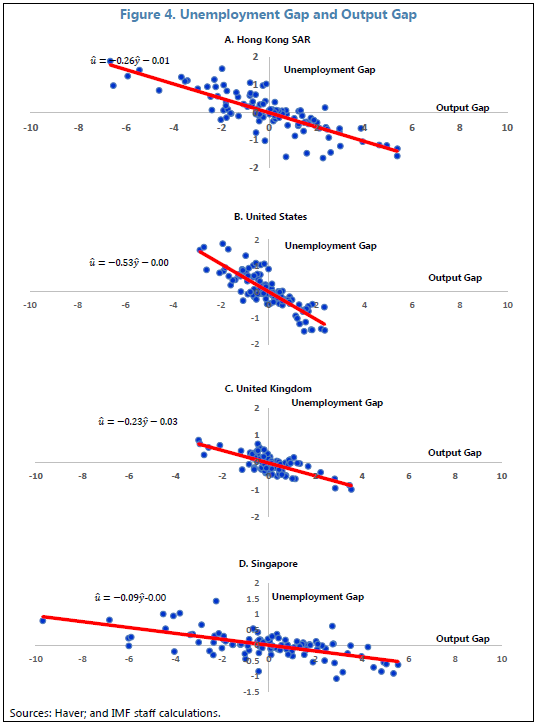
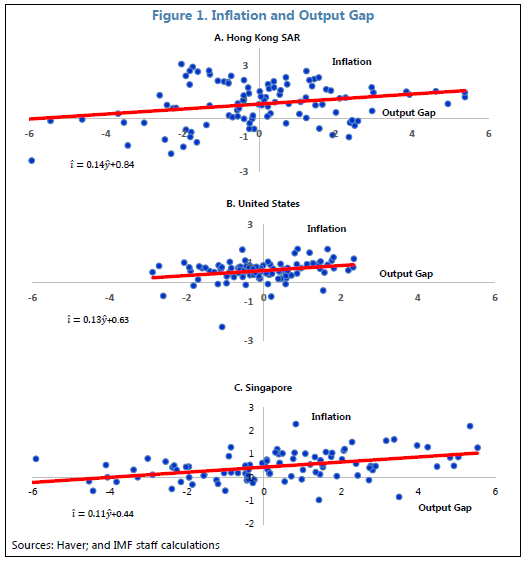
A nice paper comparing basic macroeconomic relationships in Hong Kong (SAR) and Singapore to those in the United States and the United Kingdom.
Continue reading here.
A nice paper comparing basic macroeconomic relationships in Hong Kong (SAR) and Singapore to those in the United States and the United Kingdom.
Continue reading here.
Posted by at 8:57 AM
Labels: Macro Demystified
Macroeconomic Structural Policies and Income Inequality in Low-Income Developing Countries
Below is the executive summary of a new IMF report:
“Despite strong growth over the past two decades, income inequality remains high in many low-income developing countries (LIDCs). As shown by earlier work, including by the IMF, high levels of inequality can impair both the future pace and the sustainability of growth and macroeconomic stability, thereby also limiting countries’ ability to reach the Sustainable Development Goals.
This note explores how policies and reforms aimed at boosting growth affect the extent of income inequality in LIDCs and how complementary policy measures can be used to offset adverse distributional effects of such reforms. It examines: (i) the distributional consequences of selective economic reforms and macro-structural policies that are generally considered to be growth-enhancing; (ii) the channels and mechanisms through which inequality is likely to be affected, given structural characteristics common to most LIDCs; and (iii) the scope for complementary policies to ensure that a reform package can boost growth without widening inequality. The study complements recent work on the inequality-growth trade-offs (including Ostry, Berg, and Tsangarides, 2014; and Organization for Economic Cooperation and Development (OECD), 2015), and by using a more granular model-based analysis to identify the mechanisms through which specific reforms affect growth and inequality.
The note identifies macro-distributional challenges that can be expected to confront LIDCs, given structural characteristics common to these economies. Specifically, the note examines how features such as high levels of informality, limited geographic or inter-sectoral labor mobility, large inter-sectoral productivity differences, lack of access to finance, and low levels of infrastructure can make growth-inequality trade-offs particularly challenging for these economies. The main focus is on identifying the key channels through which growth-oriented reforms can influence income distribution, rather than identifying the universe of reforms that could have adverse distributional effects. For illustrative purposes, the note zooms in on a set of macro-structural reforms that have been regarded as growth-promoting in LIDCs (see IMF, 2015a)—specifically, selected fiscal reforms (tax policy measures, higher public infrastructure investment); financial sector reforms; and reforms to the agricultural sector.
The findings confirm that these macro-structural policies can have important distributional consequences in LIDCs, with the impact dependent both on the design of reforms and on country-specific economic characteristics. Results from cross-country statistical analysis and detailed country-case studies suggest that: (i) the distributional impact of tax policies depends not only on the specific tax instruments chosen (with indirect taxes usually seen as being regressive and direct income taxation usually seen as progressive), but also on how the additional budgetary resources are deployed; (ii) better and more infrastructure investment can both boost growth and lower inequality levels; (iii) financial sector reforms can exacerbate inequality if financial access is limited to a small share of the population and labor mobility is constrained; and (iv) reforms that boost agricultural output can worsen income inequality in situations where the agricultural sector is large and productivity gains benefit mostly the rural better-off.
Accompanying measures can make reforms supportive of growth while limiting adverse distributional effects. Some reforms may boost growth and welfare for all with distributional consequences that may not be undesirable from an economic and/or social point of view. Other reforms can bring economic gains only to a few with distributional consequences that may be considered unwelcome by societies. While there is no one-size-fits-all recipe, the note explores how targeted policy interventions, implemented in conjunction with pro-growth reforms, can be deployed to contain any adverse distributional effects of the reform measures—recognizing that societal views on what constitutes an undesirable distributional outcome will differ from country to country. The analysis focuses on the macroeconomic mechanisms through which such interventions can contain or offset any adverse distributional impact of pro-growth reforms; the note does not examine how these interventions can best be implemented in the presence of weak domestic administrative capacity or political economy constraints. Some policy interventions cited, such as conditional cash transfers, can be challenging to administer in countries with weak capacity, while measures to enhance labor mobility, such as strengthening land ownership rights, can take time and be politically very difficult to implement.”
Below is the executive summary of a new IMF report:
“Despite strong growth over the past two decades, income inequality remains high in many low-income developing countries (LIDCs). As shown by earlier work, including by the IMF, high levels of inequality can impair both the future pace and the sustainability of growth and macroeconomic stability, thereby also limiting countries’ ability to reach the Sustainable Development Goals.
This note explores how policies and reforms aimed at boosting growth affect the extent of income inequality in LIDCs and how complementary policy measures can be used to offset adverse distributional effects of such reforms.
Posted by at 8:36 AM
Labels: Inclusive Growth
Subscribe to: Posts