



Tuesday, April 11, 2017
A Closer Look at Global Housing
Posted by at 4:55 PM
Labels: Global Housing Watch
Monday, April 10, 2017
Housing Market in San Marino
“Credit growth continues to be subdued, and activity in the housing market remains at the low level. (…) In the housing market, the number of real estate sales remains low, but the average tax per transaction for non-leasing properties, which is likely correlated with real estate prices, has stabilized”, says IMF report.
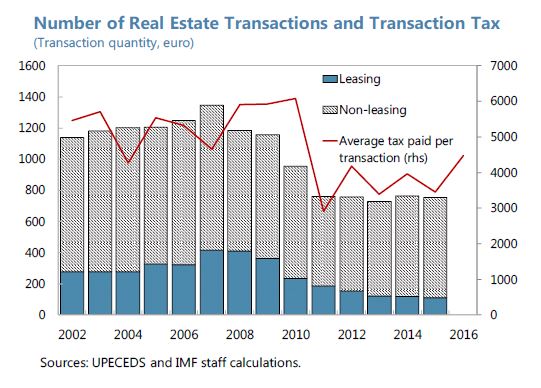
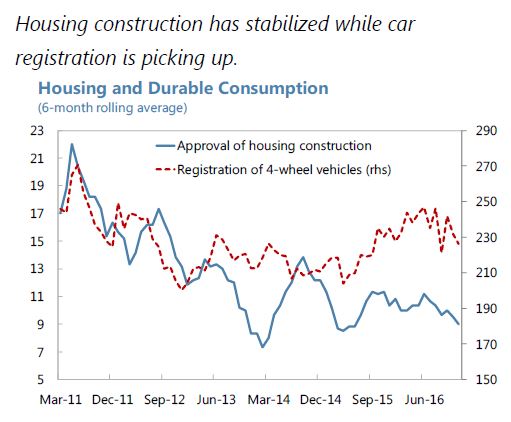
“Credit growth continues to be subdued, and activity in the housing market remains at the low level. (…) In the housing market, the number of real estate sales remains low, but the average tax per transaction for non-leasing properties, which is likely correlated with real estate prices, has stabilized”, says IMF report.
Posted by at 1:30 PM
Labels: Global Housing Watch
Saturday, April 8, 2017
Workshop on Forecasting Issues in Developing Economies
Forecasting Issues in Developing Economies
April 26-27, 2017, Washington, DC
Wednesday, April 26
8.45-9.30 Registration and Breakfast
9.30-9.45 Opening Remarks: Tao Zhang, Deputy Managing Director, IMF
9.45-10.15 Session 1: Forecasting Turning Points
Chair: Prakash Loungani, Research Department, IMF
David Kuenzel, Wesleyan University
Chris Papageorgiou, Research Department, IMF
IMF Forecasts in Time of Crisis (Paper and Presentation)
(with Charis Christofides and Theo Eicher)
Discussant: Herman Stekler, George Washington University
10.15-11.15 Session 2: Energy and Climate Change
Chair: Gail Cohen, National Academies of Sciences, Engineering & Medicine
Jevgenijs Steinbuks, The World Bank
Assessing the Accuracy of Electricity Demand Forecasts in Developing Countries (Paper and Presentation)
Xinye Zheng, Renmin University of China
Economic Structure and Energy Consumption: Implications for 2030 Chinese Energy Demand (Paper and Presentation)
(with Fanghua Li and Li Zhang)
Discussant: Fred Joutz, George Washington University
11.15-11.30 Coffee Break
11.30-12.30 Session 3: Dealing with Uncertainty
Chair: Min Wei, Federal Reserve Board
Xuguang Simon Sheng, American University
The Measurement and Transmission of Macroeconomic Uncertainty: Evidence from the U.S. and BRIC Countries (Paper and Presentation)
(with Yang Liu)
Svetlana Makarova, University College London
Quasi Ex-Ante Inflation Forecast Uncertainty (Paper and Presentation)
(with Wojciech Charemza and Carlos Diaz)
Discussant: Sangyup (Sam) Choi, Mideastern & C. Asia Dept., IMF
12.30-2.00 Lunch
2.00-3.00 Session 4: Issues in Macroeconomics and Empirical Finance
Chair: Kirstin Hubrich, Federal Reserve Board
Speaker: Jonathan Wright, Johns Hopkins University
Ten Thoughts for Forecasting and Policy (Presentation)
Gloria Gonzalez-Rivera, University of California, Riverside
A Bootstrap Approach for Generalized Autocontour Testing. Implications for VIX Forecast Densities (Paper and Presentation)
(with J.H. Mazzeu, E. Ruiz, and H. Veiga)
3.00-3.30 Session 5: Financial Forecasting
Chair: Rita Biswas, University at Albany – SUNY
Sophia Chen, Research Department, IMF
Financial Information and Macroeconomic Forecasts (Paper and Presentation)
(with Romain Ranciere)
Discussant: Zhaogang Song, Johns Hopkins University
3.30-3.45 Group Photo
3.45-4.00 Coffee Break
4.00-5.15 Session 6: Frontiers of Forecasting
Chair: Herman Stekler, George Washington University
Keynotes:
Frank Diebold, University of Pennsylvania
Econometrics, Predictive Modeling, Causal Estimation, and Machine Learning
Kajal Lahiri, University at Albany – SUNY
The International Transmission of Shocks. A Factor Structural Analysis Using Forecast Data (Presentation)
7.00 Workshop Dinner
Taberna del Alabardero (1776 I St., NW; entrance on 18th Street)
Thursday, April 27
9.00-9.30 Breakfast
9.30-10.30 Session 7: Unemployment and Growth Forecasts
Chair: Milt Marquis, Florida State University
Neil Ericsson, Federal Reserve Board
Detecting Time-dependent Bias in the Fed’s Greenbook Forecasts (Paper)
(with Emilio Fiallos and J E. Seymour)
Laurence Ball, Johns Hopkins University
An Assessment of IMF Unemployment Forecasts for Advanced and Developing Economies (Paper and Presentation)
(with Zidong An, Joao Jalles and Prakash Loungani)
Discussant: Gabe Mathy, American University
10.30-10.45 Coffee Break
10.45-11.45 Session 8: Inflation and Monetary Policy
Chair: Subir Gokarn, Office of Executive Directors, IMF
Abhiman Das, Indian Institute of Management
Herbert Zhao, Towson University
Asymmetries in Indian Inflation Expectations: A Study Using IESH Quantitative Survey Data (Paper and Presentation)
(with Kajal Lahiri)
Roberto Duncan, Ohio University
New Perspectives on Forecasting Inflation in Emerging Economies: An Empirical Assessment (Paper and Presentation)
(with Enrique Martinez-Garcia)
Discussant: Tara Sinclair, George Washington University
11.45-12.30 Session 9: Economic Prospects for Africa
Chair: Maxwell Opoku-Afari, African Department, IMF
Speakers:Anthony Simpasa, African Development Bank
Intelligent Forecasting of Economic Growth for African Economies: Artificial Neural Networks versus Time Series and Structural Econometric Models (Paper and Presentation)
(with Chuku Chuku and Jacob Oduor)
Discussant: Khaled Hussein, UN Economic Commission for Africa
Forecasting Issues in Developing Economies
April 26-27, 2017, Washington, DC

Wednesday, April 26
8.45-9.30 Registration and Breakfast
9.30-9.45 Opening Remarks: Tao Zhang, Deputy Managing Director, IMF
9.45-10.15 Session 1: Forecasting Turning Points
Chair: Prakash Loungani, Research Department, IMF
David Kuenzel, Wesleyan University
Chris Papageorgiou, Research Department, IMF
IMF Forecasts in Time of Crisis (Paper and Presentation)
(with Charis Christofides and Theo Eicher)
Discussant: Herman Stekler,
Posted by at 5:11 PM
Labels: Forecasting Forum
Tuesday, April 4, 2017
Corruption and Growth in Ukraine
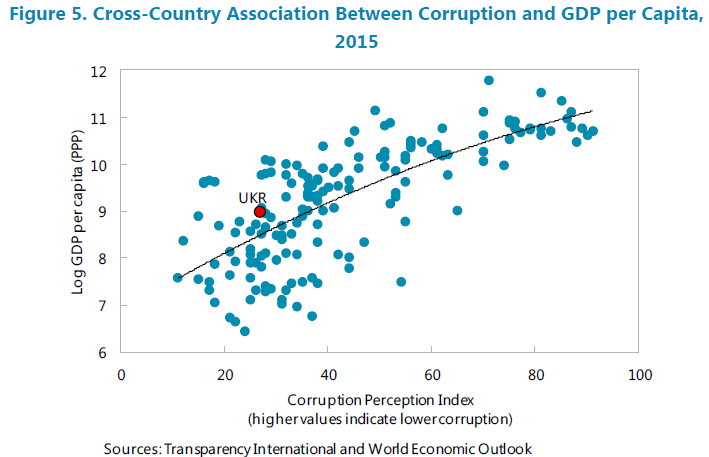
An IMF report says “The level of corruption in Ukraine is exceptionally high. This can severely undermine economic growth prospects, in particular by hindering private investment. Reducing corruption is therefore essential to speed up the process of economic convergence to the rest of Europe. Regional comparisons help identifying best practices in reducing corruption. The Ukrainian authorities have recently adopted important measures that follow some of these best practices. They are, however, facing a number of specific challenges, including the concentration of political and economic powers in a small group of people which may hamper effective anti-corruption efforts.”
Continue reading here.
An IMF report says “The level of corruption in Ukraine is exceptionally high. This can severely undermine economic growth prospects, in particular by hindering private investment. Reducing corruption is therefore essential to speed up the process of economic convergence to the rest of Europe. Regional comparisons help identifying best practices in reducing corruption. The Ukrainian authorities have recently adopted important measures that follow some of these best practices.
Posted by at 12:00 PM
Labels: Inclusive Growth
Monday, April 3, 2017
Housing Market in Netherlands
The IMF’s latest report on Netherlands points out the following:
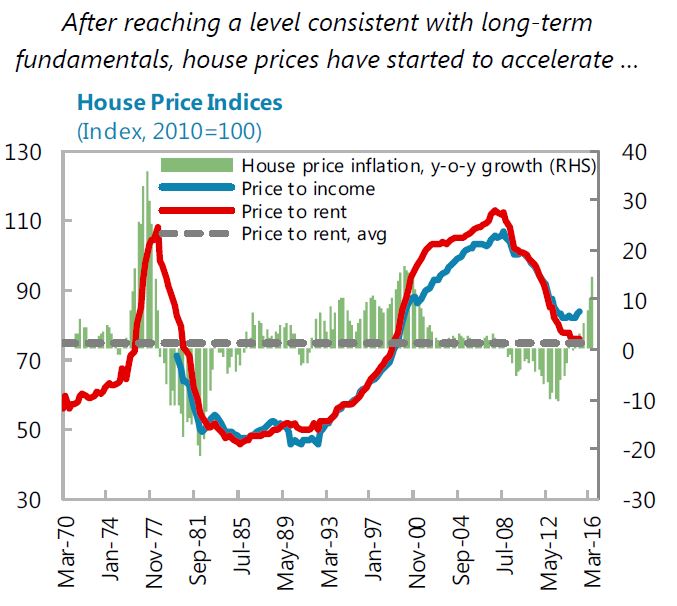
- “House prices have been accelerating and close monitoring may be warranted in the country’s main cities. After turning a corner in 2014, house prices have been steadily accelerating and transaction volumes have doubled in 2016. At the aggregate level, real house prices are broadly consistent with long-term equilibrium (priceto-income, price-to-rent ratios, Figure 3) but developments have been uneven across regions, with prices for apartments in Amsterdam 15 percent higher than a year ago. After plummeting by 20 percent during the crisis, commercial real estate has only started to recover recently.”
- “Households remain highly leveraged, with a sizeable share of mortgages in negative equity.”
- “Staff recommends accelerating the implementation of macro-prudential and other measures aimed at lessening household financial vulnerabilities. The authorities should build on recent initiatives, (…) They should accelerate the phasing down of mortgage interest deductibility (MID), by at least 1 percentage point per year ultimately bringing it to a neutral level relative to the taxation of other assets. (…) The authorities should continue to gradually lower the maximum limit on LTV ratios by at least 1 percentage point per year to no more than 90 percent by 2028 and to 80 percent thereafter. (…) The authorities should introduce prudential ceilings on debt service-to-income caps by income category that could not be relaxed during periods of strong growth.”
- “The private rental market needs to be deregulated and placed on a more even footing with owner-occupied homes and social housing.”
The IMF’s latest report on Netherlands points out the following:
- “House prices have been accelerating and close monitoring may be warranted in the country’s main cities. After turning a corner in 2014, house prices have been steadily accelerating and transaction volumes have doubled in 2016. At the aggregate level, real house prices are broadly consistent with long-term equilibrium (priceto-income, price-to-rent ratios, Figure 3) but developments have been uneven across regions,
Posted by at 2:32 PM
Labels: Global Housing Watch
Subscribe to: Posts