



Wednesday, June 28, 2017
House Prices in Peru
“The property sector has grown rapidly, though there has been some price moderation recently and indicators do not suggest overheating. Prices have risen over the decade, in tandem with Peru’s economic expansion. In Q2 2016, the growth in median apartment prices in Lima softened compared to Q2 2015, but remained well above the 5-year average. Valuation indicators show that Peru’s property market is on an average footing compared to regional peers (…). The country also faces a housing deficit, particularly in the lower-income segments, and buying patterns do not appear speculative. Furthermore, property price indices in Peru only reflect the capital, Lima, which has a higher population growth and urbanization level than the rest of the country”, according to the IMF’s annual economic report on Peru.
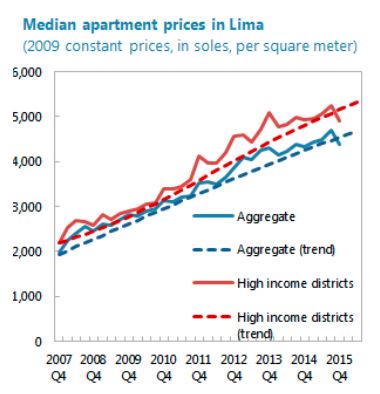
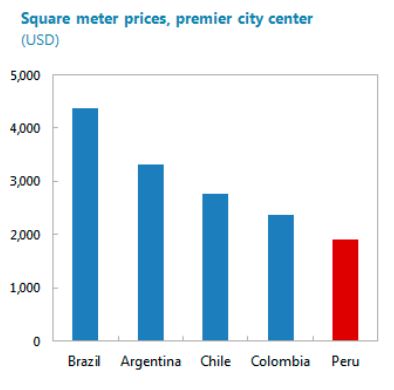
“The property sector has grown rapidly, though there has been some price moderation recently and indicators do not suggest overheating. Prices have risen over the decade, in tandem with Peru’s economic expansion. In Q2 2016, the growth in median apartment prices in Lima softened compared to Q2 2015, but remained well above the 5-year average. Valuation indicators show that Peru’s property market is on an average footing compared to regional peers (…). The country also faces a housing deficit,
Posted by at 3:39 PM
Labels: Global Housing Watch
Tuesday, June 27, 2017
Housing View – June 27, 2017
On macroprudential policy:
- Stanley Fischer on Housing and Financial Stability – Federal Reserve Board
- DNB-Riksbank Macroprudential Conference – De Nederlandsche Bank
On cross-country:
- Global House Price Index – Q1 2017 – Knight Frank
- Q1 2017: World’s housing markets poised to slow, though the boom continues strongly in Europe, Canada, and some parts of Asia – Global Property Guide
- Global developments in residential property prices – Bank for International Settlements
- Europe’s Next Housing Boom Raises Red Flags in Ex-Communist East – Bloomberg
- Relevamiento Inmobiliario de América Latina – Universidad Torcuato Di Tella
- Recent Trends and Developments in European Mortgage Markets – CEPS
- House prices and monetary policy in the euro area: evidence from structural VARs – European Central Bank
- A housing policy that could almost pay for itself? Think retrofitting – World Bank
On the US:
- Is a Bubble Brewing in the Multifamily Housing Market? – Federal Reserve Bank of St. Louis
- The State of the Nation’s Housing 2017 – Harvard Joint Center for Housing Studies
- Does it matter whether those who lost their homes during the crisis come back to the housing market? – Federal Reserve Bank of Richmond
- Housing Constraints and Spatial Misallocation – University of California, Berkeley
- Dynamics of Housing Debt in the Recent Boom and Great Recession – NBER
On other countries:
- Is Australia’s property market overheating? – The Economist
- The lessons from Canada’s attempts to curb its house-price boom – The Economist
- Czech central bank moves to rein in lending in ‘overvalued’ property market – Financial Times
- How can we dampen the build-up of housing price bubbles? – Bank of Finland
- A review of residential mortgage lending in 2016 – Central Bank of Ireland
- [New Zealand] House prices slow, and will likely keep slowing – CoreLogic
- South Korea tightens rules on housing to restrain buying frenzy in some cities – Reuters
- [Spain] Buen desempeño del mercado inmobiliario en 1T17 – BBVA
On macroprudential policy:
- Stanley Fischer on Housing and Financial Stability – Federal Reserve Board
- DNB-Riksbank Macroprudential Conference – De Nederlandsche Bank
On cross-country:
- Global House Price Index – Q1 2017 – Knight Frank
- Q1 2017: World’s housing markets poised to slow, though the boom continues strongly in Europe, Canada, and some parts of Asia – Global Property Guide
- Global developments in residential property prices –
Posted by at 5:00 AM
Labels: Global Housing Watch
Monday, June 26, 2017
House Prices in Ireland
IMF’s new report on Ireland says that: “Strong momentum in the housing market requires close monitoring. Recent policy actions to address homelessness, improve housing affordability and the recalibration of macroprudential measures may have added impetus to the market, which also has seen an increase in price expectations and a surge in mortgage approvals. This suggests that strong demand is likely to be sustained in the period ahead, particularly given the positive momentum in the labor market and improved household balance sheets. Staff analysis—though subject to uncertainty—finds no clear evidence of a significant price misalignment in the residential property market (…), yet persistent pressures could lead to imbalances, particularly given the lagged supply response.”
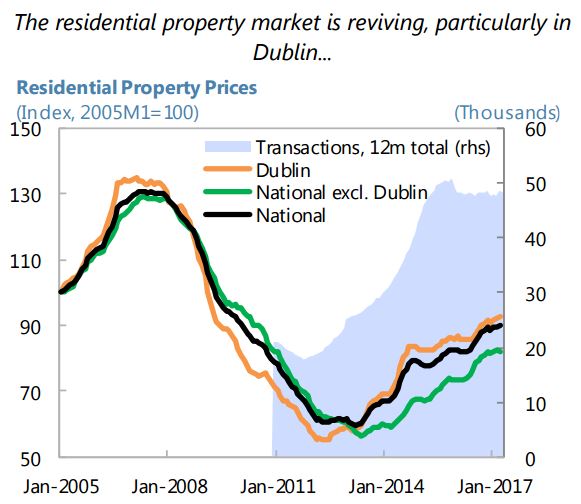
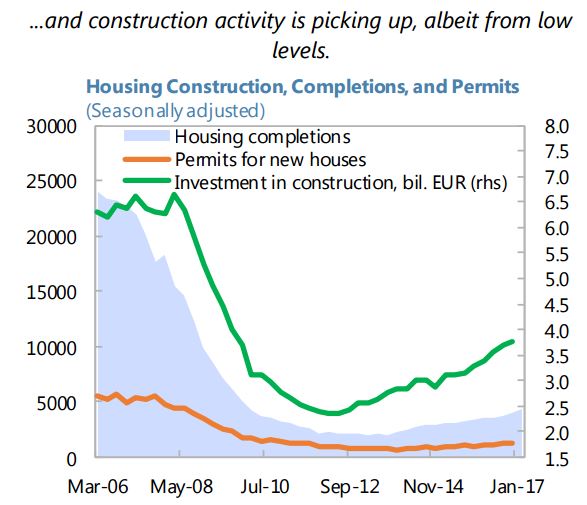
IMF’s new report on Ireland says that: “Strong momentum in the housing market requires close monitoring. Recent policy actions to address homelessness, improve housing affordability and the recalibration of macroprudential measures may have added impetus to the market, which also has seen an increase in price expectations and a surge in mortgage approvals. This suggests that strong demand is likely to be sustained in the period ahead, particularly given the positive momentum in the labor market and improved household balance sheets.
Posted by at 6:05 PM
Labels: Global Housing Watch
House Prices in Czech Republic
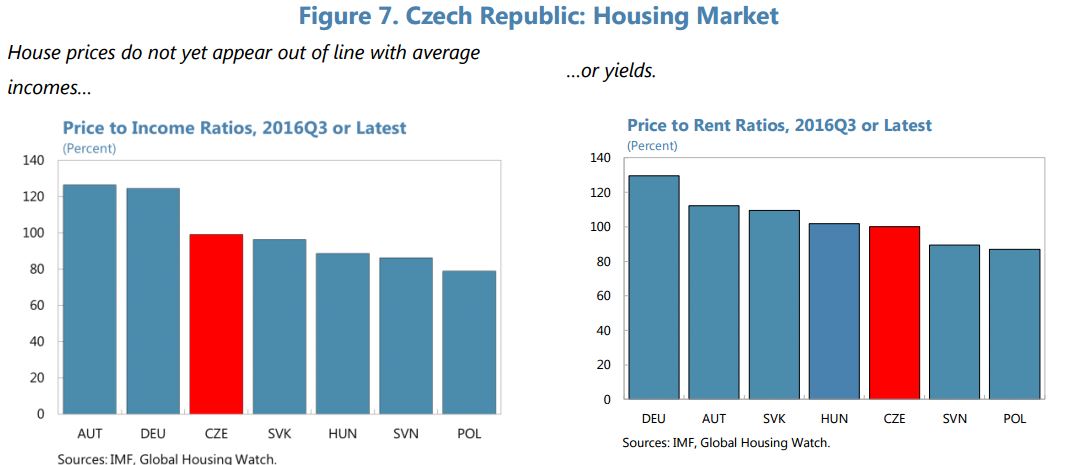
“Real estate values have also been increasing quickly. House prices have escalated rapidly from a post-crisis trough in 2012, both in Prague and outside the capital region. The increases are in line with those in neighboring countries, and simple metrics—price to income and price to rent ratios—do not yet show current house price levels to be unusually high (Figure 7, charts 1–2). However, data gaps preclude a more conclusive analysis—in particular, an aggregate price index for the commercial real estate market is not publicly available”, says IMF’s new report on Czech Republic.
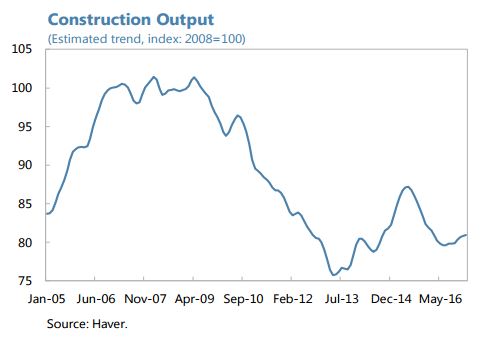
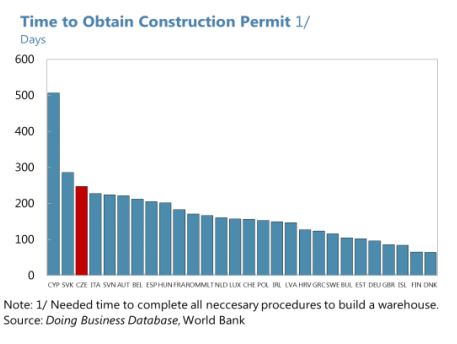
On housing supply the report says that: “House price increases are amplified by inelastic supply. Construction declined considerably after the global financial crisis, and has not recovered significantly, despite the increase in house prices. In addition, the processes for obtaining necessary permits are long, complex, and often inconsistent, limiting the ability of supply to respond quickly to demand.”
“Real estate values have also been increasing quickly. House prices have escalated rapidly from a post-crisis trough in 2012, both in Prague and outside the capital region. The increases are in line with those in neighboring countries, and simple metrics—price to income and price to rent ratios—do not yet show current house price levels to be unusually high (Figure 7, charts 1–2). However, data gaps preclude a more conclusive analysis—in particular, an aggregate price index for the commercial real estate market is not publicly available”,
Posted by at 5:56 PM
Labels: Global Housing Watch
Income Inequality and the Welfare System in Ireland
A new IMF report finds:
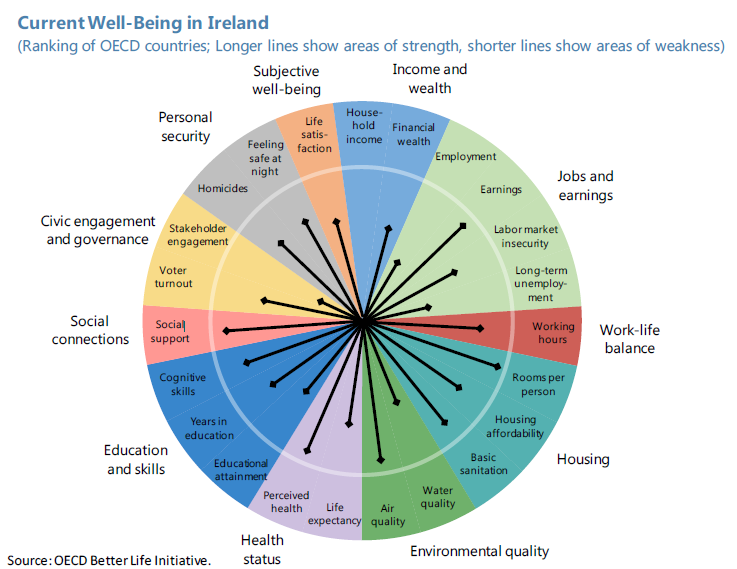
“Ireland is characterized by one of highest dispersions of market income among EU (and OECD) countries. Specific features of the Irish economy, as well as specific structural gaps, contribute to explaining this situation.
Ireland’s tax-benefit system is one of the most effective in the EU in redistributing income, thereby mitigating income disparities across a range of factors (including regions). A relatively progressive tax system funds a robust system of social benefits, a significant share of which is means-tested.
Despite the severe financial crisis and substantial budget cuts, the government succeeded in preserving most welfare expenditure, which provided an important cushion against the worst effects of the crisis. This helped safeguard social solidarity and cohesion.
During the crisis, the elderly were shielded more than younger generations, who also face more uncertain job opportunities than before the crisis. With the economic recovery and the associated decline in unemployment, including youth joblessness, the intergenerational distribution has shown some improvement. Nonetheless, it would be useful to consider potential steps to reinforce the current welfare system to address future challenges.
Although efficient, the welfare system is complex, covers a relatively high number of individuals and families, and represents a sizable portion of public expenditures. Efforts should continue to get more people into jobs, and specifically more secure and better paying jobs, thus mitigating market-income, as well as regional, inequality. To this end, the authorities recognize that upskilling and reskilling the labor force requires enhancing the effectiveness of active labormarket policies and, more broadly, better aligning educational path with enterprise needs. They are also working to address gaps in childcare provision, a crucial drag on female labor market participation.”
Continue reading here.
A new IMF report finds:
“Ireland is characterized by one of highest dispersions of market income among EU (and OECD) countries. Specific features of the Irish economy, as well as specific structural gaps, contribute to explaining this situation.
Ireland’s tax-benefit system is one of the most effective in the EU in redistributing income, thereby mitigating income disparities across a range of factors (including regions). A relatively progressive tax system funds a robust system of social benefits,
Posted by at 1:18 PM
Labels: Inclusive Growth
Subscribe to: Posts