



Wednesday, January 10, 2018
Workshop: Trade Policy, Inclusion and the Rise of the Service Economy
The Council on Economic Policies, the International Monetary Fund and the World Trade Organization are organizing a workshop on 25-26 April, 2018 in Geneva, Switzerland, on policy relevant aspects of the links between trade in services and inclusive growth. Papers presented in the workshop will be considered for an expedited review process for a Review of International Economics special issue to be published in 2019.
Topics
We particularly encourage the submission of unpublished empirical work that uses new datasets or exploits policy experiments in a novel and informative way. Topics of interest include, but are not limited to:
- What is the effect of services trade on inclusive growth and structural transformation? Is trade in services a promising development strategy for developing economies?
- How does services trade affect employment, income and gender inequality, quality of and access to service delivery, and innovation?
- What are key determinants of and barriers to services trade? To what extent have trade agreements reduced them?
- What policies are needed to increase services trade opportunities for inclusive growth?
Program
The workshop will start with a welcome dinner on April 24. April 25 will be devoted to paper presentations as well as a policy debate with trade negotiators and other practitioners in the evening. Presentations will continue in the morning of April 26, followed by an exploration of new directions for research in the afternoon. The workshop will take place at the WTO Secretariat.
Submissions
Papers should be submitted by February 15, 2018 to trade@cepweb.org. Successful submissions will be notified by beginning of March 2018.
Program Committee
- Peter Egger, ETH Zurich
- Ricardo Hausmann, Harvard University
- Bernard Hoekman, European University Institute
- Bob Koopman, World Trade Organization
- Aaditya Mattoo, World Bank
- Margaret McMillan, Tufts University
- Chris Papageorgiou, International Monetary Fund
- Johannes Schwarzer, Council on Economic Policies
The Council on Economic Policies, the International Monetary Fund and the World Trade Organization are organizing a workshop on 25-26 April, 2018 in Geneva, Switzerland, on policy relevant aspects of the links between trade in services and inclusive growth. Papers presented in the workshop will be considered for an expedited review process for a Review of International Economics special issue to be published in 2019.
Topics
We particularly encourage the submission of unpublished empirical work that uses new datasets or exploits policy experiments in a novel and informative way.
Posted by at 11:04 PM
Labels: Inclusive Growth
Tuesday, January 9, 2018
For Vietnam, Greener Growth Can Reduce Climate Change Risks
A new IMF report says that: “By 2100, climate change could impact more than 12 percent of the Vietnamese population and reduce growth by 10 percent. The Vietnamese government considers the response to climate change a vital issue and has implemented environmental policies to better cope with these risks.”
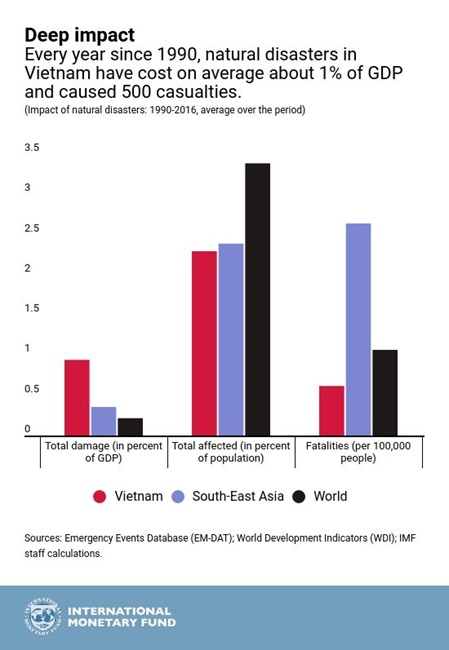
“But the country—which has relied heavily on fossil fuels and overexploitation of natural resources—needs to further adapt its economy toward a more sustainable and ecofriendly growth model.”
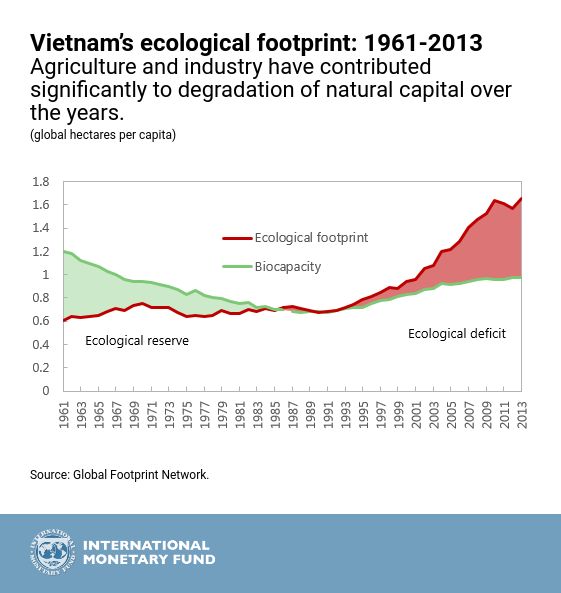
“Policies that can better prepare Vietnam for the future impact of climate change should focus on:
- Lowering the intensity of fossil fuels in Vietnam’s GDP: raising the contribution of renewable energy would help to break the link between greenhouse gas emissions and output.
- Providing stronger incentives for households, firms, and government to pursue green growth: taxation of fossil fuels that fully prices environmental and health externalities would nudge energy demand toward renewables and generate revenue to finance adaptation and mitigation plans.
- Investing in climate resilient infrastructure would help households and firms cope with storms. The expected cost of natural disasters could be usefully included in public debt sustainability analyses.
- Promoting research and development and other innovation policies can provide further incentives to investment in existing clean energy sources and improvements in clean technologies.
- Shifting to autonomous, electric, shared vehicles, as already planned in Singapore, would help reduce congestion and pollution in cities. Improved government capacity to coordinate technological change and promote innovation and green growth would be key.”
A new IMF report says that: “By 2100, climate change could impact more than 12 percent of the Vietnamese population and reduce growth by 10 percent. The Vietnamese government considers the response to climate change a vital issue and has implemented environmental policies to better cope with these risks.”
“But the country—which has relied heavily on fossil fuels and overexploitation of natural resources—needs to further adapt its economy toward a more sustainable and ecofriendly growth model.”
Posted by at 9:01 PM
Labels: Energy & Climate Change
Saturday, January 6, 2018
Growth-Equity Trade-offs in Structural Reforms
From a new IMF working paper by Jonathan Ostry, Andrew Berg, and Siddharth Kothari:
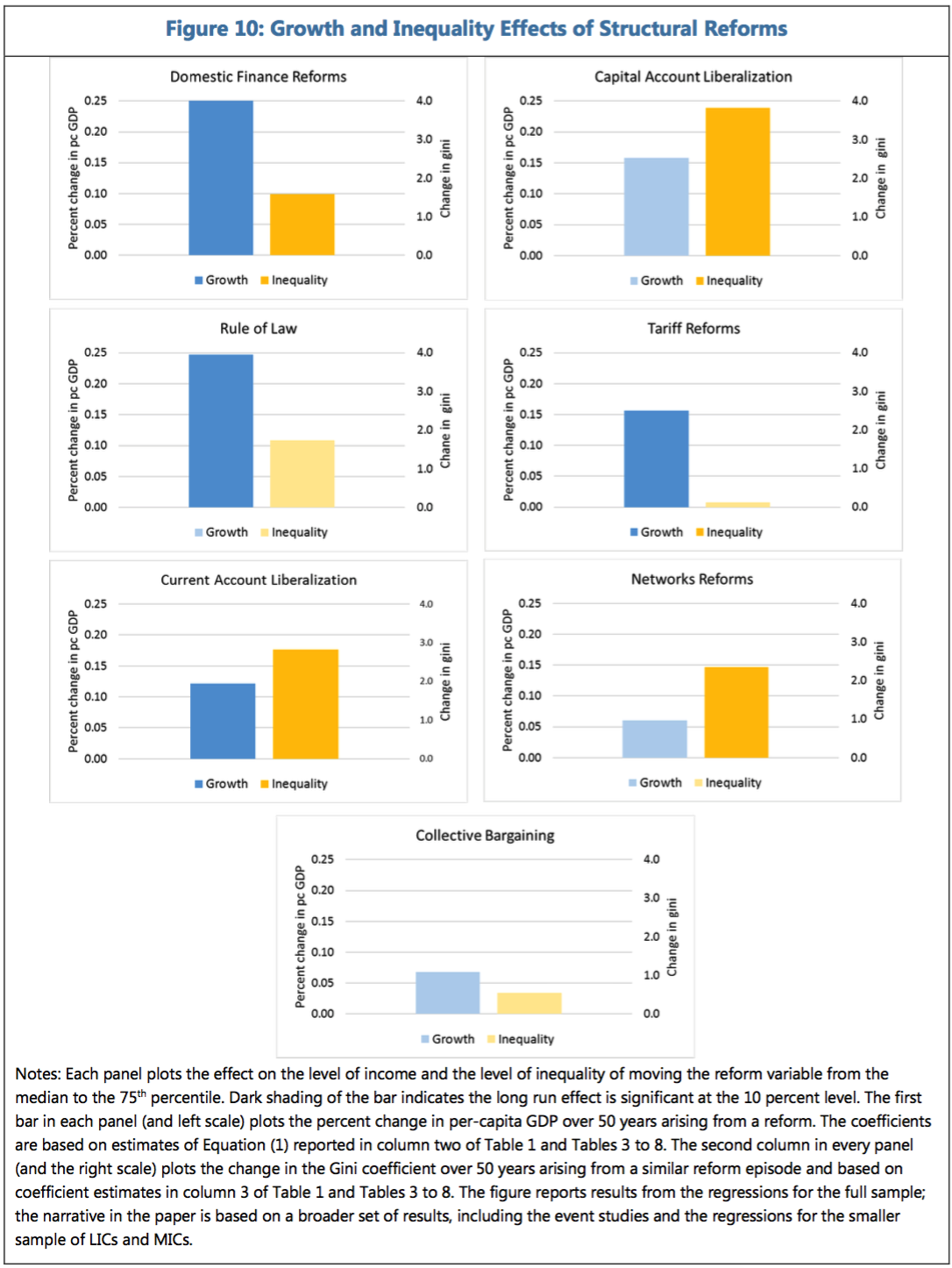
“Do structural reforms that aim to boost potential output also change the distribution of income? We shed light on this question by looking at the broad patterns in the cross-country data covering advanced, emerging-market, and low-income countries. Our main finding is that there is indeed evidence of a growth-equity tradeoff for some important reforms. Financial and capital account liberalization seem to increase both growth and inequality, as do some measures of liberalization of current account transactions. Reforms aimed at strengthening the impartiality of and adherence to the legal system seem to entail no growth-equity tradeoff—such reforms are good for growth and do not worsen inequality. The results for our index of network reforms as well as our measure of the decentralization of collective labor bargaining are the weakest and least robust, potentially due to data limitations. We also ask: If some structural reforms worsen inequality, to what degree does this offset the growth gains from the reforms themselves? While higher inequality does dampen the growth benefits, the net effect on growth remains positive for most reform indicators.”
From a new IMF working paper by Jonathan Ostry, Andrew Berg, and Siddharth Kothari:
“Do structural reforms that aim to boost potential output also change the distribution of income? We shed light on this question by looking at the broad patterns in the cross-country data covering advanced, emerging-market, and low-income countries. Our main finding is that there is indeed evidence of a growth-equity tradeoff for some important reforms. Financial and capital account liberalization seem to increase both growth and inequality,
Posted by at 8:28 AM
Labels: Inclusive Growth
Friday, January 5, 2018
Housing View – January 5, 2018 [2018 AEA Annual Meeting Special Edition]
On international house pricing:
- Measuring House Prices in the Long Run: Insights from Dublin, 1900-2015 – AEA
- A Tale of Two Countries: Comparing Booms, Busts and Bubbles in the United States and Chinese Housing Markets – Paper
- Analyzing the Changes in the Distribution of House Prices in Beijing – AEA
- Locally Weighted Quantile House Price Indices and Distribution in Japanese Cities, 1986 – AEA
- Do Airbnb Properties Affect House Prices? – Paper
- The Sharing Economy and Housing Affordability: Evidence from Airbnb – Paper
- Think Globally, Aggregate Locally: Index Consistency in the Presence Asymmetric Appreciation – Paper
- S. Metropolitan House Price Dynamics – Paper
- Did Investors Price Regional Housing Bubbles? A Tale of Two Markets – Paper
- Monetary Policy and the Housing Market – Paper
- Teardowns, Popups and Bump-outs: What Do Building Permits Say About Housing Supply? – Paper
- House Price Beliefs and Leverage Choice – Paper
- Do Gasoline Prices Affect Residential Property Values? – Paper
- Bank Risk-taking and the Real Economy: Evidence From the Housing Boom and its Aftermath – AEA
- Do Financial Constraints Cool a Housing Boom? Theory and Evidence From a Macroprudential Policy on Million Dollar Homes – Paper
- Housing Appreciation and Marginal Land Supply in Monocentric Cities with Topography – Paper
- Prospect Theory, Reverse Disposition Effect and the Housing Market – Paper
- How Do Households Discount Over Centuries? Evidence From Singapore’s Private Housing Market – Paper
- Property Right Restriction and House Prices – Paper and Presentation
- Cyclical Housing Prices in Flatland – Paper and Presentation
- House Prices, Mortgage Debt and Labor Mobility – AEA
- Model-Free Estimation of the Hedonic Price for Housing Space – Paper
On household finance:
- Household Finance and Consumer Behavior – Paper
- The Housing Crisis and the Rise in Student Loans – Paper
- Home Equity and the Timing of Claiming Social Security Retirement Income – AEA
- The Effect of Debt on Default and Consumption: Evidence From Housing Policy in the Great Recession – Paper
- Housing Wealth Effects: The Long View – Paper
On mortgages:
- Time to Homeownership and Mortgage Design: Income Sharing and Saving Incentive – Paper
- The Effect of Changing Mortgage Payments on Default and Prepayment: Evidence From HAMP Resets – Paper and Presentation
- The Effect of Interest Rates on Home Buying: Evidence From a Discontinuity in Mortgage Insurance Premiums – Paper and Presentation
- Liquidity Provision, Credit Risk and the Bond Spread: New Evidence From the Subprime Mortgage Market – Paper
- Collateral Damage: The Impact of Shale Gas on Mortgage Lending – Paper
- Are Mortgage Regulations Affecting Entrepreneurship? – Paper
- Eyes Wide Shut? Mortgage Insurance During the Housing Boom – AEA
- Effects of FHA Loan Limit Increases by ESA 2008: Housing Demand and Adverse Selection – AEA
- The Macroeconomic Effect of Government Asset Purchases: Evidence From Post-war United States Housing Credit Policy – Paper and Presentation
- How Much Are Car Purchases Driven by Home Equity Withdrawal? – Paper
- How Home Equity Extraction and Reverse Mortgages Affect the Credit Outcomes of Senior Households – AEA
- An Empirical Study of Termination Behavior of Reverse Mortgages – Paper
- Mortgage Default with Positive Equity – Paper
- Lending Competition and Non-Traditional Mortgages – Paper
On behavioral real estate:
- How Do the CEO Political Leanings Affect REIT Business Decisions? – Paper
- Outshine to Outbid: Weather-induced Sentiments on Housing Market – Paper and Presentation
- Contact High: The External Effects of Retail Marijuana Establishments on House Prices – AEA
- Relational Contracts, Reputational Concerns, and Appraiser Behavior: Evidence from the Housing Market – Paper
On affordable housing:
- Neighbors and Networks: The Role of Social Interactions on the Residential Choices of Housing Choice Voucher Holders – Paper
- Neighborhood Choices, Neighborhood Effects and Housing Vouchers – AEA
- Waiting for Affordable Housing – Paper
- Long-Run Outcomes of HOPE VI Public Housing Demolitions for Children – AEA
- The Effects of Residential Evictions on Low-Income Adults – Paper
On property taxes:
- Greener on the Other Side? Spatial Discontinuities in Property Tax Rates and their Effects on Tax Morale – AEA
- The Hated Property Tax: Salience, Tax Rates, and Tax Revolts – AEA
- Measuring Both Direct and Spillover Effects of Taxation: Evidence From a Property Tax Break for First-Time Buyers – Paper
- Impact of Housing Tax Preferences on Home Values and Neighborhood Sorting – AEA
- Do Local Governments Tax Homeowner Communities Differently? – Paper
On agency and bargaining:
- Why Disclose Less Information? Toward Resolving a Disclosure Puzzle in the Housing Market – Paper
- Examining Both Sides of the Transaction: Bargaining in the Housing Market – Paper
- Investor Bargaining Power, Rental Externalities and Housing Prices – Paper
- When are Real Estate Flippers Smarter Than the Crowd? – Paper
On homeownership:
- African-American Mayors, Home Ownership and Mortgage Lending in US Cities – Paper
- Do Homeowners Save More Than Renters? Evidence From the Panel on Household Finances – Paper and Presentation
- Home Sweet Home: (Mis-)Beliefs About the Extent to Which Home Ownership Makes People Happy – Paper
- Job Separation Risk and Home Ownership: Evidence From Assistant Professors – AEA
- Identifying the Benefits from Home Ownership: A Swedish Experiment – Paper
- Owned Now Rented Later? Housing Stock Transitions and Market Dynamics – Paper
- Diverted Homeowners and Rental Affordability – AEA
- School Quality, Latent Demand, and Bidding Wars for Houses – AEA
- Wage Trickle Down vs. Rent Trickle Down: How Does Increase in College Graduates Affect Wages and Rents? – AEA

Photo by Aliis Sinisalu
On international house pricing:
- Measuring House Prices in the Long Run: Insights from Dublin, 1900-2015 – AEA
- A Tale of Two Countries: Comparing Booms, Busts and Bubbles in the United States and Chinese Housing Markets – Paper
- Analyzing the Changes in the Distribution of House Prices in Beijing – AEA
- Locally Weighted Quantile House Price Indices and Distribution in Japanese Cities,
Posted by at 5:00 AM
Labels: Global Housing Watch
Thursday, January 4, 2018
Okun’s Law in Russia
A new paper concludes that “Okun’s law is applicable in Russia.” “The economic connection between economic growth rates and changes in unemployment proposed by Okun (1962) over half a century ago remains one of the main tools for analyzing labor markets.”
“Gabrisch and Buscher (2006) proposed that the formation of the labor market mechanism in the formerly planned economies could be considered as completed once Okun’s law became persistently applicable there.”
“The general conclusion is that Okun’s law is applicable in Russia both in the short and long run. A comparison (Akhundova et al., 2005) has shown that transition processes in the Russian labor market were completed during the first half of the 2000s (i.e., the shaping of the labor market mechanisms took slightly more than 10 years).”
The article is available from the Russian Journal of Economics.
A new paper concludes that “Okun’s law is applicable in Russia.” “The economic connection between economic growth rates and changes in unemployment proposed by Okun (1962) over half a century ago remains one of the main tools for analyzing labor markets.”
“Gabrisch and Buscher (2006) proposed that the formation of the labor market mechanism in the formerly planned economies could be considered as completed once Okun’s law became persistently applicable there.”
“The general conclusion is that Okun’s law is applicable in Russia both in the short and long run.
Posted by at 10:42 AM
Labels: Inclusive Growth
Subscribe to: Posts