



Friday, February 23, 2018
Housing View – February 23, 2018
On the US:
- Jon Gray: Blackstone’s real estate chief turns heir apparent – Financial Times
- The Role of Technology in Mortgage Lending – Federal Reserve Bank of New York
On other countries:
- [Australia] Housing Market Imbalances in Australia: Development, Prospects, and Policies – IMF
- [Australia] Household Indebtedness and Mortgage Stress – Reserve Bank of Australia
- [Canada] Canada province readies housing plan amid affordability crisis – Reuters
- [Canada] British Columbia takes aim at housing speculation – Reuters
- [Canada] Vancouver’s Hot Housing Market Gets Tougher for Wealthy Chinese – Bloomberg
- [China] Housing Price, Consumption, and Financial Market: Evidence from Urban Household Data in China – ASCE
- [Malaysia] Unsold residential units in Malaysia at highest level for a decade – Global Property Guide
- [Spain] Mortgage Finance and Culture – IZA Institute of Labor Economics
- [Switzerland] Geneva’s ‘safe-haven’ houses look vulnerable – Financial Times
- Out of Sync Subnational Housing Markets and Macroprudential Policies – CESifo Group Munich
- [United Kingdom] UK’s Housing Market – IMF
- [United Kingdom] House prices and rents in the UK – mainly macro
- [United Kingdom] London, Residential Market Outlook, Spring 2018 – Cluttons
- [United Kingdom] A Fix to the U.K. Housing Crunch: Have More Money – Citylab

Photo by Aliis Sinisalu
On the US:
- Jon Gray: Blackstone’s real estate chief turns heir apparent – Financial Times
- The Role of Technology in Mortgage Lending – Federal Reserve Bank of New York
On other countries:
- [Australia] Housing Market Imbalances in Australia: Development, Prospects, and Policies – IMF
- [Australia] Household Indebtedness and Mortgage Stress – Reserve Bank of Australia
- [Canada] Canada province readies housing plan amid affordability crisis – Reuters
- [Canada] British Columbia takes aim at housing speculation – Reuters
- [Canada] Vancouver’s Hot Housing Market Gets Tougher for Wealthy Chinese – Bloomberg
- [China] Housing Price,
Posted by at 6:53 AM
Labels: Global Housing Watch
Wednesday, February 21, 2018
Mortgage Finance and Culture
From a new paper by Núria Rodríguez-Planas (IZA Institute of Labor Economics):
“Using a nationally representative sample of 12,344 immigrants from 41 different countries of ancestry living in Spain in 2007, we find that the higher the housing-loan penetration in the country of ancestry, the higher the likelihood of having a mortgage in Spain. Similarly, the higher the mortgage depth in the country of ancestry, the higher the present value of the monthly mortgage payments. Our results suggest that social norms regarding mortgage finance in the country of ancestry matter in determining immigrants’ mortgage finance in the host country. More specifically, the effect of social norms on the decision to have a mortgage (the extensive margin) and the amount of the mortgage payments (the intensive margin) is about one third and tenth the size of the effect of having a college degree on mortgage debt, respectively. Evidence of strong persistence of culture among those with longer tenure in the host country, those who immigrated as children or young adults, and second-generation immigrants suggests that vertical transmission of beliefs (from parents to children) is a plausible channel of transmission. Perhaps most importantly, we find that cultural attitudes regarding property rights are most relevant when explaining individuals’ decision to get a mortgage, but those regarding credit information matter most when explaining the amount of the mortgage debt.”
From a new paper by Núria Rodríguez-Planas (IZA Institute of Labor Economics):
“Using a nationally representative sample of 12,344 immigrants from 41 different countries of ancestry living in Spain in 2007, we find that the higher the housing-loan penetration in the country of ancestry, the higher the likelihood of having a mortgage in Spain. Similarly, the higher the mortgage depth in the country of ancestry, the higher the present value of the monthly mortgage payments.
Posted by at 1:40 PM
Labels: Global Housing Watch
Housing Market Imbalances in Australia: Development, Prospects, and Policies
From the IMF’s latest report on Australia:
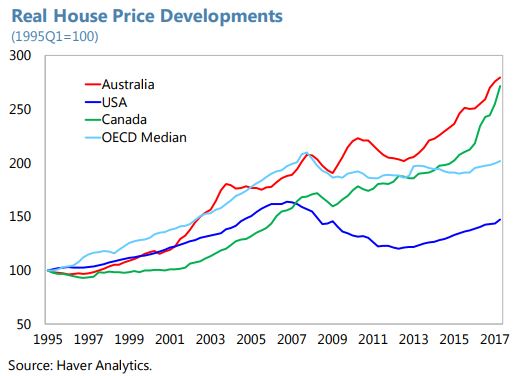
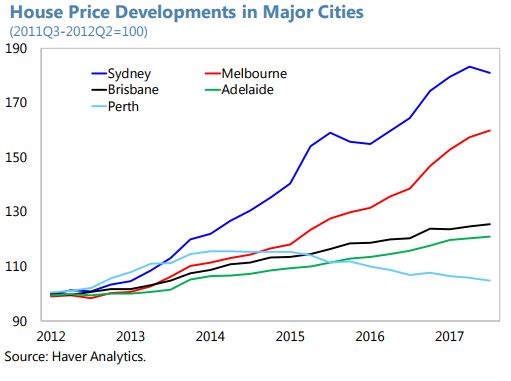
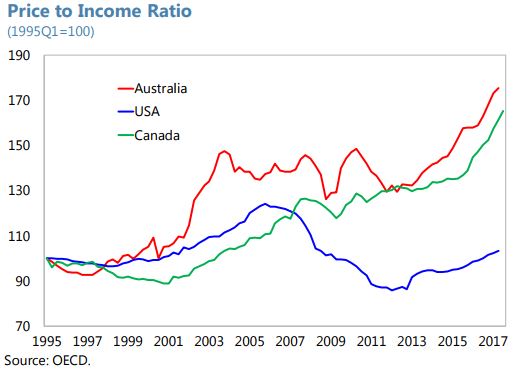
“After a housing boom over the past 6 years, Australia’s housing market imbalances and the macro-financial impact of their possible resolution have become a concern. House prices in the country’s eight capital cities have increased by 50 percent since early 2012, raising the value of Australian residential property from around 4 to over 5 times gross household disposable income and household debt to around twice the level of that income.
The housing boom has primarily been a regional boom, driven by demand shifts, and amplified by legacy imbalances and a slow supply response. Developments in Sydney and Melbourne have driven national house prices, reflecting shifts in the strength of regional economic activity and population growth since the end of the mining investment boom.
While housing markets may stabilize soon, housing affordability issues will likely remain a concern given prospects for further population growth in the eastern capitals. With such growth, the capitals need to prepare for affordable housing supply in the future, as both short-and long-term price elasticities of supply are low. In the long-term, urbanization, labor mobility, and productivity can be closely linked.
Housing-related policies have begun to address related imbalances and could usefully be complemented by tax reform. Reducing the imbalances requires a multi-pronged approach amid strong demand fundamentals. The combination of more infrastructure investment and recent zoning and planning regulatory reform should contribute to increase the supply of developable land and enable its more efficient use. Prudential policies have increased the resilience of household balance sheets and the banking sector to housing and other shocks. But household debt remains high, and continued prudential policies are important to manage the risks to domestic financial stability. Housing tax reform would support the effectiveness of the overall policy response.”
From the IMF’s latest report on Australia:
“After a housing boom over the past 6 years, Australia’s housing market imbalances and the macro-financial impact of their possible resolution have become a concern. House prices in the country’s eight capital cities have increased by 50 percent since early 2012, raising the value of Australian residential property from around 4 to over 5 times gross household disposable income and household debt to around twice the level of that income.
Posted by at 1:32 PM
Labels: Global Housing Watch
Monday, February 19, 2018
The New Minimum Wage Policy in Korea
From the latest IMF report on Korea’s minimum wage:
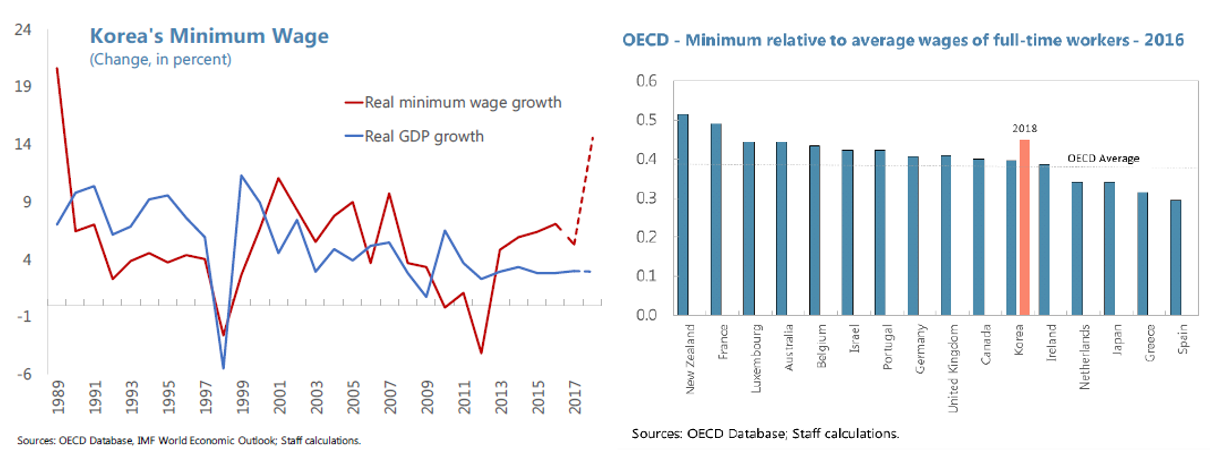
“The 2018 minimum wage hike is by far the largest increase in real terms since the minimum wage system was established in late 1980s. […] This hike will bring Korea’s minimum wage close to the OECD average.
A hike in the minimum wage could have an impact on multiple fronts. In general, it effects employment, especially youth employment, the overall wage levels in the economy, income distribution, and competitiveness of the firms. These in turn affect economic growth and inflation.” Continue reading here.
From the latest IMF report on Korea’s minimum wage:
“The 2018 minimum wage hike is by far the largest increase in real terms since the minimum wage system was established in late 1980s. […] This hike will bring Korea’s minimum wage close to the OECD average.
A hike in the minimum wage could have an impact on multiple fronts. In general, it effects employment,
Posted by at 10:04 PM
Labels: Inclusive Growth
Youth (Un)Employment in Korea—Recent Trends Drivers
From the latest IMF report on Korea’s youth unemployment:
“While Korea’s rate of youth unemployment is low in international comparison, it has recently increased. In addition, the share of inactive youth is exceptionally high. These developments are concerning as extensive research has shown long-lasting negative effects for individuals affected and the society and economy as a whole.
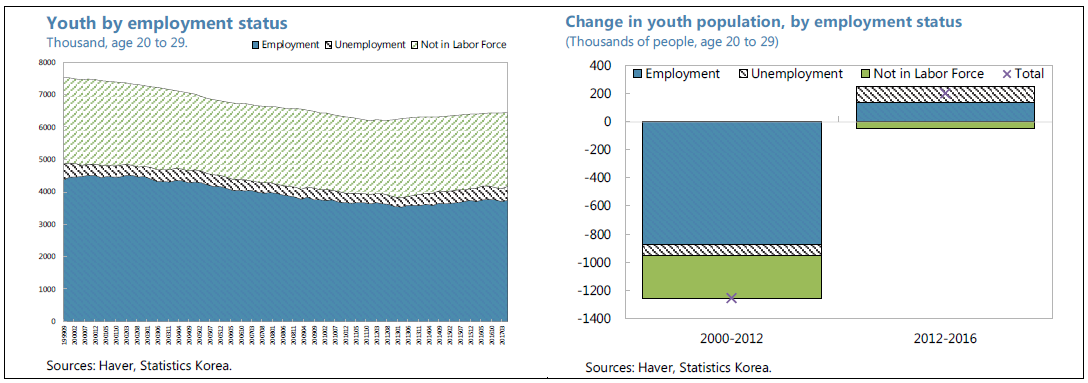
This paper discusses the potential drivers behind youth unemployment in Korea, the various measures taken by the authorities and best practices from the literature and other countries. The analysis suggests that various factors have contributed to the current situation, including cyclical, structural and policy variables. In particular, weak consumption, a temporary increase in the youth cohort and expectation and skill mismatches are likely responsible. Moreover, issues with educational quality, a focus on direct job creation and high protection of regular workers and the resulting labor market duality have also contributed.
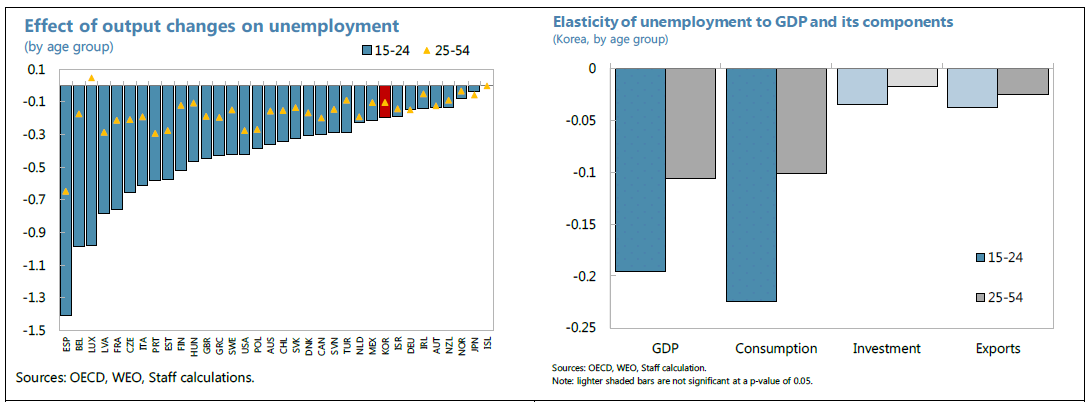
The Korean government has already made significant and comprehensive efforts to tackle youth employment issues and plans to further expand on them. Based on a growing literature of international experiences and policy evaluations, the government could consider (i) fine-tuning existing measures, (ii) expanding preemptive measures and (iii) addressing general cyclical and structural impediments.”
From the latest IMF report on Korea’s youth unemployment:
“While Korea’s rate of youth unemployment is low in international comparison, it has recently increased. In addition, the share of inactive youth is exceptionally high. These developments are concerning as extensive research has shown long-lasting negative effects for individuals affected and the society and economy as a whole.
This paper discusses the potential drivers behind youth unemployment in Korea,
Posted by at 9:36 PM
Labels: Inclusive Growth
Subscribe to: Posts