



Friday, August 17, 2018
Forecasting Failures and the Need for Automatic Stabilizers
From a new post by Chris Dillow:
“Simon has a good discussion on whether fiscal or monetary policy is better at stabilizing output. I’d suggest, though, that neither is in practice particularly good and that what we need instead are stronger automatic stabilizers.
I say so for a simple reason: recessions are unpredictable. Back in 2000 Prakash Loungani studied the record of private sector consensus forecasts for GDP and concluded that “the record of failure to predict recessions is virtually unblemished” – a fact which remained true thereafter.
The ECB, for example, raised rates in 2007 and 2008, oblivious to the impending disaster. The Bank of England did little better. In February 2008, its “fan chart” attached only a slight probability to GDP failing in year-on-year terms at any time in 2008 or 2009 when in fact it fell 6.1% in the following 12 months. Because of this, it didn’t cut Bank Rate to 0.5% until March 2009.
Given that it takes around two years for changes in interest rates to have its maximum effect upon output, this means that monetary policy does a better job of repairing the economy after a recession than it does of preventing recession in the first place. And of course, as there’s no evidence that governments can predict recessions any better than the private sector or central banks, the same is true for fiscal policy.
All this suggests to me that if we want to stabilize in the face of unpredictable recessions, we need not just discretionary monetary or fiscal policy but rather better automatic stabilizers.”
From a new post by Chris Dillow:
“Simon has a good discussion on whether fiscal or monetary policy is better at stabilizing output. I’d suggest, though, that neither is in practice particularly good and that what we need instead are stronger automatic stabilizers.
I say so for a simple reason: recessions are unpredictable. Back in 2000 Prakash Loungani studied the record of private sector consensus forecasts for GDP and concluded that “the record of failure to predict recessions is virtually unblemished”
Posted by at 10:10 AM
Labels: Forecasting Forum
Employment Protection Deregulation and Labor Shares in Advanced Economies
A new IMF working paper by Gabriele Ciminelli, Romain Duval, and Davide Furceri investigates “the impact of job protection deregulation in a sample of 26 advanced economies over the period 1970-2015, using a newly constructed dataset of major reforms to employment protection legislation for regular contracts” and finds “a statistically significant, economically large and robust negative effect of deregulation on the labor share. In particular, illustrative back-of-the-envelope calculations suggest that job protection deregulation may have contributed about 15 percent to the average labor share decline in advanced economies. Together with existing evidence regarding the macroeconomic gains from job protection and other labor market reforms, [these] results also point to the need for policymakers to address efficiency-equity trade-offs when designing such reforms.”
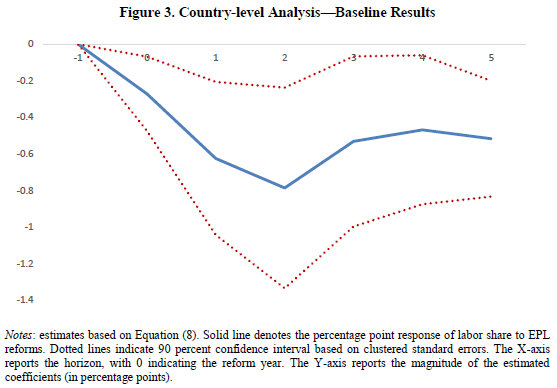
A new IMF working paper by Gabriele Ciminelli, Romain Duval, and Davide Furceri investigates “the impact of job protection deregulation in a sample of 26 advanced economies over the period 1970-2015, using a newly constructed dataset of major reforms to employment protection legislation for regular contracts” and finds “a statistically significant, economically large and robust negative effect of deregulation on the labor share. In particular, illustrative back-of-the-envelope calculations suggest that job protection deregulation may have contributed about 15 percent to the average labor share decline in advanced economies.
Posted by at 10:02 AM
Labels: Inclusive Growth
Housing View – August 17, 2018
On cross-country:
- Our cities house-price index suggests the property market is slowing – Economist
- Global House Price Index – Economist
- Planning rules are driving the global housing crisis – Financial Times
- Opinion today: Demented by the housing crisis: Simply comparing the number of households to dwellings gives a foolishly misleading idea – Financial Times
On the US:
- Our Shrinking Supply of Low-Cost Rental Units – Joint Center for Housing Studies
- Who Owns a Home in America, in 12 Charts – Citylab
- Does Homeownership Influence Political Behavior? Evidence from Administrative Data – Stanford University
- The effects of housing supply restrictions on partisan geography – Political Geography
- Redfin doubling down on direct home buying, plans expansion of Redfin Now – HousingWire
- Housing market has hit a ‘significant slowdown’ in recent weeks, Redfin CEO says – MarketWatch
- New housing construction doesn’t fuel SF evictions, claims report – Curbed
- Hosing Homebuyers: Why Cities Should Not Pay For Water and Wastewater Infrastructure with Development Charges – D. Howe Institute
- Seattle’s Socialist City Council Member Thinks Housing Is a Human Right—Unless it Comes at the Expense of Music Venues – Reason
- Highest Share of Homeowners Likely to Move in Q3 2018 in Chicago, DC, Orlando, Tampa, Atlanta – ATTOM
On other countries:
- [China] China’s new home price growth hits two-year high as small cities boom – Reuters
- [Germany] Creating Permanent Housing Affordability: Lessons From German Cooperative Housing Models – Urban Institute
- [New Zealand] New Zealand bans sales of homes to foreigners – BBC
- [Singapore] Singapore Home Prices Won’t Pop Without More Migrants – Bloomberg

Photo by Aliis Sinisalu
On cross-country:
- Our cities house-price index suggests the property market is slowing – Economist
- Global House Price Index – Economist
- Planning rules are driving the global housing crisis – Financial Times
- Opinion today: Demented by the housing crisis: Simply comparing the number of households to dwellings gives a foolishly misleading idea – Financial Times
On the US:
- Our Shrinking Supply of Low-Cost Rental Units – Joint Center for Housing Studies
- Who Owns a Home in America,
Posted by at 5:00 AM
Labels: Global Housing Watch
Tuesday, August 14, 2018
Inequality in the Middle East
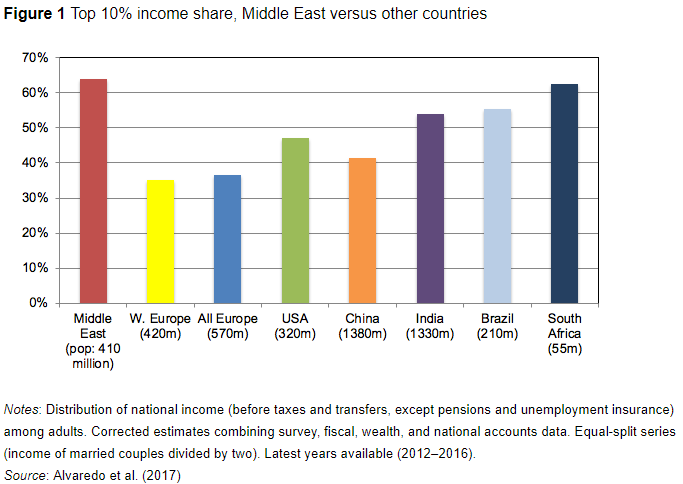
A new VOX post “uses new ‘distributional national accounts’ data to show that the Middle East is in fact the most unequal region in the world, with both enormous inequality between countries and large inequality within countries. The results emphasise the need to develop mechanisms of regional redistribution and to increase transparency on income and wealth data.”
“According to our benchmark estimates, the share of total income accruing to the top 10% of income earners is about 64% in the Middle East, which compares with 37% in Western Europe, 47% in the US, 55% in Brazil, and 62% in South Africa – the two latter countries being often characterised as the most unequal in the world (see Figure 1).”
Continue reading here.
A new VOX post “uses new ‘distributional national accounts’ data to show that the Middle East is in fact the most unequal region in the world, with both enormous inequality between countries and large inequality within countries. The results emphasise the need to develop mechanisms of regional redistribution and to increase transparency on income and wealth data.”
“According to our benchmark estimates, the share of total income accruing to the top 10% of income earners is about 64% in the Middle East,
Posted by at 9:52 AM
Labels: Inclusive Growth
The Global Liveability Index 2018
From the EIU report:
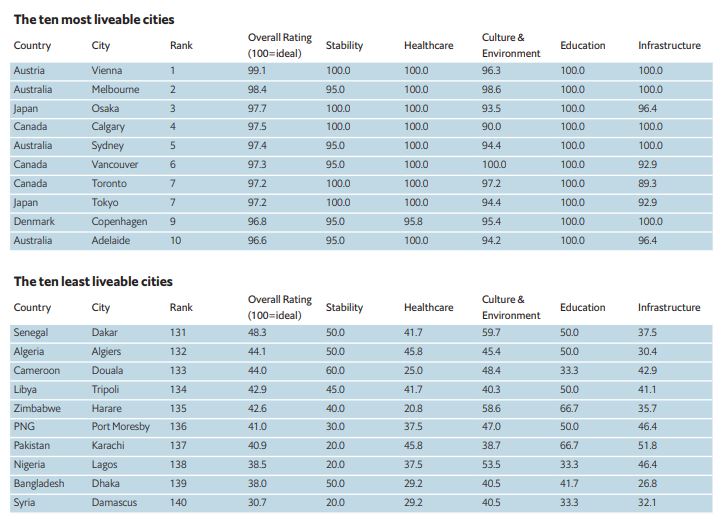
“The results of the Global Liveability Index 2018 reveal that Vienna has displaced Melbourne as the world’s most liveable city. This ends a record seven consecutive years at the head of the survey for the Australian city.
This year’s Index also finds an improvement in the scores of the top-ranked cities, reflecting improvements in safety and stability across most regions. Other key findings include:
- Canadian cities outperform cities in the United States, with three Canadian cities making this year’s top ten
- Manchester, Paris and Copenhagen have seen the biggest ranking improvements among western European cities over the past year
- Osaka and Tokyo have climbed up the ranking to enter to top 10 for the first time”
From the EIU report:
“The results of the Global Liveability Index 2018 reveal that Vienna has displaced Melbourne as the world’s most liveable city. This ends a record seven consecutive years at the head of the survey for the Australian city.
This year’s Index also finds an improvement in the scores of the top-ranked cities, reflecting improvements in safety and stability across most regions. Other key findings include:
- Canadian cities outperform cities in the United States,
Posted by at 9:36 AM
Labels: Global Housing Watch
Subscribe to: Posts