



Friday, July 6, 2018
Climate Change and NYU Volatility Institute
From Francis Diebold’s Blog:
“There is little doubt that climate change — tracking, assessment, and hopefully its eventual mitigation — is the burning issue of our times. Perhaps surprisingly, time-series econometric methods have much to offer for weather and climatological modeling (e.g., here), and several econometric groups in the UK, Denmark, and elsewhere have been pushing the agenda forward.
Now the NYU Volatility Institute is firmly on board. A couple months ago I was at their most recent annual conference, “A Financial Approach to Climate Risk”, but it somehow fell through the proverbial (blogging) cracks. The program is here, with links to many papers, slides, and videos. Two highlights, among many, were the presentations by Jim Stock (insights on the climate debate gleaned from econometric tools, slides here) and Bob Litterman (an asset-pricing perspective on the social cost of climate change, paper here). A fine initiative!”
From Francis Diebold’s Blog:
“There is little doubt that climate change — tracking, assessment, and hopefully its eventual mitigation — is the burning issue of our times. Perhaps surprisingly, time-series econometric methods have much to offer for weather and climatological modeling (e.g., here), and several econometric groups in the UK, Denmark, and elsewhere have been pushing the agenda forward.
Now the NYU Volatility Institute is firmly on board.
Posted by at 5:32 PM
Labels: Energy & Climate Change, Forecasting Forum
Bank Competition, Risk Taking, and their Consequences: Evidence from the U.S. Mortgage and Labor Markets
From a new IMF working paper:
“The risk shifting incentive identified by Jensen and Meckling (1976) can induce excessive
risk taking by banks in a competitive environment (Hellmann, Murdock, and Stiglitz (2000)).
This paper tests this risk shifting hypothesis of competition in the U.S. mortgage market
between 2000 and 2005. Our study exploits a natural exogenous variation of local house
price volatility in the cross section of U.S. cities and counties, one of the most important
sources of risk for mortgage returns. This paper finds that banks in high-competition markets
lowered their lending standards (e.g., raising the loan-to-income ratio and acceptance rate) in anticipation of high house price volatility while those in low-competition markets did not, an indication consistent with the risk shifting hypothesis.This paper also examines the real economic consequences of this risk taking pattern through
the credit supply channel. In particular, it studies the change in local employment in
non-financail sectors at the beginning of the Great Recession. We find that between 2007 and
2009 non-financial sector employment in high competition markets lost 1.5 percent for one
standard deviation increase in local house price volatility, while this relationship was
insignificant for low-competition markets. This exercise identifies a credit-supply channel, in
addition to the demand channel shown in Mian and Sufi (2014), that contributed to the rise in non-financial sector unemployment during the Great Recession.The analysis in this study shows the importance of banks’ risk taking incentive due to
competition prior to the recent crisis. It helps deepen the understanding of why the financial
sector had accumulated so much mortgage risk despite that an reverting house price would
lead to massive mortgage defaults (e.g., Palmer (2015)). When studying the impact on the
real economy such as non-financial sector employment, this risk taking pattern can also be
used to identify the credit supply channel of bank lending. This analysis offers a possible
strategy to disentangle the supply and demand effects of bank lending on real economic
activities.”
From a new IMF working paper:
“The risk shifting incentive identified by Jensen and Meckling (1976) can induce excessive
risk taking by banks in a competitive environment (Hellmann, Murdock, and Stiglitz (2000)).
This paper tests this risk shifting hypothesis of competition in the U.S. mortgage market
between 2000 and 2005. Our study exploits a natural exogenous variation of local house
price volatility in the cross section of U.S.
Posted by at 5:04 PM
Labels: Global Housing Watch
Housing View – July 6, 2018
On cross-country:
- Global cities record weakest [house] price growth since 2015 – Knight Frank
- Top employers are helping with city housing – Raconteur
- Airbnb’s newest weapon against regulation: The Real Estate Industry – Wired
On the US:
- Are Affordability Perceptions Reducing Household Mobility and Exacerbating the Housing Shortage? – Fannie Mae
- Why does cost of living vary so much? Housing, housing, housing – Federal Reserve Bank of St. Louis
- Why is it so difficult to live where you work? Housing costs and homeownership in economic centers – Federal Reserve Bank of St. Louis
- What Will It Cost to Fix New York’s Public Housing? – New York Times
- San Francisco Is So Expensive, You Can Make Six Figures and Still Be ‘Low Income’ – New York Times
On other countries:
- [Australia] The Outlook for the Housing Market – Reserve Bank of Australia
- [Canada] Pricey Vancouver Housing Market Weakens With Buyers on Sidelines – Bloomberg
- [Germany] Berlin Aims to Cut Its Residential Real-Estate Boom Down to Size – Wall Street Journal
- [Hong Kong] Don’t Expect Hong Kong’s Vacant-Home Tax to Cool Prices – Bloomberg
- [Ireland] Irish lenders told to raise capital buffers – Financial Times
- [Singapore] Singapore Property Curbs Are a Mallet, Not a Hammer – Bloomberg
- [Spain] Housing In Spain: An Unbalanced Market, But Not A Bubble – The Corner
- [United Kingdom] Policy Exchange: housing speech – UK.Gov
- [United Kingdom] UK housing market stuck in doldrums as prices stagnate – Financial Times

Photo by Aliis Sinisalu
On cross-country:
- Global cities record weakest [house] price growth since 2015 – Knight Frank
- Top employers are helping with city housing – Raconteur
- Airbnb’s newest weapon against regulation: The Real Estate Industry – Wired
On the US:
- Are Affordability Perceptions Reducing Household Mobility and Exacerbating the Housing Shortage? – Fannie Mae
- Why does cost of living vary so much?
Posted by at 4:56 PM
Labels: Global Housing Watch
Thursday, July 5, 2018
House Prices in Mongolia
The IMF’s latest report on Mongolia says that:
“(…) …and housing prices stabilized after years of deflation, in line with stronger economic activity and household lending.”
The IMF’s latest report on Mongolia says that:
“(…) …and housing prices stabilized after years of deflation, in line with stronger economic activity and household lending.”

Posted by at 4:07 PM
Labels: Global Housing Watch
Optimal inflation and the identification of the Phillips curve
From a new VOX post by Michael McLeay and Silvana Tenreyro:
“We have long known that the empirical Phillips curve may vary with monetary policy (Lucas 1976). One common explanation for the Great Inflation of the 1970s is that policymakers mistakenly tried to exploit the prevailing reduced-form Phillips curve, and in so doing caused it to disappear (e.g. Sargent et al. 2006). In contrast, our point is that a disappearing Phillips curve is also a natural consequence of good monetary policy. If the true model of the economy involves a Phillips curve relationship, monetary policymakers aware of its existence should ensure it remains elusive in the data.”
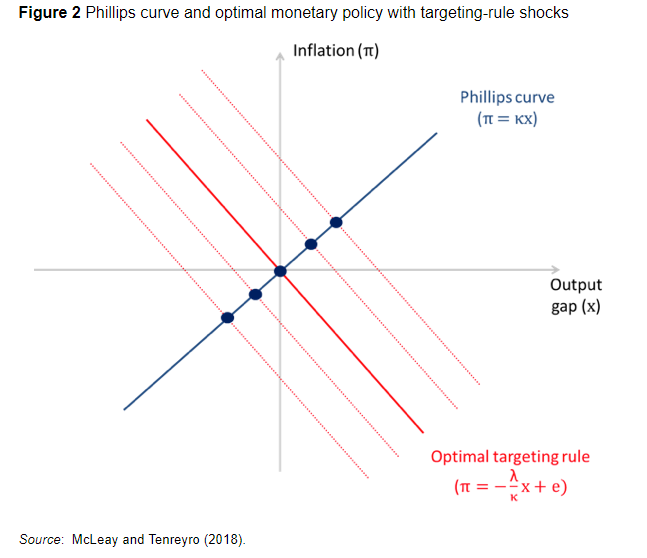
From a new VOX post by Michael McLeay and Silvana Tenreyro:
“We have long known that the empirical Phillips curve may vary with monetary policy (Lucas 1976). One common explanation for the Great Inflation of the 1970s is that policymakers mistakenly tried to exploit the prevailing reduced-form Phillips curve, and in so doing caused it to disappear (e.g. Sargent et al. 2006). In contrast, our point is that a disappearing Phillips curve is also a natural consequence of good monetary policy.
Posted by at 1:13 PM
Labels: Macro Demystified
Subscribe to: Posts