



Friday, December 7, 2018
Overfitting in Judgment-based Economic Forecasts: The Case of IMF Growth Projections
From a new IMF working paper:
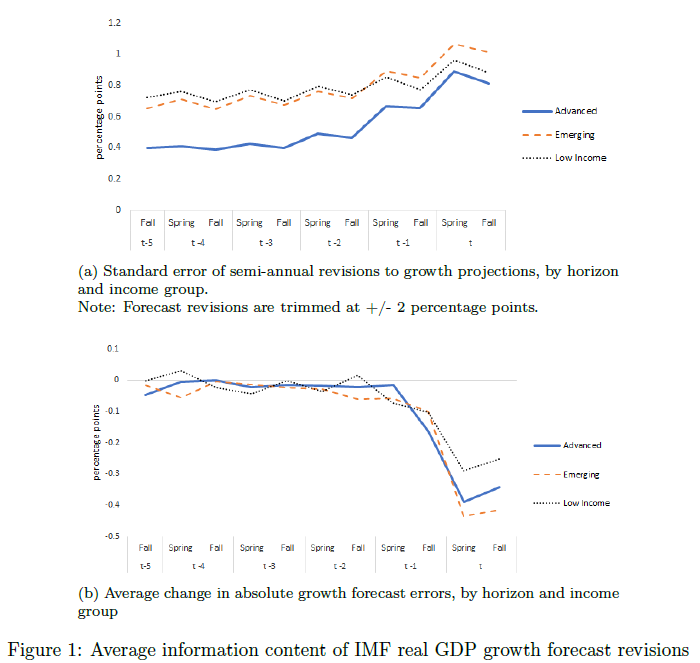
“I regress real GDP growth rates on the IMF’s growth forecasts and find that IMF forecasts behave similarly to those generated by overfitted models, placing too much weight on observable predictors and underestimating the forces of mean reversion. I identify several such variables that explain forecasts well but are not predictors of actual growth. I show that, at long horizons, IMF forecasts are little better than a forecasting rule that uses no information other than the historical global sample average growth rate (i.e., a constant). Given the large noise component in forecasts, particularly at longer horizons, the paper calls into question the usefulness of judgment-based medium and long-run forecasts for policy analysis, including for debt sustainability assessments, and points to statistical methods to improve forecast accuracy by taking into account the risk of overfitting.”
From a new IMF working paper:
“I regress real GDP growth rates on the IMF’s growth forecasts and find that IMF forecasts behave similarly to those generated by overfitted models, placing too much weight on observable predictors and underestimating the forces of mean reversion. I identify several such variables that explain forecasts well but are not predictors of actual growth. I show that, at long horizons, IMF forecasts are little better than a forecasting rule that uses no information other than the historical global sample average growth rate (i.e.,
Posted by at 5:48 PM
Labels: Forecasting Forum
You are needed but not your skills: Challenges to manufacturing workers in the wake of globalisation
From a new VOX post:
“The impact of trade shocks on labour market shifts is usually studied in the context of re-training and social welfare frictions. Using evidence from Denmark, this column shows how workers can experience long-run reductions in earnings no matter how easy it is to change sector. A sudden and obligatory shift toward a new sector may, by its nature, generate some worker dissatisfaction.”
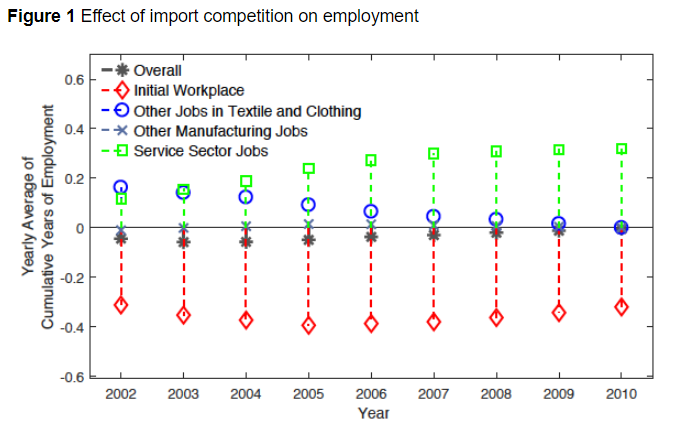
“Figure 1 shows the import competition-induced sectoral change. Each marker shows the causal effect of import competition in the corresponding year on employment at the respective job/sector indicated in the legend, as captured by the difference-in-difference specification with individual fixed effects.”
“The challenges faced by manufacturing workers, who once exemplified the middle class, have important implications for the whole society. My findings show that adjustment problems do not end once manufacturing workers find full-time jobs in the growing service sector. And the Danish labour market institutions, despite being successful in keeping the workers within the labour market and ensuring fast inter-sectoral movement as well as largely covering the earnings losses of workers with transfers, were not fully successful in relieving the pain of the people whose human capital is not relevant for service sector jobs. In the end one feels better when earning a living rather than getting a transfer, and when enjoying and taking pride in work rather than changing from one job to another due to skill mis-match. Thus, it may be unavoidable that a sudden and obligatory shift toward a new sector demanding new skills leads to dissatisfaction. Although, the social system in Denmark may be a factor in keeping the dissatisfaction within limits and preventing unwanted political consequences.”
From a new VOX post:
“The impact of trade shocks on labour market shifts is usually studied in the context of re-training and social welfare frictions. Using evidence from Denmark, this column shows how workers can experience long-run reductions in earnings no matter how easy it is to change sector. A sudden and obligatory shift toward a new sector may, by its nature, generate some worker dissatisfaction.”
“Figure 1 shows the import competition-induced sectoral change.
Posted by at 5:42 PM
Labels: Inclusive Growth
Crowdsourcing Economic Forecasts
From a new working paper:
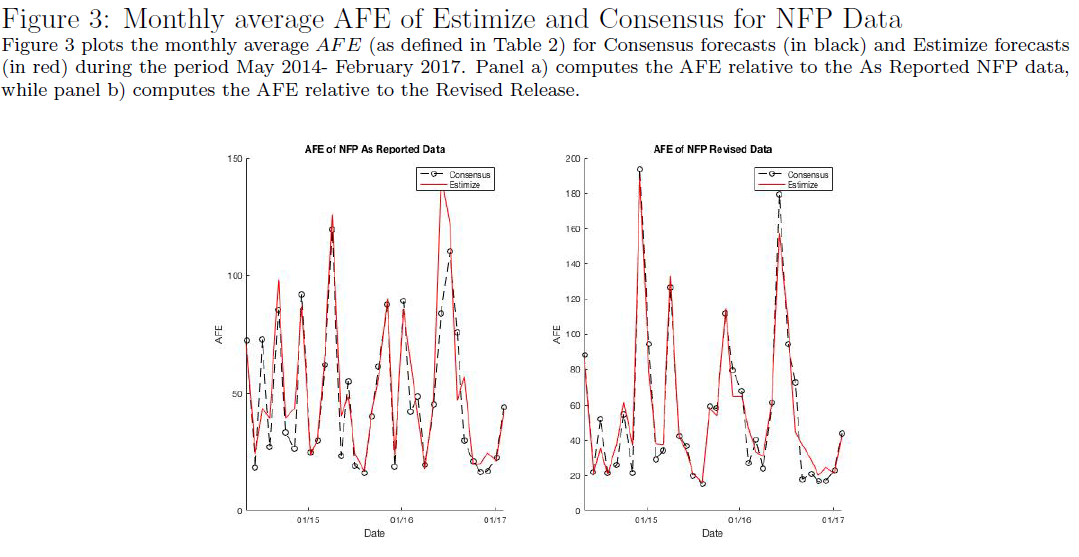
“Economic forecasts are often disseminated via a survey of professionals (i.e. “Consensus”). In this paper we compare and contrast the Consensus with a crowdsourced alternative wherein anyone may submit a forecast. We focus on U.S. Nonfarm Payrolls and find that, on average, Consensus is more accurate, but the best crowdsourced forecasters are superior to the best Consensus forecasters. We also find that information plays a key role. When the Consensus is uncertain and herds together, the crowdsourced forecasts appear to be more. Our findings provide evidence that crowdsourcing might provide a valuable supplement to traditional macroeconomic forecasts.”
From a new working paper:
“Economic forecasts are often disseminated via a survey of professionals (i.e. “Consensus”). In this paper we compare and contrast the Consensus with a crowdsourced alternative wherein anyone may submit a forecast. We focus on U.S. Nonfarm Payrolls and find that, on average, Consensus is more accurate, but the best crowdsourced forecasters are superior to the best Consensus forecasters. We also find that information plays a key role.
Posted by at 5:39 PM
Labels: Forecasting Forum
Housing View – December 7, 2018
On cross-country:
- The state of the housing market in the euro area – European Central Bank
- We let kids design our city — here’s what happened | Mara Mintzer – TEDxMileHigh
- Inflation measures should add house prices to prevent bubbles – Financial Times
- Q3 2018: World’s housing markets poised to slow, but strong house price rises continue in Europe and parts of Asia – Global Property Guide
- Blueprint for Better Housing: New Urban Agenda – The American Institute of Architects
On the US:
- The housing market is having a wobble – Economist
- Non-bank firms are now big players in America’s mortgage market – Economist
- How Many Young Homebuyers Get Support from Their Parents and How Much of a Difference Does It Make? – Harvard Joint Center for Housing Studies
- Amazon’s Northern Virginia headquarters could exacerbate existing economic disparities – Brookings
- Are Housing Price Cycles Asymmetric? Evidence from the US States and Metropolitan Areas – IDEAS
- The Major Challenge of Inadequate U.S. Housing Supply – FreddieMac
- Should California subsidize housing with ‘rent stamps’? – San Francisco Chronicle
On other countries:
- [France] The Costs of Agglomeration: House and Land Prices in French Cities – Review of Economic Studies
- [Germany] Germany’s house price rises continue – Global Property Guide
- [Hong Kong] Hong Kong’s red-hot property market – Global Property Guide
- [Ireland] Review of residential mortgage lending requirements – Central Bank of Ireland

Photo by Aliis Sinisalu
On cross-country:
- The state of the housing market in the euro area – European Central Bank
- We let kids design our city — here’s what happened | Mara Mintzer – TEDxMileHigh
- Inflation measures should add house prices to prevent bubbles – Financial Times
- Q3 2018: World’s housing markets poised to slow, but strong house price rises continue in Europe and parts of Asia – Global Property Guide
- Blueprint for Better Housing: New Urban Agenda – The American Institute of Architects
Posted by at 5:00 AM
Labels: Global Housing Watch
Thursday, December 6, 2018
The U.S. Just Became a Net Oil Exporter for the First Time in 75 Years
From Bloomberg:
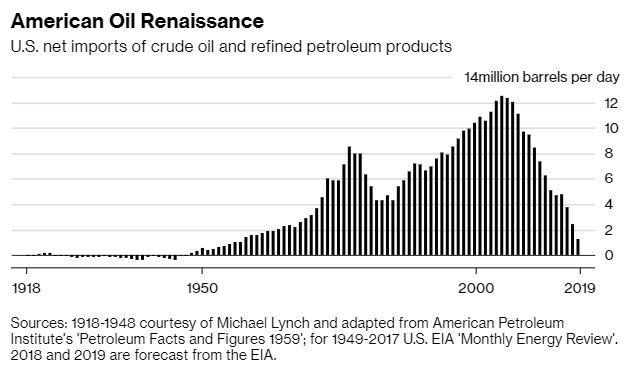
“America turned into a net oil exporter last week, breaking 75 years of continued dependence on foreign oil and marking a pivotal — even if likely brief — moment toward what U.S. President Donald Trump has branded as “energy independence.”
The shift to net exports is the dramatic result of an unprecedented boom in American oil production, with thousands of wells pumping from the Permian region of Texas and New Mexico to the Bakken in North Dakota to the Marcellus in Pennsylvania.
While the country has been heading in that direction for years, this week’s dramatic shift came as data showed a sharp drop in imports and a jump in exports to a record high. Given the volatility in weekly data, the U.S. will likely remain a small net importer most of the time.
“We are becoming the dominant energy power in the world,” said Michael Lynch, president of Strategic Energy & Economic Research. “But, because the change is gradual over time, I don’t think it’s going to cause a huge revolution, but you do have to think that OPEC is going to have to take that into account when they think about cutting.”
The shale revolution has transformed oil wildcatters into billionaires and the U.S. into the world’s largest petroleum producer, surpassing Russia and Saudi Arabia. The power of OPEC has been diminished, undercutting one of the major geopolitical forces of the last half century. The cartel and its allies are meeting in Vienna this week, trying to make a tough choice to cut output and support prices, risking the loss of more market share to the U.S.”
Continue reading here.
From Bloomberg:
“America turned into a net oil exporter last week, breaking 75 years of continued dependence on foreign oil and marking a pivotal — even if likely brief — moment toward what U.S. President Donald Trump has branded as “energy independence.”
The shift to net exports is the dramatic result of an unprecedented boom in American oil production, with thousands of wells pumping from the Permian region of Texas and New Mexico to the Bakken in North Dakota to the Marcellus in Pennsylvania.
Posted by at 4:25 PM
Labels: Energy & Climate Change
Subscribe to: Posts