



Tuesday, December 11, 2018
100 Million and Counting: A Portrait of Economic Insecurity in the United States
From a new PolicyLink report:
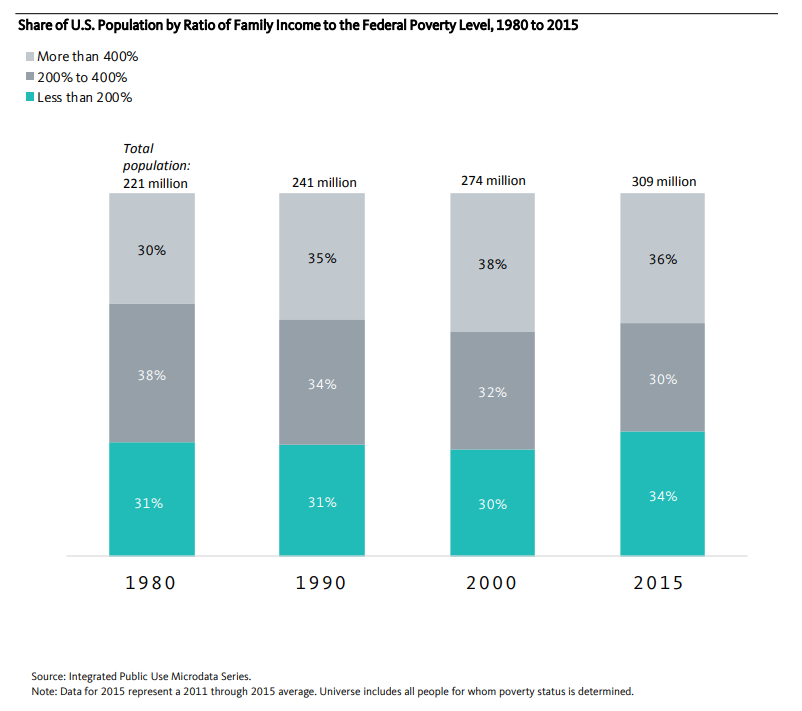
“Economic insecurity is both widespread and uneven, reflecting not only the toxic polarization of wealth and income in this nation, but also the persistence of racial inequities. Structural racism and systemic barriers have long excluded people of color from American prosperity, and while economic insecurity plagues people of all races and ethnicities, people of color are disproportionately burdened by economic insecurity. Given the rapid demographic changes in the United States, if economic conditions do not improve among people of color, a larger and larger share of the population will struggle to make ends meet.
A mounting body of research suggests that such inequality and exclusion lead to declining economic growth. The inverse is also true: by developing high-impact, targeted solutions that dismantle barriers and connect economically insecure people and households to resources and opportunities, we can lay the foundation for an economy that works for everyone. Now is the time for bold policy and systems changes that deliver on the promise of inclusive prosperity.”
From a new PolicyLink report:
“Economic insecurity is both widespread and uneven, reflecting not only the toxic polarization of wealth and income in this nation, but also the persistence of racial inequities. Structural racism and systemic barriers have long excluded people of color from American prosperity, and while economic insecurity plagues people of all races and ethnicities, people of color are disproportionately burdened by economic insecurity. Given the rapid demographic changes in the United States,
Posted by at 8:43 PM
Labels: Inclusive Growth
Universal Basic Income: Debate and Impact Assessment
A new IMF working paper discusses “the definition and modelling of a universal basic income (UBI). After clarifying the debate about what a UBI is and presenting the arguments in favor and against, an analytical approach for its assessment is proposed. The adoption of a UBI as a policy tool is discussed with regard to the policy objectives (shaped by social preferences) it is designed to achieve. Key design dimensions to be considered include: coverage, generosity of the program, overall progressivity of the policy, and its financing.”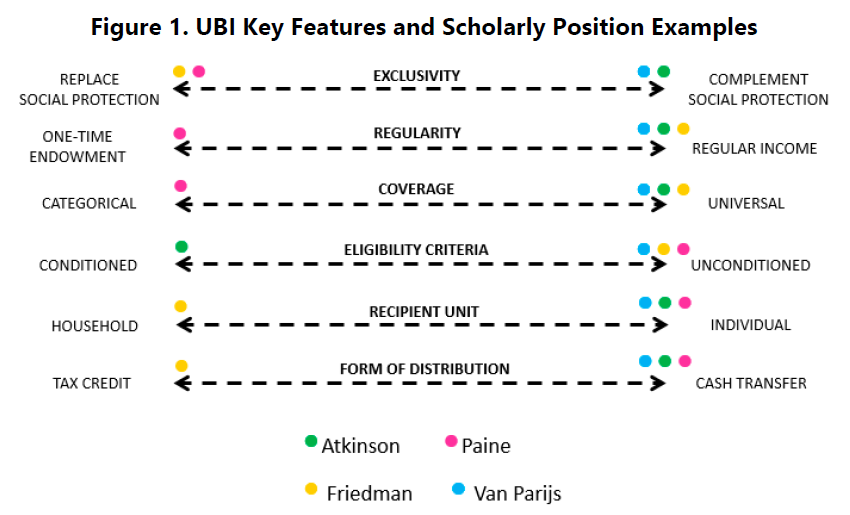
“The joint empirical analysis of the relative redistributive performance of a UBI, existing social
safety nets and available financing options is powerful in highlighting the tradeoffs faced by
policymakers when assessing social spending programs along key dimensions:
- coverage at the bottom of the income distribution vs. leakages to richer households,
- generosity of transfers vs. incentives and economic distortions,
- fiscal cost vs. alternative use of scarce fiscal resources.
The fourth aspect that weighs heavily in shaping policy choices is how to reconcile objectives and
implementation challenges.
The saliency of each of these tradeoffs depends on each country specific circumstances, in
particular on its position in the coverage/generosity/progressivity space (Figure 2), its capacity to
raise resources in a progressive and sustainable manner and the ability to roll out a (more or less)
complex program. Social preferences, together with constraints, determine how these tradeoffs
are called.
The relevance of these tradeoffs and the design of a transfer program has implications that go beyond the performance of the specific scheme. They are related to and impact how a country overall benefit-tax system affects individual behaviors,27 bearing far-reaching implications for labor market, consumption and investment decisions that will in turn impact back the fiscal sustainability of the tax-and-transfer system. As mentioned, inefficiencies (e.g., disincentives to
work) are relevant issues also under existing safety nets—that are rarely universal and unconditional—and their current financing mechanism. For this reason, a broader discussion is needed, that would move beyond just looking at UBI in isolation to assessing whether a policy package encompassing a UBI would increase or decrease the distortionary impact of government policies and or improve/reduce the performance of a safety net. As important is the thorough assessment of implementation capacity both for targeted and universal type of programs. In short, efficiency and equity impact of a UBI cannot be gauged in isolation.
Beyond the discussion presented in this paper and short-term considerations, other issues also point to the usefulness of broadening the horizon when discussing universal programs and looking for ways to make social protection systems adequate for facing future challenges. For example, in an economic environment where job security decreases and income volatility increases, expanding available insurance mechanisms for those who are out of work may become an important policy objective; similarly, where there is a need to generate public support while protecting vulnerable households from undesired side effects of structural reforms that impact large segments of the population. protecting vulnerable households from undesired side effects of structural reforms that impact large segments of the population.”
A new IMF working paper discusses “the definition and modelling of a universal basic income (UBI). After clarifying the debate about what a UBI is and presenting the arguments in favor and against, an analytical approach for its assessment is proposed. The adoption of a UBI as a policy tool is discussed with regard to the policy objectives (shaped by social preferences) it is designed to achieve. Key design dimensions to be considered include: coverage,
Posted by at 8:38 PM
Labels: Inclusive Growth
Media Sentiment and International Asset Prices
From a new IMF working paper by Samuel P. Fraiberger, ; Do Lee, Damien Puy, and Romain Ranciere:
“We assess the impact of media sentiment on international equity prices using more than 4.5 million Reuters articles published across the globe between 1991 and 2015. News sentiment robustly predicts daily returns in both advanced and emerging markets, even after controlling for known determinants of stock prices. But not all news-sentiment is alike. A local (country-specific) increase in news optimism (pessimism) predicts a small and transitory increase (decrease) in local returns. By contrast, changes in global news sentiment have a larger impact on equity returns around the world, which does not reverse in the short run. We also find evidence that news sentiment affects mainly foreign – rather than local – investors: although local news optimism attracts international equity flows for a few days, global news optimism generates a permanent foreign equity inflow. Our results confirm the value of media content in capturing investor sentiment.”
From a new IMF working paper by Samuel P. Fraiberger, ; Do Lee, Damien Puy, and Romain Ranciere:
“We assess the impact of media sentiment on international equity prices using more than 4.5 million Reuters articles published across the globe between 1991 and 2015. News sentiment robustly predicts daily returns in both advanced and emerging markets, even after controlling for known determinants of stock prices. But not all news-sentiment is alike.
Posted by at 10:01 AM
Labels: Macro Demystified
Drivers of commodity price booms and busts in the long run
From a VoxEU post by David Jacks, and Martin Stuermer:
“There is a lack of consensus on the importance of various drivers of long-run commodity prices. This column analyses a new dataset of prices and production for 15 commodities, including metals, agricultural goods, and soft commodities, between 1870 and 2015. Demand shocks due to rapid industrialisation and urbanisation have driven a substantial amount of variation in commodity price booms. While demand shocks have gained importance over time, commodity supply shocks have become less relevant.
Understanding the drivers of commodity price booms and busts is of first-order importance for the global economy. A significant portion of real income and welfare in both commodity-consuming and commodity-producing nations hinges upon these prices (Bernanke 2006). They vitally affect the distribution of income within particular nations as the ownership of natural resources varies widely, potentially setting the stage for civil conflict (Dube and Vargas 2013). And the long-run drivers of commodity prices have serious implications for the formation and persistence of growth-detracting and growth-enhancing institutions (van der Ploeg 2011).
But for all this, outside spectators – whether they are academics, the general public, the investment community, or policymakers – remain divided in assigning the importance of various forces in the determination of commodity price booms and busts. Understanding which shocks drive these events and how long they persist is important for the conduct of macroeconomic policy, formulating environmental and resource policies, and, perhaps most importantly, investment decisions in the resource sectors of the global economy.
While the literature on modelling oil markets has examined a handful of booms and busts since the early 1970s (e.g. Kilian 2009, Kilian and Murphy 2014), our analysis of commodity markets is based on a new dataset of real prices and output for 15 grains, metals, and soft commodities from 1870 to 2015 (Jacks and Stuermer 2018). Unanticipated changes in world demand affect all commodity prices simultaneously. Throughout history, aggregate commodity demand shocks due to rapid industrialisation and urbanisation have driven commodity price booms. China’s recent effect on commodity markets is, thus, not a new phenomenon.
Commodities in the long run and identifying price shocks
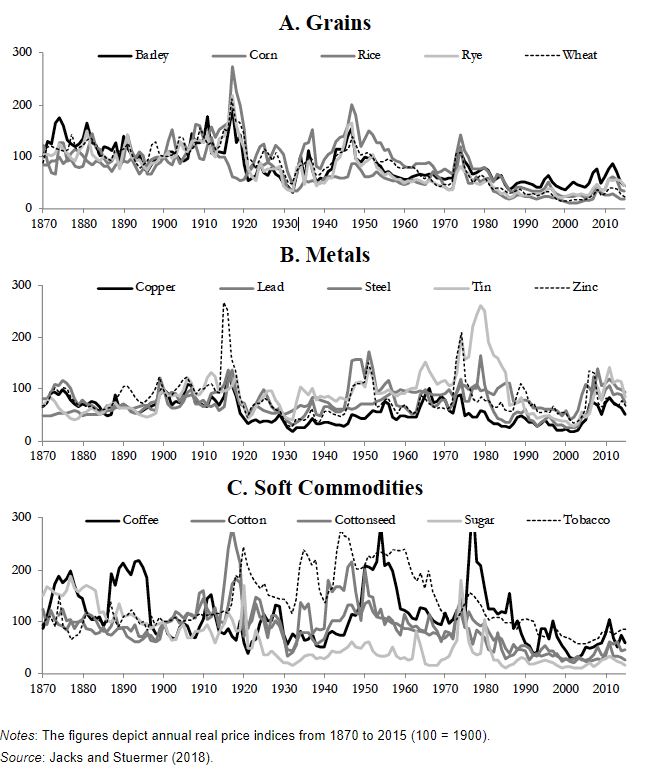
A new dataset encompassing global output and real prices for 15 commodities – barley, coffee, copper, corn, cotton, cottonseed, lead, rice, rye, steel, sugar, tin, tobacco, wheat, and zinc – has been assembled covering the past 145 years (see Figure 1) and representing in excess of $2.5 trillion in annual gross value of production in 2015. The commodity markets selected exhibit characteristics that make such long-run analysis feasible: a high degree of product homogeneity, long-standing evidence of an integrated world market, and no indication of sudden changes in how the commodity is used. Thus, they have desirable characteristics that commodities such as crude oil or iron ore have only gained relatively recently.
Figure 1 Booms and busts are not new phenomena
Continue reading here.
From a VoxEU post by David Jacks, and Martin Stuermer:
“There is a lack of consensus on the importance of various drivers of long-run commodity prices. This column analyses a new dataset of prices and production for 15 commodities, including metals, agricultural goods, and soft commodities, between 1870 and 2015. Demand shocks due to rapid industrialisation and urbanisation have driven a substantial amount of variation in commodity price booms.
Posted by at 9:59 AM
Labels: Energy & Climate Change
Optimal Control of a Global Model of Climate Change with Adaptation and Mitigation
From a new IMF working paper by Manoj Atolia, Prakash Loungani, Helmut Maurer, and Willi Semmler:
“The Integrated Assessment Model (IAM) has extensively treated the adverse effects of climate change and the appropriate mitigation policy. We extend such a model to include optimal policies for mitigation, adaptation and infrastructure investment studying the dynamics of the transition to a low fossil-fuel economy. We focus on the adverse effects of increase in atmospheric CO2 concentration on households. Formally, the model gives rise to an optimal control problem of finite horizon consisting of a dynamic system with five-dimensional state vector consisting of stocks of private capital, green capital, public capital, stock of brown energy in the ground, and emissions. Given the numerous challenges to climate change policies the control vector is also five-dimensional. Our solutions are characterized by turnpike property and the optimal policy that accomplishes the objective of keeping the CO2 levels within bound is characterized by a significant proportion of investment in public capital going to mitigation in the initial periods. When initial levels of CO2 are high, adaptation efforts also start immediately, but during the initial period, they account for a smaller proportion of government’s public investment.”
From a new IMF working paper by Manoj Atolia, Prakash Loungani, Helmut Maurer, and Willi Semmler:
“The Integrated Assessment Model (IAM) has extensively treated the adverse effects of climate change and the appropriate mitigation policy. We extend such a model to include optimal policies for mitigation, adaptation and infrastructure investment studying the dynamics of the transition to a low fossil-fuel economy. We focus on the adverse effects of increase in atmospheric CO2 concentration on households.
Posted by at 9:55 AM
Labels: Energy & Climate Change
Subscribe to: Posts