



Wednesday, January 16, 2019
Housing Market in Finland
The IMF’s latest report on Finland says:
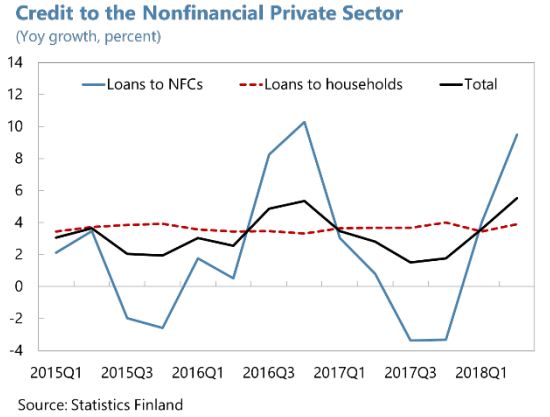
“Credit has expanded moderately overall, but housing corporation loans and consumer credit have been rising more rapidly. Total loan growth to the private nonfinancial sector has remained broadly constant at around 3½ percent for the past five years. Most lending to households has been in the form of secured lending for housing, which has grown around 4 percent. Corporate loan growth has rebounded strongly in the second quarter of the year after a sharp contraction in the second half of 2017. Two lending categories stand out:
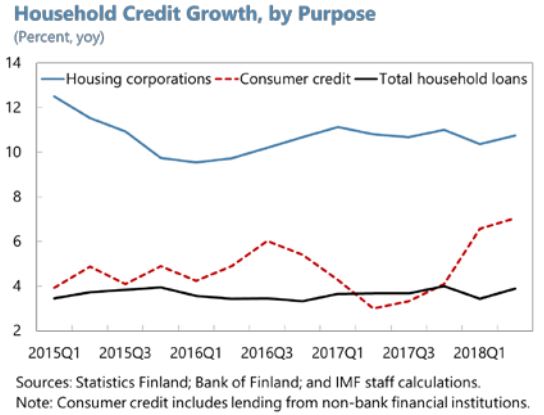
Loans to housing corporations have been expanding rapidly—above 10 percent—for many years. The drivers—expansion of the housing stock and renovation of rental properties—are
healthy. But the shareholders of housing corporations include homeowners, making these de facto indirect loans to households, and households might thereby be tempted to take on more debt than can easily be repaid.Consumer credit has been increasing steadily—above 7 percent y/y in the second quarter of 2018—and now accounts for 12 percent of aggregate household debt, driven by credit
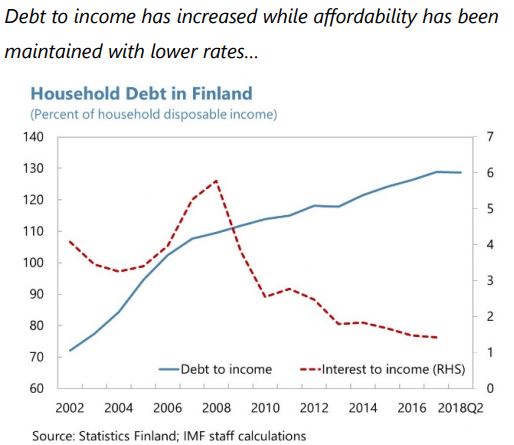
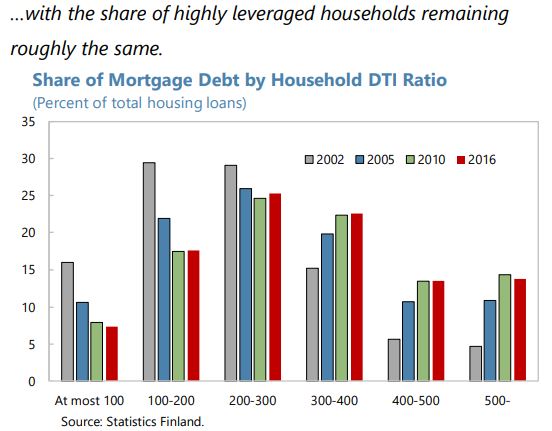
institutions easing lending standards and a rapid increase in non-bank lending. The expansion has been associated with an increase in payment defaults.Household debt has been increasing steadily, despite the increase in real disposable incomes. Saving rates are lower than peers, although some of the difference is attributable to Finland’s public pension system. Household debt remains lower than Nordic peers, but is expected to increase further. Highly-indebted households (i.e. those with debt greater than four times their income) accounted for over a quarter of borrowing in 2016; preliminary survey data for 2017 indicate that the typical new borrower for housing purchases is taking on leverage of 4½ times income. The share of floating rate loans in household lending is high, exacerbating households’ vulnerabilities to interest rate and/or income shocks, although this is mitigated by the prevalence of mortgages with annuity repayments.
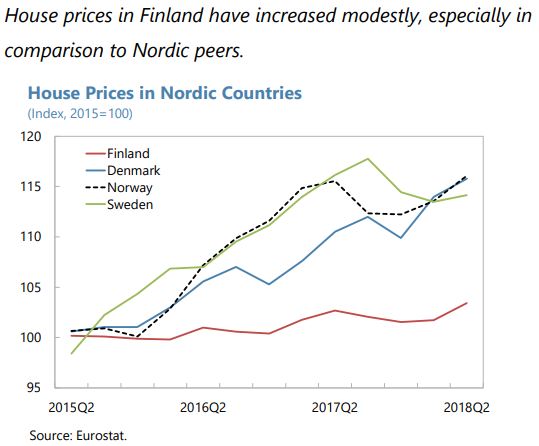
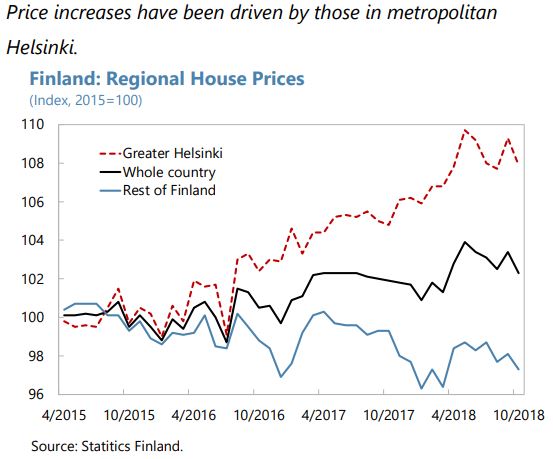
Residential real estate markets do not seem overheated overall, but demand still exceeds supply in major metropolitan areas, and commercial real estate may expose the economy to shocks. Housing starts and completions have been elevated, but price increases in greater Helsinki suggest demand still outstrips supply. Across the whole country, house price increases have been modest, especially in comparison to Nordic peers, with house price deflation in regions outside greater Helsinki. Price-to-income and price-to-rent ratios have not risen much during the recent economic recovery. Low and declining yields in commercial real estate suggest relatively high valuations.
The authorities have tightened credit policies. A floor of 15 percent on the average risk weight for housing loans took effect in January for institutions using internal risk-based (IRB) models. Effective July, the maximum loan-to-collateral (LTC) ratio for housing loans (excluding loans on first homes) was cut from 90 to 85 percent.
The recent tightening is appropriate, but policy could be more effective if the toolkit were modified. Although overall household debt and leverage are not high in comparison with other Nordic countries, there are some cohorts that are increasingly vulnerable to income and/or interest rate shocks—which, in view of the concentration of total lending in real estate, opens the financial system to risks.
The current cap on mortgage loans relative to collateral could usefully be replaced with a cap relative to the value of the property, as is common in other countries. And because the
underlying problem is more the level of debt than housing valuations, it would be useful for the authorities to have debt-based macroprudential tools (such as debt-to-income or debt-service to-income caps) at their disposal should leverage become more stretched. Applying such tools well depends on accurate information. Staff supports the recent Justice Ministry recommendation for the establishment of a “positive credit register”—i.e. a database that credit firms and the FINFSA could use to obtain real-time information about customers’ debt and income levels. A new challenge arises from non-bank lending, including online platforms such as peer-to-peer lending, which is not being recorded in credit statistics and registers.The growing reliance on consumer credit, especially that provided by non-banks and via digital platforms, raises additional concerns. Some of these outlets are not regulated and provide cross border financing. Attempts were made to circumvent legally-binding interest rate caps, raising the question of whether borrowers—especially those dealing with non-bank lenders—are sufficiently informed about the conditions of their loans. The authorities are amending the legislation on interest rate caps to close loopholes. Additional consumer protection measures are needed and require more data collection, especially on consumer lending provided through digital platforms. Tighter prudential requirements to demonstrate creditworthiness could also be considered.
Macroprudential authority tools should not be expected to solve underlying supply problems. The authorities have already implemented measures to expand housing supply in urban areas, including Helsinki. The government provides considerable support for social housing, which should make it easier to move across regions. But property taxation could be deterring mobility: recurrent property taxes collected by municipalities tend to be low, with some exceptions, while transaction tax rates are steeper at 4 percent.”

The IMF’s latest report on Finland says:
“Credit has expanded moderately overall, but housing corporation loans and consumer credit have been rising more rapidly. Total loan growth to the private nonfinancial sector has remained broadly constant at around 3½ percent for the past five years. Most lending to households has been in the form of secured lending for housing, which has grown around 4 percent. Corporate loan growth has rebounded strongly in the second quarter of the year after a sharp contraction in the second half of 2017.
Posted by at 10:56 AM
Labels: Global Housing Watch
Tuesday, January 15, 2019
The Key to Gentrification
From EconoSpeak:
“In the world of urban politics, there is probably no more potent populist rallying cry than the demand to halt gentrification. Activists have fought it on multiple fronts: zoning, development subsidies, permitting, rent control—every lever housing policies afford. But what if they’re mistaking cause for effect, hacking away at the visible manifestations of the problem while leaving the problem itself intact?
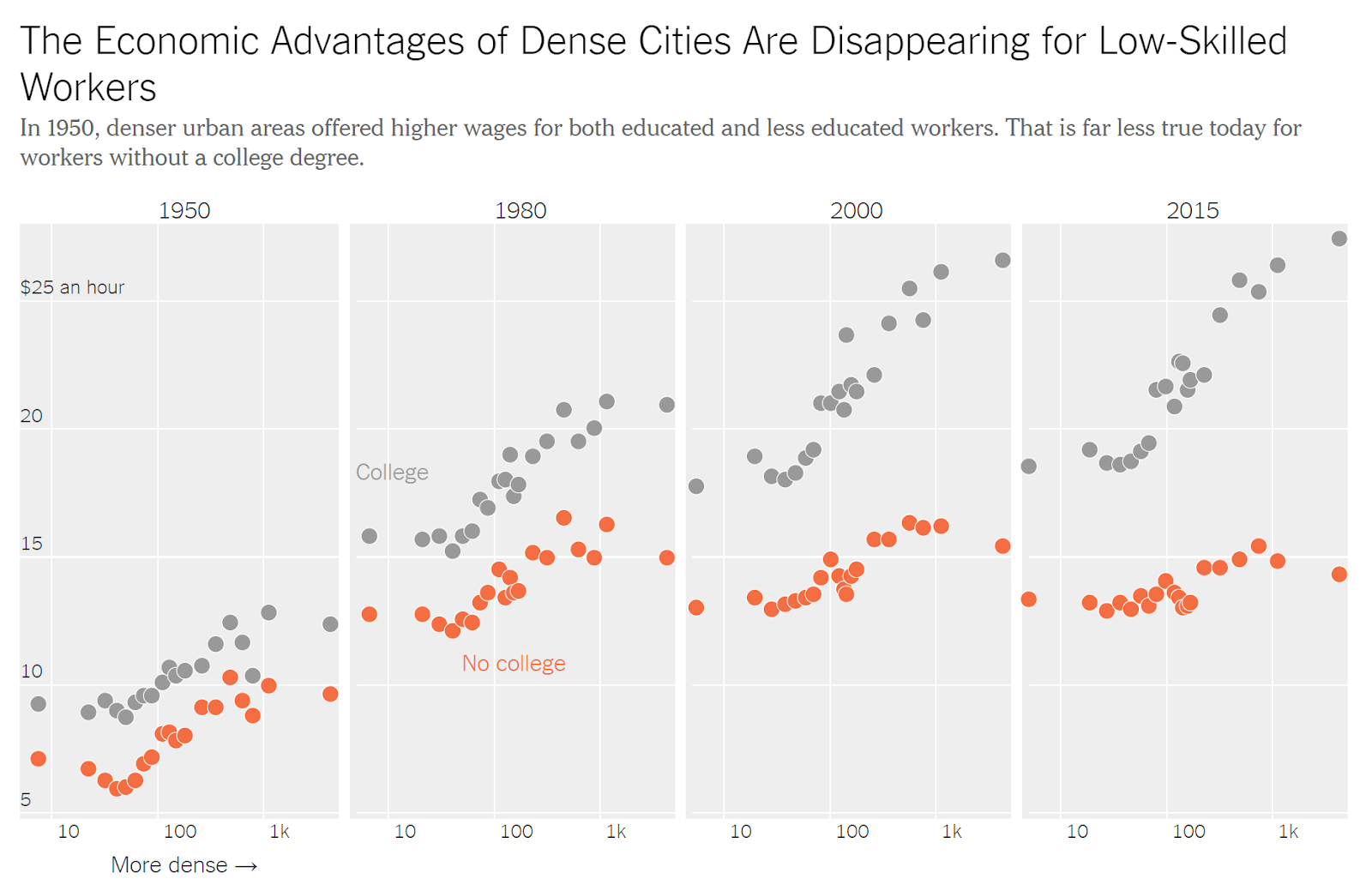
Pivot to an important article in today’s New York Times, reporting on recent research David Autor of MIT presented at the economics meetings in Atlanta earlier this month. It’s all summed up in this set of charts:
As you can see from the tiny print at the top, the data are being read horizontally within each chart, from less dense regions (rural areas) on the left to high density cities on the right. The question being asked in the article is, if you live in a rural area or a small town, how much benefit can you get from moving to a big city? In the early post-WWII period, the answer was “a lot” for both the majority holding only a high school diploma and the few with a college BA. By 2015 the situation had changed: it was still a good move for college grads but there was little to be gained by those with only a high school education—and probably even less when you factor in the increased cost of living. That’s an interesting story.
But there’s another way to read these charts, vertically, comparing wage gaps at any particular time and place between these two education-defined groups. In 1950 the gap was relatively small; in the densest cities the college crowd made about 30% more per hour than the high schoolers. By 2015 they made almost twice as much. And don’t forget that the rise of inequality is virtually fractal: similar gaps have opened up within the top 20%, and within the top 5%, 1% and .01%. The whole rightward tail of the distribution has elongated, pulling ever further from the median.”
Continue reading here.
From EconoSpeak:
“In the world of urban politics, there is probably no more potent populist rallying cry than the demand to halt gentrification. Activists have fought it on multiple fronts: zoning, development subsidies, permitting, rent control—every lever housing policies afford. But what if they’re mistaking cause for effect, hacking away at the visible manifestations of the problem while leaving the problem itself intact?
Pivot to an important article in today’s New York Times,
Posted by at 10:46 AM
Labels: Global Housing Watch, Inclusive Growth
Chart of the day…. or century?

Posted by at 10:36 AM
Labels: Macro Demystified
Friday, January 11, 2019
Housing View – January 11, 2019
On the US:
- Housing finance issues to watch in 2019 – Urban Institute
- Experts weigh in on housing reform at House hearing – Housing Wire
- The Price of Residential Land for Counties, ZIP codes, and Census Tracts in the United States – Federal Housing Finance Agency
- Leaving Households Behind: Institutional Investors and the U.S. Housing Recovery – Federal Reserve Bank of Philadelphia
- Real-estate agents say government shutdown is impacting the housing market – MarketWatch
- Chinese buyers expand their reach in the US housing market as the middle class gets in on the act – CNBC
- What actions can policymakers take to avert the brewing national housing crisis? – Washington Post
- 2018 Roundup: Our Most Popular Blogs of the Year – Harvard Joint Center for Housing Studies
- Appraising Home Purchase Appraisals – Federal Reserve Bank of Philadelphia
- California Housing Development Is A ‘Disaster Waiting To Happen’ – NPR
- Is Housing the Business Cycle, 2019? – Econbrowser
- Elizabeth Warren’s Housing Crisis Plan Hints at Reparations – Citylab
- Substance Use Disorder Treatment Centers and Property Values – NBER
- Affordable homes or investment assets? – Washington Post
- The American Dream Isn’t for Black Millennials – New York Times
- Rich Cities Created the Housing Shortage – Wall Street Journal
- Housing Confidence Down as More Americans Believe It’s a Bad Time to Buy a Home – Fannie Mae
- It’s a Wonderful Loan: A Short History of Building and Loan Associations – Federal Reserve Bank of Richmond
- See How Landlords Pack Section 8 Renters Into Poorer Neighborhoods – Citylab
- As Fewer Young Adults Wed, Married Couples’ Wealth Surpasses Others’ – Federal Reserve Bank of St. Louis
- America’s Housing Crisis Could Imperil Trump’s Presidency – Citylab
- Survey: First Home Nightmares – Porch
- US housing market uncertainty prompts Lennar to scrap guidance – Financial Times
On other countries:
- [Australia] Australia’s house price slide prompts worries about economy – Financial Times
- [Canada] What happened when Vancouver residents built new homes in their backyards – Financial Times
- [China] China house price gains no longer a certainty: central bank adviser – Reuters
- [China] Empty Homes and Protests: China’s Property Market Strains the World – New York Times
- [China] China warns cities to cut reliance on property, developers’ shares fall – Reuters
- [Netherlands] Amsterdam Houses Head for Record Prices – Bloomberg
- [New Zealand] New Zealand’s house prices are rising again – Global Property Guide
- [Slovak Republic] Slovak Republic’s house price rises slowing – Global Property Guide
- [United Kingdom] Cheer up, millennials! It will become easier to buy a house – Economist

Photo by Aliis Sinisalu
On the US:
- Housing finance issues to watch in 2019 – Urban Institute
- Experts weigh in on housing reform at House hearing – Housing Wire
- The Price of Residential Land for Counties, ZIP codes, and Census Tracts in the United States – Federal Housing Finance Agency
- Leaving Households Behind: Institutional Investors and the U.S. Housing Recovery – Federal Reserve Bank of Philadelphia
- Real-estate agents say government shutdown is impacting the housing market – MarketWatch
- Chinese buyers expand their reach in the US housing market as the middle class gets in on the act – CNBC
- What actions can policymakers take to avert the brewing national housing crisis?
Posted by at 5:00 AM
Labels: Global Housing Watch
Wednesday, January 9, 2019
Factors in Unemployment Dynamics
From a FEDS Note by Hie Joo Ahn and James Hamilton:
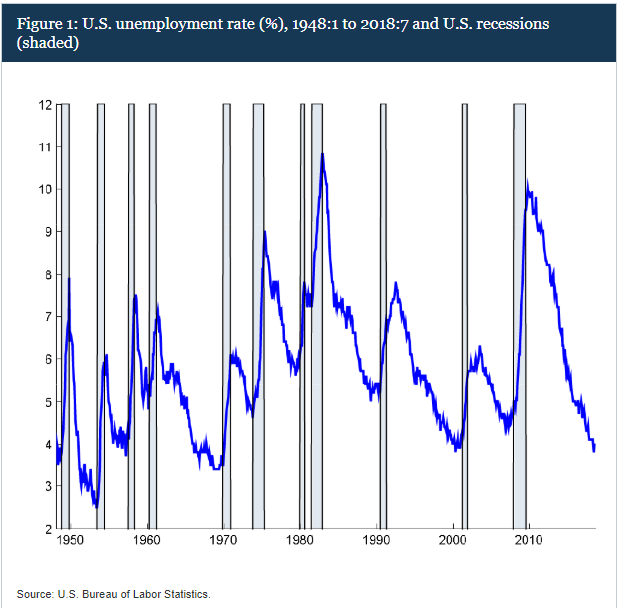
“The U.S. unemployment rate averaged 8.4% during the first five years of recovery from the Great Recession of 2007-2009, the weakest recovery on record (see Figure 1). But as the expansion continued, unemployment continued to decline and by 2018 reached the lowest levels in almost half a century. Why did unemployment remain so high for so long, and what factors contributed to the recent lows?”
“One of the most striking features of the length of time people stay unemployed is the heterogeneity across the experience of different people. Most people who become unemployed find a new job relatively quickly. Even during the Great Recession, of people who were newly unemployed in month t, on average only 64% were still unemployed in month t + 1. By contrast, if someone has been unemployed for 4-6 months as of month t, on average since 1976, there was an 81% probability that they would still be unemployed in month t + 1. The lowest the latter probability ever got in any month from 1976 to 2018 was 71%. In other words, the newly unemployed during the Great Recession had better success finding jobs than did the long-term unemployed during the strongest economic boom.”
Continue reading here.
From a FEDS Note by Hie Joo Ahn and James Hamilton:
“The U.S. unemployment rate averaged 8.4% during the first five years of recovery from the Great Recession of 2007-2009, the weakest recovery on record (see Figure 1). But as the expansion continued, unemployment continued to decline and by 2018 reached the lowest levels in almost half a century. Why did unemployment remain so high for so long,
Posted by at 10:38 PM
Labels: Inclusive Growth
Subscribe to: Posts