



Monday, May 20, 2019
Energy and the Military: Leading by Example
From YaleGlobal Online:
“As the world demands more energy, nations face the often-competing pressures to increase energy access and affordability, protect the environment, and assure energy security. The military, long focused on energy issues related to mission delivery, has often been at the forefront of technological innovation and deployment. The quiet innovations in the defense sector could help solve energy challenges nations confront today.
In energy policy circles, the conventional concept of energy security relates to economic prosperity and social harmony. In a globalized energy market, energy policies are designed to reduce the economic impacts of supply and price shocks through efficiency, diversified supplies, and fuel choice. In military energy decision-making, however, “security” focuses on achieving strategic objectives, and enables nearly everything the military does. In the defense domain, energy has the potential to be both an enabler of hard power but also a weapon of war via denial and willful coercion.
Energy has played a role in every facet of war. Many of the lessons learned during the world wars of the 20th century are still being appreciated and relearned in today’s conflicts. One of the most famous examples of energy influencing military strategy comes from 1911, when Winston Churchill, then First Lord of the Admiralty, converted the British fleet from Welsh coal to foreign oil. The gain in speed and decrease in logistical burden gave the British Royal Navy a critical advantage over the Axis powers. The policy brought further advantage as oil’s less smoky combustion allowed the Royal Navy to avoid coal’s telltale plumes that revealed a fleet’s position.
As militaries shifted toward oil during the early 20th century as the main energy source, a scramble to secure oil supplies influenced events leading to and throughout WWII. Some of the greatest strategic decisions in World War II had their roots in a desire to access energy resources. The German military’s perceived need for oil created a two-front war, and its failure to take and hold Soviet oilfields spelled disaster at Stalingrad. The Japanese surprised the American naval fleet on December 7, 1941, an attempt to secure oil-shipping lanes and secure other natural resources, such as rubber, from Southeast Asia. Energy’s link to World War II conflict had as much to do with denial of resources to the enemy as securing one’s own oil supply chains. The stalling of General Patton’s Third Army following its campaign across France in summer 1944 is a telling example of fuel acting as “tether” to military operations.
The skill and technologies of logistics forces in providing fuel has grown significantly since World War II. Energy security has been a challenge in Afghanistan, NATO’s largest operation. In late 2012, more than 100,000 troops consumed more than 6.8 million liters of fuel per day, 99 percent delivered by truck, from Pakistan and later through a complex Central Asia route. The enduring criticality of energy logistics was highlighted when retired General James N. Mattis entreated the US Department of Defense to “unleash us from the tether of fuel.” The 2010 test deployment of portable solar-powered generation systems at US Marine forward operating bases in Afghanistan reduced the bases’ diesel generator usage by more than 90 percent.”
Continue reading here.
From YaleGlobal Online:
“As the world demands more energy, nations face the often-competing pressures to increase energy access and affordability, protect the environment, and assure energy security. The military, long focused on energy issues related to mission delivery, has often been at the forefront of technological innovation and deployment. The quiet innovations in the defense sector could help solve energy challenges nations confront today.
In energy policy circles,
Posted by at 9:39 AM
Labels: Energy & Climate Change
The new globalisation and income inequality
From VoxEU post by Sergi Basco and Martí Mestieri:
“Trade in intermediates (or ‘unbundling of production’) and trade in capital have become increasingly important in last 25 years. This column shows that trade in intermediates generates a reallocation of capital across countries that exacerbates world inequality in both income and welfare. Unbundling of production hurts middle-income countries but helps those with high productivity. Trade in intermediates also increases within-country inequality, and this increase is U-shaped in the aggregate productivity level of the country.
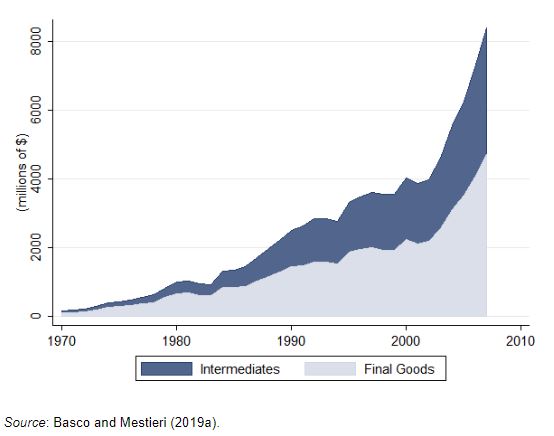
Two remarkable facts of the globalisation process witnessed in the last 25 years are the large increases in both trade in intermediate goods and in capital mobility. Before the 1990s, trade in final goods accounted for most of the value of world exports and international capital mobility was relatively low. In contrast, after the 1990s, trade in intermediate goods, or ‘unbundling of production’, has become more prominent over time (see Figure 1) and global supply chains have emerged – a phenomenon termed ‘New Globalisation’ by Baldwin (2016). There has also been a sizable growth of both gross and net international capital flows (e.g. Lane and Milesi-Ferretti 2007). Some authors have blamed globalisation for the increasing inequality and loss of jobs in developed countries (e.g. Acemoglu et al. 2016). However, there has not been any theoretical analysis of the long-run effect of unbundling of production on inequality between and within countries.
Figure 1 International unbundling of production
A distinctive feature of intermediate goods, which we document in a recent paper (Basco and Mestieri 2019a), is that they are more heterogenous in capital intensity than final goods. Factor proportion (Heckscher-Ohlin) trade models emphasise that trade in goods which are heterogenous in capital intensity creates winners and losers from globalisation because trade alters the relative return to factors of production. Moreover, since capital can be accumulated, trade in intermediates can have dynamic effects through altering countries’ savings rate. In addition, capital mobility implies that trade in intermediates can affect the global allocation of capital. Changes in the global allocation of capital also affect returns to other domestic factors of production (e.g. labour), to the extent that capital and labour are complements in production. In sum, trade in intermediates (unbundling of production) has the potential to affect the redistribution of capital and labour between and within countries.”
Continue reading here.
From VoxEU post by Sergi Basco and Martí Mestieri:
“Trade in intermediates (or ‘unbundling of production’) and trade in capital have become increasingly important in last 25 years. This column shows that trade in intermediates generates a reallocation of capital across countries that exacerbates world inequality in both income and welfare. Unbundling of production hurts middle-income countries but helps those with high productivity. Trade in intermediates also increases within-country inequality, and this increase is U-shaped in the aggregate productivity level of the country.
Posted by at 9:37 AM
Labels: Inclusive Growth
Friday, May 17, 2019
Housing View – May 17, 2019
On cross-country:
- House Prices Are Up: Should We Be Happy? – IMF
- How real-estate barons have ridden the tech boom – The Economist
- “Housing affordability is a key determinant of individual well-being and overall economic growth” The World Bank Look at Housing, Mobility and Welfare – Housing Europe
- This Land is whose Land? Picking the Housing Europe annual conference theme – Housing Europe
- European Summer School for young professionals 2019 – Housing Europe
On the US:
- California’s Rent Control Advocates Are About To Get What They Want, Good and Hard – Reason
- Special briefing on new construction, housing supply, and home prices – American Enterprise Institute
- Proposed Rule Could Evict 55,000 Children From Subsidized Housing – NPR
- Chipping away at the mortgage deduction – Brookings Institute
- The Capital Region needs more housing – Brookings Institute
- AEI Housing Center announces 10 best and worst metro areas to live in for science, technology, engineering, and math (STEM) jobs – American Enterprise Institute
- A great choice by the Federal Housing Finance Agency – American Enterprise Institute
- Second Home Buyers and the Housing Boom and Bust – Federal Reserve Board
- When Airbnb Listings in a City Increase, So Do Rent Prices – Harvard Business Review
- Chinese nationals purchase more U.S. residential real estate than buyers from any other foreign country, but Trump’s trade war could soon end that – MarketWatch
On other countries:
- [Canada] Combatting Money Laundering in BC Real Estate – CityNews
- [Canada] Poloz Underestimates Housing Slump, Capital Economics Says – Bloomberg
- [China] The Demand for Reverse Mortgages in China – VoxChina
- [Netherlands] Amsterdam Parliament Seeks Three-Year Freeze for Housing Resales – Bloomberg
- [Singapore] Do Real Estate Agents Have Information Advantages in Housing Markets? – Journal of Financial Economics
On cross-country:
- House Prices Are Up: Should We Be Happy? – IMF
- How real-estate barons have ridden the tech boom – The Economist
- “Housing affordability is a key determinant of individual well-being and overall economic growth” The World Bank Look at Housing, Mobility and Welfare – Housing Europe
- This Land is whose Land? Picking the Housing Europe annual conference theme – Housing Europe
- European Summer School for young professionals 2019 – Housing Europe
Posted by at 5:00 AM
Labels: Global Housing Watch
Monday, May 13, 2019
Evolution of Macroprudential Policies in Korea
From the IMF’s latest report on Korea:
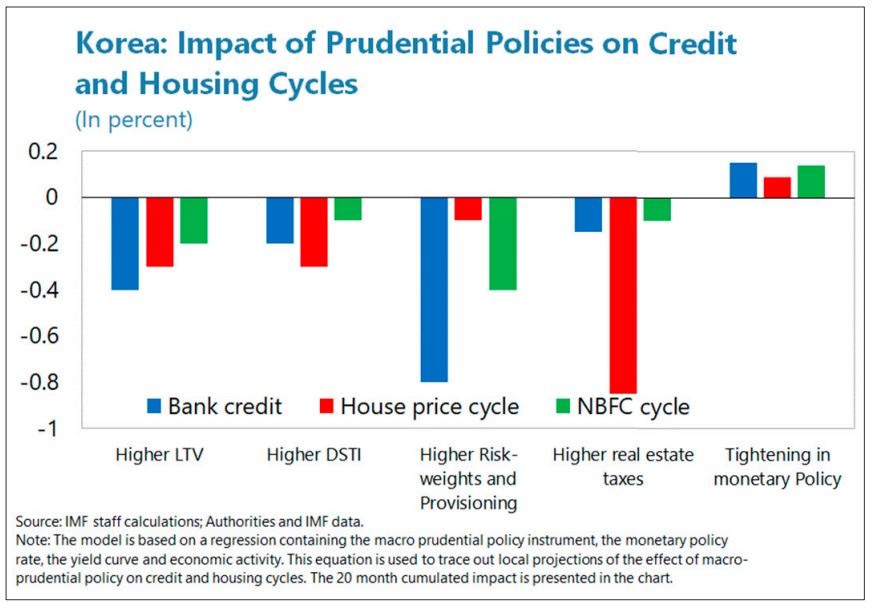
“Evidence for Korea suggests that financial stability will not necessarily materialize as a natural by-product of a so-called appropriate monetary policy stance. Although the effects of monetary and macroprudential instruments may overlap, they are not perfect substitutes. Empirical evidence for Korea shows that macroprudential policy have made two active contributions to limit financial risks to the wider economy:
- Preempting aggregate weakness by limiting the buildup of risk, thereby reducing the occurrence of crises. Macroprudential policies can reduce the procyclical feedback between asset prices and credit.
- Reducing the systemic vulnerability by increasing the resilience of the financial system. By building buffers, macroprudential policy helps maintain the ability of the financial system to provide credit to the economy, even under adverse conditions.
Policymakers should be mindful that macroprudential policy is not free of costs and that there may be trade-offs between the stability and the efficiency of financial systems. For instance, when policymakers impose high capital and liquidity requirements on financial institutions, they may enhance the stability of the system, but they also drive up the price of credit. For macroprudential policy to contribute to financial stability and social welfare, its objectives need to be defined clearly and in a manner that can form the basis of a strong accountability framework.”
From the IMF’s latest report on Korea:
“Evidence for Korea suggests that financial stability will not necessarily materialize as a natural by-product of a so-called appropriate monetary policy stance. Although the effects of monetary and macroprudential instruments may overlap, they are not perfect substitutes. Empirical evidence for Korea shows that macroprudential policy have made two active contributions to limit financial risks to the wider economy:
- Preempting aggregate weakness by limiting the buildup of risk,
Posted by at 3:33 PM
Labels: Global Housing Watch
Housing Market in Luxembourg
From the IMF’s latest report on Luxembourg:
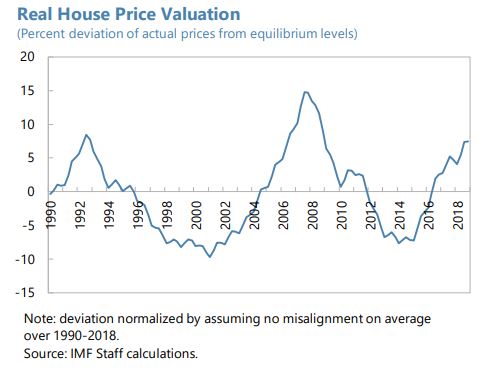
“Real house prices are estimated to be slightly overvalued in 2018. The percent deviation between the actual house price index and the predicted house price index suggests that real house prices were slightly overvalued, by about 7.5 percent in 2018.
Going forward, given supply constraints, Brexit-related immigration flows could add demand pressures and increase overvaluation of residential real estate (RRE) prices.
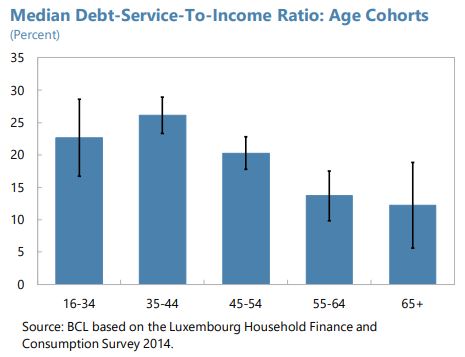
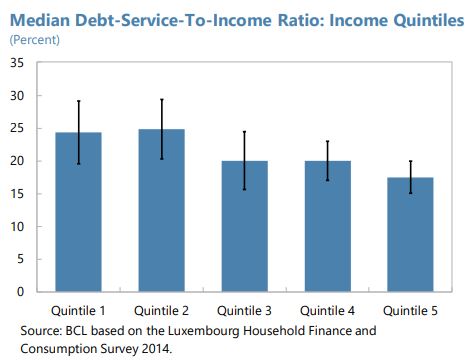
However, elevated household indebtedness indicates medium-term vulnerabilities, especially among younger age cohorts. Household debt remained high at about 170 percent of net disposable income in 2017, placing Luxembourg above the average of OECD countries. According to the latest available data from CSSF, 32 percent of households have a debt-service-to-income (DSTI) ratio greater than 45 percent. Disaggregated data from Household Finance and Consumption Survey (2014) indicates very high debt-to-income and DSTI ratios for younger cohorts (below 45 years old). The median and 75th percentile DSTI ratios were approaching 25 and 40 percent of disposable income, respectively. Classified by income quintiles, debt service burden is larger for poorer households (quintiles 1 and 2). In 2018, the share of adjustable rate mortgages in new mortgages remained stable at about 50 percent, indicating that some household balance sheets remain vulnerable to interest rate risks. These vulnerabilities would be exacerbated should monetary policy normalize faster than anticipated.
Rising RRE prices and elevated household indebtedness require continued monitoring of financial stability risks including banks’ ability to absorb price declines. Non-performing loans (NPLs) in the real estate sector remain low, with the ratio of total NPLs in RRE to total assets of the domestic banking system at 0.18 percent. However, borrower-based indicators point towards the need for closer monitoring of financial stability risks. Loan-to-value (LTV) ratios above 80 percent, for instance, are high at 31 percent of the outstanding mortgage stock. This is expected to increase further as one half of all new mortgage loans continue to have LTV ratios above 80 percent.”
From the IMF’s latest report on Luxembourg:
“Real house prices are estimated to be slightly overvalued in 2018. The percent deviation between the actual house price index and the predicted house price index suggests that real house prices were slightly overvalued, by about 7.5 percent in 2018.
Going forward, given supply constraints, Brexit-related immigration flows could add demand pressures and increase overvaluation of residential real estate (RRE) prices.
However,
Posted by at 10:40 AM
Labels: Global Housing Watch
Subscribe to: Posts