


Monday, July 29, 2019
A Hesitant Transition: Renewable Energy Growth and Carbon Emissions
From the India Forum:
“Renewable energy capacity has expanded globally but this does not as yet mark a shift away from fossil fuels. On current trends, energy use from CO2-emitting fuels will continue to rise in the future. Talk of decarbonsiation of the world economy is premature.
In 2015, global carbon dioxide (CO2) emissions plateaued even as the world economy grew by about 3%. Emissions rose, but only slightly, the following year. There was much relief, even triumph, in the mainstream press and some scholarly literature, that the world economy had begun decarbonising. Reports suggested we were experiencing “a partial decoupling between the growth in CO2 emissions and that in the economy”.
Since 1970, CO2 emissions from fossil fuels―coal, oil, and gas―had grown by about 0.4% for every one percentage point rise in world GDP. But now writers surmised, they would stay flat or even decline while economic growth continued.
A second proposition, connected to the first, suggests we have been witnessing an energy transition worldwide: a shift away from fossil fuels and towards a huge expansion of renewable energy, led primarily by solar and wind power. Referring to one such fossil fuel, the energy analyst and executive chairman of Brookings India, Vikram S Mehta, wrote a couple of years ago, “Historians will look back on 2016 as the year of inflexion for the oil industry … the year the oil era began to slowly but inexorably hand over the energy baton to clean energy”(“Over the Barrel”, Indian Express, 6 February 2017). The climate change activist and writer Bill McKibben recently wrote approvingly “ … in the next few years, we will reach the peak use of fossil fuels, not because we are running out of them but because renewables will have become so cheap. … [Kingsmill] Bond writes that in the 2020s―probably the early 2020s―the demand for fossil fuels will stop growing.” ( “A Future Without Fossil Fuels”, New York Review of Books, 4 April 2019)
This essay probes whether, and to what extent, these two propositions hold water. It builds on arguments made by others that talk of an energy transition is misleading (Sweeney and Treat 2017) or very partial (Pirani 2018). Using the latest available data I show that whereas we are undoubtedly witnessing an expansion of renewable energy worldwide, it does not amount to a transition. Not as yet. For the concept energy “transition” also implies that we are transiting away from what was dominant earlier and relegating it to a small proportion of the energy landscape. That is certainly not happening with oil and gas. Whether we are even transiting from coal is moot.
What’s more, given the accelerating impacts of global warming in recent years, are we transiting away from fossil fuels at anywhere near the pace that the science demands? This question has acquired even greater salience with the eruption of the “Extinction Rebellion” and other movements in Europe and elsewhere, including India, by school students and others demanding sharp cuts in emissions and the declaration of a climate crisis, both in India and on a planetary scale.”
From the India Forum:
“Renewable energy capacity has expanded globally but this does not as yet mark a shift away from fossil fuels. On current trends, energy use from CO2-emitting fuels will continue to rise in the future. Talk of decarbonsiation of the world economy is premature.
In 2015, global carbon dioxide (CO2) emissions plateaued even as the world economy grew by about 3%. Emissions rose,
Posted by at 10:11 AM
Labels: Energy & Climate Change
Thursday, July 25, 2019
Housing Market in France
From the IMF’s latest report on France:
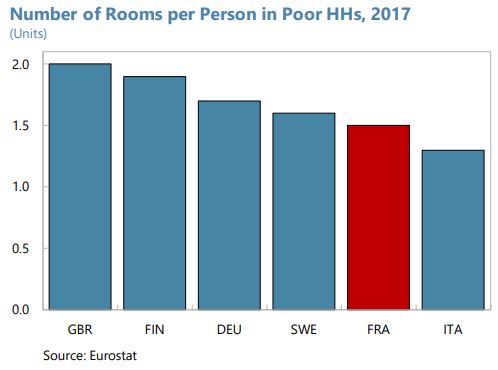
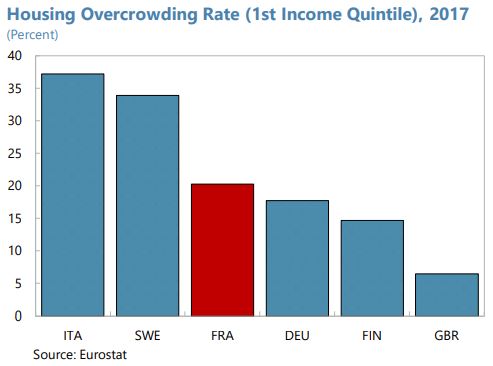
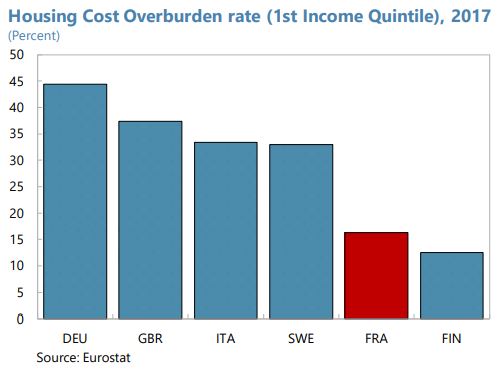
“Spending on housing is among the highest among European countries, with mixed outcomes for vulnerable groups (…). Similar to the UK, France spends 1.3 percent of GDP on housing development and housing benefits compared to 0.4 percent and 0.2 percent in Germany and Italy respectively. However, this is associated with mixed outcomes: while the overburden rate of poor households is among the lowest in France (16 percent compared to 37 percent in the UK), the number of rooms per person in poor households is lower in France than in the UK and in Germany, and houses of those at the lowest end of the income distribution in France are three times more overcrowded than in the UK.”

From the IMF’s latest report on France:
“Spending on housing is among the highest among European countries, with mixed outcomes for vulnerable groups (…). Similar to the UK, France spends 1.3 percent of GDP on housing development and housing benefits compared to 0.4 percent and 0.2 percent in Germany and Italy respectively. However, this is associated with mixed outcomes: while the overburden rate of poor households is among the lowest in France (16 percent compared to 37 percent in the UK),
Posted by at 4:31 PM
Labels: Global Housing Watch
Wednesday, July 24, 2019
Okun’s Law–Sectoral and Cross Country Differences
In a new paper, authors Eiji Goto and Constantin Burgi analyze the Okun’s law through sectoral and cross-country differences. The specific value add to existing research, according to the authors, is as follows:
“We contribute to the literature on cyclical differences by determining which category the Okun’s coefficient falls in. Specifically, we test whether the aggregate differences disappear if the sector sizes are the same across countries (e.g. if manufacturing has the same share of GDP for all countries) and we find that this can be rejected. We also examine whether all of the sectoral coefficients are proportional and we find that we cannot reject this. Next, we inspect whether any sector’s coefficient is the same as the aggregate’s and we find that this can also be rejected. Lastly, we decompose the Okun’s coefficient to determine whether the correlation between unemployment or the standard deviations of unemployment or GDP are driving the differences. We find that the standard deviation of unemployment is the main driver”
In a new paper, authors Eiji Goto and Constantin Burgi analyze the Okun’s law through sectoral and cross-country differences. The specific value add to existing research, according to the authors, is as follows:
“We contribute to the literature on cyclical differences by determining which category the Okun’s coefficient falls in. Specifically, we test whether the aggregate differences disappear if the sector sizes are the same across countries (e.g. if manufacturing has the same share of GDP for all countries) and we find that this can be rejected.
Posted by at 3:57 PM
Labels: Inclusive Growth
Tuesday, July 23, 2019
Costs of Recessions
From Stumbling and Mumbling:
“The Resolution Foundation’s James Smith has written a nice paper on the likelihood of recession and the fact that, with monetary less able to support the economy, we need to think about alternative ways of tackling recessions. I just want to amplify what he says in two ways.
First, there’s increasing evidence that recessions can do long-term damage, even if the economy appears to bounce back in the short-term. There are at least three mechanisms here:
– Education. Bryan Stuart shows that the 1980-82 recession in the US “generated sizable long-run reductions in education and income.” Parents who suffer a drop in income spend less on children’s books and educational trips, and this makes them less likely to go to college a few years later. Such effects are magnified if bad macro policy causes restraints upon public spending on schools and libraries.
– Productivity. Recessions increase uncertainty, which depresses investment in both capital and R&D, leading to lower productivity growth. The Bank of England’s Dario Bonciani and Joonseok Jason Oh say:
Shocks increasing macroeconomic uncertainty can lead to very persistent negative effects on economic activity that last well beyond the business cycle frequency.
– Scarring. A recent paper by Erin McGuire shows that people who grow up in hard times “invest less in risky assets throughout their lives, invest more in property, and are less likely to be self-employed.” This corroborates research (pdf) by Ulrike Malmendier and Stefan Nagel. Through this channel, recessions can reduce entrepreneurship and increase the cost of capital even decades later.
Against all this, it is theoretically possible that recessions have a beneficial “cleansing” (pdf) effect: in driving inefficient firms out of business, they make it easier for more efficient ones to expand, and this raises productivity growth.”
Continue reading here.
From Stumbling and Mumbling:
“The Resolution Foundation’s James Smith has written a nice paper on the likelihood of recession and the fact that, with monetary less able to support the economy, we need to think about alternative ways of tackling recessions. I just want to amplify what he says in two ways.
First, there’s increasing evidence that recessions can do long-term damage, even if the economy appears to bounce back in the short-term.
Posted by at 11:16 AM
Labels: Inclusive Growth
Monday, July 22, 2019
Mapped: The Countries With the Highest Housing Bubble Risks
From Visual Capitalist:
“With a decade-long bull market and an ultra low interest rate environment globally, it’s not surprising to see capital flock to housing assets.
For many investors, real estate is considered as good of a place as any to park money—but what happens when things get a little too frothy, and the fundamentals begin to slip away?
In recent years, experts have been closely watching several indicators that point to rising bubble risks in some housing markets. Further, they are also warning that countries like Canada and New Zealand may be overdue for a correction in housing prices.
Key Housing Market Indicators
Earlier this week, Bloomberg published results from a new study by economist Niraj Shah as he aimed to build a housing bubble dashboard.
It tracks four key metrics:
- House Price-Rent Ratio
The ratio of house prices to the annualized cost of rent- House Price-Income Ratio
The ratio of house prices to household income- Real House Prices
Housing prices adjusted for inflation- Credit to Households (% of GDP)
Amount of debt held by households, compared to total economic outputRanking high on just one of these metrics is a warning sign for a country’s housing market, while ranking high on multiple measures signals even greater fragility.”
Continue reading here.
From Visual Capitalist:
“With a decade-long bull market and an ultra low interest rate environment globally, it’s not surprising to see capital flock to housing assets.
For many investors, real estate is considered as good of a place as any to park money—but what happens when things get a little too frothy, and the fundamentals begin to slip away?
In recent years, experts have been closely watching several indicators that point to rising bubble risks in some housing markets.
Posted by at 9:54 AM
Labels: Global Housing Watch
Subscribe to: Posts