



Friday, October 18, 2019
Housing View – October 18, 2019
On cross-country:
- Making Sense of Increased Synchronization in Global House Prices – Federal Reserve Bank of Dallas
On the US:
- Housing Market Points to Recession By Election Day – Council on Foreign Relations
- 2019 Cost Burden Report: Half of Renter Households Struggle With Affordability – Apartment List
- Rent control is making a comeback. Does it work? – Curbed
- This Is How to Make Democratic Candidates’ Housing Plans a Reality – Citylab
- So You Make $100,000? It Still Might Not Be Enough to Buy a Home. – Wall Street Journal
- Explaining the Black-White Homeownership Gap – Urban Institute
- How Cities Address the Housing Crisis, and Why It’s Not Enough – Citylab
- Empty Garages: The Answer to California’s Housing Shortage? – New York Times
- Policy Uncertainty and Bank Mortgage Credit – Bank for International Settlements
On other countries:
- [Argentina] Argentina defaults again; currency controls to hurt the housing market further – Global Property Guide
- [Australia] Housing and the Economy – Reserve Bank of Australia
- [Canada] How Ottawa can tackle the housing shortage – Fraser Institute
- [Chile] Chile’s housing market strengthens – Global Property Guide
- [Dominican Republic ] The Dominican Republic has empty beaches, low costs, and great yields – Global Property Guide
- [Hong Kong] Hong Kong leader Carrie Lam unveils property measures – Reuters
- [Indonesia] Jakarta’s rental yields are moderate to attractive – Global Property Guide
- [Qatar] Qatar’s housing market is gradually improving – Global Property Guide
- [Romania] Moderate to good rental yields in Bucharest, Romania – Global Property Guide
- [Russia] Russia’s house prices are picking up again – Global Property Guide
- [United Kingdom] How far do people move house? – Bank of England
On cross-country:
- Making Sense of Increased Synchronization in Global House Prices – Federal Reserve Bank of Dallas
On the US:
- Housing Market Points to Recession By Election Day – Council on Foreign Relations
- 2019 Cost Burden Report: Half of Renter Households Struggle With Affordability – Apartment List
- Rent control is making a comeback. Does it work?
Posted by at 5:00 AM
Labels: Global Housing Watch
Thursday, October 17, 2019
The link between declining middle-wage jobs, rising wage inequality, and worker welfare
From VOX post by Jennifer Hunt and Ryan Nunn:
“Over the last five decades, middle-wage jobs diminished in the US as wage inequality increased. This column investigates the relationship between these two phenomena, and finds no evidence that either computerisation or automation (often cited as a source of both trends) produced employment polarisation or increased wage inequality. By examining wages at the individual level (rather than occupation-average wages), the column suggests that the evolution of wages can be better explained by distinct causes—ranging from changing labour market institutions to globalisation—than by observable demographic factors.
Middle-wage jobs in the US are gradually diminishing while wage inequality has been rising. But are the two related? Does the decline in middle-wage jobs represent polarisation of employment, and is the decline a good or a bad thing for workers?
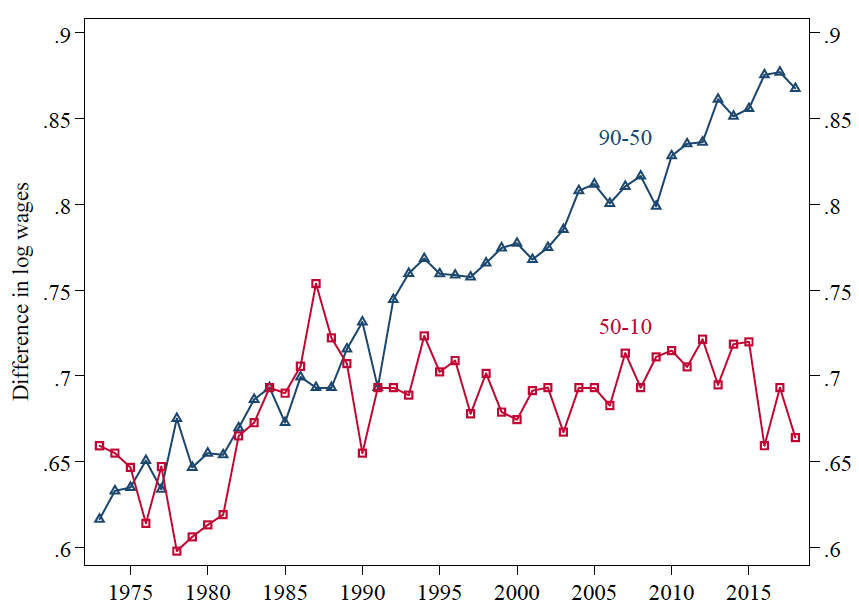
Inequality between top and middle hourly wages has increased steadily for the last 50 years in the US. By contrast, inequality between middle and bottom wages rose sharply in the 1980s; then, after a slight decline, it remained stable for the next 30 years. These gaps are commonly measured as the ratio of the 90th and 50th percentile wages (the wage of the worker earning more than 90% of workers relative to the wage of the worker earning more than 50% of workers) and the ratio of the 50th and 10th percentile wages, as shown in Figure 1.
Note: Difference between 90th and median log hourly wages (90-50) and median and 10th percentile wages (50-10), weighted by weekly hours work. Non-self employed workers 18-64 without missing values for covariates used elsewhere in the paper, but including imputed values.
Source: CPS MORGs 1979-2018 and CPS Mays 1973-1979.Economists have investigated many potential explanations for these changes, including the decline of unions (Fortin et al. 2019); the inflation-adjusted minimum wage (Lee 1999); the spread of outsourcing and temporary-agency labour (Feenstra and Hanson 1999); reduced competition and dynamism (Furman and Orszag 2018, Shambaugh et al. 2018); and increased international trade, off-shoring, and technological progress (Blum 2008, Feenstra and Hanson 2003). The first two factors played an important role in the 1980s, and many researchers believe that technology has played an important role throughout.
A complementary analysis focuses on employment shares of low-, middle-, and high-wage workers rather than wage inequality. One of the most striking findings from this work is that the share of middle-wage jobs has declined. This decline can be measured in different ways, one of which is to examine shifts in the occupational composition of employment. Some research foregrounds the role of technology in its examination of these shifts, because in addition to a decline in the employment share of middle-wage occupations and a rise in employment share of high-wage occupations, the share of low-wage occupation employment share has been rising (e.g. Autor 2015a,b and Autor and Dorn 2013 for the US; Goos et al. 2009 and Goos et al. 2014 for other countries).”
Continue reading here.
From VOX post by Jennifer Hunt and Ryan Nunn:
“Over the last five decades, middle-wage jobs diminished in the US as wage inequality increased. This column investigates the relationship between these two phenomena, and finds no evidence that either computerisation or automation (often cited as a source of both trends) produced employment polarisation or increased wage inequality. By examining wages at the individual level (rather than occupation-average wages), the column suggests that the evolution of wages can be better explained by distinct causes—ranging from changing labour market institutions to globalisation—than by observable demographic factors.
Posted by at 9:18 AM
Labels: Inclusive Growth
Tuesday, October 15, 2019
Putting Economic Policy to the Test: An economist’s real-life experiments yield surprising results
A F&D profile of Esther Duflo:
“IT IS A CAPITAL MISTAKE to theorize before one has data,” Sherlock Holmes remarks to his friend Dr. Watson in “A Scandal in Bohemia.” Development economist Esther Duflo would probably agree.
A slight, intense, 31-year-old with dark hair and eyes and the harried air of someone with too much to do in too little time, Duflo, a native of France, is part of a rising group of young economists who are questioning traditional development strategies. Her modest office at the Massachusetts Institute of Technology, where she is Castle Krob Development Associate Professor of Economics, is decorated with textiles from India and Indonesia, two of the developing countries in which she has done research.
Describing her methods, Duflo says that she works “in a very micro way. My projects always consider one simple, stripped-down question having to do with how people react within a certain context.” Typically, her question has to do with how a selected program in a developing country has affected the poor people it was designed to benefit. She amasses huge amounts of data in the field, in collaboration with local nongovernmental organizations (NGOs) and academics, and then subjects the data to rigorous econometric analysis to determine the program’s impact.
Although she considers her questions “simple,” her goal is anything but. Indeed, research carried out by Duflo and her peers is challenging some of the cherished assumptions on which many development policies are based. For example, in a study of Indonesia’s massive school construction program (the country built over 61,000 primary schools in 1974–78), Duflo found that, while workers who were educated in the new schools received higher wages, the wages of older workers in the same districts increased more slowly from year to year, apparently because the market was flooded with graduates from the new schools and capital formation did not keep up with the increase in human capital. These findings, she concluded, “are important because, contrary to what is often assumed (on the basis of the experience of Southeast Asian countries), acceleration in the rate of accumulation of human capital is not necessarily accompanied by economic growth.”
Studying real people in real environments is central to Duflo’s approach. In a paper she wrote in 2003, “Poor but Rational?” she speculates that there may be “more to learn about human behavior from the choices made by Kenyan farmers confronted with a real choice than from those made by American undergraduates in laboratory conditions.”
Continue reading here.
A F&D profile of Esther Duflo:
“IT IS A CAPITAL MISTAKE to theorize before one has data,” Sherlock Holmes remarks to his friend Dr. Watson in “A Scandal in Bohemia.” Development economist Esther Duflo would probably agree.
A slight, intense, 31-year-old with dark hair and eyes and the harried air of someone with too much to do in too little time, Duflo, a native of France, is part of a rising group of young economists who are questioning traditional development strategies.
Posted by at 10:23 AM
Labels: Profiles of Economists
Monday, October 14, 2019
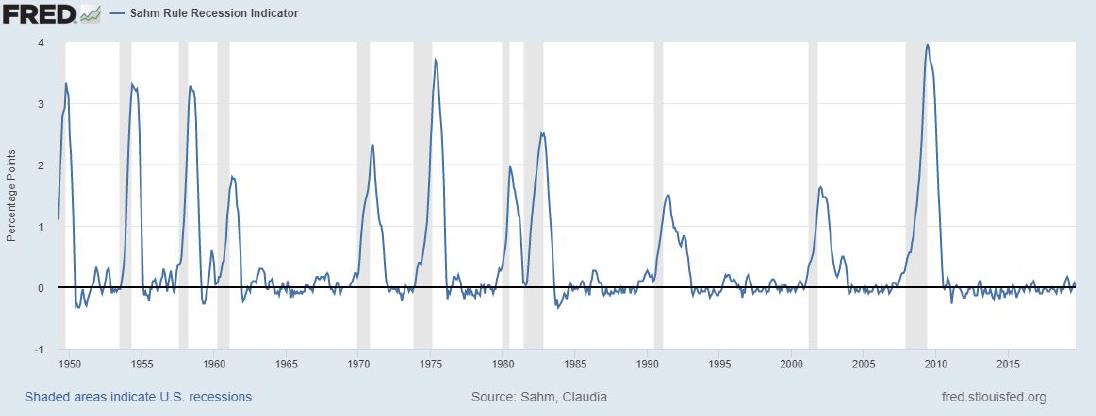
Recession 2020?
An interesting presentation on recession dynamics by Tara M Sinclair from George Washington University. They answer three fundamental questions:
“1. Are we in a recession now?
2. When is the next recession coming?
3. What will the next recession look like? ”
Source: Recession 2020? Tara M. Sinclair @TaraSinc The George Washington UniversityResearch Program on Forecasting
An interesting presentation on recession dynamics by Tara M Sinclair from George Washington University. They answer three fundamental questions:
“1. Are we in a recession now?
2. When is the next recession coming?
3. What will the next recession look like? ”
Source: Recession 2020? Tara M. Sinclair @TaraSinc The George Washington UniversityResearch Program on Forecasting
Posted by at 4:14 PM
Labels: Forecasting Forum
Friday, October 11, 2019
Drilling Down: The Impact of Oil Price Shocks on Housing Prices
From a new paper by Valerie Grossman, Enrique Martínez-García, Luis Bernardo Torres and Yongzhi Sun:
“This paper investigates the impact of oil price shocks on house prices in the largest urban centers in Texas. We model their dynamic relationship taking into account demand- and supply-side housing fundamentals (personal disposable income per capita, long-term interest rates, and rural land prices) as well as their varying dependence on oil activity. We show the following: 1) Oil price shocks have limited pass-through to house prices—the highest pass-through is found among the most oil-dependent cities where, after 20 quarters, the cumulative response of house prices is 21 percent of the cumulative effect on oil prices. Still, among less oil-dependent urban areas, the house price response to a one standard deviation oil price shock is economically significant and comparable in magnitude to the response to a one standard deviation income shock. 2) Omitting oil prices when looking at housing markets in oil-producing areas biases empirical inferences by substantially overestimating the effect of income shocks on house prices. 3) The empirical relationship linking oil price fluctuations to house prices has remained largely stable over time, in spite of the significant changes in Texas’ oil sector with the onset of the shale revolution in the 2000s.”
From a new paper by Valerie Grossman, Enrique Martínez-García, Luis Bernardo Torres and Yongzhi Sun:
“This paper investigates the impact of oil price shocks on house prices in the largest urban centers in Texas. We model their dynamic relationship taking into account demand- and supply-side housing fundamentals (personal disposable income per capita, long-term interest rates, and rural land prices) as well as their varying dependence on oil activity. We show the following: 1) Oil price shocks have limited pass-through to house prices—the highest pass-through is found among the most oil-dependent cities where,
Posted by at 10:18 AM
Subscribe to: Posts