



Thursday, November 4, 2021
Absolute Poverty and Sound Public Finance in the Eurozone
“In this paper, the relation between structural public balance adjustment and absolute poverty in 19 Eurozone countries during the time span 2005–2017 has been investigated. Absolute poverty is becoming more and more relevant in advanced economies, and due to its non-country-specific nature, it allows for a more accurate comparison among countries with very different GDP levels, which also belong to the same economic area. Structural public balance adjustments represent the tool that individual countries must use to contain their deficit and debt within the threshold.
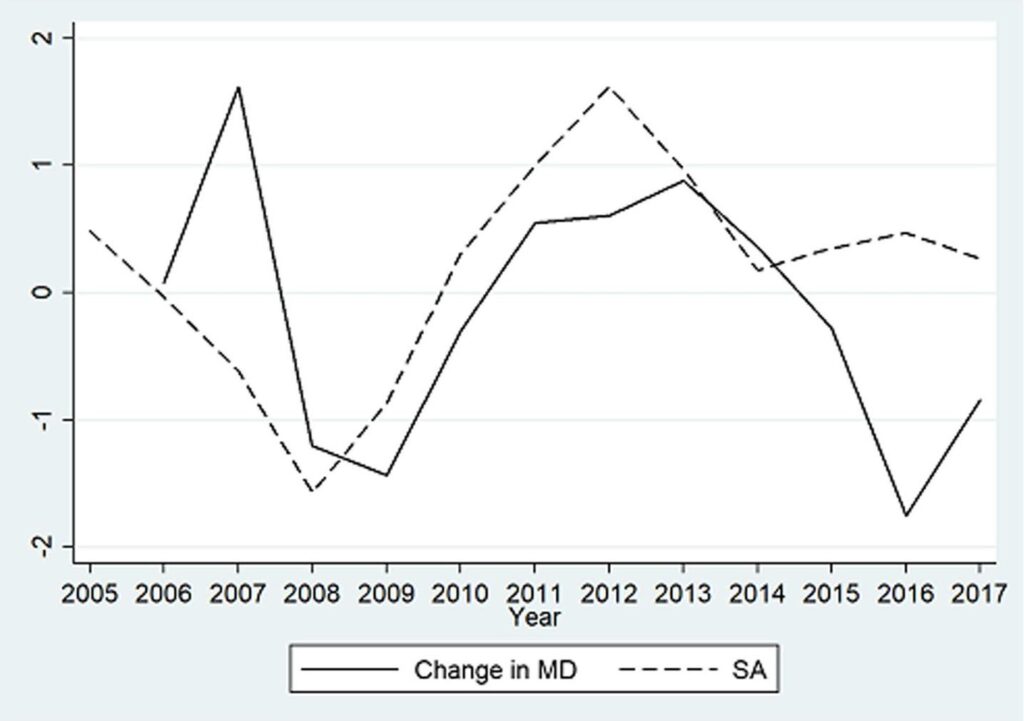
The empirical estimates presented in this paper allow us to support the conclusion that structural public balance adjustments have a direct relation with absolute poverty and that restrictive fiscal measures increase material deprivation, while expansive measures decrease it. In line with the recent debate on the efficacy of fiscal policy, this is the result of the effects of government expenditure on growth that the eventual presence of redistributive measures has not been able to counteract. The introduction in the estimates of other variables affecting poverty consolidates the results and indicates, as additional causes, the rate of inflation and trade openness. Further estimates were conducted on a reduced sample of 12 EMU countries for a longer period (1995–2017) and for the two subsamples of pre (1995–2008) and post (2009– 2017) crisis period using a dependent variable indicator of monetary poverty confirm the
existence of a direct relation between structural adjustments and the share of population living in awkward social conditions.
However, inside the European policy framework, national policies are constrained in their ability to implement autonomously fiscal policies. In the absence of a sustained rate of growth, the interaction among fiscal policy stance, government bonds yields and capital flows limits any kind of single states intervention in the fear of interest rates increase (Canale et al. 2018). Therefore, whatever their aims, national governments are very limitedly able to reconcile the objective of poverty alleviation with that of sound public finance. The increase in poverty is perceived as a kind of unavoidable consequence of fiscal profligacy.”
Source: Canale, R and Liotti, G. (2021). Absolute Poverty and Sound Public Finance in the Eurozone. Journal of Economic Inequality.
Click here to read the full paper.
“In this paper, the relation between structural public balance adjustment and absolute poverty in 19 Eurozone countries during the time span 2005–2017 has been investigated. Absolute poverty is becoming more and more relevant in advanced economies, and due to its non-country-specific nature, it allows for a more accurate comparison among countries with very different GDP levels, which also belong to the same economic area. Structural public balance adjustments represent the tool that individual countries must use to contain their deficit and debt within the threshold.
Posted by at 3:18 PM
Labels: Inclusive Growth
Wednesday, November 3, 2021
The Climate Action Gender Gap
This week of the year 2021 is of prime significance for the world as leaders from across countries have gathered in Glasgow, Scotland for the CoP26 summit which is touted to be the biggest environment-based conference after the Paris Summit in 2015.
Besides the heads of states, more than a fifth of the major corporations in the world have pledged to reach the net-zero carbon emissions target by 2030. However, what is striking is how the role of women as climate leaders, investors, and influencers is largely missing from the mainstream discussion on emissions reduction.
This report draws out interesting parallels between seemingly disparate objectives like climate change and diversity, that corporations must address as part of their journey towards a greener planet. It highlights the influence of greater gender equality on an enterprise’s climate outcomes, by having women in leadership positions to act as changemakers, as low-carbon product influencers, and climate-focused business investors.
Click here to read the full report.
This week of the year 2021 is of prime significance for the world as leaders from across countries have gathered in Glasgow, Scotland for the CoP26 summit which is touted to be the biggest environment-based conference after the Paris Summit in 2015.
Besides the heads of states, more than a fifth of the major corporations in the world have pledged to reach the net-zero carbon emissions target by 2030. However, what is striking is how the role of women as climate leaders,
Posted by at 1:36 PM
Labels: Energy & Climate Change, Inclusive Growth
Flattening the curve: Pandemic-Induced revaluation of urban real estate
From a new paper by Arpit Gupta, Vrinda Mittal, Jonas Peeters, and Stijn Van Nieuwerburgh:
“We show that the COVID-19 pandemic brought house price and rent declines in city centers, and price and rent increases away from the center, thereby flattening the bid-rent curve in most U.S. metropolitan areas. Across MSAs, the flattening of the bid-rent curve is larger when working from home is more prevalent, housing markets are more regulated, and supply is less elastic. Housing markets predict an urban revival with urban rent growth exceeding suburban rent growth for the foreseeable future, as working from home recedes.”
From a new paper by Arpit Gupta, Vrinda Mittal, Jonas Peeters, and Stijn Van Nieuwerburgh:
“We show that the COVID-19 pandemic brought house price and rent declines in city centers, and price and rent increases away from the center, thereby flattening the bid-rent curve in most U.S. metropolitan areas. Across MSAs, the flattening of the bid-rent curve is larger when working from home is more prevalent, housing markets are more regulated,
Posted by at 7:45 AM
Labels: Global Housing Watch
Tuesday, November 2, 2021
Conference Board: Are Consumer Expectations Signaling a U.S. Recession?
From The Conference Board.
By Dana M. Peterson & Lynn Franco
“US consumer expectations as measured by The Conference Board Consumer Confidence Index ticked up in October, but this followed three months of declines. Did the declines signal recession in 2022 or just a hiccup related to the Delta variant? We propose the latter.
Indeed, material downshifts in the consumer expectations gauge, with the exception of the pandemic, have preceded US recessions. However, closer examination of the index reveals at least 18 instances since the inception of the measure when there were 10 point or more declines in the index that did not predict recession (Figure 1). Notably, those dips often coincided with shocks to the economy, including wars, bad weather, and happenings in Washington, DC (Figure 2). Indeed, the three month decline in expectations this year occurred while the Delta variant swept across the nation – a sort of shock within the pandemic shock. Notably, consumer expectations were rising earlier this year as vaccinations rose, mobility restrictions lessened, and in-person services began to reopen.”
Continue reading here.
From The Conference Board.
By Dana M. Peterson & Lynn Franco
“US consumer expectations as measured by The Conference Board Consumer Confidence Index ticked up in October, but this followed three months of declines. Did the declines signal recession in 2022 or just a hiccup related to the Delta variant? We propose the latter.
Indeed, material downshifts in the consumer expectations gauge, with the exception of the pandemic, have preceded US recessions.
Posted by at 5:27 PM
Labels: Forecasting Forum
The International Monetary Fund’s View of Social Equity Throughout Its 75 Years of Existence
“The (International Monetary) Fund’s stance on equity has changed in parallel with external circumstances and the demands of its members, driven, sometimes forcefully, by its MDs. Poverty featured prominently in the Fund’s discourse in its early years when the institution began to take into account the voice and needs of its most vulnerable members. The 1980s and 1990s saw the consolidation of concessional financing, which broadened its focus towards equity between individuals and the “high-quality growth” championed by management and, at first, also by member countries. In the research conducted by the institution’s staff, inequality, social factors, and gender issues gradually gained prominence. These factors were included only to a limited extent and temporarily in the Fund’s activity, given the absence of strong support from the Board.
At the beginning of this century, there was growing disaffection with the Fund among developing countries, which demanded to be treated on a more equal footing. The far-reaching institutional and cultural reform of the IMF in the first decade of this millennium helped to put inequality and other macro-critical issues firmly on the Fund’s agenda. It is possible that the fallout from this century’s two major crises is contributing to consolidate inequality, gender, and the environment in the Fund’s activity and discourse. This may also have been assisted by the fact that the IMF has been led by two women in the recent past.
This paper has analysed how equity issues have been incorporated into the debate and design of the Fund’s policies and, through its texts, what stance each agent (management, member countries and staff) has adopted at each point in time. As a possible follow-up to this analysis, it is worth exploring the extent to which the Fund has put this “declaration of intent” into effect in its surveillance and lending activity and whether its implementation has been consistent with the general guidelines on equity. A text-mining analysis of the content of Article IV reports and IMF programmes could help assess the effective implementation of these issues, for which the annual reports provide only an approximation, and to verify the consistency between discourse, policy design and implementation.”
Source: Banco de España. 2021. The International Monetary Fund’s View of Social Equity Throughout Its 75 Years of Existence (p. 18)
Click here to read the full report.
“The (International Monetary) Fund’s stance on equity has changed in parallel with external circumstances and the demands of its members, driven, sometimes forcefully, by its MDs. Poverty featured prominently in the Fund’s discourse in its early years when the institution began to take into account the voice and needs of its most vulnerable members. The 1980s and 1990s saw the consolidation of concessional financing, which broadened its focus towards equity between individuals and the “high-quality growth” championed by management and,
Posted by at 9:25 AM
Labels: Inclusive Growth
Subscribe to: Posts