



Friday, January 14, 2022
Housing View – January 14, 2022
On cross-country:
- Cross-Country Comparison: Home Rent Growth – Core Logic
On the US:
- There Was No Housing Bubble in 2008 and There Isn’t One Now. Some smart economists are challenging the conventional wisdom that the Great Recession was triggered by out-of-control home prices. – Bloomberg
- Apartment Occupancy Just Hit a Historic High. Is That Good? There’s a silver lining to astronomic U.S. rent hikes: Most tenants won’t pay them, because they’re already locked into their leases. – Bloomberg
- Housing costs swell, hampering home buyers and pushing up rents – New York Times
- Call for Papers: The Mortgage Market Research Conference: Call for Papers – Federal Reserve Bank of Philadelphia
- Mortgage Rates Hit Highest Levels Since Spring 2020. Increase in cost comes after ultralow rates have fueled boom in home sales and prices – Wall Street Journal
- Wall Street Is Using Tech Firms Like Zillow to Eat Up Starter Homes. A business that’s touted as a convenience for home sellers has created a secret pipeline for big investors to buy properties, often in communities of color. – Bloomberg
- People Don’t Want to Move to Shrinking Cities. Slowing population growth could worsen America’s geographic divides, with home prices skyrocketing in some places and plummeting in others. – Bloomberg
- Rising sea levels threaten affordable housing – NPR
- ‘Magic’ Multigenerational Housing Aims to Alleviate Social Isolation. Two co-living communities set to break ground this year seek to address loneliness, as well as the caregiving and affordable-housing shortages, in the U.S. – Wall Street Journal
- U.S. mortgage interest rates surge by most in almost 2 years – Reuters
- Can You Game Your Way Out of American Housing Injustice? A new video game uses a choose-your-own adventure format to interrogate the illusion of choice in the U.S. housing system. – Bloomberg
- There’s Still No Amazon for Housing, But Fintech’s Working on It. Buying and selling a house is a large, complicated transaction, so companies are focusing on making small parts of it easier. – Bloomberg
On China
- China Plans Millions of Low-Cost Rental Homes in Equality Push – Bloomberg
On other countries:
- [Germany] Germany Fights Soaring Home Prices With Curbs on Mortgage Lending. As in the U.S. and other economies, pandemic financial support has sparked a surge in property investment and borrowing in the country – Wall Street Journal
- [Germany] Germany asks banks to build buffers as property market heats up – Reuters
- [Hong Kong] Why Hong Kong housing and office markets are facing very different supply shocks – South China Morning Post
- [United Kingdom] U.K. House Prices Surged Last Year at Fastest Pace Since 2004 – Bloomberg
- [United Kingdom] Help to Buy has pushed up house prices in England, says report. Lords claim flagship £29bn policy would have been better spent on social housing – FT
- [United Kingdom] Letter: Britain must encourage more affordable housing – FT
- [United Kingdom] As the North Cotswolds Get Hipper, Home Values Soar. House prices in this section of the English countryside have risen thanks to the flurry of celebrity residents who have turned the north Cotswolds into the place to see and be seen – Wall Street Journal
On cross-country:
- Cross-Country Comparison: Home Rent Growth – Core Logic
On the US:
- There Was No Housing Bubble in 2008 and There Isn’t One Now. Some smart economists are challenging the conventional wisdom that the Great Recession was triggered by out-of-control home prices. – Bloomberg
- Apartment Occupancy Just Hit a Historic High. Is That Good? There’s a silver lining to astronomic U.S.
Posted by at 5:00 AM
Labels: Global Housing Watch
Thursday, January 13, 2022
What Americans Like about their Health Care
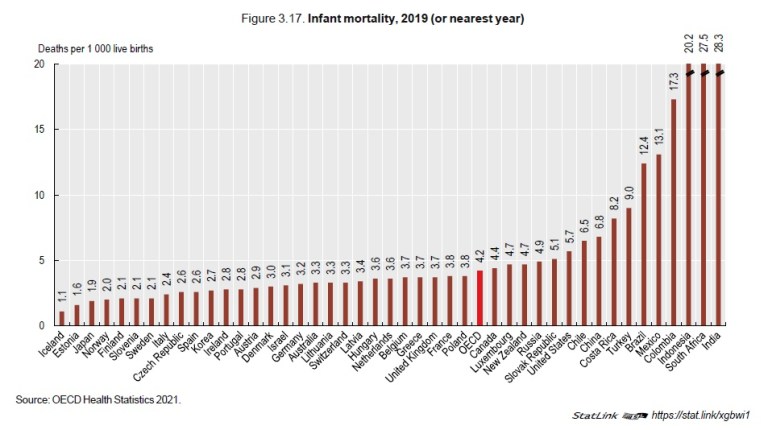
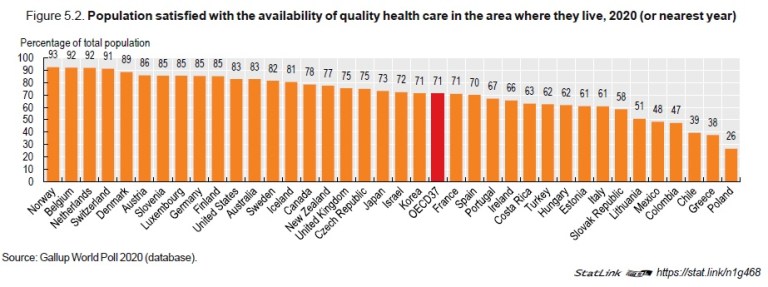
In a latest blog for the Conversable Economist, author Timothy Taylor studies data from the OECD publication, Health at a Glance (2021) to understand why meaningful healthcare reform in the USA may be harder to achieve.
It glances over evidence that demonstrates USA’s not-so-commendable performance on health and wellbeing indicators (like mortality, growth in life expectancy, etc.) despite a large share of expenditure on healthcare. Subsequently, parameters of Americans’ satisfaction from their healthcare industry are discussed, which are found to be upbeat and high-ranking in contrast.
Click here to read the full blog.
In a latest blog for the Conversable Economist, author Timothy Taylor studies data from the OECD publication, Health at a Glance (2021) to understand why meaningful healthcare reform in the USA may be harder to achieve.
It glances over evidence that demonstrates USA’s not-so-commendable performance on health and wellbeing indicators (like mortality, growth in life expectancy, etc.) despite a large share of expenditure on healthcare. Subsequently, parameters of Americans’
Posted by at 9:23 AM
Labels: Inclusive Growth
Fiscal Inflation
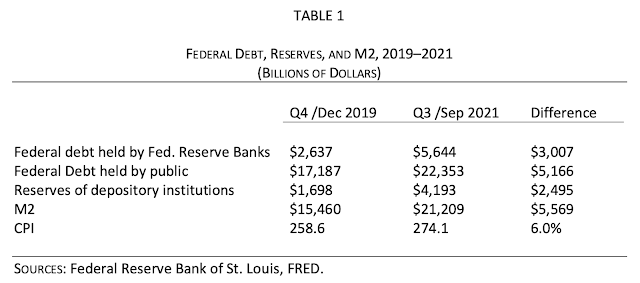
In his blog, The Grumpy Economist, John H. Cochrane, Senior Fellow at Stanford University’s Hoover Institution writes about the role of fiscal policy in pushing inflation.
“Starting in March 2020, in response to the disruptions of Covid-19, the U.S. government created about $3 trillion of new bank reserves, equivalent to cash, and sent checks to people and businesses. (Mechanically, the Treasury issued $3 trillion of new debt, which the Fed quickly bought in return for $3 trillion of new reserves. The Treasury sent out checks, transferring the reserves to people’s banks. See Table 1.) The Treasury then borrowed another $2 trillion or so, and sent more checks. Overall federal debt rose nearly 30 percent. Is it at all a surprise that a year later inflation breaks out? It is hard to ask for a clearer demonstration of fiscal inflation, an immense fiscal helicopter drop, exhibit A for the fiscal theory of the price level (Cochrane 2022a, 2022b).”
Click here to read the full blog.
Related Reading:
In his blog, The Grumpy Economist, John H. Cochrane, Senior Fellow at Stanford University’s Hoover Institution writes about the role of fiscal policy in pushing inflation.
“Starting in March 2020, in response to the disruptions of Covid-19, the U.S. government created about $3 trillion of new bank reserves, equivalent to cash, and sent checks to people and businesses. (Mechanically, the Treasury issued $3 trillion of new debt, which the Fed quickly bought in return for $3 trillion of new reserves.
Posted by at 8:53 AM
Labels: Macro Demystified
Wednesday, January 12, 2022
The Promise of Services-Led Development with Small Firms
In a recent column for VoxEU CEPR, Elwyn Davies, Mary Hallward-Driemeier and Gaurav Nayyar of the World Bank write about prospects of services-led development and the role of small firms in driving it.
“This column argues that the services sector deserves more credit for helping drive economic transformation than it generally receives. Using firm-level data from 20 developing economies, the authors find that while services establishments are smaller than manufacturing establishments, this matters less for their productivity. Services firms can scale up without sizing up through investments in human and other more intangible forms of capital can leverage the diffusion of digital technologies. “
This theme is elaborated upon further in their book, At Your Service?: The Promise of Services-Led Development (2021), which “assesses the scope of a services-driven development model and policy directions that maximize its potential”.
Related Reading:
Services Development and Comparative Advantage in Manufacturing
In a recent column for VoxEU CEPR, Elwyn Davies, Mary Hallward-Driemeier and Gaurav Nayyar of the World Bank write about prospects of services-led development and the role of small firms in driving it.
“This column argues that the services sector deserves more credit for helping drive economic transformation than it generally receives. Using firm-level data from 20 developing economies, the authors find that while services establishments are smaller than manufacturing establishments,
Posted by at 10:38 AM
Labels: Inclusive Growth
[New Paper] Forecasting Real GDP Growth for Africa
By Philip Hans Franses and Max Welz
“This paper deals with forecasting low-frequency macroeconomic variables, when data
are available for a reasonably large number of countries or states. As many macroeconomic
variables have a stochastic trend, the forecasting methodology also addresses potentially
common stochastic trends. In this paper the particular focus is on forecasting annual real
GDP (Gross Domestic Product) growth rates in Africa.”
To read more click here.
By Philip Hans Franses and Max Welz
“This paper deals with forecasting low-frequency macroeconomic variables, when data
are available for a reasonably large number of countries or states. As many macroeconomic
variables have a stochastic trend, the forecasting methodology also addresses potentially
common stochastic trends. In this paper the particular focus is on forecasting annual real
GDP (Gross Domestic Product) growth rates in Africa.”
To read more click here.
Posted by at 10:22 AM
Labels: Forecasting Forum
Subscribe to: Posts