



Thursday, January 20, 2022
EconoFact at Five
From EconBrowser:
“[On] January 20th, EconoFact celebrates its 5 year anniversary, providing non-partisan, incisive analyses on timely and important economic and social policy issues. It does so by bringing to the public debate the expertise of leading economists and social scientists via memos and podcasts.
Topics:
With contributions from a network of economists and social scientists. (full disclosure: I’m one of the contributors.)
The entire topics list A-Z is here.”
From EconBrowser:
“[On] January 20th, EconoFact celebrates its 5 year anniversary, providing non-partisan, incisive analyses on timely and important economic and social policy issues. It does so by bringing to the public debate the expertise of leading economists and social scientists via memos and podcasts.
Topics:
With contributions from a network of economists and social scientists.
Posted by at 7:38 AM
Labels: Macro Demystified
Housing affordability and responses during times of stress: A preliminary look during the COVID-19 pandemic
From a new paper by Stephen Malpezzi:
“The global SARS-CoV-2/COVID-19 Pandemic has disrupted public health, economies, and housing markets since early 2020. The shock has called forth a number of policy responses, such as moratoria on foreclosures and evictions, attempts to regulate rents and prices, and a range of subsidies on both supply and demand sides. This paper reviews the state of housing markets and discusses the expected efficacy of alternative policy measures taken or contemplated. Recognizing the provisional nature of any paper written during a large and durable ongoing shock, suggestions for additional research are provided.”
From a new paper by Stephen Malpezzi:
“The global SARS-CoV-2/COVID-19 Pandemic has disrupted public health, economies, and housing markets since early 2020. The shock has called forth a number of policy responses, such as moratoria on foreclosures and evictions, attempts to regulate rents and prices, and a range of subsidies on both supply and demand sides. This paper reviews the state of housing markets and discusses the expected efficacy of alternative policy measures taken or contemplated.
Posted by at 7:34 AM
Labels: Global Housing Watch
Residential Mobility and Unemployment in the UK
Building upon their earlier work on the same topic, economists Monica Langella and Alan Manning of the Centre for Economic Performance, London School of Economics, further assess spatial differences and trends in internal migration to understand unemployment adjustment in the United Kingdom.
Abstract– “This paper uses UK census data to investigate how unemployment affects residential mobility using small areas as potential destinations and origins and four decades of data. It finds that both in- and out-migration are affected by local unemployment – but also that there is a very high ‘cost of distance’, so most moves are very local. We complement the study with individual longitudinal data to analyse individual heterogeneities in mobility. We show that elasticities to local unemployment are different across people with different characteristics. For instance, people who are better educated are more sensitive, the same applies to homeowners. Ethnic minorities are on average less sensitive to local unemployment rates and tend to end up in higher unemployment areas when moving.”
The paper offers comprehensive coverage of contrasting evidence, which on one hand shows that theoretically migration from economically depressed to booming areas must tackle unemployment, but on the other makes one question if this principle still holds owing to empirical results found from studies conducted in the US labor market (M. Dao, D. Furceri, P. Loungani, 2017). It proceeds to offer reasons to support the claim that migration response to economic booms has been observed to slow down on several instances, and reconciles the diverse range of evidence available from experiences of different countries.
Click here to read the full paper.
Building upon their earlier work on the same topic, economists Monica Langella and Alan Manning of the Centre for Economic Performance, London School of Economics, further assess spatial differences and trends in internal migration to understand unemployment adjustment in the United Kingdom.
Abstract– “This paper uses UK census data to investigate how unemployment affects residential mobility using small areas as potential destinations and origins and four decades of data. It finds that both in- and out-migration are affected by local unemployment –
Posted by at 7:21 AM
Labels: Inclusive Growth
Wednesday, January 19, 2022
Thinking Can Make It So: The Important Role of Inflation Expectations
From ECONOFACT:
“The Issue:
Consumer prices rose 7 percent between December 2020 and December 2021, the third month in a row that this year-to-year inflation rate exceeded 6 percent. This December figure is the largest 12-month increase in 40 years. A central concern now is whether inflation will be transitory or, instead, we are entering a persistently high-inflation period, like what occurred in the 1970s. The proximate causes of current inflation include supply chain disruptions, labor shortages and pent-up consumer spending. But another important source of ongoing high inflation is an expectation of high inflation among households and businesses. How does the expectation of high inflation become self-fulfilling, and what proxies do we have to reflect this inherently unobservable but very important economic variable?
The Facts:
One source of inflation is when spending by people and companies strains the economy’s capacity for providing goods and services. Strains on the economy’s productive capacity can arise because of an increase in demand, constrictions to supply, or some combination of these two factors. Currently in the United States and other developed countries it is the combination of high demand and constrained supply that is feeding inflationary pressures. Demand in the United States was supported through the first year-and-a-half of the pandemic by government support programs. Cash payments to individuals and families under the CARES act of March 2020, the CARES Supplemental Appropriations Act of December 2020 and the American Rescue Plan of March 2021 contributed to sharp increases in personal disposable income. Spending may also have been boosted by low interest rates, which have increased the value of stocks, houses and other assets. Supply has been constrained because of a 2 percentage point drop in the share of the population participating in the labor force (either working or looking for a job).”
Continue reading here.
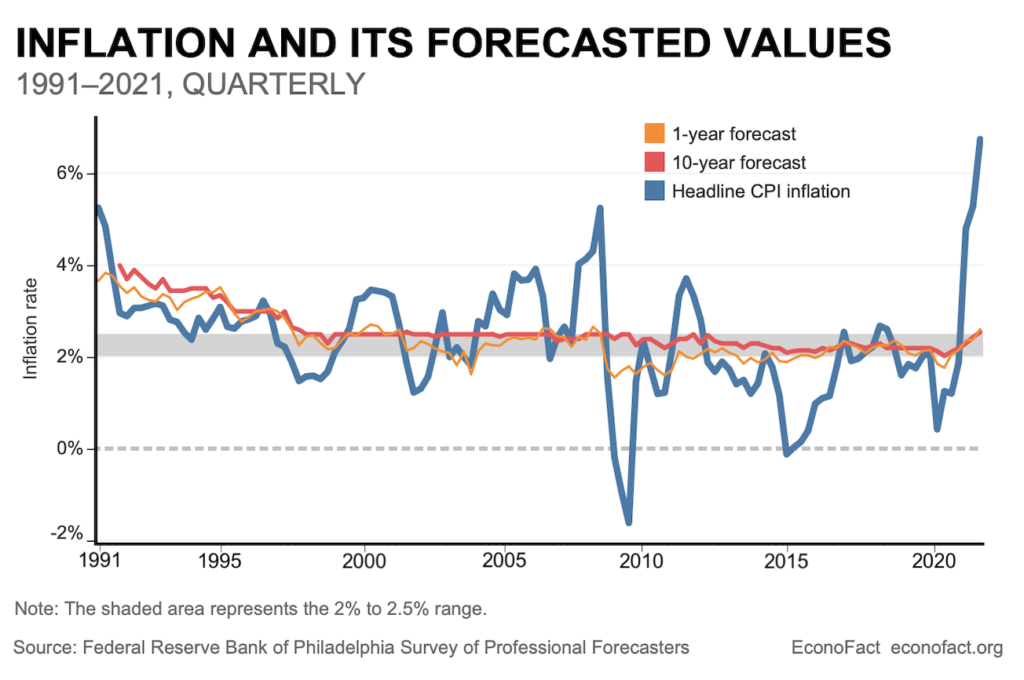
From ECONOFACT:
“The Issue:
Consumer prices rose 7 percent between December 2020 and December 2021, the third month in a row that this year-to-year inflation rate exceeded 6 percent. This December figure is the largest 12-month increase in 40 years. A central concern now is whether inflation will be transitory or, instead, we are entering a persistently high-inflation period, like what occurred in the 1970s.
Posted by at 6:24 PM
Labels: Macro Demystified
[New Paper] Parameter-efficient deep probabilistic forecasting
New paper by Olivier Sprangers, Sebastian Schelter & Maartende Rijke
Abstract:
Probabilistic time series forecasting is crucial in many application domains, such as retail, ecommerce, finance, and biology. With the increasing availability of large volumes of data, a number of neural architectures have been proposed for this problem. In particular, Transformer-based methods achieve state-of-the-art performance on real-world benchmarks. However, these methods require a large number of parameters to be learned, which imposes high memory requirements on the computational resources for training such models. To address this problem, we introduce a novel bidirectional temporal convolutional network that requires an order of magnitude fewer parameters than a common Transformer-based approach. Our model combines two temporal convolutional networks: the first network encodes future covariates of the time series, whereas the second network encodes past observations and covariates. We jointly estimate the parameters of an output distribution via these two networks. Experiments on four real-world datasets show that our method performs on par with four state-of-the-art probabilistic forecasting methods, including a Transformer-based approach and WaveNet, on two point metrics (sMAPE and NRMSE) as well as on a set of range metrics (quantile loss percentiles) in the majority of cases. We also demonstrate that our method requires significantly fewer parameters than Transformer-based methods, which means that the model can be trained faster with significantly lower memory requirements, which as a consequence reduces the infrastructure cost for deploying these models.
Read more here.
New paper by Olivier Sprangers, Sebastian Schelter & Maartende Rijke
Abstract:
Probabilistic time series forecasting is crucial in many application domains, such as retail, ecommerce, finance, and biology. With the increasing availability of large volumes of data, a number of neural architectures have been proposed for this problem. In particular, Transformer-based methods achieve state-of-the-art performance on real-world benchmarks. However, these methods require a large number of parameters to be learned, which imposes high memory requirements on the computational resources for training such models.
Posted by at 5:37 PM
Labels: Forecasting Forum
Subscribe to: Posts