



Sunday, April 10, 2022
Five reasons China’s productivity slowed down
From Noahpinion:
“It’s always an interesting experience to read books about China’s economy from before 2018 or so. So many world-shaking events have changed the story since then — Trump’s trade war, Covid, Xi’s industrial crackdowns, the real estate bust, lockdowns, Russia’s invasion of Ukraine. Reading predictions of China’s evolution from before these events occurred is a little like reading sci-fi from 1962.
When I started China’s Economy: What Everyone Needs to Know®, by the veteran economic consultant Arthur Kroeber, I was prepared for this surreal effect. After all, it was published in April 2016 — not the most opportune timing. So I was pleasantly surprised by how relevant the book still felt. Most of the book’s explanations of aspects of the Chinese economy — fiscal federalism, urbanization and real estate construction, corruption, Chinese firms’ position within the supply chain, etc. — are either still highly relevant, or provide important explanations of what Xi’s policies were reacting against. Dan Wang was not wrong to recommend that I read it.
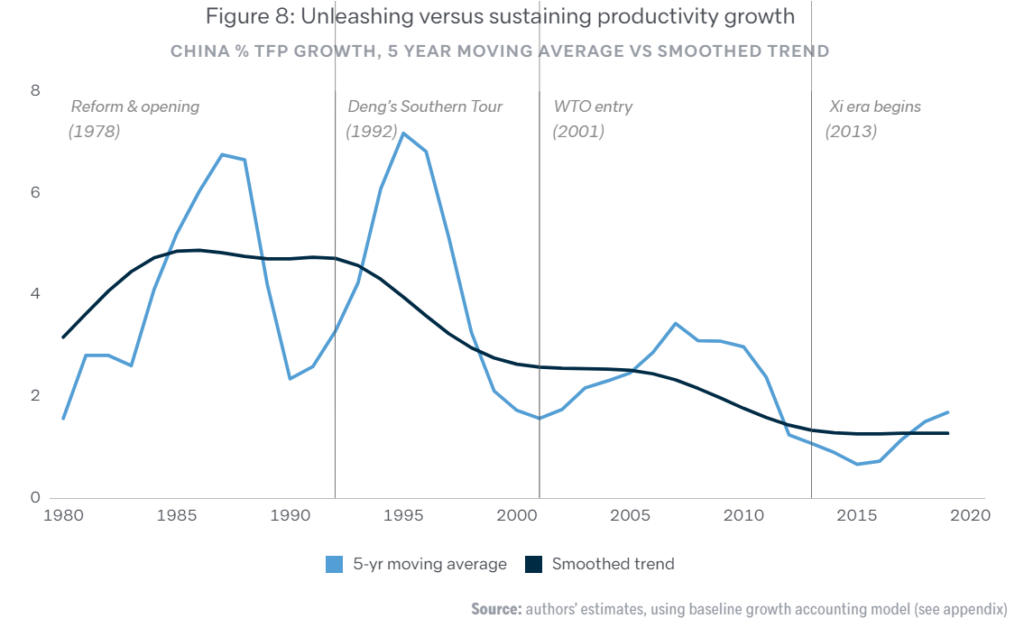
But China’s Economy is still a book from 2016, and through it all runs a strain of stubborn optimism that seems a lot less justifiable six years later. Most crucially, while Kroeber acknowledged many of China’s economic challenges — an unsustainable pace of real estate construction, low efficiency of capital, an imbalance between investment and consumption, and so on — he argued that China would eventually overcome these challenges by shifting from an extensive growth model based on resource mobilization to one based on greater efficiency and productivity improvements. This was despite his acknowledgement of the fact that productivity growth had already slowed well before 2016, and that Xi’s policies so far didn’t seem up to the challenge of reviving it.
In many ways, productivity growth is the thread that ties together the entire story of the Chinese economy since 2008. Basic economic theory says that eventually the growth benefits of capital accumulation hit a wall, and you have to improve technology and/or efficiency to keep growth going. Some countries, like Japan, South Korea, Singapore, and Taiwan, have done this successfully, and are now rich; other, like Thailand, failed to do it and are now languishing at the middle income level. For several decades, Chinese productivity growth looked like Japan’s or Korea’s did. But slightly before Xi came to power, it downshifted to look a bit more like Thailand. Here’s a graph from the Lowy Institute’s recent report:”
From Noahpinion:
“It’s always an interesting experience to read books about China’s economy from before 2018 or so. So many world-shaking events have changed the story since then — Trump’s trade war, Covid, Xi’s industrial crackdowns, the real estate bust, lockdowns, Russia’s invasion of Ukraine. Reading predictions of China’s evolution from before these events occurred is a little like reading sci-fi from 1962.
When I started China’s Economy: What Everyone Needs to Know®,
Posted by at 7:58 AM
Labels: Macro Demystified
Friday, April 8, 2022
Regional Differences in Okun’s Law and Explanatory Factors: Some Insights From Europe
From a new paper by Adolfo Maza:
“Okun’s law is one of the best-known stylized facts in the economic literature, as well as one of the most widely used policy tools. The aim of this paper, which utilizes a comprehensive sample of 265 European regions by using annual observations covering the period from 2000 to 2019, is to deepen our knowledge of Okun’s law from two perspectives: on one hand, by checking the existence and intensity of regional differences, and on the other hand, by assessing the factors that explain them. To this end, in the first part, we apply a heterogeneous panel approach that deals with cross-sectional dependence, which allows us to obtain an average coefficient as well as region-specific coefficients. In the second part, a cross-sectional spatial model is used to uncover explanatory factors. Our findings reveal quite remarkable regional differences, as well as a somewhat geographical pattern in them. Moreover, they point out the importance of demographic factors (such as gender and age), labor market variables (share of employment in industry and construction, as well as self-employment and part-time employment and the severity of long-term unemployment), R&D expenditure, and some national institutional factors when it comes to explaining differences across regions.”
From a new paper by Adolfo Maza:
“Okun’s law is one of the best-known stylized facts in the economic literature, as well as one of the most widely used policy tools. The aim of this paper, which utilizes a comprehensive sample of 265 European regions by using annual observations covering the period from 2000 to 2019, is to deepen our knowledge of Okun’s law from two perspectives: on one hand, by checking the existence and intensity of regional differences,
Posted by at 11:29 AM
Labels: Macro Demystified
Housing View – April 8, 2022
On cross-country:
- Global Residential Cities Index – Q4 2021 – Knight Frank
- Understanding African Real Estate Markets – Routledge
- Tighter monetary policy and regulation point to slowdown in property market – ING
On the US:
- Housing Market Expectations – CEPR
- The (Non-)Effect of Opportunity Zones on Housing Prices – Journal of Urban Economics
- The Housing Market Is Hot But Certainly Not ‘Unhinged’. Simple patterns in aggregated numbers provide no understanding as to why buyers are paying more for homes. – Bloomberg
- In Wealthy U.S. Suburbs, There’s Not Much of a Housing Boom. Westchester, NY, and Montgomery County, MD, are up about 1%. Home prices in two-thirds of counties gained over 10%: Attom – Bloomberg
- More Than Shelter: The Effects of Rental Eviction Moratoria on Household Well-Being – Philadelphia Fed
- Where pro-housing groups are emerging – Brookings
- The Effect of Housing First Programs on Future Homelessness and Socioeconomic Outcomes – Kansas Fed
- What Has Research Shown About Alternative Home Financing in the U.S.? A look at the available evidence and the persistent gaps, as well as topics for future investigation – PEW
- Home Prices Can Always Get More Ridiculous. Welcome to the (maybe) new normal. – Bloomberg
- Emergency Rental Assistance Has Helped Stabilize Struggling Renters – Harvard Joint Center for Housing Studies
- US mortgage interest rates hit 5% for the first time in a decade. That’s great news – Quartz
On other countries:
- [Australia] The risks of Australia’s ‘house and holes’ economy are rising. As the country faces an election, it is increasingly reliant on housing and mining for growth – FT
- [Australia] Australia’s Property Market Is Beginning to Cool, Led by Sydney – Bloomberg
- [Canada] Toronto Home Prices Dip as New Listings Close the Gap With Sales – Bloomberg
- [Canada] Canada to Ban Foreigners From Buying Homes as Prices Soar. Trudeau to put billions toward boosting housing supply. Benchmark price is up more than 50% over past two years – Bloomberg
- [Hong Kong] Hong Kong’s property tycoons braced for further losses from zero-Covid regime. Family-run developers forecast to face sharp fall in house prices after steep revenue drops last year – FT
- [Germany] Germany’s Bundesbank warns over bank loans to hot property market – Reuters
- [United Kingdom] UK house prices rise at fastest pace in 18 years. Annual growth hits 14.3% as price-to-earnings ratio reaches all-time high, according to Nationwide survey – FT
- [United Kingdom] UK house prices reach record high in March as supply remains short. Average cost of a property reaches £282,753 driven by strong demand for homes in less dense areas – FT
On cross-country:
- Global Residential Cities Index – Q4 2021 – Knight Frank
- Understanding African Real Estate Markets – Routledge
- Tighter monetary policy and regulation point to slowdown in property market – ING
On the US:
- Housing Market Expectations – CEPR
- The (Non-)Effect of Opportunity Zones on Housing Prices – Journal of Urban Economics
- The Housing Market Is Hot But Certainly Not ‘Unhinged’.
Posted by at 5:00 AM
Labels: Global Housing Watch
Wednesday, April 6, 2022
Globalisation and the effective taxation of capital versus labour
From VoxEU post by Pierre Bachas, Matthew Fisher-Post, Anders Jensen, and Gabriel Zucman:
“Globalisation has wide-ranging effects on tax systems. This column uses a new dataset of taxes on capital and labour across countries and time to assess these dynamics. The authors document a global convergence of average effective labour and capital taxes over time, as labour taxes have increased and capital taxes fallen. However, the large fall in capital taxation in developed economies contrasts its gradual rise in developing economies, albeit from a low base. This trend is consistent with evidence suggesting the causal effect of trade integration on the tax capacity of developing economies.
Social scientists have for a long time been cognisant that globalisation may have deep impacts on tax systems. In particular, economists have conjectured that increased openness pushes governments to reduce taxes on mobile factors of production and recover the revenue shortfalls by increasing taxes on immobile factors (Bates et al. 1985, Rodrik 1997). In this view, globalisation erodes the taxes effectively paid by capital owners, shifting the tax burden towards workers. The fall of statutory tax rates on corporate income worldwide (IMF 2019), and evidence that globalisation reduces income tax rates on mobile high-income earners at the expense of median-income workers (Egger et al. 2019) support this hypothesis. Prior work has focused on the recent experience of high-income countries, but how has cross-border integration affected the relative taxation of labour and capital historically and globally? And which countries have been most affected by the erosion of effective capital taxation, and why? Answering these questions is critical to shed light on the macroeconomic effects and long-run social sustainability of globalisation.
A new dataset to measure the effective taxation of capital and labour globally since the 1960s
Assessing the extent to which globalisation has affected tax systems requires a global and long-run dataset on the taxation of capital and labour. In Bachas et al. (2022), we assemble data on effective tax rates (ETRs) on labour and capital covering 150 countries and half a century. Constructed following a common methodology, these series offer a worldwide, historical, and comparative perspective on the evolution of tax structures.1
ETRs capture all taxes paid: on corporate income, individual income, payroll, property, inheritance, and consumption. They then assign each type of tax revenue to capital, labour or a mix of the two and divide these by their respective capital and labour flows in national accounts (Mendoza et al. 1994).2 ETRs thus make it possible to estimate total tax wedges – for instance, the gap between what it costs to employ a worker and what the worker receives – and how these wedges vary internationally and over time. Since capital income is always more concentrated than labour income, the relative taxation of the two factors of production is closely linked to the overall progressivity of the tax system.”
Continue reading here.
From VoxEU post by Pierre Bachas, Matthew Fisher-Post, Anders Jensen, and Gabriel Zucman:
“Globalisation has wide-ranging effects on tax systems. This column uses a new dataset of taxes on capital and labour across countries and time to assess these dynamics. The authors document a global convergence of average effective labour and capital taxes over time, as labour taxes have increased and capital taxes fallen. However, the large fall in capital taxation in developed economies contrasts its gradual rise in developing economies,
Posted by at 8:01 AM
Labels: Macro Demystified
Tuesday, April 5, 2022
Learning from Lucas
From Thomas J. Sargent:
“This paper recollects meetings with Robert E. Lucas, Jr. over many years. It describes how, through personal interactions and studying his work, Lucas taught me to think about economics.
Introduction
Starting in 1966, Robert E. Lucas, Jr. and other friends generously taught me about macroeconomics. This paper tells how in the early 1970s, together with Neil Wallace, I had hoped to construct, estimate, and optimally control a 1960s-style Keynesian macroeconomic model; how in 1973 Neil and I came to appreciate the way Lucas (1972a) affected our project; and how Chris Sims, Neil, Lars Hansen, and I struggled to respond constructively to Lucas’s insights by building, estimating, and evaluating rational expectations macro models. My story is full of starts and stops and accounts of once-promising dead ends. Let me summarize what might be worthwhile messages.
Recollecting parts of my intellectual journey with Bob starts in Section 2 with the story of our first meeting and my early exposure to the professional milieu around him at Carnegie, and how these interactions opened my bumpy road to rational expectations macroeconomics. In Section 3, I describe how in 1970, nine years after Muth (1961) had defined it, I was still unsure about how to define a rational expectation equilibrium, and how a conversation with Ed Prescott helped set me straight. In Section 4, I describe a large obsolescence shock, triggered by the neutrality paper (Lucas, 1972a), that hit me when I was 30 years old––actually, it was an aggregate obsolescence shock that hit the entire macro community. Section 5 provides a short story about my contribution to the creative process that led to the Lucas (1976) critique. I often encountered conflicts between evidence and theories, i.e., between empirical findings and simple models. Thus, in Section 6, I tell how in 1975, contrary to what I had gathered from talking to Neil Wallace, Lucas endorsed my estimation of an ad hoc demand function for money by saying that if theorizing to build deep foundations did not imply a demand function for money that looked much like Cagan’s, then it should be ignored. Section 7 is a story about how Bob’s idea about two factors underlying US business cycle facts, a nominal and a real one, inspired my paper on index models with Chris Sims, and why Bob didn’t publish his comment on our paper. In Section 8, I describe how Bob inspired me to apply recursive methods in a paper of mine on Tobin’s q in a general equilibrium.
The mid-1970s was the period when the Lucas critique and the theoretical and empirical work it elicited started reshaping econometric practice. After the dust had settled, macroeconometric practice was no longer what it had been before. Section 9 offers a look into this transformation process by showing that the exchange of ideas between adherents of the new approach and monetary policy was often very direct. In Sections 10–12, I describe how initially Bob urged me to pursue work that deployed the method of maximum likelihood to estimate and evaluate rational expectations macro models, how Bob later told me that this approach was rejecting too many good models, and how that led Bob largely to abandon econometrics for more forgiving calibrations in Prescott’s style. It was also thinking about the relationship between calibration and econometrics that led Lars Hansen and me to begin working on bringing concerns about robustness and model misspecification into macroeconomics. A message here is that hearing others and being open to new ideas can send you back to the drawing board and back to school. In Section 13, I tell how, late in our research careers, Bob and I revisited the idea that had originally attracted us to rational expectations––the hunch that it would be fruitful to put the model builder and the econometrician on the same footing, as John F. Muth (1961) had advocated. Section 14 denies that there has ever been a ‘rational expectations school’ that advocates and agreed upon set of policy prescriptions or a unique macroeconomic model. As an additional story, Section 15 illustrates Bob’s careful ways of thinking and writing. Section 16 contains some concluding remarks.
For me, research has always involved socializing and listening to and occasionally having the courage to talk back to larger-than-life personalities, wonderful people including Hyman Minsky, Oliver Williamson, Peter Diamond, Leonard Rapping, Neil Wallace, Chris Sims, Ed Prescott, and many others, who have strong and contending views. This adventure put a charge into learning macroeconomics.
Differences in preferences about how to do scientific economics are mainly about personalities and not about intelligence quotients. Personality differences surface in whether it is better to reason mainly in terms of English words or with mathematical expressions (see the story in Section 9 about Hyman Minsky, my mentor at Berkeley), or the primacy of theory versus econometric evidence (see Sections 10–12 for stories about interactions with Bob Lucas about econometrics and calibration; or the story in Section 15 about whether, without really thinking about it, I was behaving as a Bayesian or a frequentist). When differences in preferences do reflect differences in personalities, some disagreements across very smart researchers cannot be resolved from macro data that are too sparse along the dimensions that would be needed to resolve them.”
From Thomas J. Sargent:
“This paper recollects meetings with Robert E. Lucas, Jr. over many years. It describes how, through personal interactions and studying his work, Lucas taught me to think about economics.
Introduction
Starting in 1966, Robert E. Lucas, Jr. and other friends generously taught me about macroeconomics. This paper tells how in the early 1970s, together with Neil Wallace, I had hoped to construct,
Posted by at 6:28 PM
Labels: Profiles of Economists
Subscribe to: Posts