Showing posts with label Inclusive Growth. Show all posts
Tuesday, May 1, 2018
Revisiting the 1990s Debate on Globalisation
“Two decades ago, the economics profession concluded that trade with developing countries was not seriously hurting unskilled workers in developed countries.” A new post by Adrian Wood argues that “the debate from which that consensus emerged came to an end prematurely. Even now, the evidence does not permit any firm conclusion about the contribution of globalisation to the economic misfortunes of less-educated people in developed countries. Had there been less consensus among economists, more might have been done, sooner, to mitigate the social costs of globalisation.”
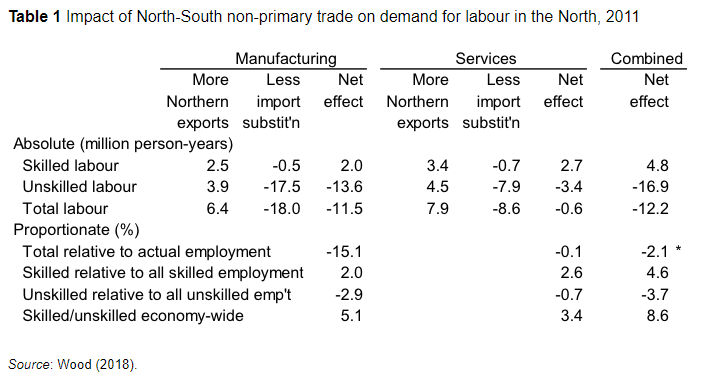
“Two decades ago, the economics profession concluded that trade with developing countries was not seriously hurting unskilled workers in developed countries.” A new post by Adrian Wood argues that “the debate from which that consensus emerged came to an end prematurely. Even now, the evidence does not permit any firm conclusion about the contribution of globalisation to the economic misfortunes of less-educated people in developed countries. Had there been less consensus among economists,
Posted by at 11:37 AM
Labels: Inclusive Growth
Inequality in US Life Expectancy
From a new post by Timothy Taylor:
“How much would you be willing to pay, in actual money, for an additional 30 years of life expectancy?”
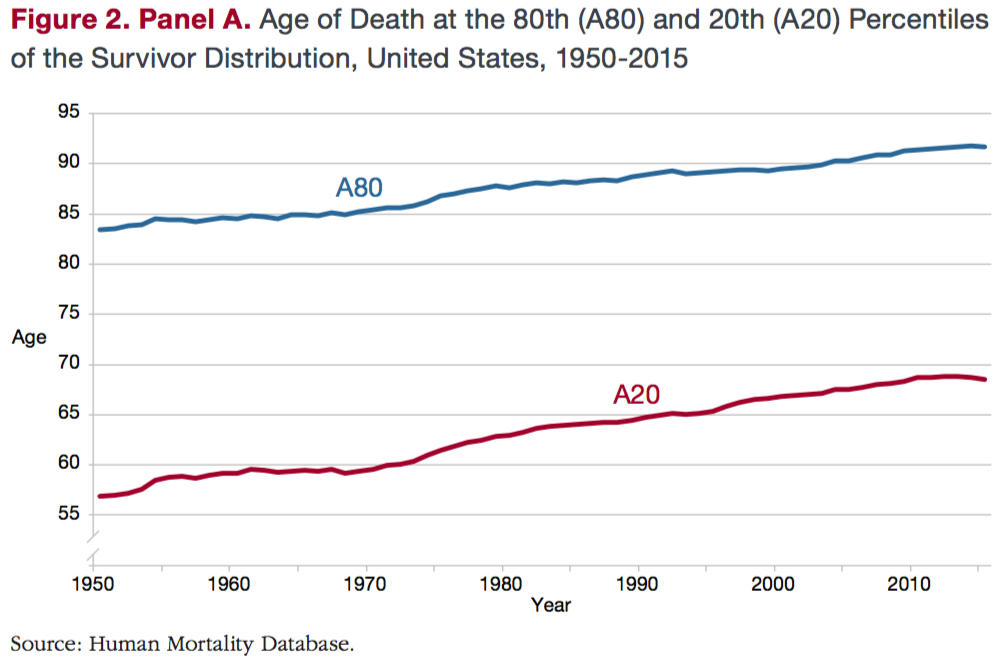
“Fuchs and Eggleston are especially focused on the inequality of life expectancy. So they look at where the age of death falls for the 20th and the 80 percentile of this distribution. Then they calculate how the age of death at these percentiles has evolved over time. It’s a little tricky to eyeball this result from the graph (and the authors provide more specific statistical meaures), but the inequality from 80th to 20th percentile diminished somewhat between about 1950 and 2000, but since then the degree of inequality hasn’t changed much.”
From a new post by Timothy Taylor:
“How much would you be willing to pay, in actual money, for an additional 30 years of life expectancy?”
“Fuchs and Eggleston are especially focused on the inequality of life expectancy. So they look at where the age of death falls for the 20th and the 80 percentile of this distribution. Then they calculate how the age of death at these percentiles has evolved over time.
Posted by at 11:36 AM
Labels: Inclusive Growth
Inequality and Poverty in Israel
A new IMF country report says that “Poverty and income inequality are high in Israel compared with peers, being exacerbated by the lower labor participation and productivity of some population groups, such as the Israeli-Arab and Haredi populations and non-Haredi Jewish women. Israel’s low redistribution of income through the budget limits its impact on reducing poverty and inequality. Given the projected rise in the share of the Haredi, and, to a lesser extent Arab, populations in coming decades, addressing the structural issues behind their low participation and productivity is an urgent matter.”
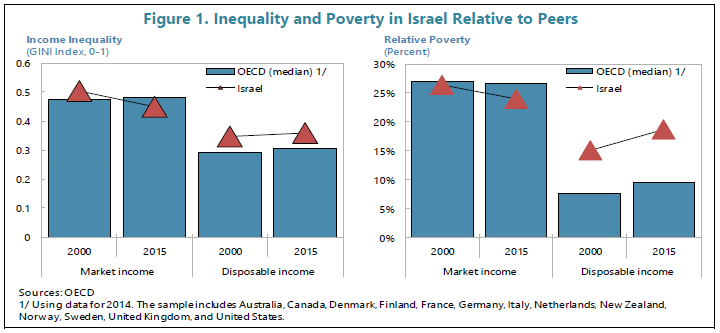
A new IMF country report says that “Poverty and income inequality are high in Israel compared with peers, being exacerbated by the lower labor participation and productivity of some population groups, such as the Israeli-Arab and Haredi populations and non-Haredi Jewish women. Israel’s low redistribution of income through the budget limits its impact on reducing poverty and inequality. Given the projected rise in the share of the Haredi, and, to a lesser extent Arab,
Posted by at 11:06 AM
Labels: Inclusive Growth
Friday, April 27, 2018
Fiscal Consolidation in Latin America and the Caribbean
A new IMF working paper constructs a new database on fiscal consolidation of 14 Latin American and Caribbean economies over the period 1989-2016. This paper further classifies “the consolidation episodes as “tax-based” or “expenditure-based” depending on whether tax hikes or expenditure cuts account for most of the budgetary impact of the consolidation.”
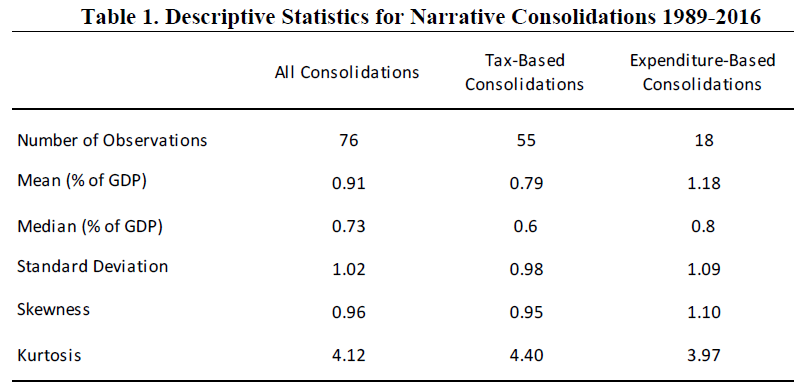
“The average consolidation size (excluding zero observations i.e. considering that a fiscal policy action occurred) is 0.9 percent of GDP with a standard deviation of about 1 percentage point (Table 1). Expenditure based consolidations are typically larger, although comparisons along this dimension should be made with care given the relatively small number of expenditure-based consolidations.”
A new IMF working paper constructs a new database on fiscal consolidation of 14 Latin American and Caribbean economies over the period 1989-2016. This paper further classifies “the consolidation episodes as “tax-based” or “expenditure-based” depending on whether tax hikes or expenditure cuts account for most of the budgetary impact of the consolidation.”
“The average consolidation size (excluding zero observations i.e. considering that a fiscal policy action occurred) is 0.9 percent of GDP with a standard deviation of about 1 percentage point (Table 1).
Posted by at 8:57 AM
Labels: Inclusive Growth
Wednesday, April 25, 2018
Growth Acceleration in the West African Economic and Monetary Union
From a new IMF country report:
“The West African Economic and Monetary Union (WAEMU) member countries have experienced growth acceleration since 2012. Relative to an earlier reference period in the 1990s, the WAEMU’s recent strong growth has coincided with an increase in macroeconomic stability and investment, improvement in political institutions, improvement in the terms of trade, and increase in productivity.”
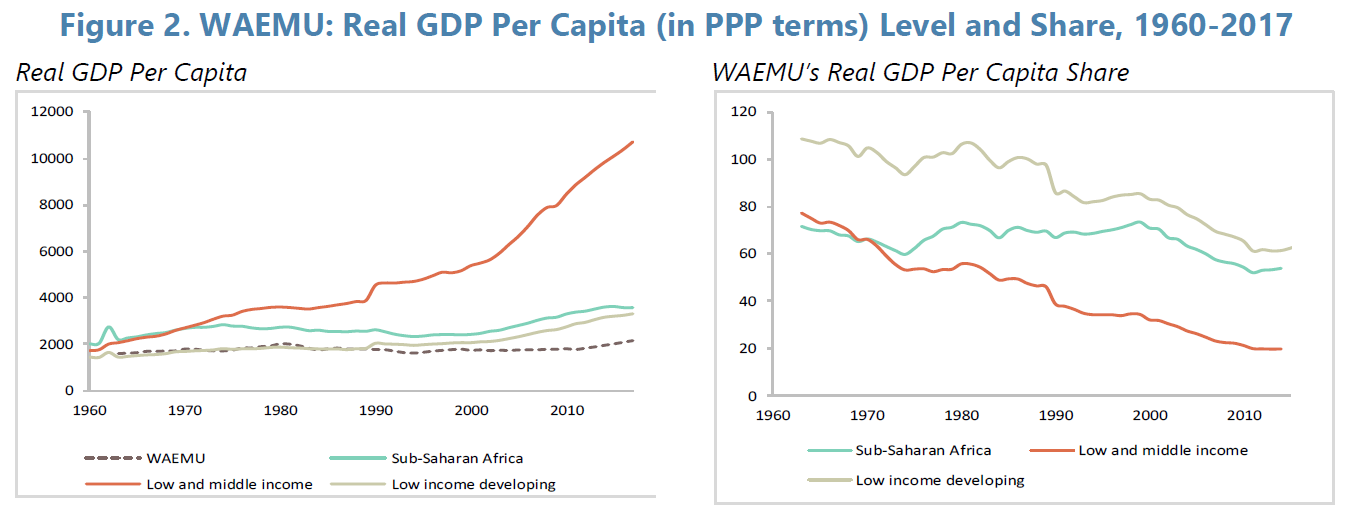
“Real GDP per capita in WAEMU countries has remained mostly stagnant while it has increased in other LIDCs (Figure 2). Income per capita in the WAEMU was close to that of the group of low and middle-income countries or low income developing countries or SSA in the early 1960s. However, since then, in terms of per capita income, WAEMU’s countries have experienced a widening gap relative to other LIDCs. While the share of the WAEMU income per capita in purchasing power parity—PPP—was 108 percent of that of the group of low-income developing countries in the early 1960s, it dropped to 65 percent in 2017.”
Continue reading here.
From a new IMF country report:
“The West African Economic and Monetary Union (WAEMU) member countries have experienced growth acceleration since 2012. Relative to an earlier reference period in the 1990s, the WAEMU’s recent strong growth has coincided with an increase in macroeconomic stability and investment, improvement in political institutions, improvement in the terms of trade, and increase in productivity.”
“Real GDP per capita in WAEMU countries has remained mostly stagnant while it has increased in other LIDCs (Figure 2).
Posted by at 1:37 PM
Labels: Inclusive Growth
Subscribe to: Posts