Showing posts with label Global Housing Watch. Show all posts
Sunday, December 5, 2021
2022 AEA’s papers on housing
*Note that this post will be updated as links to papers and presentations become available. Last updated: January 9, 2022.
On Covid-19 and health
- Can Stay-at-Home Orders Create a Pandemic Housing Boom? – Paper and Presentation
- How Resilient is Mortgage Credit Supply? Evidence from the COVID-19 Pandemic – Paper and Presentation
- COVID-19, Housing Prices and Macroprudential Policies – Paper and Presentation
- Flattening the Curve: Pandemic-Induced Revaluation of Urban Real Estate – Paper and Presentation
- The Impact of the Coronavirus Pandemic on New York City Real Estate: First Evidence – Paper and Presentation
- Living On My Own: The Impact of an Epidemic on Housing Preferences – Paper and Presentation
- Cleanliness is Next to Income: The Impact of COVID-19 on Short-Term Rentals – Paper and Presentation
- The Impact of Medicaid Expansion on Those Lacking Housing Basics, 2010-19 – Paper and Presentation
- Marital Transitions, Housing, and Long-Term Care in Old Age – Paper and Presentation
- Stuck at Home: Housing Demand During the COVID-19 Pandemic – Paper and Presentation
- Housing as a Human Right: Alternative Institutional Structures and Covid-19 – Paper and Presentation
- Racial Heterogeneity in Mortgage Outcomes During the COVID-19 Pandemic – Paper and Presentation
- COVID-19 Rental Eviction Moratoria and Household Well-Being – Paper and Presentation
- Impact of COVID-19 on Residential Real Estate – Paper and Presentation
- The Effects of Free Housing on Children’s Health and Healthcare Use – Paper and Presentation
- Health Implications of Housing Programs: Evidence from a Population-Wide Weatherization Program – Paper and Presentation
- The Health Consequence of Rising Housing Prices in China – Paper and Presentation
On house prices
- Internal Migration and House Prices in Australia – Paper and Presentation
- Old Age Savings and House Price Shocks – Paper and Presentation
- The Economic Burden of Pension Shortfalls: Evidence from House Prices – Paper and Presentation
- The Effect of School Redistricting on Housing Markets – Paper and Presentation
- Match Quality and House Price Dispersion: Evidence from Norwegian Housing Auctions – Paper and Presentation
- The Effect of School Redistricting on Neighborhood Sorting and House Prices – Paper and Presentation
- House Prices, Investors, and Credit in the Great Housing Bust – Paper and Presentation
- House Price Contagion and United States City Migration Networks – Paper and Presentation
- Housing Market Segmentation – Paper and Presentation
- House Prices, Home Equity, and Entrepreneurship: Evidence from U.S. Census Micro Data – Paper and Presentation
- What Do Hedonic House Price Estimates Tell Us When CAP Rates Vary? – Paper and Presentation
On mortgage market
- Reinforcement Learning for Household Finance: Designing Optimal Policy for Mortgage Market – Paper and Presentation
- Reluctant Savers and Mortgage Subsidies – Paper and Presentation
- The Consumption Response to Borrowing Constraints in the Mortgage Market – Paper and Presentation
- The Industry Expertise Channel of Mortgage Lending – Paper and Presentation
- Can Time‐Varying Risk Premia and Household Heterogeneity Explain Credit Cycles? – Paper and Presentation
- Mortgage Pricing and Monetary Policy – Paper and Presentation
- Appraisal Inflation and Private Mortgage Securitization – Paper and Presentation
- Opioid Epidemic and Mortgage Default – Paper and Presentation
- The Impact of Interest Rate Declines on Distressed Borrowers: Evidence from the 2000s Housing Bust – Paper and Presentation
- The Mortgage Piggy Bank: Building Wealth through Amortization – Paper and Presentation
- Mortgage Delinquency and Default: A Tale of Two Options – Paper and Presentation
- Is There Crowd-Out in Mortgage Refinance? – Paper and Presentation
- Do Mortgage Lenders Compete Locally? Implications for Credit Access – Paper and Presentation
- How Costly is Noise? Data and Disparities in the United States Mortgage Market – Paper and Presentation
On rental market
- Are Housing Rental Markets that Competitive? A Dynamic Monopoly Approach – Paper and Presentation
- Objectified Housing Sales and Rent Prices in Representative Household Surveys: the Impact on Macroeconomic Statistics – Paper and Presentation
- Eviction Risk of Rental Housing: Does It Matter How Your Landlord Finances the Property? – Paper and Presentation
- Macroeconomic Statistics based on Surveys: Circumventing Subjectivity in Housing Sales and Rent Data – Paper and Presentation
- Late Payment Fees and Nonpayment in Rental Markets, and Implications for Inflation Measurement: Theoretical Considerations and Evidence – Paper and Presentation
On inequality
- Land Prices and the Persistent Effects of Wealth Inequality – Paper and Presentation
- Racial Disparities in Housing Returns – Paper and Presentation
- Housing Market Channels of Segregation – Paper and Presentation
- Using High Frequency Evaluations to Estimate Discrimination: Evidence from Mortgage Loan Officers – Paper and Presentation
- Boomtowns: Local Shocks and Inequality in 1920s California – Paper and Presentation
- Do Credit Policies Affect Racial Groups Differently? Evidence from the Mortgage Market – Paper and Presentation
- The Impact of Federal Housing Policies on Racial Inequality – Paper and Presentation
- A Field Experiment on Racial Discrimination in the Rental Housing Market of Hawaii – Paper and Presentation
- The Intergenerational Transmission of Housing Wealth – Paper and Presentation
- The Impact of Federal Housing Policies on Racial Inequality – Paper and Presentation
On climate change and natural disasters
- Tsunami Risk and Information Shocks: Evidence from the Oregon Housing Market – Paper and Presentation
- Mortgage Markets with Climate-Change Risk: Evidence from Wildfires in California – Paper and Presentation
- Who Benefits from Water Quality Control? The Unequal Impacts of Environmental Regulation on Housing Wealth and Consumption – Paper and Presentation
- Peer Effects in Residential Green Infrastructure Adoption – Paper and Presentation
On housing supply and affordability
- Why Are More Young Adults Living With Their Parents? A role for housing affordability – Paper and Presentation
- How to Reduce Housing Costs? Understanding Local Deterrents to Building Multi-Family Housing – Paper and Presentation
- How to Build Affordable Housing? The Role of Local Barriers to Building Multi-Unit Housing – Paper and Presentation
- Reclaiming Local Control: School Finance Reforms and Housing Supply Restrictions – Paper and Presentation
- Sorting into Neighborhoods: The Role of Minimum Lot Sizes – Paper and Presentation
- Student Housing, Gentrification and Affordability: The US context – Paper and Presentation
On other papers
- The Long-Run Effects of Low-Income Housing on Neighborhood Composition – Paper and Presentation
- The Housing Phillips Curve – Paper and Presentation
- Who’s Right, Weber or Glaeser? – Paper and Presentation
- Estimating Housing Rent Depreciation for Inflation Adjustments – Paper and Presentation
- Housing Exclusion in Westchester County, NY – Paper and Presentation
- Who Gains from Housing Market Stimulus? Evidence from Housing Assistance Grants with Threshold Prices – Paper and Presentation
- Overconfidence and Personal Bankruptcy: Evidence from Mispricing in Singapore’s Private Housing Markets – Paper and Presentation
- Heirs’ Property in an Urban Context – Paper and Presentation
- Price Diffusion across International Private Commercial Real Estate Markets – Paper and Presentation
- Corporate Real Estate Holdings, Firm Value, and Returns: Evidence from a Dynamic Partial Adjustment Model – Paper and Presentation
- Retirement, Housing Mobility, Downsizing and Neighbourhood Quality-A Causal Investigation – Paper and Presentation
- The Value of School Social Climate Information: Evidence from Chicago Housing Transactions – Paper and Presentation
- The Impact of Public Housing on Student Academic Outcomes – Paper and Presentation
- Does Airbnb Reduce Matching Frictions in the Housing Market? – Paper and Presentation
- The Nexus between Fuel, Income, and Housing Poverty: Evidence from Egypt – Paper and Presentation
- What Determines the Success of Housing Mobility Programs? – Paper and Presentation
- Mandatory Pension Saving and Homeownership – Paper and Presentation
- Dynastic Home Equity – Paper and Presentation
- The Amenity Effects of Low-Income Housing Development – Paper and Presentation
- Decoupling Homes and Schools: Assessing the Impact of Forced School Choice on Residential Change – Paper and Presentation
- Does Financial Distress Affect Workers’ Productivity? Evidence from Real Estate Agents – Paper and Presentation
- Impact of Institutional Investors on Real Estate Risk – Paper and Presentation
- Tax Subsidies and the Cost of Homeownership: Evidence from the Tax Cuts and Jobs Act – Paper and Presentation
- New Listing Alert: Alternative Theory of Housing Search – Paper and Presentation
- Zero Price Effect and Consumer Welfare: Evidence from Online Classified Home Service – Paper and Presentation
- Breaking the Commitment Device: The Effect of Home Equity Withdrawal on Consumption, Saving, and Welfare – Paper and Presentation
*Note that this post will be updated as links to papers and presentations become available. Last updated: January 9, 2022.
On Covid-19 and health
- Can Stay-at-Home Orders Create a Pandemic Housing Boom? – Paper and Presentation
- How Resilient is Mortgage Credit Supply? Evidence from the COVID-19 Pandemic – Paper and Presentation
- COVID-19, Housing Prices and Macroprudential Policies – Paper and Presentation
- Flattening the Curve: Pandemic-Induced Revaluation of Urban Real Estate – Paper and Presentation
- The Impact of the Coronavirus Pandemic on New York City Real Estate: First Evidence – Paper and Presentation
- Living On My Own: The Impact of an Epidemic on Housing Preferences – Paper and Presentation
- Cleanliness is Next to Income: The Impact of COVID-19 on Short-Term Rentals – Paper and Presentation
- The Impact of Medicaid Expansion on Those Lacking Housing Basics,
Posted by at 2:01 PM
Labels: Global Housing Watch
Friday, December 3, 2021
Housing View – December 3, 2021
On cross-country:
- Some Economics of Place Effects – Conversable Economist
- A Convenient Representation of the Wealth Distribution and More Evidence on Homeownership and Wealth Inequality in Euro Area Countries – IZA
On the US:
- Fannie Mae, Freddie Mac to Back Home Loans of Nearly $1 Million. The maximum size of home-mortgage loans eligible for government backing will jump to $970,800 next year in high-cost markets – Wall Street Journal
- US lifts upper limit on government-backed home mortgages to almost $1m. Value of mortgages for purchase by Fannie Mae and Freddie Mac rises 18% after ‘exceptionally fast’ price increase – FT
- Supply-Chain Woes Snarl Attempts to Tame House Prices.Rising costs of construction materials, labor shortages complicate efforts to cool some of the world’s hottest property markets – Wall Street Journal
- The Housing Gang Is Getting Back Together for Another Bust. Fan and Fred will buy mortgages up to $1 million, repeating the mistakes that led to the 2008 crash. – Wall Street Journal
- Renters strike back as cities cap price hikes by landlords.The revival of rent control policies long derided by economists, including one of President Joe Biden’s top advisers, comes as officials scramble to contain rising prices across a range of goods and services. – Politico
- Racial Discrimination and Housing Outcomes in the United States Rental Market – NBER
- Have More People Moved During the Pandemic? – Harvard Joint Center for Housing Studies
- An Economy That Works for All: Fostering Low-Income Homeownership – New York Fed
- Individual and Local Effects of Unemployment on Mortgage Defaults – Philadelphia Fed
- Austin’s Texas-Size Luxury Housing Boom. The capital city has one of the hottest high-end real-estate markets in the country, with entry-level list prices for the top 5% of the market hitting $2.34 million in 2021, a rise of nearly 33% over 2020 prices – Wall Street Journal
- Individual and Local Effects of Unemployment on Mortgage Defaults – Philadelphia Fed
On China
- China Home Sales Slump Deepens as Easing Shows Little Effect – Bloomberg
- China Evergrande’s electric-vehicle unit gets US$200 million from returning undeveloped land.The Hong Kong-listed carmaker says the money will be used to fund construction projects and pay wages. Its cash-strapped parent, China Evergrande, is hoping to transform its business focus from property development to car manufacturing – South China Morning Post
- China property bond fears remain as house prices fall. Evergrande’s missed payments have led to a reckoning across the country’s real estate industry – FT
- Even in tech hub Shenzhen, China’s property market succumbs to chills – Reuters
On other countries:
- [Canada] Want to solve the housing crisis? Address super-charged demand – The Conversation
- [Czech Republic] Czech central bank gets tougher in mortgage lending rules amid property boom – Reuters
- [Germany] German banks vulnerable to housing bubble; should build buffers: Bundesbank – Reuters
- [Germany] Price rises in German housing market to ease but affordability worsen – Reuters
- [Hong Kong] Hong Kong home prices ease for 2nd month after record high – Reuters
- [Ireland] Irish house prices undervalued? Shows how misleading stats can be. European Commission report saying houses undervalued relies on outmoded statistics – The Irish Times
- [United Kingdom] Surge in stamp duty refunds on second-home surcharge. Property stock levels decline during the pandemic, say agents – FT
- [United Kingdom] The big picture: the decline and fall of a utopian social housing scheme – The Guardian
- [United Kingdom] London Housing Market Poised to Lag Behind U.K. Regions in 2022 – Bloomberg
On cross-country:
- Some Economics of Place Effects – Conversable Economist
- A Convenient Representation of the Wealth Distribution and More Evidence on Homeownership and Wealth Inequality in Euro Area Countries – IZA
On the US:
- Fannie Mae, Freddie Mac to Back Home Loans of Nearly $1 Million. The maximum size of home-mortgage loans eligible for government backing will jump to $970,800 next year in high-cost markets – Wall Street Journal
- US lifts upper limit on government-backed home mortgages to almost $1m.
Posted by at 5:00 AM
Labels: Global Housing Watch
Monday, November 29, 2021
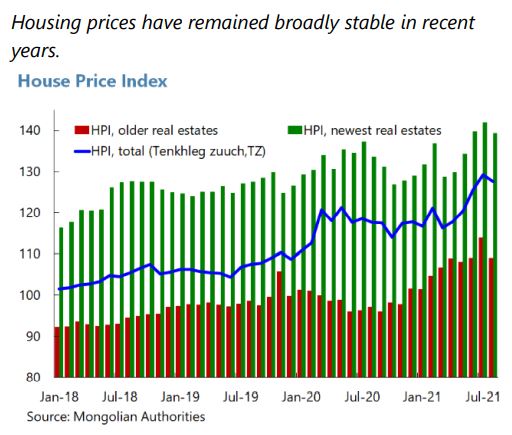
House Prices in Mongolia
Posted by at 6:16 PM
Labels: Global Housing Watch
Saturday, November 27, 2021
Demographia United States Housing Affordability: 188 Markets Rated
From New Geography:
“The Urban Reform Institute has published the 2021 edition of Demographia United States Housing Affordability, which rates middle-income housing affordability in the third quarter 2020. Demographia United States Housing Affordability is a supplement to Demographia International Housing Affordability, which covers 92 major housing markets (1,000,000 or more population) in 8 nations (Australia, Canada, China [Hong Kong only], Ireland, New Zealand, Singapore, the United Kingdom and the United States). The Demographia United States Housing Affordability provides ratings in 188 markets, including the 56 major metropolitan areas included in the earlier report.
Over the past year, housing affordability has deteriorated. Urban Reform Institute President Charles Blain noted: “It is not surprising that housing affordability — given the large influx of new buyers, particularly in suburban and outlying areas — has continued to deteriorate. As a result, many low-income and middle-income households who already have suffered the worst consequences from housing inflation will see their standards of living further decline.”
Rating Housing Affordability (The Median Multiple)
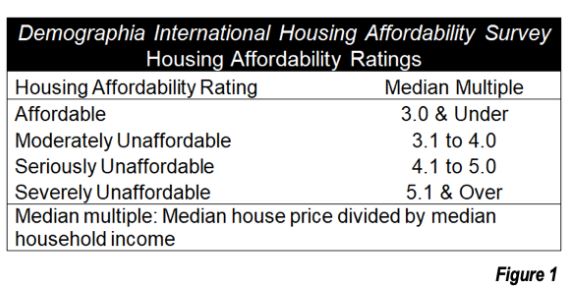
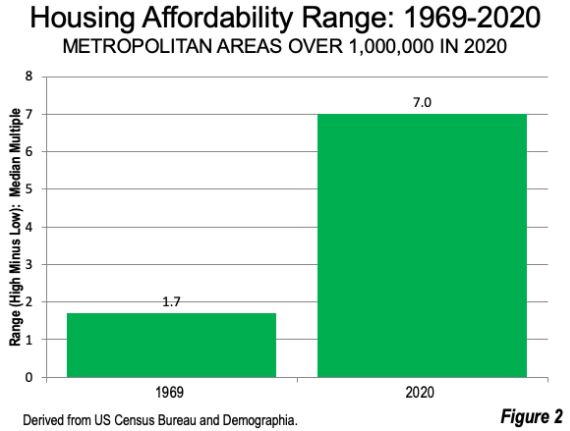
Demographia rates middle-income housing affordability in four categories, ranging from the most affordable (“affordable”) to the least affordable (“severely unaffordable”), as is indicated in Figure 1. As late as the 1990s price-to-income ratios were at or below 3.0 in Australia, Ireland, New Zealand, the United Kingdom and the United States, in markets rated “affordable. Since then, there has been a substantial divergence in affordability between major markets, which research has associated with stronger land use regulation (especially urban containment). The range between least affordable and most affordable markets rose by more than four times from 1969 to 2020 (Figure 2).”
Continue reading here.
From New Geography:
“The Urban Reform Institute has published the 2021 edition of Demographia United States Housing Affordability, which rates middle-income housing affordability in the third quarter 2020. Demographia United States Housing Affordability is a supplement to Demographia International Housing Affordability, which covers 92 major housing markets (1,000,000 or more population) in 8 nations (Australia, Canada, China [Hong Kong only],
Posted by at 7:06 AM
Labels: Global Housing Watch
Friday, November 26, 2021
Housing View – November 26, 2021
On cross-country:
- Hostility towards private equity’s push into property is misguided. Big investors are filling a gap in the market – The Economist
On the US:
- How Jerome Powell as Fed Chair Will Affect Crypto, Hot Housing and Inflation. Wall Street loves Powell for helping lift the stock market up from its pandemic lows. But will he continue to keep rates low and credit cheap? – Bloomberg
- Mortgage Bills Are Coming Again. $10 Billion in Aid May Arrive First. The federal Homeowner Assistance Fund aims to help those still struggling as forbearance periods come to an end. But the assistance isn’t limited to mortgage payments. – New York Times
- A record number of US homes are being built just for renters – Quartz
- Some Eviction Economics – Conversable Economist
- Home Prices Are Surging. The Manufactured-Housing Industry Sees an Opening. Some lenders and advocates think factory-built homes are a solution to the U.S. housing crunch – Wall Street Journal
- The Housing Proposal That’s Quietly Tearing Apart Atlanta. Secession efforts by Buckhead residents are gaining momentum as the city proposes zoning changes to create more apartments and affordable housing. – Bloomberg
- New York Targets Affluent Neighborhoods in Push for Affordable Housing. Supporters say the plans help address New York’s housing crisis and help integrate the city’s neighborhoods. Opponents see more gentrification and giveaways for developers. – New York Times
- Housing Is Cruising For A Bust, But Not Just Yet – Forbes
- The destabilizing cost of a pandemic: What COVID-19 meant for renters already getting assistance – Brookings
- Mortgage Burnout Looms for Lenders. Mortgage originators are likely to feel a hangover from the pandemic boom, so they need some new tricks – Wall Street Journal
- Five things to know about rising house prices. Benjamin Keys, a professor of real estate and finance at the Wharton School, gives his five main takeaways from the recent increase in house prices. – Penn Today
On China
- China eases pressure on property sector but reform remains priority. Beijing’s policy loosening to prevent collapse of industry does not represent a retreat, analysts say – FT
- China’s Economy Czar Liu He Calls For Stable Housing Market – Bloomberg
- Will China’s property tax rob from the rich and give to the poor, aiding common prosperity drive? China’s property tax plan is part of Xi Jinping’s so-called common prosperity campaign to redistribute wealth and to address widening social inequality. The plan will not be implemented straight away, with a five year pilot programme set to test the proposal before it is eventually rolled out across the country – South China Morning Post
On other countries:
- [Albania] A Denser City, But at What Cost? Albania’s capital is getting a makeover intended to stop urban sprawl. But critics say the plan could leave Tirana changed beyond recognition, and erase its history. – Bloomberg
- [Australia] ‘Twilight’ for Australia’s housing boom as prices to fall 10% in 2023, CBA says. Commonwealth Bank expects a peak in 2022 and then a drop the following year as borrowing costs rise – The Guardian
- [Australia] Who is responsible for housing affordability? – ABC
- [Austria] Austrian central bank sees growing risks from mortgages amid property boom – Reuters
- [Canada] Financial stability through the pandemic and beyond – Bank of Canada
- [Colombia] Striking a Balance. Toward a Comprehensive Housing Policy for a Post-COVID Colombia – World Bank
- [Hong Kong] Hong Kong conundrum: sky-high prices and flats the size of parking spaces. Ranked the world’s least affordable housing market, the cramped city suffers from a lack of supply – FT
- [New Zealand] New Zealand raises rates to 0.75% as house prices surge. Rates will have to rise above their neutral level to cool the economy, says central bank – FT
- [New Zealand] RBNZ outlines new home loan restrictions – Financial Review
- [Nigeria] Empty houses litter Nigeria’s cities despite housing crisis – Reuters
- [United Kingdom] Nationwide’s profits almost triple as mortgage borrowing stays high. UK building society reports strong demand despite expected BoE interest rate rises – FT
- [United Kingdom] Revealed: first-time homes have grown less affordable under the Tories. Guardian analysis shows situation has worsened in most of England and Wales since 2015 – The Guardian
On cross-country:
- Hostility towards private equity’s push into property is misguided. Big investors are filling a gap in the market – The Economist
On the US:
- How Jerome Powell as Fed Chair Will Affect Crypto, Hot Housing and Inflation. Wall Street loves Powell for helping lift the stock market up from its pandemic lows. But will he continue to keep rates low and credit cheap?
Posted by at 5:00 AM
Labels: Global Housing Watch
Subscribe to: Posts