Showing posts with label Global Housing Watch. Show all posts
Friday, May 17, 2013
House Prices in Belgium
“Real estate prices have continued to increase steadily through the financial crisis, outpacing increases in other advanced countries,” according to the IMF’s annual economic report on Belgium. It says that “prices have increased by 60 percent in real terms since 2000, and—unlike in other EU countries—there has been no price correction during the crisis. Marked increases in price-to-income and price-to-rent ratios relative to historical average suggest significant overvaluation. However, these measures do not account for the fact that housing was relatively inexpensive to begin with, and that there is therefore a large catching up effect underlying the rise of these indicators. Also, the rental market is very narrow as it is focused only on low-income social housing on one hand and high-end apartments in Brussels on the other. A broader assessment, including a comparison of absolute price levels relative to the rest of Europe, suggests that the degree of overvaluation is of the order of 5 to 20 percent.”

“Real estate prices have continued to increase steadily through the financial crisis, outpacing increases in other advanced countries,” according to the IMF’s annual economic report on Belgium. It says that “prices have increased by 60 percent in real terms since 2000, and—unlike in other EU countries—there has been no price correction during the crisis. Marked increases in price-to-income and price-to-rent ratios relative to historical average suggest significant overvaluation. However, these measures do not account for the fact that housing was relatively inexpensive to begin with,
Posted by at 3:55 PM
Labels: Global Housing Watch
Tuesday, May 14, 2013
House Prices in New Zealand
House prices are high in New Zealand, according to a new report by the IMF. Although affordability metrics are difficult to interpret, most show a significant deterioration in the last two decades. The median house to income ratio rose from 3 in 2000 to about 5 in 2007, before declining to about 4½ in the last five years as incomes outpaced nominal house price growth. This ratio is somewhat higher than that of several peer countries. Despite the recent decline, various measures still point to overvalued house prices. Model based analysis suggests an overvaluation of about 25 percent. Price income ratios are 20 percent higher than the average of the last three decades. Price to rent ratios, which also rose significantly during last boom, show an even larger overvaluation, although rent values in New Zealand are distorted by the large stock of public housing, which serves about 5 percent of the population.
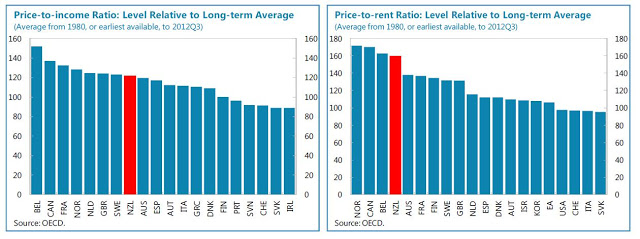
From this high base, house prices are beginning to rise again, particularly in Auckland and Christchurch. Real house prices post-2008 had been relatively stable until recent months, when nation-wide annual house price inflation picked up to over 5 percent.Auckland has had price increases of almost 12 percent for some months. The recent price pick up creates the risk of speculative demand that could induce price overshooting. Supply response will take time, and increased demand is likely to continue. Continue reading here.
House prices are high in New Zealand, according to a new report by the IMF. Although affordability metrics are difficult to interpret, most show a significant deterioration in the last two decades. The median house to income ratio rose from 3 in 2000 to about 5 in 2007, before declining to about 4½ in the last five years as incomes outpaced nominal house price growth. This ratio is somewhat higher than that of several peer countries.
Posted by at 9:34 PM
Labels: Global Housing Watch
Monday, February 18, 2013
Global House Price Watch
Global Housing Market: Spring in the air?
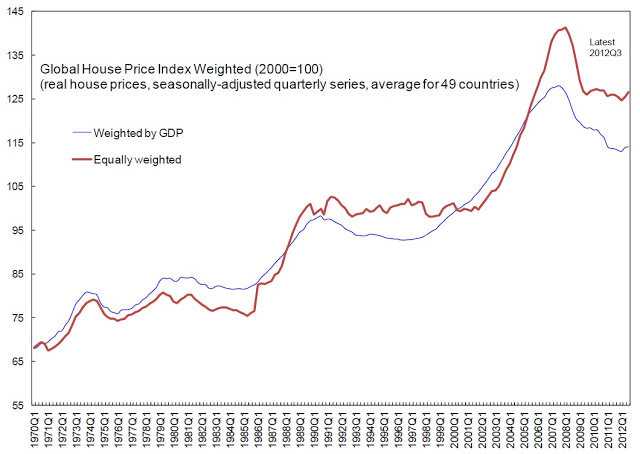
In a special report on house prices on March 30th 2002, the Economist said that if there is one single factor that has saved the world economy from a deep recession it is the housing market. In contrast, during the Great Recession (December 2007 to June 2009), the housing market was cast as the villain of the piece. How has the housing market fared since the end of the Great Recession? An updated global index of house prices has shown a mild sign of an uptick. Both the equally-weighted index and GDP-weighted index measures of global house prices show signs of improvement in house prices (see Chart 1).
Chart 1. Global House Price Index
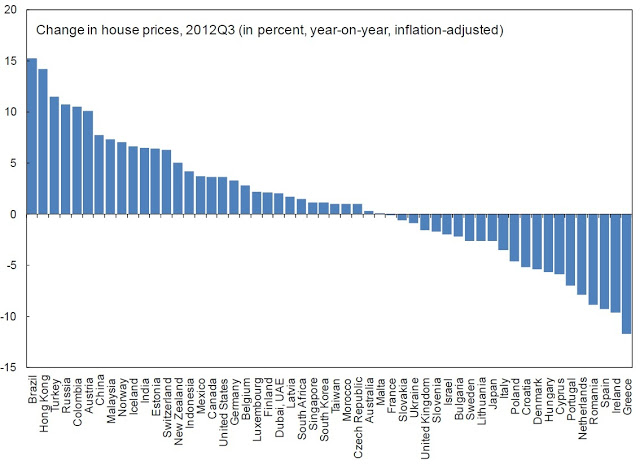
Zooming in, house prices around the world have followed different trajectories. In some parts of the world, house prices have appreciated or recovered, in others they continue to fall. For example, house prices for the United States have improved, while the outlook for house prices in a good part of Europe is gloomy.
Chart 2. House Prices around the World
Still room for house price correction?
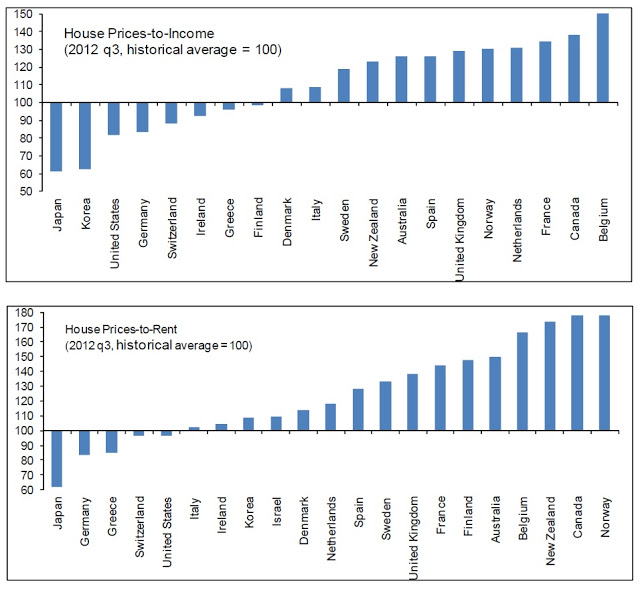
Chart 3 shows that in Canada, Belgium, Australia, United Kingdom and others, the house prices-to-income ratio and the house prices-to-rent ratio is still above historical averages. At the the other end, in Japan, United States, Germany, Greece and other countries, these rations are now below historical averages.
Chart 3. House Prices Relative to Incomes & Rents: Current Ratios Compared With Historical Averages
Assessing the outlook for house prices requires a more detailed look than just these historical ratios. In recent months, IMF staff have written about the outlook in Canada, Denmark, France, Hong Kong, Ireland and South Korea.
Global Housing Market: Spring in the air?
In a special report on house prices on March 30th 2002, the Economist said that if there is one single factor that has saved the world economy from a deep recession it is the housing market. In contrast, during the Great Recession (December 2007 to June 2009), the housing market was cast as the villain of the piece. How has the housing market fared since the end of the Great Recession?
Posted by at 5:53 PM
Labels: Global Housing Watch
Friday, February 15, 2013
House Prices in Canada
House price growth moderated in 2012, although with some regional variation. National house prices fell 1.2 percent over the second half of 2012, driven mainly by the sharp retrenchment in British Columbia. In turn, this was mainly the consequence of a sharp correction of prices in the Vancouver area, where condos prices were down to their 2010 levels as of December 2012. On a yearly basis, national house prices index is still up by about 3.5 percent in 2012, slightly down from the 6 percent growth in 2011, with Toronto, Calgary and in particular Regina posting the largest increases, according to a new IMF report on Canada.
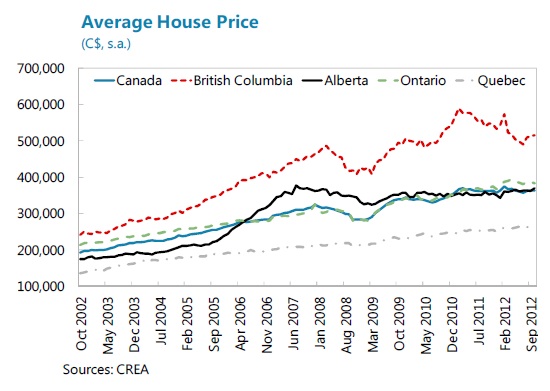
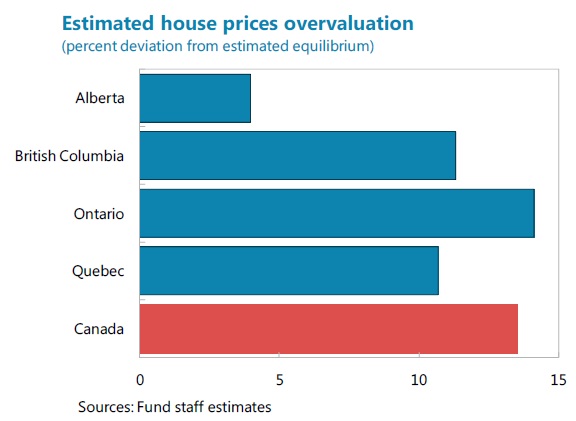
Moreover, the report points out that house prices are still on the strong side. As of December 2012, at a national level house prices were still almost 30 percent above their January 2009 trough. In Q3:2012, the house price-to-rent ratio was 60 percent above its historical average in Canada, more than in any other advanced economies with the only exception of Norway and Belgium. Price-to-income ratios also look high, and at almost 40 percent above their long-term average are among the highest.
House price growth moderated in 2012, although with some regional variation. National house prices fell 1.2 percent over the second half of 2012, driven mainly by the sharp retrenchment in British Columbia. In turn, this was mainly the consequence of a sharp correction of prices in the Vancouver area, where condos prices were down to their 2010 levels as of December 2012. On a yearly basis, national house prices index is still up by about 3.5 percent in 2012,
Posted by at 1:54 AM
Labels: Global Housing Watch
Subscribe to: Posts