Showing posts with label Global Housing Watch. Show all posts
Tuesday, April 29, 2014
Global House Prices: Continue Rising
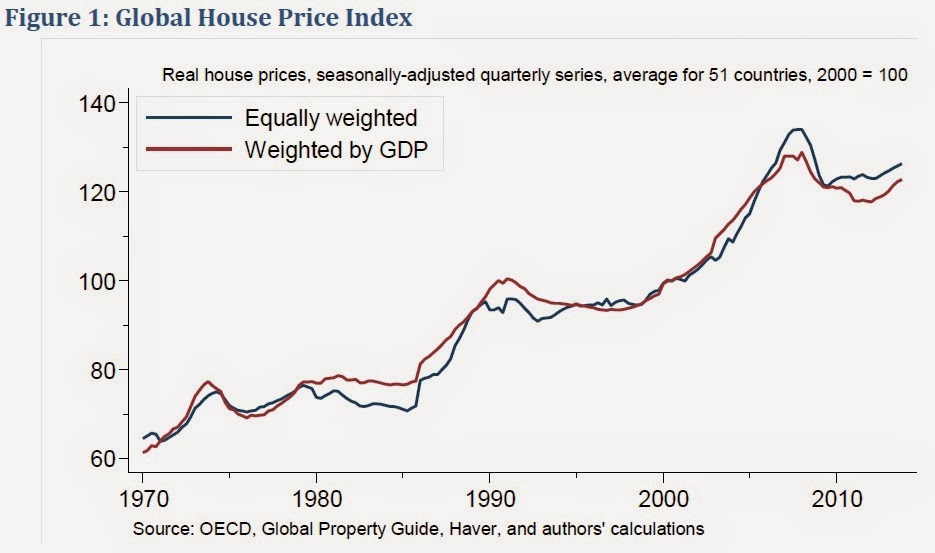
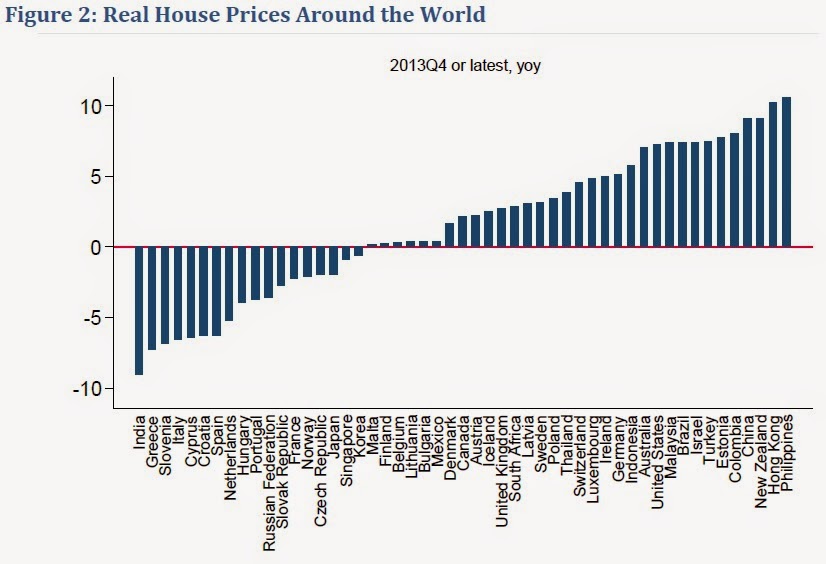
House Prices in OECD Countries: Where Do They Stand?
When comparing current house prices to the fourth quarter of 2006, the scale is balanced with half of the countries showing an increase in house prices and the other half showing a decline. However, the picture changes when we look at standard house price valuations in OECD countries. More than half of the OECD countries are above their historical averages for price-to-income and price-to-rent ratios. But, these valuations metrics should be taken with a grain of salt (e.g. in Finland, there is a difference between how actual average markets rents and the CPI rent component have developed, which over time results in difference in price-to-rent ratio).
At the aggregate level, global house price index continues to rise, registering seven consecutive quarters of growth. Similarly, at the micro level, more countries are registering growth, thirty three out of fifty one countries.
House Prices in OECD Countries: Where Do They Stand?
When comparing current house prices to the fourth quarter of 2006, the scale is balanced with half of the countries showing an increase in house prices and the other half showing a decline.
Posted by at 3:54 PM
Labels: Global Housing Watch
Sunday, April 20, 2014
House Prices in Malaysia
A new IMF note on Malaysia’s housing market points out that:
- “The high growth in housing prices over the past two years cannot be easily attributed to the factors that, historically, have explained developments in house prices (…) the growth rate in house prices displays a structural break in 2010.”
- “In particular, the behavior of residential loans does not seem to contribute to the recent dynamics of house prices.”
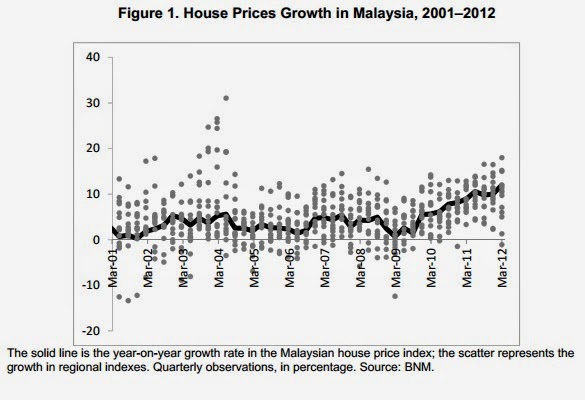
A new IMF note on Malaysia’s housing market points out that:
- “The high growth in housing prices over the past two years cannot be easily attributed to the factors that, historically, have explained developments in house prices (…) the growth rate in house prices displays a structural break in 2010.”
- “In particular, the behavior of residential loans does not seem to contribute to the recent dynamics of house prices.”
Posted by at 5:20 PM
Labels: Global Housing Watch
Saturday, March 15, 2014
House Prices in Malaysia
“House prices have increased rapidly, outpacing income and rental growth, along with strong demand for residential property loans, driven by a robust labor markets and falling lending rates. However, underwriting standards do not appear to have deteriorated, as evidenced by lower default rates by month on book for more recent vintages,” says the annual IMF economic report on Malaysia.
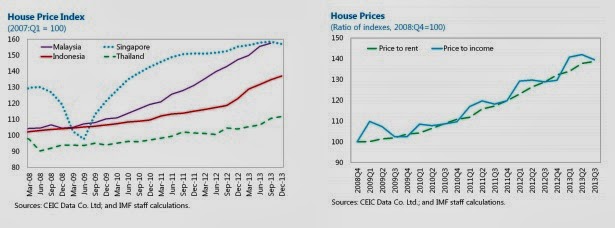
“House prices have increased rapidly, outpacing income and rental growth, along with strong demand for residential property loans, driven by a robust labor markets and falling lending rates. However, underwriting standards do not appear to have deteriorated, as evidenced by lower default rates by month on book for more recent vintages,” says the annual IMF economic report on Malaysia.
Posted by at 4:46 PM
Labels: Global Housing Watch
Wednesday, March 12, 2014
House Prices in Belgium
House prices are overvalued by “5–15 percent” according to a new IMF report on the Belgium economy. The report says that “Risks of a sharp correction of real estate prices appear contained. Property prices have risen by 110 percent in real terms since 2000, and, unlike in other EU countries, continued to increase through the financial crisis. Overvaluation estimates range from 10–60 percent, but valuation estimates based on price-to-income and price-to-rent ratios often miss catch-up effects. A finer assessment (interest-adjusted affordability regression analysis) suggests overvaluation of 5–15 percent. In fact, absolute prices remain moderate by European comparison. High ownership rates (around 70 percent), coupled with persistent housing shortages, are likely to prevent a rapid price decline. Robust household balance sheets, the prevalence of fixed interest rate mortgages, and the recent tightening of capital requirements on mortgage lending should limit the impact of an interest rate and/or unemployment shocks on the quality of the mortgage portfolio. However, the prevalence of fixed-rate mortgages shifts the interest rate risk to banks.”
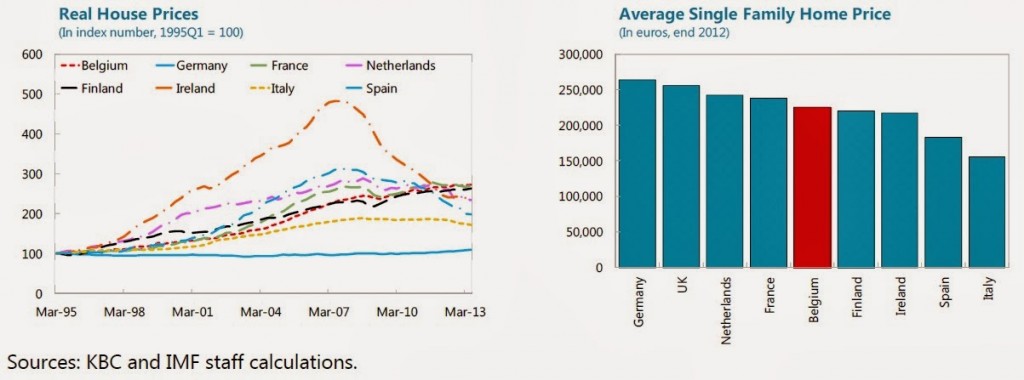
House prices are overvalued by “5–15 percent” according to a new IMF report on the Belgium economy. The report says that “Risks of a sharp correction of real estate prices appear contained. Property prices have risen by 110 percent in real terms since 2000, and, unlike in other EU countries, continued to increase through the financial crisis. Overvaluation estimates range from 10–60 percent, but valuation estimates based on price-to-income and price-to-rent ratios often miss catch-up effects.
Posted by at 5:02 PM
Labels: Global Housing Watch
Thursday, February 20, 2014
House Prices in Spain
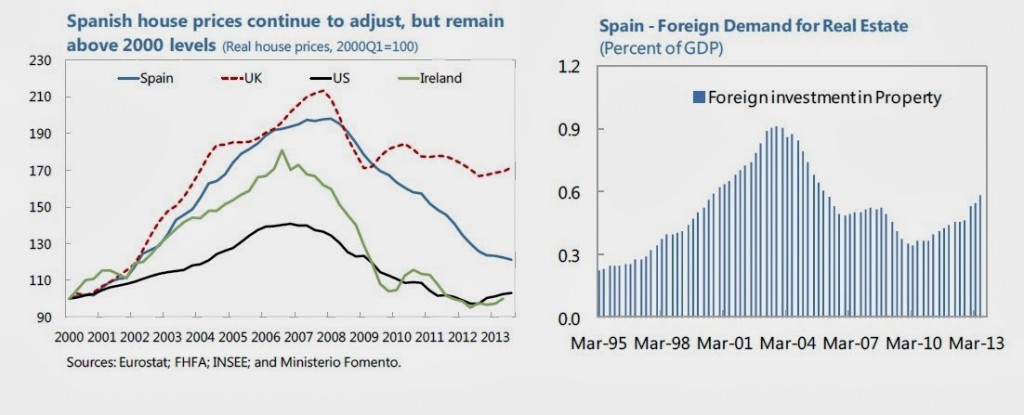
“Although house prices have started to stabilize in the most recent data, further declines are possible as the supply overhang is still large (the stock of vacant new houses equals four years of sales, and the population is falling). On the upside, foreign investor interest in Spanish property has increased noticeably in recent months,” according to a new report from the IMF.
Posted by at 8:25 PM
Labels: Global Housing Watch
Subscribe to: Posts