Showing posts with label Global Housing Watch. Show all posts
Wednesday, September 30, 2015
US Housing Market: An Update
What are the latest developments and emerging trends in the US housing and mortgage markets? This was the overall question that was the subject of a recent conference organized by Goldman Sachs in New York City on September 11. Here is a brief summary on the conference takeaways (extracts are taken from a note prepared by Hui Shan and Marty Young, both from Goldman Sachs).
On the housing market: “Housing starts far from normal, but hard constraints prevent a faster pace of normalization. The prolonged downturn disrupted the supply chain. For example, trade schools for construction workers disappeared, local governments cut back on their capacity in granting building permits, and builders did not begin buying lots three years ago, as they were not sure that housing had bottomed or could not secure financing. These forces add up to a slow pace of recovery.” Moreover, “There has been a seismic shift in household composition, with more singles and more families without kids. Both demographic and business cycle forces point to expanded growth in multi-family rental into the future.”
On how technology can change the housing and mortgage markets? “Compared to many other industries, housing and mortgage markets have lagged in their adoption of technology. More recently, real estate brokers have been using online search data to predict house price and home sales movements.” However, more could be done. For example, “Embracing e-Mortgage technology could potentially shorten closing timelines and reduce costs.”
On policy: “Housing policy needs to adapt to the new economy. Traditional ways of underwriting mortgages need to be changed to adapt to the evolving economy. For example, new FICO score formulas that reduce the weight of medical debt need to be incorporated. Income of borrowers such as Uber drivers needs to be underwritten properly. An inability to adjust to the changing economy can result in an inadvertent tightening of mortgage lending.”
From the Global Housing Watch Newsletter: September 2015
What are the latest developments and emerging trends in the US housing and mortgage markets? This was the overall question that was the subject of a recent conference organized by Goldman Sachs in New York City on September 11. Here is a brief summary on the conference takeaways (extracts are taken from a note prepared by Hui Shan and Marty Young, both from Goldman Sachs).
Posted by at 9:00 AM
Labels: Global Housing Watch
Monday, September 28, 2015
India’s Housing Market: What’s happened? What’s next?
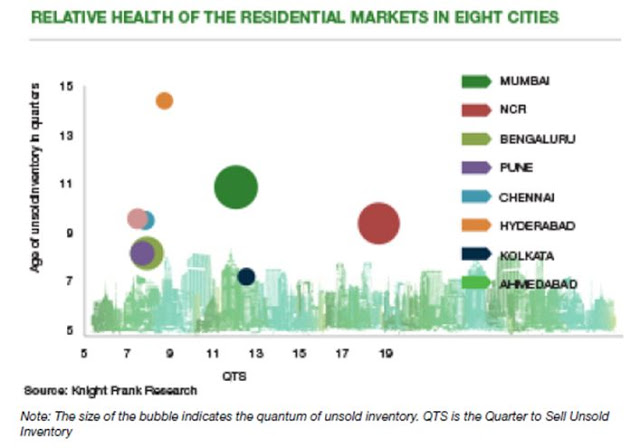
What’s happened to India’s housing market? There seems to be a slowdown and also a rising stock of unsold houses. This development has led to different views on India’s housing market. In a recent interview, Raghuram Rajan (Reserve Bank of India—RBI) said that “if real estate developers, who are sitting on unsold [housing] stocks, start bringing down prices, that will be a very big help to the sector because once there is a sense that the prices have stabilized more people will be willing to buy. (…) we also don’t want to create a situation where prices stay high at the level, which means demand can’t pick up (…)”. Similarly, the National Housing Bank (NHB) and Rayman Partners also agree that house prices are high. In terms of how long it will take to clear the housing inventory, Knight Frank says that “Mumbai has the highest number of unsold units in India (…). However, the NCR [National Capital Region] market will take the maximum time to liquidate its existing unsold inventory. At the current pace of sales, NCR will take more than four years to exhaust the unsold homes completely. Pune is currently the healthiest market, with the lowest QTS [quarters to sell unsold inventory] and a relatively lower age of unsold inventory”.
However, PropTiger and Farook Mahmood (Silverline Group and Chairman of NAR-India 7th Annual Convention) noted that when we talk about housing inventory data, we need to differentiate between the different types of inventory (e.g. ready-to-move-in vs. under-construction).
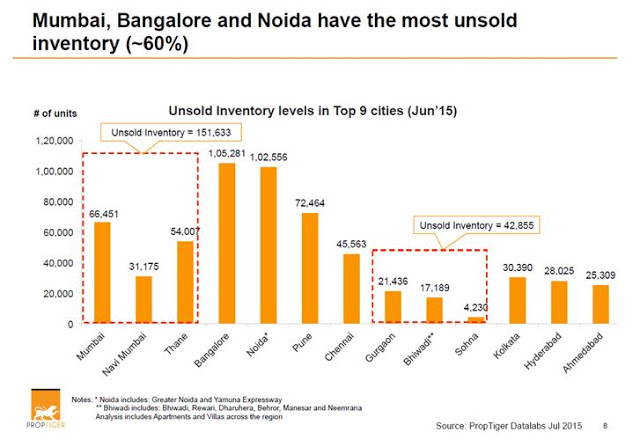
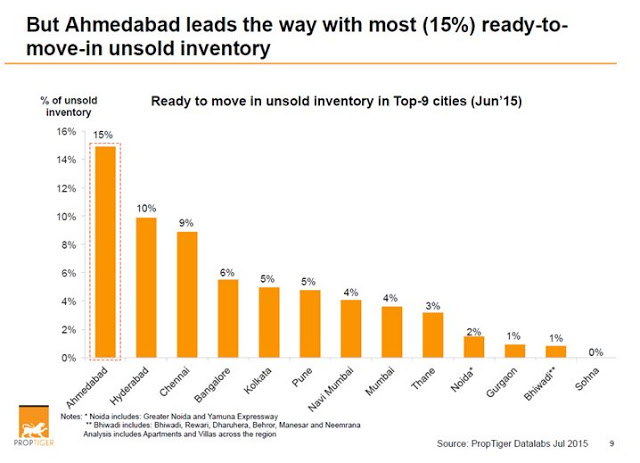
Also, the price of the unsold housing stock differs. For example, “69% of Mumbai’s unsold housing stock is priced above Rs. 1 Crore”, notes Ramesh Nair at Jones Lang LaSalle. Meanwhile, Irfan Razack (Prestige Group) stated that “(…) prices could come down only if the government reduced taxes related to property and ensured speedy approval of projects.” And Shashank Jain (PricewaterhouseCoopers) said “(…) developers were unlikely to drop base prices (…) if base prices were reduced, buyers may hold back purchases expecting more cuts in future. That would become counterproductive for the industry and economy.” Finally, a report by Ambit notes that there is “(…) a broad-based real estate pullback, with prices correcting in most tier I and tier II cities alongside sharp drops in transaction and new launch volumes. The drivers for this slowdown are a mix of supply-side factors (banks have pulled back lending to developers) and demand-side factors (the black money bill has created fear amongst speculators).”
What’s next for India’s housing market? “As the economic growth has started to take off, the overall buyer sentiment is expected to rise. Presumably, developers are counting on this to happen and hence holding the prices”, according to the RBI’s latest report. Meanwhile, PropTiger says that the housing market “(…) will soon be in better shape with the number of new launches likely to rise (…) when the festival season begins in October (…) the Q1 report predicts that the prices are not likely to fall in the near future.” On the unsold inventory, Knight Frank says that “(…) the unwinding process of the excess unsold inventory in these markets has already commenced since the first half of this year and (…) this process will continue for another six months in order to bring stability in the residential market. The deliberate slowdown in new launches undertaken by the real estate developer fraternity seems to be a pragmatic step in this direction and will hopefully lead the industry towards a path of sustainable development.” Finally, Shashank Jain says that “The inherent Indian demographics still makes the country’s real estate sector attractive. But if you are looking at short-term gains, then that continues to be a challenge (…) The long-term story is intact.”
More on India’s housing market. Charan Singh (Indian Institute of Management Bangalore) has studied the housing market in India. On India’s house price index, Singh notes that the NHB and RBI construct and release a house price index. But, there are a number of problems with both indices. NHB’s HPI “(…) is based on extensive data collected by different commercial banks and finance company located in 26 cities and is widely accepted in the country. Innovations that rely on data sources cannot be implemented until precise indices are provided in public domain and with robust history to inspire confidence. In India, neither data definitions are standardized nor is the methodology. The data is also collected by non-trained officials. The methodology of the RBI’s HPI is somewhat standardized but also has gaps. HPI only covers data collected from registration department of 9 cities but computes a national HPI based on that limited data set.” In a separate study, Singh compares India’s housing market with the United States and Spain and notes that there is need to have a well developed housing finance market in India.
From the Global Housing Watch Newsletter: September 2015
What’s happened to India’s housing market? There seems to be a slowdown and also a rising stock of unsold houses. This development has led to different views on India’s housing market. In a recent interview, Raghuram Rajan (Reserve Bank of India—RBI) said that “if real estate developers, who are sitting on unsold [housing] stocks, start bringing down prices, that will be a very big help to the sector because once there is a sense that the prices have stabilized more people will be willing to buy.
Posted by at 9:00 AM
Labels: Global Housing Watch
Monday, September 21, 2015
Developments in Israel’s Housing Market

Another IMF report compares the system of taxation on housing in Israel with other countries. It finds that “The current framework of housing taxation in Israel is broadly in line with global standards, but with few elements that have likely increased underlying demand for housing. (…) The Israeli government has appropriately taken steps to tighten the eligibility of exemptions for the capital gains, acquisition tax, and gift taxes. (…) Addressing the supply-side issues will be critical.”
The IMF’s latest report on Israel points out that “To contain further housing price increases, supply needs to be boosted. Concerted efforts among relevant ministries and local governments are needed. To contain the increase in leverage, macroprudential measures should be used.”
Another IMF report compares the system of taxation on housing in Israel with other countries. It finds that “The current framework of housing taxation in Israel is broadly in line with global standards,
Posted by at 9:00 AM
Labels: Global Housing Watch
Friday, September 18, 2015
Housing Market in Saudi Arabia
The report also “(…) emphasized the need for ensuring that the housing needs of the population are met in a cost-effective way while minimizing the disruption to private real estate and mortgage markets. Housing is appropriately an important policy priority, but the program cost is high and to date it has moved slowly. Measures to expand supply should include a strengthened role for the government acting as a facilitator and regulator rather than a developer to help expand housing supply in a cost effective way. In this context, streamlining regulatory and approval processes to achieve efficiency gains could improve the functioning of private real estate markets. With respect to the support for buyers, financing should be targeted to those who are unable to obtain financing from banks or finance companies, and focus on purchases of new dwellings to avoid bidding real estate prices up further.”
“The government is continuing to implement its program to provide affordable housing. In light of the growing population and reported high house prices in the major cities, this is a considerable challenge. Estimates suggest that 160-180,000 new homes will need to be built each year over the next few years to meet growing demand. The government has allocated SR 250 billion from the budget surplus fund for the program, and the Ministry of Housing is continuing to develop options to support buyers which include the provision of interest-free loans (up to SR 500,000), Read the full article…
Posted by at 9:00 AM
Labels: Global Housing Watch
Wednesday, September 16, 2015
Rising House Prices and Household Debt: A Twin Boom in Norway?
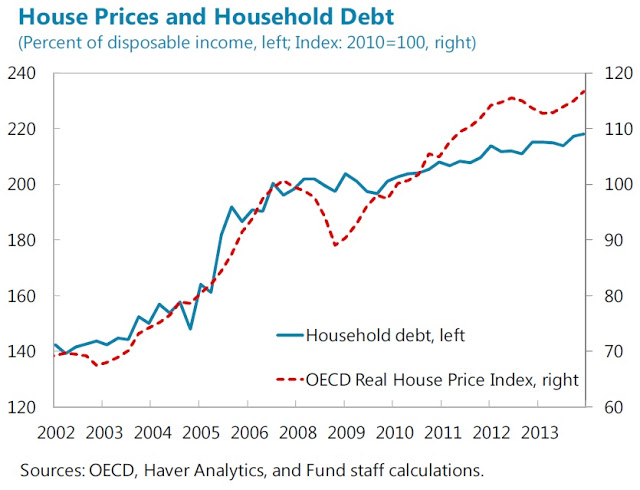
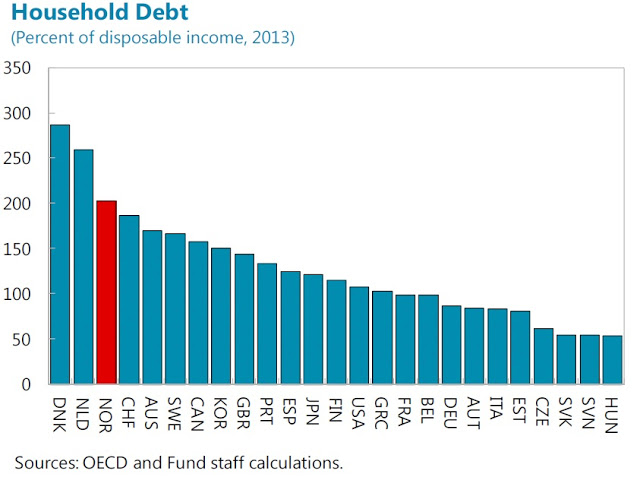
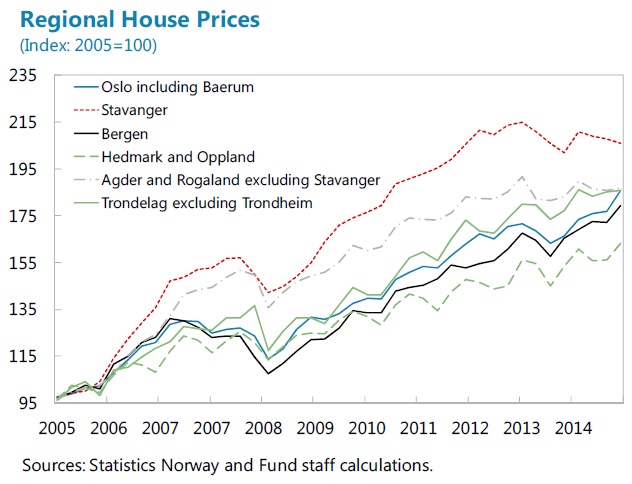
“The Norwegian housing market was only moderately affected by the global financial crisis, and the rising trend of house prices resumed shortly after the crisis. In the meantime, household debt reached more than 200 percent of disposable income, and it is expected to grow further”, a new IMF paper examines the characteristics of household debt and the factors driving the housing boom and debt accumulation. The paper also examines the potential macroeconomic impact of a possible house price correction. Read the full article…
Posted by at 9:00 AM
Labels: Global Housing Watch
Subscribe to: Posts