Showing posts with label Global Housing Watch. Show all posts
Saturday, September 10, 2016
Immigrants and the Housing Market
by: Hites Ahir
What is the impact of immigration on the housing market? What is the impact at the county level? What do recent trends tell us? Does immigration results in increased residential segregation in urban neighborhoods? These are some of the questions that were discussed at a recent conference organized by the Cato Institute on Immigration Economics on September 2.
The conference had a panel session on Immigration and Real Estate. The panelists were Gary D. Painter (University of Southern California Sol Price Center for Social Innovation), Jacob Vigdor (University of Washington), and Susan M. Wachter (University of Pennsylvania). Mark Calabria (Cato Institute) moderated the session. What follows are some highlights from this session.
The $3.7 trillion effect on housing wealth
Vigdor talked about the impact of immigration on the housing market at the county-level in the United States. To estimate the impact, Vigdor uses population and housing data for US counties from 1970 to 2010. Among other findings, he finds that if 1,000 immigrants move into a community, the forecast is that median home values will rise by $116 US dollars. He points out that most immigrants reside in a county of 800,000 housing units. So the total impact per immigrant on the housing market is about $90,000 US dollars. And if we multiply $90,000 by 40 million immigrants in the US, we get $3.7 trillion US dollars—this is the impact of immigration on US housing wealth.
Are immigrants less or more mobile?
Painter showed that immigrants now are no more mobile than native born populations. The “gap between natives and immigrants has fallen tremendously”, Painter said. For example, using data from the current population survey, he showed that overall mobility has decreased for immigrants. Similarly, long distance mobility (interstate and inter-county) shows that overall mobility in the US has been declining, but it is declining even faster for the immigrant population. He says that the most interesting finding is that the housing demand of immigrants is no different than natives.
How does immigration impact neighborhoods?
In a paper co-authored with Albert Saiz (Massachusetts Institute of Technology), Wachter tests whether immigration results in increased residential segregation in urban neighborhoods due to native attitudes toward mixed neighborhoods. “In general, we find that immigration does lead to more segregated neighborhoods”, Wachter said. The paper also finds that there is a relative price decline and native flight. “In areas with higher initial density of white residents or more expensive initial housing prices, immigration has a stronger impact on outflow of native population”, Wachter said.
Video of the session:
by: Hites Ahir
What is the impact of immigration on the housing market? What is the impact at the county level? What do recent trends tell us? Does immigration results in increased residential segregation in urban neighborhoods? These are some of the questions that were discussed at a recent conference organized by the Cato Institute on Immigration Economics on September 2.
The conference had a panel session on Immigration and Real Estate.
Posted by at 5:40 PM
Labels: Global Housing Watch
Tuesday, August 30, 2016
House prices in Korea
“House prices have been rising in the Seoul metropolitan area, while prices in other regions have weakened after increasingly rapidly over the past few years. Overall, house prices do not seem overvalued according to the usual affordability metric”, says IMF’s report on Korea.
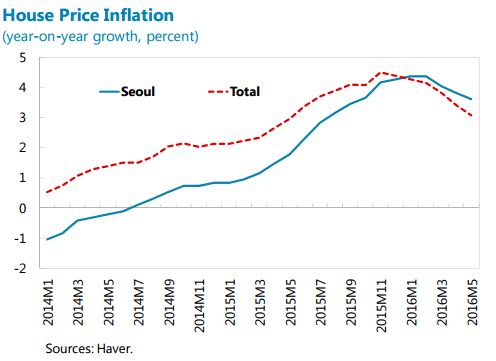
“House prices have been rising in the Seoul metropolitan area, while prices in other regions have weakened after increasingly rapidly over the past few years. Overall, house prices do not seem overvalued according to the usual affordability metric”, says IMF’s report on Korea.
Posted by at 5:00 AM
Labels: Global Housing Watch
Tuesday, August 23, 2016
Global and Local Housing Markets: The View From Experts at the Dallas FED
From Global Housing Watch Newsletter: August 2016
In this issue of the Global Housing Watch newsletter, Enrique Martínez-García and Valerie Grossman spoke with Hites Ahir about their work on housing markets. Martínez-García is a senior research economist and advisor, and Grossman is a senior research analyst in the Research Department at the Federal Reserve Bank of Dallas.
Disclaimer: The views expressed in this Q&A are those of the authors and do not necessarily reflect the views of the Federal Reserve Bank of Dallas or the Federal Reserve System.

Enrique Martínez-García and Valerie Grossman
Hites Ahir: Since 2011, the Dallas Fed has been publishing data on house prices and personal disposable income across countries. Could you tell us what prompted you to look at house prices across countries and a bit about the data?
Enrique Martínez-García and Valerie Grossman: The global 2008-09 recession brought renewed interest in understanding housing and its effects on the macroeconomy, but also a growing recognition that there is an important global dimension to housing that can no longer be ignored. Early on in our own work, we realized that the lack of consistent, reliable and comparable time series across countries remained a significant limitation to tackle questions on international housing—and not just for us! Since 2011, with a lot of help at the beginning from our former colleague Adrienne Mack, we have combed through many sources and consulted housing experts from around the world. As a result of all this extensive work, we put together a balanced panel dataset of quarterly housing market indicators starting in the first quarter of 1975 for 23 countries (currently).
Our dataset is released regularly to the public at quarterly frequency through the Dallas Fed’s international house price database website to further facilitate discussion and research on global housing. The database includes corresponding indexes on personal disposable income (PDI) per capita to control for changes in the affordability of housing, and additional novel tools for monitoring housing. We also continue to develop new sources and new partnerships to broaden the database—next on our agenda for this year is the inclusion of data for Slovenia.
Hites Ahir: The Bank for International Settlements (BIS) and the Organisation for Economic Co-operation and Development (OECD) also publish data on house prices. How does the Dallas Fed’s house price dataset compare to the other two?
Enrique Martínez-García and Valerie Grossman: We view our database as opening a new window to track and investigate international housing dynamics. Other resources such as the BIS repository and its panel of long time series or the long-standing work of the OECD on house prices and house-price-to-fundamental ratios provide additional information and bring forth their own approaches. There is naturally somewhat of an overlap, so we complement each other (and in some areas we even benefit from their work). However, our data is also distinct along key dimensions that are worth highlighting.
Our emphasis, which differentiates us from the BIS and the OECD, is on the consistency, comparability and replicability across countries for empirical analysis, taking the U.S. Federal Housing Finance Agency price index as our reference benchmark. Additionally, we foster research on international housing by including PDI per capita and other unique resources like statistics summarizing key features of the time series (exuberance indicators) as well as historical vintages.
Our country sources and methodology are largely determined by these overarching goals, which explains some of the differences that arise and variation in coverage between our data and the OECD and BIS data. We provide extensive and up-to-date documentation on our general methodology and the country detail, for anyone interested in exploring the nitty-gritty of the international house price database.
Hites Ahir: There is also a dataset on Exuberance Indicators produced by the Dallas Fed. Could you explain what these indicators are?
Enrique Martínez-García and Valerie Grossman: The exuberance indicators are the result of an ongoing partnership with Efthymios Pavlidis and his colleagues in the Department of Economics at Lancaster University Management School, who separately release similar indicators for U.K. regional housing markets. We derive these indicators from the recently developed recursive unit root tests of Yale economist Peter C. B. Phillips and his co-authors called Supremum Augmented Dickey Fuller (SADF) and Generalized SADF (GSADF). We employ them to detect and date the periods of exuberance during which house prices (or conventional house-price-to-fundamentals ratios) display explosive behavior.
Exuberant or explosive price behavior may occur when house prices are not based on housing market fundamentals, so these exuberance measures provide useful information for the detection of emerging misalignments and are powerful tools for monitoring housing. Detecting such periods is important due to the fact that, historically, rapid price increases have been followed by large corrections, which have severe consequences for the real economy—the most notable example being the boom-bust episode of the 2000s.
In a 2015 paper published at The Journal of Real Estate Finance and Economics, we explore the features of the international house price database in detail, showing evidence of the unique global dimension of the episode of exuberance that preceded the global 2008-09 recession. Incidentally, we also propose in that paper a novel extension of the GSADF test to a panel setting to exploit the large cross-sectional dimension of our international data. We view this as an important step to enhance our ability to detect common episodes across multiple series.
Hites Ahir: All the datasets were updated in July and include the data for the first quarter of 2016. Looking at the data, are you seeing any common patterns across countries?
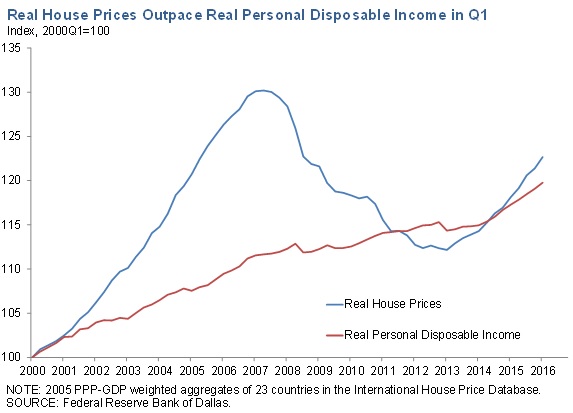
Enrique Martínez-García and Valerie Grossman: While our 23-country aggregates for both real house prices and real personal disposable income are rising, house price growth continues to outpace that of PDI per capita in the first quarter of 2016, suggesting that housing is becoming less affordable globally albeit not across all countries. The recovery of real house prices remains uneven and, as a matter of fact, we still see a number of countries below their pre-recession levels.
The exuberance statistics based on real house prices do show areas of emerging risk, meaning that several countries show multiple quarters where the indicator is above conventional critical values for detecting explosive behavior—among them most notably Switzerland and Canada. However, we would caution not to over-interpret those signs of risk. We still don’t see any major signs of a boom in the price-to-income ratios where we control for changes in the affordability of housing—so as not to treat house price movements in isolation.
Hites Ahir: In a recent article titled: Curb Your Enthusiasm: Keeping an Eye on Home Prices, you take a look at house prices in Texas. What do you find?
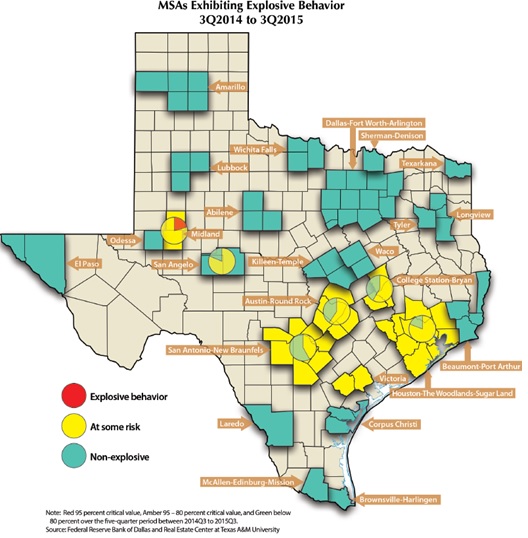
Enrique Martínez-García and Valerie Grossman: In this paper co-authored with Luis B. Torres of the Real Estate Center at Texas A&M, we apply the exuberance statistics to explore house price regional behavior for Texas and its 25 Metropolitan Statistical Areas (MSAs). At the state level, we detect two major periods of explosive behavior. The first one occurred during the late 1980s oil bust, pushing the Texas economy into a recession. House prices in the state broadly collapsed while those in the rest of the country did not. The second episode occurred in the late 1990s and early 2000s coinciding with the early stages of the housing boom in the U.S. and globally that led to the 2008-09 global recession. For the state, the episode ended much earlier than for the U.S. and many other countries, allowing Texas to avoid the worst of the housing fallout that caused so much of the damage elsewhere.
Interestingly, at the MSA level, we find that differences across regional housing markets in Texas result in varying patterns of exuberant behavior across the 25 MSAs in the state. Ripple effects from oil boom-bust periods, especially during the 1980s, and from national and global forces—like the widespread decline in long-term interest rates since the 1990s—underpin the experiences of most MSAs. However, regional and local factors also appear to play a role in the likelihood that a period of exuberance will occur. We also report that by our metric, neither Texas nor any of its 25 MSAs are currently experiencing a risk of explosive behavior in house prices.
Hites Ahir: What impact did recent oil price developments have on house prices in Texas?
Enrique Martínez-García and Valerie Grossman: Texas home prices have continued to climb even after the recent fall in oil prices. Constraints on supply in conjunction with strong demand have contributed to low home inventory levels and robust price gains. However, Texas is a more diversified economy now than in the 1980s and is less oil-dependent too. Consider two of the major MSAs in the state: Austin has a strong technology industry base, and Dallas is a leading transportation and warehousing hub. This diversification may have weakened the relationship between oil prices and overall Texas growth and, in particular, its impact on housing.
However, regional variation can be significant, as we discussed in our aforementioned article Curb Your Enthusiasm:…. We see that less oil-dependent regions, such as Dallas and Austin, continue to exhibit strong real appreciation. Among the more oil-dependent MSAs, Houston has held up relatively well as the downstream oil industry and the health care sector have mitigated the downturn in oil prices, although all signs point in the direction of further softening going forward. In upstream producing MSAs, like Midland and Odessa, house prices have suffered the brunt of the oil price fall more, already experiencing some real declines.
Motivated by this, we currently are investigating empirically how oil price shocks affect housing and land prices in a joint paper with co-authors Luis B. Torres and Yongzhi Sun from Texas A&M. We interpret the oil shocks as exogenous shifts in the disposable income of households and analyze its effects on Texas, exploiting the cross-sectional variation of its housing and land markets across MSAs. We also control explicitly for the effect of long-term interest rates in our model. Although our results are preliminary at this stage, we identify statistically significant short-run and long-run relationships between real house prices, real land prices and real oil prices that differ across more oil-income-dependent and less oil-income-dependent regions of the state. Stay tuned for more results coming soon….
Hites Ahir: Finally, are there any ongoing projects on housing markets that you would like to share with us?
Enrique Martínez-García and Valerie Grossman: We have a few projects that are work-in-progress that we’re really excited about. We’re exploring the patterns of the housing cycle and the role of aggregation (across geography, across housing types, etc.) for monitoring with Efthymios Pavlidis. We also have an ongoing project, to which we alluded before, on the dynamic role that oil shocks play on house and land prices with MSA-level data for Texas. We’re working on this with Luis B. Torres and Yongzhi Sun. Needless to say, we also continue to work on improving and expanding the international house price database.
From Global Housing Watch Newsletter: August 2016
In this issue of the Global Housing Watch newsletter, Enrique Martínez-García and Valerie Grossman spoke with Hites Ahir about their work on housing markets. Martínez-García is a senior research economist and advisor, and Grossman is a senior research analyst in the Research Department at the Federal Reserve Bank of Dallas.
Disclaimer: The views expressed in this Q&A are those of the authors and do not necessarily reflect the views of the Federal Reserve Bank of Dallas or the Federal Reserve System.
Posted by at 5:00 AM
Labels: Global Housing Watch
Monday, August 15, 2016
Housing Market in China
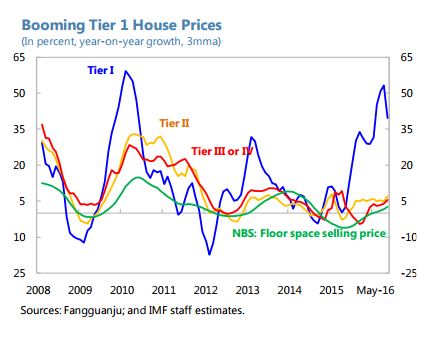
The latest IMF’s annual report on China points out the following:
- “China has recently experienced a sequence of booms in various asset prices—property, equity and bonds. This propensity is a symptom of a large stock of savings searching for yield, rising leverage, and a belief that the web of implicit guarantees will limit losses. This distorts the pricing of risk and facilitates bouts of speculative excess. Most recently, Tier-1 cities such as Shenzhen, Shanghai, and Beijing, are seeing large housing price increases as bank lending for home purchases increased strongly.”
- “Residential investment is reviving again in several parts of the country, even as excess inventory remains high, and region-specific policies could be appropriate. Specifically, tighter macroprudential measures in Tier 1 cities seem warranted (for example reducing loan-to-value ratios on mortgages for second homes). For lower-tier cities, where multi-year excess inventory levels are particularly acute, restricting new starts seems warranted, for example by tightening prudential measures on credit to property developers.”
- “The authorities observed that property prices were beginning to show signs of moderation in Tier 1 cities, while equity prices were more in line with fundamentals after the substantial correction over the last 12 months. They recognized that there were some financial sector risks, but that these were limited and the supervisors were responding proactively.”
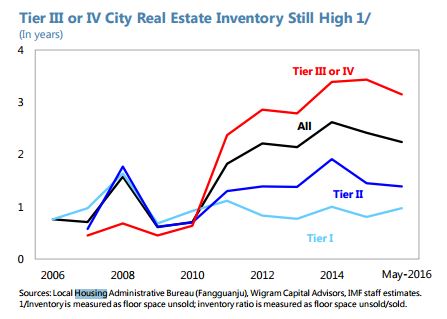
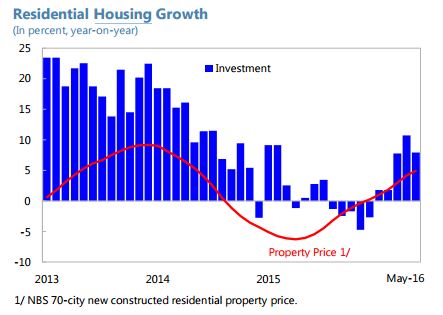
The latest IMF’s annual report on China points out the following:
- “China has recently experienced a sequence of booms in various asset prices—property, equity and bonds. This propensity is a symptom of a large stock of savings searching for yield, rising leverage, and a belief that the web of implicit guarantees will limit losses. This distorts the pricing of risk and facilitates bouts of speculative excess. Most recently, Tier-1 cities such as Shenzhen,
Posted by at 10:41 AM
Labels: Global Housing Watch
Monday, August 8, 2016
Global Housing Watch Update
This edition includes: (1) our quarterly update of the Global House Price Index; (2) a discussion of some of the factors associated with the cross-country variation in house prices in recent years; and (3) housing sector developments described in IMF country documents over the past quarter.
The Global House Price Index
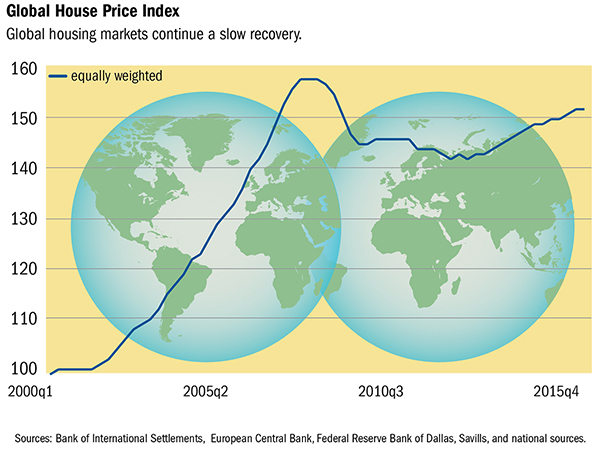
Our global house price index shows that, on average, prices are almost back up to where they were at the start of 2007 (Figure 1).
Figure 1
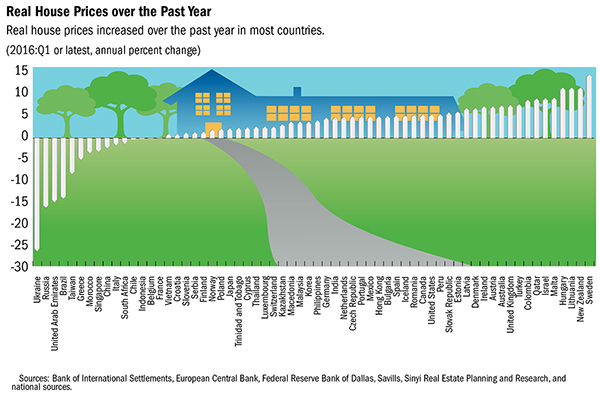
There is a fair bit of cross-country variation, as shown in Figure 2. While house prices have increased over the past year in most countries in our sample, the pace of increase varies quite a bit. And there are still a dozen or so countries where house prices have fallen over the past year, including Brazil, China and Russia.
Figure 2
The underlying data for these charts, as well as charts on credit growth and ratios of house prices to rents and incomes, are available from the IMF’s Global Housing Watch page: http://www.imf.org/external/research/housing/
Probing the Cross-Country Variation in House Prices
Both real house prices and real GDP growth in the 2007-2015 period were well below the boom experienced during 2000-2006. In the earlier period, global real GDP grew by over 4% per year while real house prices surged by about 9% on average. In the more recent period, these grew by just 2% and 1% per year, respectively. The simple correlation between real growth in house prices and GDP growth was very similar in the two periods at about 0.6. Continue reading here.
This edition includes: (1) our quarterly update of the Global House Price Index; (2) a discussion of some of the factors associated with the cross-country variation in house prices in recent years; and (3) housing sector developments described in IMF country documents over the past quarter.
The Global House Price Index
Our global house price index shows that, on average, prices are almost back up to where they were at the start of 2007 (Figure 1).
Posted by at 1:56 PM
Labels: Global Housing Watch
Subscribe to: Posts