Showing posts with label Global Housing Watch. Show all posts
Saturday, June 24, 2017
Global Housing Watch – Q2 2017
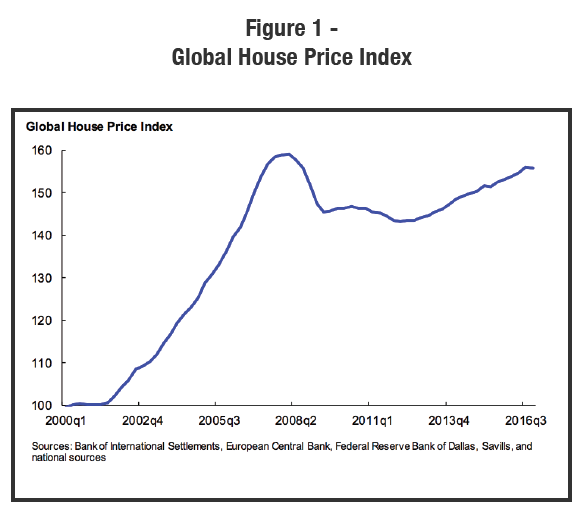
The IMF Global House Price Index is nearly back to its prior peak (see Figure 1). We have previously addressed the question of whether conditions at present are sufficiently similar to those in place during the bubble period of 2005-2008 and answered with a some-what tentative “no” (see Global House Prices: Time to Worry Again?).
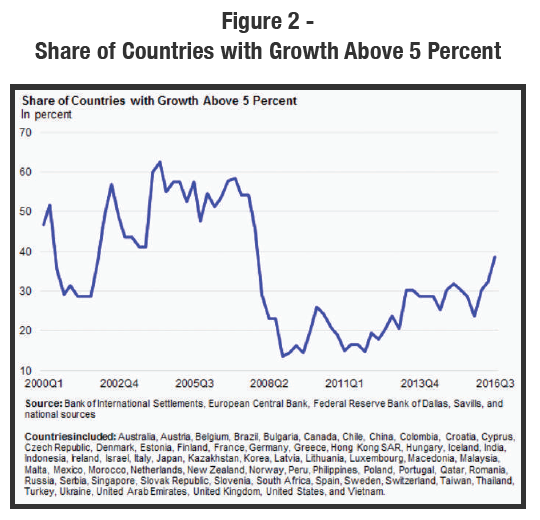
The somewhat sanguine view is partly explained by a lack of synchronicity at present that distinguishes the current state from that experienced a decade ago (see Figure 2). The answer is tentative, because over the last four years the number of countries experiencing rapid growth has approximately doubled, while remaining significantly below the prior peak.
Continue reading here.
The IMF Global House Price Index is nearly back to its prior peak (see Figure 1). We have previously addressed the question of whether conditions at present are sufficiently similar to those in place during the bubble period of 2005-2008 and answered with a some-what tentative “no” (see Global House Prices: Time to Worry Again?).
The somewhat sanguine view is partly explained by a lack of synchronicity at present that distinguishes the current state from that experienced a decade ago (see Figure 2).
Posted by at 5:14 PM
Labels: Global Housing Watch
Thursday, June 22, 2017
House Prices in Iceland
“Housing prices have surged despite still moderate credit growth. Total credit to the private sector, including loans from pension funds which now account for about half of new mortgages, has been growing at close to 8 percent y/y. Despite the recent pick up in (mostly inflation indexed) mortgage lending, the ratio of household debt to GDP has fallen from a peak of some 120 percent in 2010 to below 80 percent in 2016. Housing prices climbed almost 10 percent in 2016, centered on Reykjavík where the crowding out of homebuilding by hotel construction, and of rentals to residents by rentals to tourists, is most acute. A supply response appears to be kicking in, however, with residential investment expanding by 34 percent in 2016. For now, investment financing has a large element of retained earnings”, according to the new IMF report on Iceland.
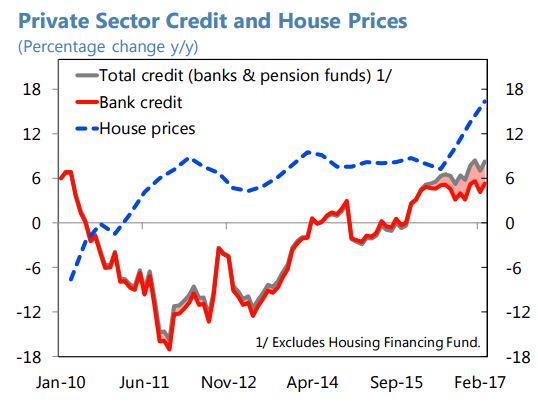
The report also says that “Housing pressures could tip the economy into overheating. Mortgage lending, while still moderate, is picking up, calling for vigilance. Macroprudential tools should address this if needed, and should include new powers to limit foreign currency lending to unhedged borrowers and, potentially, to prohibit lending by pension funds. Construction could keep lagging demand, pushing housing prices higher. If rising living costs kept foreign workers away, labor market conditions would heat up. Another round of large wage increases would compound domestic demand pressures.”
“Housing prices have surged despite still moderate credit growth. Total credit to the private sector, including loans from pension funds which now account for about half of new mortgages, has been growing at close to 8 percent y/y. Despite the recent pick up in (mostly inflation indexed) mortgage lending, the ratio of household debt to GDP has fallen from a peak of some 120 percent in 2010 to below 80 percent in 2016. Housing prices climbed almost 10 percent in 2016,
Posted by at 2:28 PM
Labels: Global Housing Watch
Wednesday, June 21, 2017
Denmark’s Housing Market
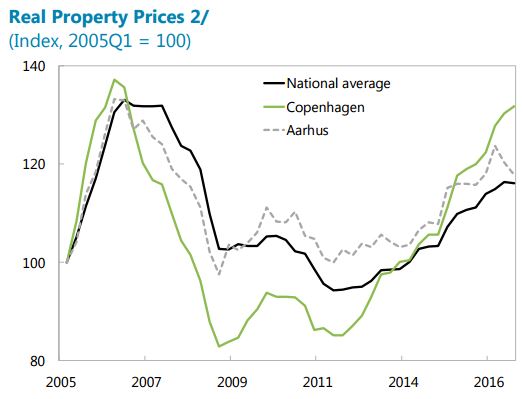
“House prices continue to rise, particularly in regions with strong new credit creation (…) While a shock to the housing market would probably not pose an acute threat to the banking system, macroeconomic risks are substantial (…) The authorities are considering additional macroprudential measures to curb risks (…) A recently agreed reform of property taxation is a step forward (…) [IMF] Staff advocated pushing ahead with macroprudential and other policies to safeguard macrofinancial stability. Recommended measures span several policy areas. (…) Staff reiterated its call for putting in place a DTI limit and welcomed the SRC’s proposal (…) The broad housing recovery and current low interest rates provide a conducive environment for reducing the tax deductibility of mortgage interest expenses and for further lowering, beyond what is currently planned, the value of the deduction for interest payments (…) Addressing longstanding housing supply constraints, such as strict zoning regulations, procedures for land development, and rental market regulations, can also help ease housing price pressures by improving the responsiveness of supply to housing demand (…) The authorities agreed that house price increases in certain areas called for vigilance”, according to the IMF’s latest report on Denmark.
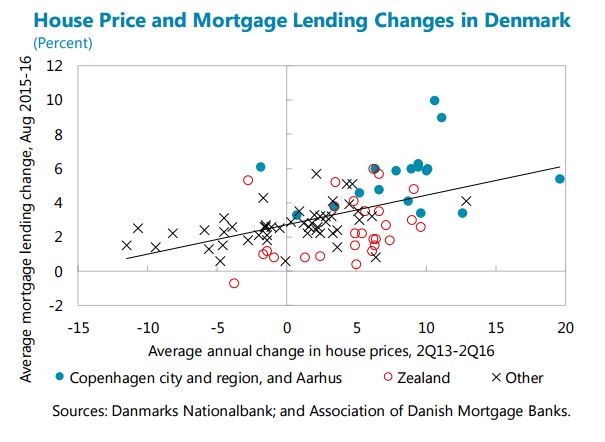
“House prices continue to rise, particularly in regions with strong new credit creation (…) While a shock to the housing market would probably not pose an acute threat to the banking system, macroeconomic risks are substantial (…) The authorities are considering additional macroprudential measures to curb risks (…) A recently agreed reform of property taxation is a step forward (…) [IMF] Staff advocated pushing ahead with macroprudential and other policies to safeguard macrofinancial stability. Recommended measures span several policy areas.
Posted by at 2:26 PM
Labels: Global Housing Watch
Thursday, June 1, 2017
House Prices in Thailand
A new IMF report on Thailand points out that “The rise in housing prices is concentrated in the Bangkok condominium market, supported by mortgage loan growth and foreign buying. Risks can be addressed through targeted, time-varying macroprudential tools (e.g., by tightening credit standards and risk weights; and loan-to-value or debt-to-income limits for mortgage loans).”
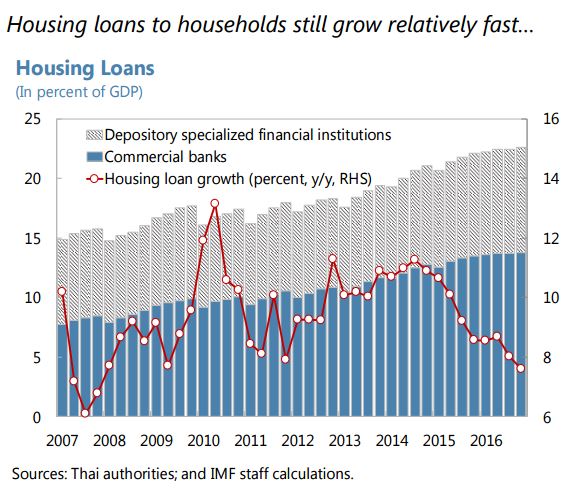
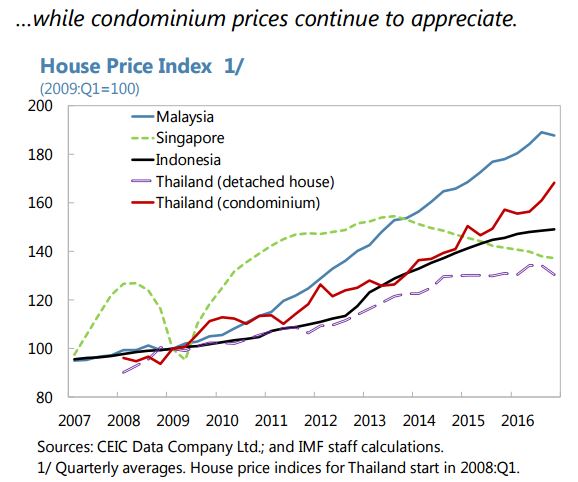
A new IMF report on Thailand points out that “The rise in housing prices is concentrated in the Bangkok condominium market, supported by mortgage loan growth and foreign buying. Risks can be addressed through targeted, time-varying macroprudential tools (e.g., by tightening credit standards and risk weights; and loan-to-value or debt-to-income limits for mortgage loans).”
Posted by at 5:19 PM
Labels: Global Housing Watch
Colombia’s Housing Market
The IMF latest report on Colombia says that “(…) overall credit growth decelerated significantly in 2016. However, the mortgage credit segment has remained resilient with a real growth of 6.8 percent. This is partly due to the various government subsidy programs: around 30 percent of the mortgages originated in 2016 were subsidized. These developments, together with the significant expansion of house prices since 2002, generate questions about the macro-financial risks associated with potential reversals in the housing and mortgage markets. Staff estimated that house prices are slightly misaligned with respect to economic fundamentals, with an estimated price gap of 13.5 percent (…). However, after the 1999 financial crisis the authorities have adopted macroprudential measures such as the use of LTV limits, and other housing financing characteristics (e.g., full recourse, no prepayment penalties, fixed-rate mortgages) that limit the vulnerabilities stemming from the housing market.”
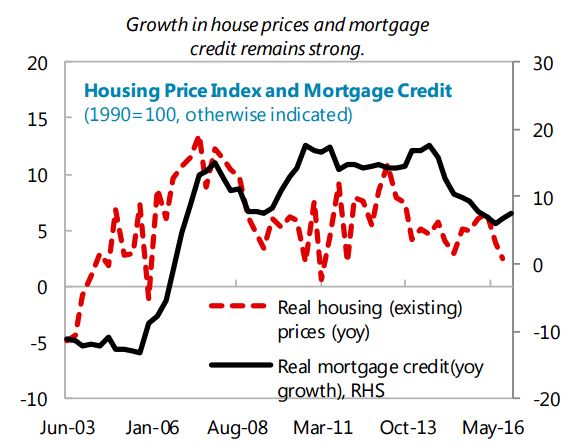
A separate paper “(…) estimates the extent of misalignments in house prices relative to fundamentals and evaluates the overall risk to the economy from the housing sector. The results suggest a moderate house price misalignment relative to fundamentals which is, however, mitigated by housing finance characteristics. ”
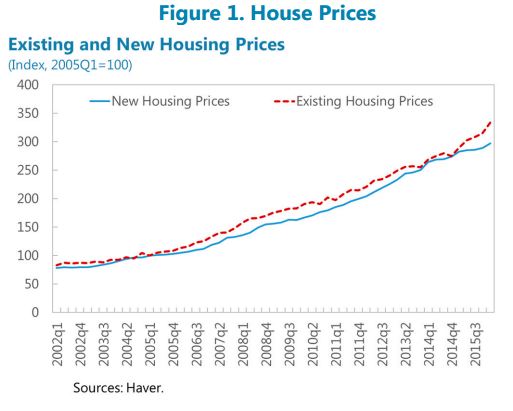
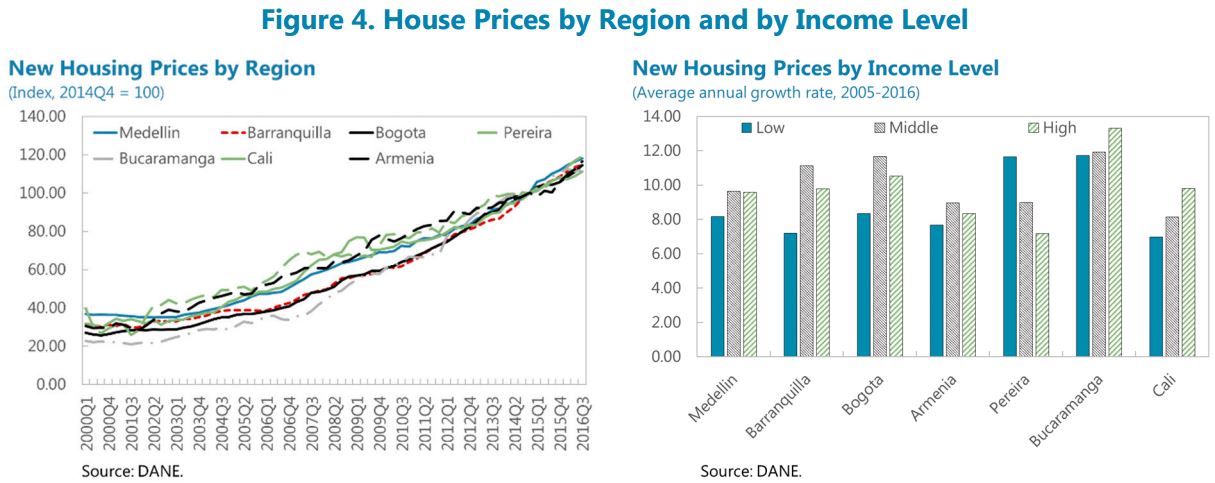
This paper also points out that “The increase in house prices has been widespread across the country. Figure 1 shows that prices for both new and existing houses have increased in the main three cities of Colombia. Figure 4 shows the evolution of prices for new houses in additional cities. Interestingly, house prices grew at high and similar rates in the seven cities considered: the average home-price index grew by an annual real rate of 5.18 percent between 2005 and 2016, with Bucaramanga having the highest average annual real growth rate (8 percent) and Armenia the lowest (3.4 percent). Notwithstanding, in all the cities house prices tended to show stronger growth for middle and upper income levels (Figure 4).”
The IMF latest report on Colombia says that “(…) overall credit growth decelerated significantly in 2016. However, the mortgage credit segment has remained resilient with a real growth of 6.8 percent. This is partly due to the various government subsidy programs: around 30 percent of the mortgages originated in 2016 were subsidized. These developments, together with the significant expansion of house prices since 2002, generate questions about the macro-financial risks associated with potential reversals in the housing and mortgage markets.
Posted by at 5:05 PM
Labels: Global Housing Watch
Subscribe to: Posts