Showing posts with label Global Housing Watch. Show all posts
Friday, May 4, 2018
Housing View – May 4, 2018
On the US:
- Nine rules for better housing policy – Brookings
- Can more housing supply solve the affordability crisis? Evidence from a neighborhood choice model – Regional Science and Urban Economics
- Land Use Regulations, Migration and Rising House Price Dispersion in the U.S. – University of Southern California
- Priced out of the American dream – Financial Times
- America Can’t Afford Ben Carson’s Housing Cuts – Bloomberg
- Getting it Right: Examining the Local Land Use Entitlement Process in California to Inform Policy and Process – Berkeley: Center for Law, Energy & the Environment
- Learning from Hurricane Sandy? Rising Seas and Housing Values in New York – ECONOFACT
On other countries:
- [Australia] Is Australia’s Housing Boom (Finally) Coming to an End? – Wall Street Journal
- [Canada] Mortgage Growth in Canada Hasn’t Been This Weak Since 2001 – Bloomberg
- [Canada] Canada’s Economy and Household Debt: How Big Is the Problem? – Bank of Canada
- [China] China’s Dandong property prices jump on Korea talks – Financial Times
- [Hong Kong] What Could End Hong Kong’s Property Boom? Here Are Some Triggers – Bloomberg
- [Israel] Housing Market in Israel – IMF
- [New Zealand] Loan-to-Value Ratio Restrictions and House Prices – Reserve Bank of New Zealand
- [New Zealand] Housing Leverage and Consumption Expenditure – Evidence from New Zealand Microdata – Reserve Bank of New Zealand
- [New Zealand] Land Use Regulation, The Redevelopment Premium and House Prices – University of Auckland
- [United Kingdom] Is innovation the answer to the chronic under-supply of housing in the UK? – Cambridge Centre for Housing & Planning Research

Photo by Aliis Sinisalu
On the US:
- Nine rules for better housing policy – Brookings
- Can more housing supply solve the affordability crisis? Evidence from a neighborhood choice model – Regional Science and Urban Economics
- Land Use Regulations, Migration and Rising House Price Dispersion in the U.S. – University of Southern California
- Priced out of the American dream – Financial Times
- America Can’t Afford Ben Carson’s Housing Cuts – Bloomberg
- Getting it Right: Examining the Local Land Use Entitlement Process in California to Inform Policy and Process – Berkeley: Center for Law,
Posted by at 5:00 AM
Labels: Global Housing Watch
Thursday, May 3, 2018
Learning from Hurricane Sandy? Rising Seas and Housing Values in New York
From ECONOFACT:
The Issue:
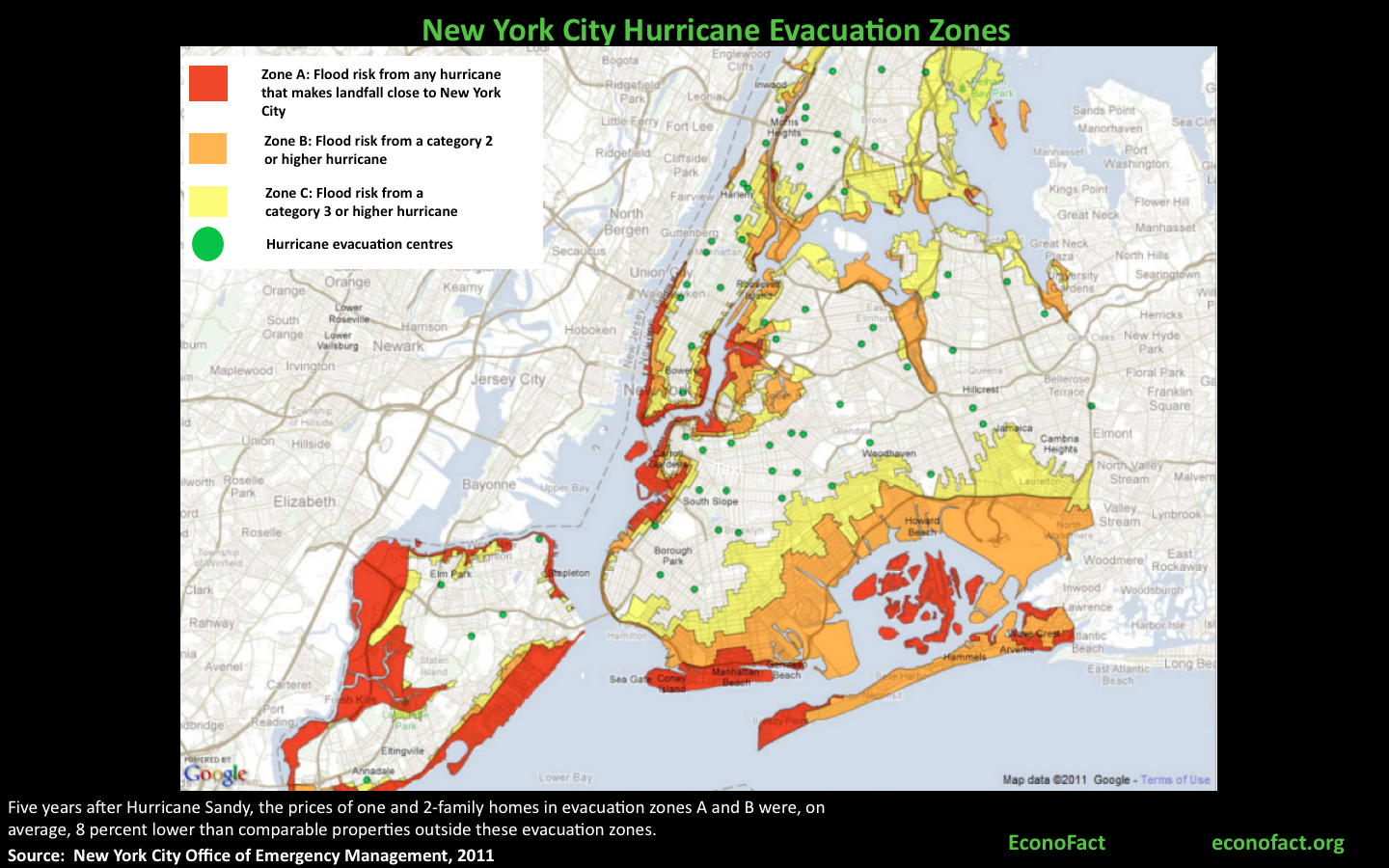
“The chance of large-scale coastal flooding episodes is increasing. In the last few decades, sea levels have been rising steadily at about 3 centimeters per decade and many estimates expect that this rate will accelerate going forward. At the same time, the population living in coastal counties in the United States grew by 40 percent between 1970 and 2010 and is projected to continue rising. Are people considering the increased risk of flooding associated with sea level rise in their housing decisions? Looking at what happened to property values in New York City after Hurricane Sandy gives us a first look at how those on the front lines may be responding.”
The Facts:
- “Past research has found the response of homebuyers towards flooding risks and the threat of other climate-related hazards to be short-lived. While a region’s exposure to hurricanes or flooding does not vary greatly from one year to the next, many studies have found that homebuyers tend to take these risks much more into account immediately following hurricanes and other catastrophic events. However, these effects tend to be short-lived —very often vanishing completely within five years (see here and here). Flood insurance take-up rates, for instance, have tended to spike the year after a flooding event and then gradually decline to the levels that prevailed before the flood. This response happened not only in the flooded zones but – to a lesser extent — also in non-flooded areas in the same television media markets according to one study. While the risk of flooding remains objectively the same, people may be more aware of it following a flood and then tend to forget about it with the passage of time. It is also possible that, as time goes by, new people who have had less direct exposure to the risk move into the area. These facts suggest a gap between objective probabilities of flood risk and households’ perceptions of this risk. In addition to the psychological biases mentioned, coordination problems, misguided policies, and the expectation of financial assistance by the government in case of disaster might contribute to a mismatch between home prices and damage risk.”
- “Hurricane Sandy was a climatic event of unprecedented proportions that impacted the Greater New York region. The storm hit New York on October 29, 2012. At the time, Sandy was the largest Atlantic hurricane on record and the second costliest in U.S. history (behind Hurricane Katrina), with damages amounting to over $19 billion. Hurricane Sandy flooded 17 percent of New York City (or nearly 90,000 buildings).”
Continue reading here.
From ECONOFACT:
The Issue:
“The chance of large-scale coastal flooding episodes is increasing. In the last few decades, sea levels have been rising steadily at about 3 centimeters per decade and many estimates expect that this rate will accelerate going forward. At the same time, the population living in coastal counties in the United States grew by 40 percent between 1970 and 2010 and is projected to continue rising.
Posted by at 3:31 PM
Labels: Global Housing Watch
Wednesday, May 2, 2018
Housing Market in Israel
From the IMF’s latest report on Israel:
- On house price developments: “Housing price increases have slowed significantly but supply may also be weakening. After more than doubling since 2008, house price rises slowed to under two percent y/y in 2017, below household income growth. Transactions also declined, with investor activity likely affected by the proposed tax on owners of more than two apartments, and first-time buyers waiting to see the “Buyer’s Price” program impact.5 But residential investment began to decline in mid-2017, and a 16 percent y/y fall in starts in H2’2017 suggests further falls to come.”
- On financial sector and housing policies:
- “Israel’s banking system is healthy. Capitalization, loan quality, and profitability continued to improve in 2017. The leverage ratio rose to 7.5 percent, exceeding that in most advanced economies. All five of the largest banks met the capital requirement, enabling them to resume or raise dividend payouts in 2017.”
- “Household debt remains relatively low, with well-contained risks, and business debt has stabilized after declining significantly. The household debt ratio has been rising for a decade, but remains low at just over 40 percent of GDP. The BoI has maintained strong macroprudential measures in the housing area (…). As a result, new mortgages with LTVs over 75 percent have been almost eliminated, and the share of lower LTV loans has risen. However, consumer credit, which usually has a variable interest rate, is almost two-fifths of total household debt, calling for close monitoring. Business sector debt has declined to below 70 percent of GDP, with the stock of corporate bonds falling to 19 percent of GDP by 2017, 9 percent of GDP less than their former ratio. Limited supply and the global search for yield may be contributing to low spreads on these bonds.”
- “Slowing housing construction despite still high housing prices calls for reforms to make supply more responsive to needs and to improve housing affordability. The authorities estimate that 45–50 thousand new housing units are needed annually during 2015–2020, rising to 60 thousand annually by 2026–35. Completions appear sufficient in 2016–2017, but shortfalls could return given recent falls in housing starts. Hence, continued reform efforts are needed:
- “Land supply, competition, and regulation. Increased land auctions are needed to avoid supply constraints and to help make construction more responsive to variations in demand. Construction costs and time to build should be reduced by streamlining building regulations and expanding foreign construction company access.”
- “Municipal incentives. To encourage timely municipal approval of residential development, residential property taxes should be raised—while avoiding work disincentives—coupled with predictable central government support to municipalities for the up-front costs of additional infrastructure and public services.”
- “Expand commutable areas and increase urban density. Well-developed public transportation can expand commutable areas and relieve demand in major centers, hence plans to establish metropolitan authorities are welcome. Urban renewal should be increased as density in Tel Aviv is relatively low, including through the proposed fast-track approvals of mixed use development.”

From the IMF’s latest report on Israel:
- On house price developments: “Housing price increases have slowed significantly but supply may also be weakening. After more than doubling since 2008, house price rises slowed to under two percent y/y in 2017, below household income growth. Transactions also declined, with investor activity likely affected by the proposed tax on owners of more than two apartments, and first-time buyers waiting to see the “Buyer’s Price” program impact.5 But residential investment began to decline in mid-2017,
Posted by at 10:13 AM
Labels: Global Housing Watch
Friday, April 27, 2018
Housing View – April 27, 2018
On the US:
- How Big is the Wealth Effect? Decomposing the Response of Consumption to House Prices – University of Maryland
- Housing Finance, Boom-Bust Episodes, and Macroeconomic Fragility – University of Missouri
- 50 years later, how close are we to making fair housing a reality? – The Atlantic
- What We Get Wrong About Closing the Racial Wealth Gap – Insight Center for Community Economic Development (coverage by Citylab and Quartz)
- U.S. Homebuying Slows Down, But Not for Hispanics – Citylab
- Stringency of Land-Use Regulation: Building Heights in US Cities – IDEAS
- Unpacking the “housing shortage” puzzle – Brookings
- Home Price Charts Updated – Case-Shiller – Real Estate Decoded
- Smartest Month to Sell a Home by Metro – ATTOM
- US housing: how Fannie Mae and Freddie Mac became rental powerhouses – Financial Times
On other countries:
- [Canada] Canadian Housing Market Still Highly Vulnerable – CMHC
- [Spain] Spain’s Palma to ban holiday rentals after residents’ complaints – BBC
Photo by Aliis Sinisalu
On the US:
- How Big is the Wealth Effect? Decomposing the Response of Consumption to House Prices – University of Maryland
- Housing Finance, Boom-Bust Episodes, and Macroeconomic Fragility – University of Missouri
- 50 years later, how close are we to making fair housing a reality? – The Atlantic
- What We Get Wrong About Closing the Racial Wealth Gap – Insight Center for Community Economic Development (coverage by Citylab and Quartz)
- U.S.
Posted by at 5:00 AM
Labels: Global Housing Watch
Tuesday, April 24, 2018
Understanding Singapore’s Housing Market
Global Housing Watch Newsletter: April 2018
In this interview, Sock-Yong Phang talks about her new book on Singapore’s housing market—Policy Innovations for Affordable Housing In Singapore: From Colony to Global City. Phang is Celia Moh Chair Professor of Economics at the Singapore Management University, Singapore.
On key characteristics of Singapore’s housing market…
Hites Ahir: How is Singapore’s housing market unusual compared to the housing market in other countries?
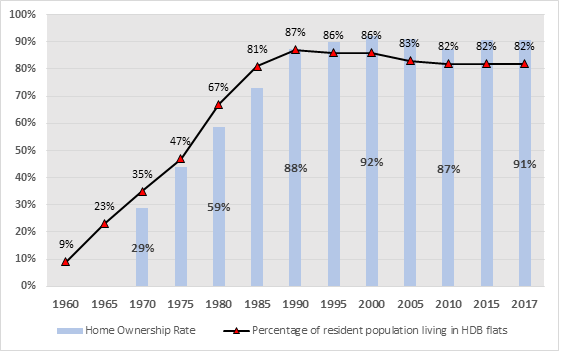
Sock-Yong Phang: Singapore has a very high homeownership rate of 91 percent, and the government’s involvement in the housing market is rather unusual. The Housing and Development Board (HDB), a statutory board of the Ministry of National Development, is the largest housing developer. In 1960, 9 percent of the population lived in rental public housing. By 1985, four-fifths of the resident population were living in HDB flats. More than 90 percent of HDB’s housing have been sold on 99-year lease tenure to eligible households – at below market prices. Buyers can sell their HDB flats in an active secondary market at market prices after 5-years.
Chart 1: Resident Population Living in HDB Flats and Homeownership Rate
Data sources: Singapore government websites
Hites Ahir: What are the key housing policies that have made a difference to Singapore’s housing market?
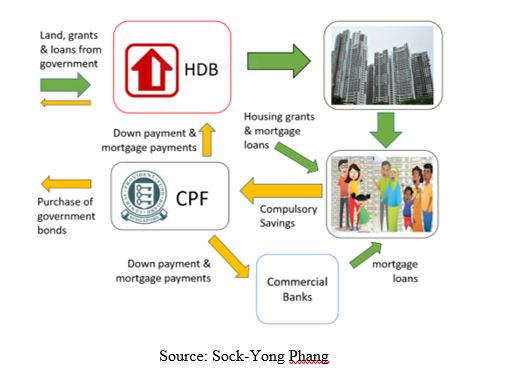
Sock-Yong Phang: One key policy is that HDB housing has transformed the physical and socioeconomic landscape. Another key policy in 1968 allowed Central Provident Fund (CPF) savings to be withdrawn by members for housing down payment, and mortgage payments. The HDB and CPF together formed an integrated sustainable framework for affordable homeownership.
Chart 2: An integrated sustainable framework for affordable homeownership
Hites Ahir: In your new book, you talk about Henry George—an American economist. Can you talk a bit about his ideas, and how it relates to Singapore?
Sock-Yong Phang: In 19th century America, Henry George observed that the explosive growth of industrial output generated dramatic increases in urban land prices. The windfalls for landowners, in turn, fueled a frenzy of land speculation and real estate bubbles and volatility. While industrialists, bankers and landowners amassed enormous wealth in the Gilded Age, there was a simultaneous rise in poverty, inequality, and social unrest. In 1879, George published a critique of the capitalist system in Progress and Poverty. His controversial view was that land should be common property, and society should share in any increase in land rents. His proposal was for a 100 percent single tax on land values.
A commentator of an article I wrote described Singapore as ‘the most Georgist” place on earth. However, there is no mention of George in the intense policy debates on land policy in the 1960s. The policymakers of that era recognized the huge importance of land to jumpstart the economy, and the housing program. Their observations on the unfairness of unearned land value increments, the negative impacts of land speculation, and the need for the state to capture land values mirrored those of George’s. However, the policies they implemented differed. These policies include compulsory state land acquisition at below market prices, development charges, and government land sales.
The state’s ownership of more than 90 percent of land enabled coordinated land use planning, and flexibility to shift allocations among competing needs for economic development. Greater reliance on land-based revenues also made feasible lower taxes on businesses, and employment. Effective land value capture facilitated growth-enhancing public-sector investments in urban infrastructure, industrial parks, urban redevelopment projects, and redistribution through HDB housing.
On affordable housing and inequality…
Hites Ahir: How does Singapore finance affordable housing for its low, and middle-income groups?
Sock-Yong Phang: Singaporeans typically purchase their first home from the HDB. The HDB provides up to 25-year mortgage loans, at an interest rate of 2.6 percent. HDB prices are below market prices, and buyers enjoy additional discounts in the form of housing grants calibrated to incomes. The government sells land to the HDB, and fully finances its annual deficit. Within the housing sector, there is a high degree of progressive taxation. Higher-income households, foreigners, and investors pay market prices, implicit higher land taxes, higher stamp duties, and are subject to higher rates of property taxes.
Hites Ahir: In the book, you also talk about housing market segmentation for housing affordability. Could you elaborate on this?
Sock-Yong Phang: If someone were to ask me for advice on what housing to buy, and how much it would cost, I would have to ask several questions. Are you a citizen, permanent resident, or foreigner? What is your household income? Are you a first-time buyer? Are you married or single? If single, how old are you? Do you plan to live near or with your parents? What is your ethnicity? These questions give a sense of the means testing, and profiling used for market segmentation. Spatially though, careful land use planning and quotas are used to integrate different household types for inclusive neighborhoods.
Hites Ahir: Did Singapore had to deal with the formation of slums?
Sock-Yong Phang: Slums and squatter settlements were prevalent in Singapore in the 1960s when a majority of the population lived in crammed conditions in pre-war shophouses, and attap/zinc-roofed housing. It was under such dire conditions that the government made improvements to housing conditions a key priority.
Hites Ahir: In the book, you also say that growing inequality has become a concern worldwide. “Discussions about solutions to tackle the challenges of poverty and inequality have tended to revolve around higher taxes on wealth and labor market interventions such as minimum wages and universal basic incomes.” What has Singapore done?
Sock-Yong Phang: Singapore has used housing policies extensively to mitigate wealth inequality. The housing tax and subsidy regime is highly progressive. Interestingly, I estimated the gross housing wealth distribution, and found it approximates the capital ownership distribution in Thomas Piketty’s vision of an ‘ideal society’.
On foreign investors and speculation…
Hites Ahir: For the past two-three years, there has been a lot of discussion on the impact of foreign investors, and speculation in the housing market. Has Singapore done anything on this? Did it work?
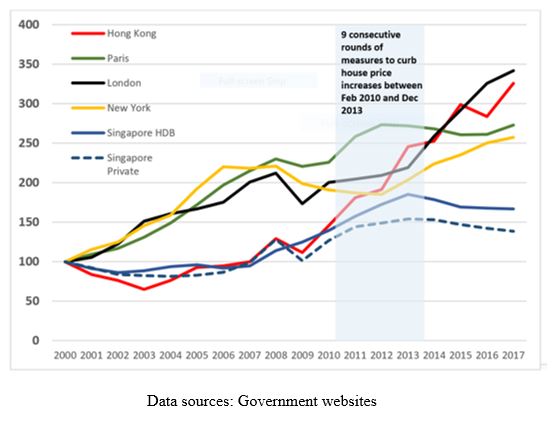
Sock-Yong Phang: Housing is an important consumption item, and household asset. Prices should not be dependent on foreign speculators and investors, foreign monetary policies, and global liquidity. Singapore keeps foreigners out of the HDB, and the landed housing sectors. Foreigners can only buy private condominiums – which are about 20 percent of the market. Despite this, price spillover effects to other protected market segments led the government to impose 9 rounds of measures to discourage foreign, and investment demand from 2010 to 2013. The instruments deployed include stamp duties, and caps on borrowing. These measures, in combination with an increase in housing supply, and slower population growth, worked – price increases started to taper off by late 2013.
Chart 3: Effectiveness of measures to curb house price increases in Singapore: comparison with house price trends (nominal prices) in 4 other global cities
On other issues…
Hites Ahir: Singapore has a homeownership rate of 90 percent. Why is the rental market not attractive or promoted?
Sock-Yong Phang: The Singapore government is, generally speaking, non-ideological, with a practical, pragmatic approach to economic policies. However, homeownership has almost the status of an ideology in Singapore. This has worked for a city-state where spatial mobility is less of an issue, and has allowed low and middle-income households to own an asset, and benefit from housing price appreciation.
Hites Ahir: Can you talk about how the median age of the population has changed over time, and what challenges this presents?
Sock-Yong Phang: The median age increased from 34.0 years in 2000 to 40.5 in 2017. Lower-income ageing homeowners are often “housing asset rich and cash poor”. The government has devised schemes to help homeowners liquidate housing equity for retirement financing. One option is to downsize to a smaller or shorter lease HDB flat. Another scheme allows homeowners to sell the tail-end of their property’s lease to the HDB. However, the low take-up rate remains a puzzle.
Hites Ahir: Why do you think it is difficult to find strong advocates for government centered housing welfare systems?
Sock-Yong Phang: Housing markets are incredibly complex. Policies designed with good intentions can go wrong, or they can become entrenched over time. Examples of policy failure include socialist housing systems, rent control, US public housing projects, and the subprime mortgages crisis. My 2013 book Housing Finance Systems: Market Failures and Government Failures has extensive discussion on these challenges.
Global Housing Watch Newsletter: April 2018
In this interview, Sock-Yong Phang talks about her new book on Singapore’s housing market—Policy Innovations for Affordable Housing In Singapore: From Colony to Global City. Phang is Celia Moh Chair Professor of Economics at the Singapore Management University, Singapore.
On key characteristics of Singapore’s housing market…
Hites Ahir: How is Singapore’s housing market unusual compared to the housing market in other countries?
Posted by at 5:00 AM
Labels: Global Housing Watch
Subscribe to: Posts