Showing posts with label Global Housing Watch. Show all posts
Thursday, July 26, 2018
Fundamental Drivers of House Prices in Advanced Economies
An IMF working paper by Nan Geng says that:
“Assessing the sustainability of house price developments has become an integral part of macro-financial surveillance. Many AEs have experienced a remarkable run-up in their national housing markets in the past two decades and in some cases house prices have remained strong in recent years. Understanding housing price developments and monitoring the extent to which house prices deviate from levels supported by long-run fundamental factors are important for assessing risks to financial and macroeconomic stability.
This paper models house prices on a cross-country basis seeking insights on deviations from sustainable valuations. Based on standard theory, it selects a small set of supply and demand fundamental drivers of house prices to model long-run equilibrium house prices in 20 AEs in the OECD. The novel feature of the model is the incorporation of policy, institutional, and structural factors—i.e. tax incentives for home ownership, rent controls, and the long-run supply responsiveness of housing construction. The estimated long-run relationship broadly captures trends in housing prices since the early 1990s. Hence, the uptrend in real housing prices largely reflects fundamentals, especially rising real disposable incomes. On average, the overvaluation of housing prices on current fundamentals is modest, but there are significant variations in the estimated valuation gaps across our sample.
Policy, institutional, and structural factors are found to be important determinants of long-run equilibrium house prices. The impact of shocks to the traditional demand and supply factors on long-run house prices varies significantly across countries depending on policies and structural factors. In particular, more generous tax relief, stricter rent control, and below-average long-run supply responsiveness are found to drive up house prices.
In this regard, structural reforms in the housing market should be considered alongside macroprudential instruments. Structural reforms can over time improve housing affordability, thereby reducing debt accumulation and enhancing financial stability. These structural reforms include, but are not limited to, reforms to raise the long-run elasticity of housing supply, phasing out rent control, and reducing tax incentives for home ownership and debt financing. Such instruments may complement and support the more commonly used macroprudential tools such as limits on loan-to-value ratios, as the impact of reforms on supply and demand fundamentals may shape longer-term expectations in the housing market.”
An IMF working paper by Nan Geng says that:
“Assessing the sustainability of house price developments has become an integral part of macro-financial surveillance. Many AEs have experienced a remarkable run-up in their national housing markets in the past two decades and in some cases house prices have remained strong in recent years. Understanding housing price developments and monitoring the extent to which house prices deviate from levels supported by long-run fundamental factors are important for assessing risks to financial and macroeconomic stability.
Posted by at 5:09 PM
Labels: Global Housing Watch
Housing in Romania
The latest IMF’s report on Romania says that:
“Real estate exposure rose with housing loans increasing from 21 to 54 percent of household loans between 2008 and 2017. These mortgage contracts (mostly at variable rates) expose banks to credit risks in the event of sharp increases in interest rates. The effectiveness of existing macroprudential tools on mortgages is undermined by the Prima Casa program, which allows loan-to-value ratios up to 95 percent. The Romanian banking system has also a large exposure to their own sovereign debt (one of the highest in the EU at around 20 percent of assets in 2017), that could lead to valuation losses in the event of interest rate increases. Finally, despite declining considerably since 2011, about 35 percent of banks’ liabilities and assets remain denominated in foreign exchange (FX), and FX liquidity risks can exist within an environment of ample overall liquidity.”
The latest IMF’s report on Romania says that:
“Real estate exposure rose with housing loans increasing from 21 to 54 percent of household loans between 2008 and 2017. These mortgage contracts (mostly at variable rates) expose banks to credit risks in the event of sharp increases in interest rates. The effectiveness of existing macroprudential tools on mortgages is undermined by the Prima Casa program, which allows loan-to-value ratios up to 95 percent.
Posted by at 5:03 PM
Labels: Global Housing Watch
Friday, July 20, 2018
Housing View – July 20, 2018
On cross-country:
- Fundamental Drivers of House Prices in Advanced Economies – IMF
- Despite the substantial guidance international law has provided, there has been a severe lack of progress for the right to housing around the world – UN Special Rapporteur on Right to Housing
- Does promoting homeownership always damage labour market performances? – IDEAS
On the US:
- Credit Supply and Housing Speculation – NBER
- CityLab University: Inclusionary Zoning – CityLab
- ‘A win-win’: Using local church buildings to address the affordable-housing crisis – Washington Post
- A Housing Paradox in Progressive Cities – New York Times
- Why the low-income housing tax credit matters for rural communities – Urban Institute
- California’s SB 375 and the Pursuit of Sustainable and Affordable Development – Terner Center
- Meet Jenny Schuetz, new Rubenstein fellow in the Metropolitan Policy Program – Brookings
- Maybe We Should Give Up On NIMBY Cities – Forbes
- Coastal Oregon’s properties under threat by rising tides – Financial Times
- Americans have not forgotten that house prices can fall – Capital Economics
- New Hotel or Affordable Housing? Race Is On to Define ‘Opportunity Zones’ – Wall Street Journal
- Big Builders Are Remodeling the Housing Market – Wall Street Journal
- These Tax Laws Are Holding Back California’s Housing Market – Bloomberg
- The Longest Economic and Housing Expansions in U.S. History – Calculated Risk
- Booming housing market today presents serious risk for future – American Enterprise Institute
- AEI: First-time homebuyers are still in the game – American Enterprise Institute
- The Blob: 1998-1999. Presented at: Should Fannie Mae and Freddie Mac be Shrinking or Expanding Their Activities? – American Enterprise Institute
On other countries:
- [Australia] Property auctions are Sydney’s newest sport – Economist
- [Australia] Going, going gone for Australia’s house price boom. And some investors smell trouble – Reuters
- [Canada] Vancouver’s One-Two Punch Is Expensive Homes and Low Wages – Bloomberg
- [Canada] C. real estate group says market balancing out amid new mortgage rules, lower demand – Globe and Mail
- [Canada] Bank Of Canada’s Stephen Poloz Suggests Buying A Smaller Home, After Hiking Interest Rates – Huffington Post
- [Canada] Ontario throne speech ignores housing affordability – Fraser Institute
- [China] The Effect of Real Estate Prices on Chinese Bank Performance – Federal Reserve Board
- [China] China housing price growth edges up in June – Financial Times
- [Chile] Alcaldesa de Peñalolén y viviendas sociales: “Aquí el prejuicio es la palabra clave” – CNN
- [Ireland] Ireland’s volatile property market shows fresh sign of a surge – Financial Times
- [Lithuania] Housing Price, Credit, and Output Cycles: How Domestic and External Shocks Impact Lithuania’s Credit – IMF
- [New Zealand] Mortgagor Vulnerability and Deposit Affordability in New Zealand before and after the Loan-to-Value Restrictions – Reserve Bank of New Zealand
- [United Kingdom] New rules on equity release ‘could raise mortgage prices’ – Financial Times
- [United Kingdom] Car dependence and housing affordability: An emerging social deprivation issue in London? – University College London
- [United Kingdom] Defying London’s House-Price Decline – Bloomberg
- [United Kingdom] No affordable homes? We’ll build them ourselves – BBC

Photo by Aliis Sinisalu
On cross-country:
- Fundamental Drivers of House Prices in Advanced Economies – IMF
- Despite the substantial guidance international law has provided, there has been a severe lack of progress for the right to housing around the world – UN Special Rapporteur on Right to Housing
- Does promoting homeownership always damage labour market performances? – IDEAS
On the US:
- Credit Supply and Housing Speculation – NBER
- CityLab University: Inclusionary Zoning – CityLab
- ‘A win-win’: Using local church buildings to address the affordable-housing crisis – Washington Post
- A Housing Paradox in Progressive Cities – New York Times
- Why the low-income housing tax credit matters for rural communities – Urban Institute
- California’s SB 375 and the Pursuit of Sustainable and Affordable Development – Terner Center
- Meet Jenny Schuetz,
Posted by at 5:00 AM
Labels: Global Housing Watch
Tuesday, July 17, 2018
How To Improve Housing Affordability in Canada’s Dynamic Regions?
From the IMF’s latest report on Canada:
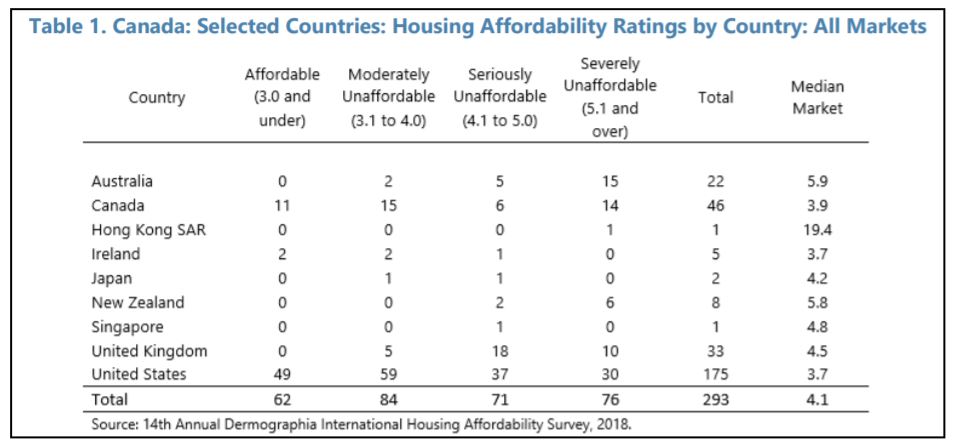
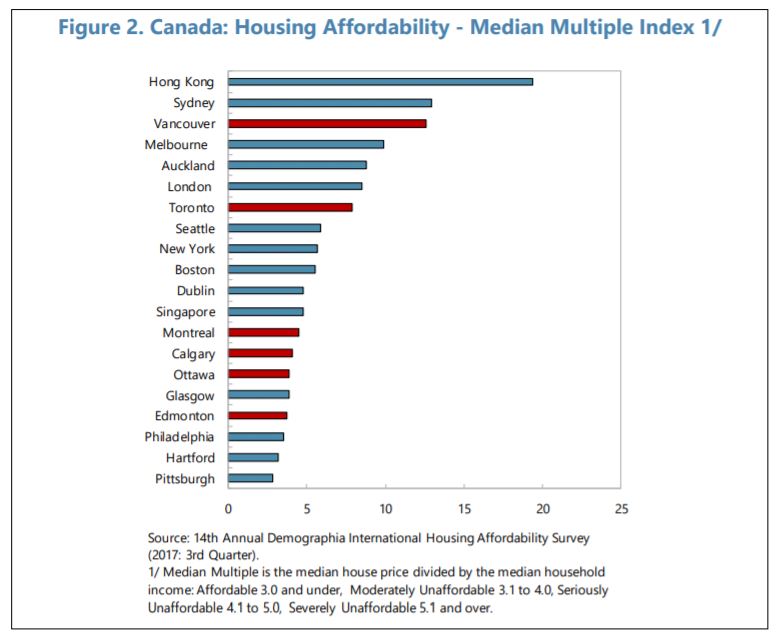
“Housing affordability is becoming an increasing social and economic concern in Canada. While Canada’s overall affordability rankings2 are not among the worst in its peer group, its
most dynamic regions, particularly around Vancouver and Toronto are severely unaffordable (Table 1). Moreover, some smaller housing markets are also becoming unaffordable, as demand pressures are spreading from the major markets to nearby markets. Deteriorating affordability raises not only important social concerns, but also economic ones, as it works against attracting and keeping talent in Canada’s most dynamic urban centers. Thus, it can have a negative effect on growth, productivity, and innovation. This note focuses on the housing markets in the Greater Toronto Area (GTA) and Greater Vancouver Area (GVA) where demand pressures have been the most acute.
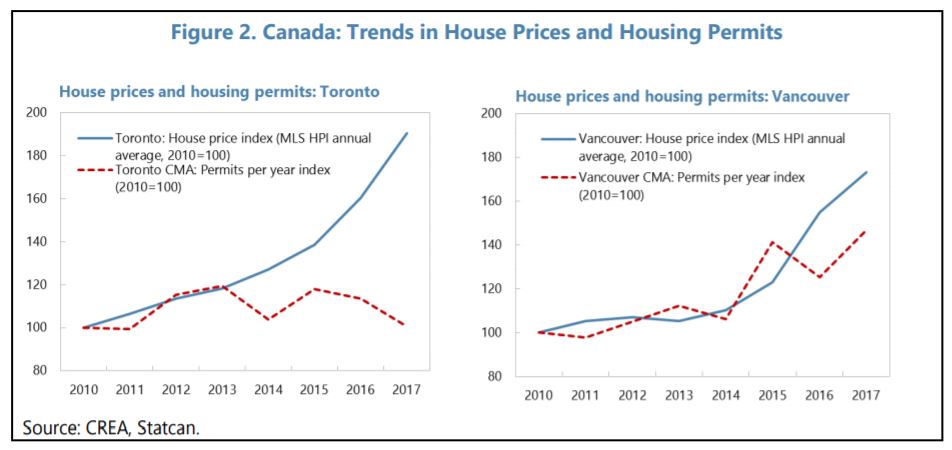
Driving the deterioration of affordability has been the significant imbalance between housing demand and supply in the most affected regions. House prices nearly doubled between early 2010 and spring 2018 in Vancouver and Toronto as demand from domestic and foreign buyers outstripped the supply of homes. House price appreciation has been slower in other parts of the country, with virtually no appreciation in the resource rich areas in the same period.
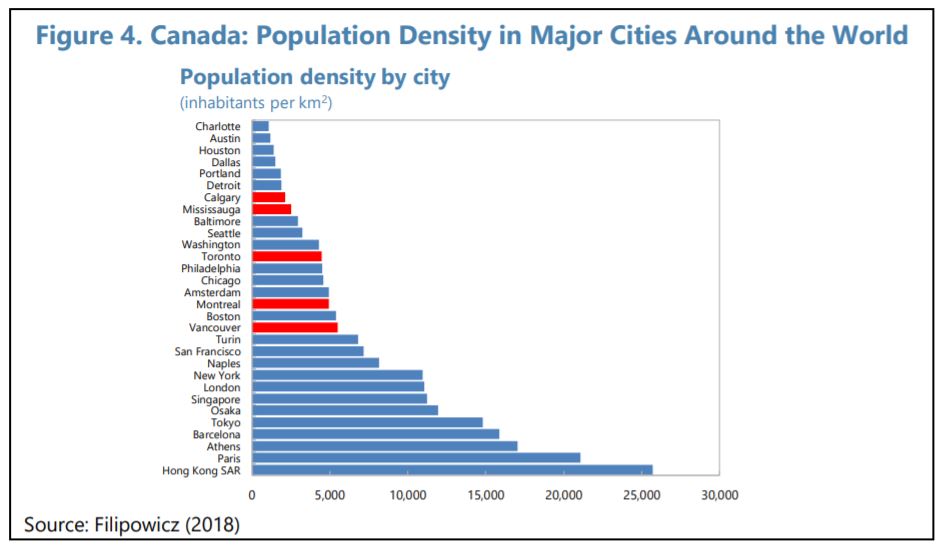
Addressing housing supply constraints is a complex exercise. It will require complementary transportation, immigration, and housing strategies at all levels of government. Some of the constraints and bottlenecks can be addressed relatively easily e.g., by streamlining and
modernizing processes, establishing databases and information sharing. Others, such as accelerating rezoning and the delivery of serviced land are more difficult issues, as they reflect deeper structural constraints. Nevertheless, addressing housing supply issues should be handled as a matter of urgency as the social and economic costs of deteriorating affordability are increasing.”
From the IMF’s latest report on Canada:
“Housing affordability is becoming an increasing social and economic concern in Canada. While Canada’s overall affordability rankings2 are not among the worst in its peer group, its
most dynamic regions, particularly around Vancouver and Toronto are severely unaffordable (Table 1). Moreover, some smaller housing markets are also becoming unaffordable, as demand pressures are spreading from the major markets to nearby markets. Deteriorating affordability raises not only important social concerns,
Posted by at 6:55 AM
Labels: Global Housing Watch
Balancing Financial Stability and Housing Affordability: The Case of Canada
From the IMF’s latest report on Canada:
“Housing market imbalances are prominent in Canada and are a key source of systemic
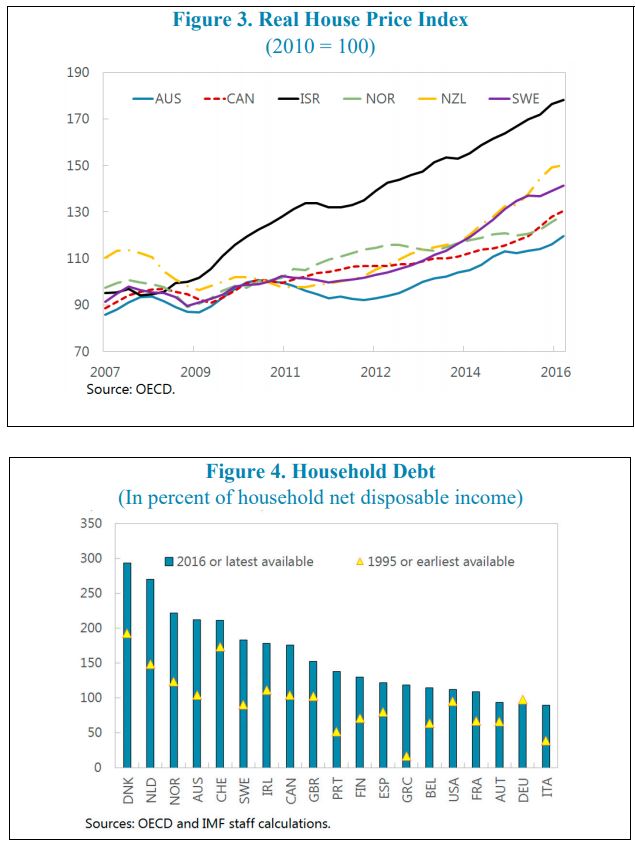
risk. Rapidly-rising house prices are usually coupled with rising household indebtedness (figure 1). High household debt raises the vulnerability of financial institutions to sharp corrections in house prices, and the interconnectedness of financial institutions make this risk systemic, not merely idiosyncratic. As such, agencies in charge of macroprudential policy/systemic risk oversight typically use macroprudential measures aimed at mitigating these risks to contain the build-up of vulnerabilities over time and enhance the resilience of the financial sector.
In addition to financial stability concerns, the rapid rise in housing prices has led to worsening housing affordability, posing a major problem to some of Canada’s most dynamic
metropolitan regions. Although Canada’s overall affordability indices are not yet among the worst globally, the Toronto and Vancouver regions are becoming severely unaffordable (figure 2). This raises important social and economic concerns.
The federal government has introduced a raft of macroprudential measures over the
past ten years to tackle growing housing market imbalances and associated risks to financial
stability. Initially, the measures were aimed at the high LTV ratio, government-backed insured mortgage market, helping to reduce the government’s exposure to the housing sector. In early 2018, the Office of the Superintendent of Financial Institutions (OSFI) tightened underwriting requirements for low-ratio mortgages to stem rising risk in the uninsured mortgage market. Low ratio mortgages are now subject to: (i) a stress test for mortgage interest rates; (ii) Loan-to-Value (LTV) measures and limits that reflect housing market risks, to be updated as housing markets and the economic environment evolve; and (iii) restrictions on combining mortgages with other lending products (e.g. co-lending arrangements) that could circumvent LTV limits (…).The governments of British Columbia and Ontario have also recently deployed property-tax measures to stem speculative activity and improve housing affordability in their major cities. A 15 percent nonresident property-transfer tax was introduced for the Toronto and Vancouver areas between 2016–17. More recently, the British Columbia government increased the property-transfer tax on nonresident homebuyers to 20 percent and expanded its geographic coverage.
The question remains: Which policy—macroprudential policy or property-tax policy—
best satisfies the overall objectives of policymakers? This chapter develops a simple Dynamic Stochastic-General-Equilibrium (DSGE) framework to assess the effectiveness of a specific
macroprudential policy—an LTV limit—against property-tax measures. The model is estimated using Bayesian methods and Canadian data. Operational objectives are specified for the central bank, the macroprudential authority, and the property-tax authority (assumed to be provincial governments). Optimal policy experiments are conducted to assess the overall performance of each policy given the specified objectives.”

From the IMF’s latest report on Canada:
“Housing market imbalances are prominent in Canada and are a key source of systemic
risk. Rapidly-rising house prices are usually coupled with rising household indebtedness (figure 1). High household debt raises the vulnerability of financial institutions to sharp corrections in house prices, and the interconnectedness of financial institutions make this risk systemic, not merely idiosyncratic. As such, agencies in charge of macroprudential policy/systemic risk oversight typically use macroprudential measures aimed at mitigating these risks to contain the build-up of vulnerabilities over time and enhance the resilience of the financial sector.
Posted by at 6:48 AM
Labels: Global Housing Watch
Subscribe to: Posts