Showing posts with label Global Housing Watch. Show all posts
Tuesday, November 20, 2018
The Evolution of Zipf’s Law for U.S. Cities
From a new working paper by Angelina Hackmann and Torben Klarl:
“Exploiting the cascade structure of cities and based on a dataset for U.S. cities between 1840 and 2016, the aim of this short paper is to answer three important questions: First, do we
observe that the U.S. city size distribution exhibits a smooth transition to Zipf’s law from the beginning or are there periods showing a pronounced departure from Zipf’s law? Second, if we observe periods of departure, which alternative laws instead should be used to accurately describe the city size distribution? Third, employing information from the cascade structure of cities, do we always find evidence for primate cities for a specific period of time? Inter alia, we find that the exact Zipf’s law has evolved over time from the more general, so-called threeparameter Zipf’s law which can be traced back to Mandelbrot (1982).”
From a new working paper by Angelina Hackmann and Torben Klarl:
“Exploiting the cascade structure of cities and based on a dataset for U.S. cities between 1840 and 2016, the aim of this short paper is to answer three important questions: First, do we
observe that the U.S. city size distribution exhibits a smooth transition to Zipf’s law from the beginning or are there periods showing a pronounced departure from Zipf’s law?
Posted by at 9:30 AM
Labels: Global Housing Watch
Friday, November 16, 2018
Superstar Firms and Cities
From Conversable Economist:
“Imagine two people who have seemingly equal skills and background. They go to work for two different companies. However, one “superstar” company grows much faster, so that wages and opportunities in that company also grow much faster. Or they go to work in two different cities. One “superstar” urban economy grows much faster, so that wages and opportunities in that city also grow faster.
Of course, such patterns of unequal growth have always existed to some extent. When evaluating a potential employer or location choice, people have always taken into account the potential for joining a superstar performer. The interesting question is whether the gap between superstar and ordinary firms, or between superstar and ordinary cities, has been growing or changing over time. For example, some argue that the rise of superstar firms, and the resulting rise in between-firm performance and labor compentiation, can explain most of the rise in US income inequality.
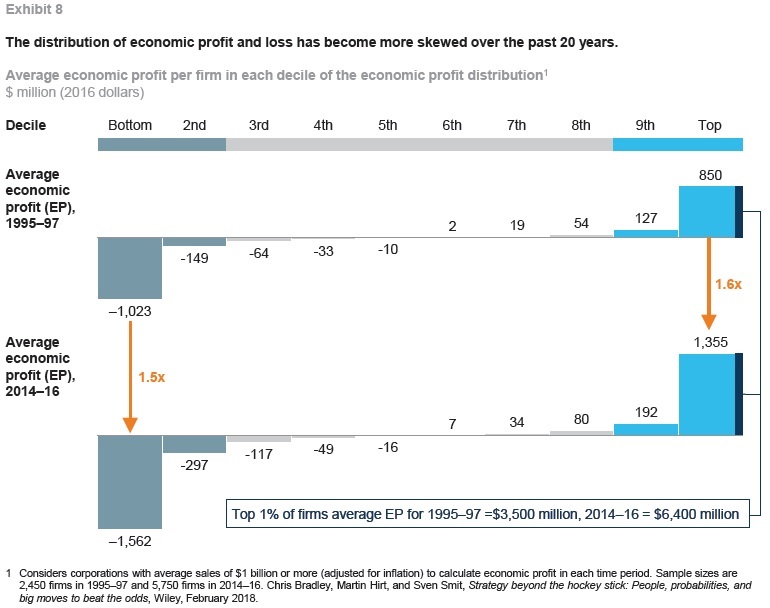
The McKinsey Global Institute has a nice report summarizing past evidence and offering new evidence of their own in Superstars: The Dynamics of Firms, Sectors, and Cities Leading the Global Economy(October 2018). It’s written by a team led by James Manyika, Sree Ramaswamy, Jacques Bughin, Jonathan Woetzel, Michael Birshan, and Zubin Nagpal. Short summary: Superstar firms and cities do seem to be widening their economic leadership gap, with the evidence that certain sectors are superstars seems weaker.
For superstar firms, the report notes:
“For firms, we analyze nearly 6,000 of the world’s largest public and private firms, each with annual revenues greater than $1 billion, that together make up 65 percent of global corporate pretax earnings. In this group, economic profit is distributed along a power curve, with the top 10 percent of firms capturing 80 percent of economic profit among companies with annual revenues greater than $1 billion. We label companies in this top 10 percent as superstar firms. The middle 80 percent of firms record near-zero economic profit in aggregate, while the bottom 10 percent destroys as much value as the top 10 percent creates. The top 1 percent by economic profit, the highest economic-value-creating firms in our sample, account for 36 percent of all economic profit for companies with annual revenues greater than $1 billion. Over the past 20 years, the gap has widened between superstar firms and median firms, and also between the bottom 10 percent and median firms. … The growth of economic profit at the top end of the distribution is thus mirrored at the bottom end by growing and increasingly persistent economic losses …”
Continue reading here.
From Conversable Economist:
“Imagine two people who have seemingly equal skills and background. They go to work for two different companies. However, one “superstar” company grows much faster, so that wages and opportunities in that company also grow much faster. Or they go to work in two different cities. One “superstar” urban economy grows much faster, so that wages and opportunities in that city also grow faster.
Of course,
Posted by at 10:03 AM
Labels: Global Housing Watch
Housing View – November 16, 2018
On cross-country:
- Living and Leaving: Housing, Mobility and Welfare in the European Union – World Bank
- Why house prices in global cities are falling – Economist
- Comment – On building typologies of housing systems in the OECD – IDEAS
On the US:
- California Midterm Results: Funding for Affordable Housing and a Rent Control Defeat – New York Times
- Collateral Damage: The Impact of Foreclosures on New Home Mortgage Lending in the 1930s – NBER
- No boom, no bust in US housing – Financial Times
- Local Banks, Credit Supply, and House Prices – Federal Reserve Bank of New York
- Income Tax Expenditures for Housing and Homeownership – Tax Policy Center
- Housing America’s Older Adults 2018 – Harvard Joint Center for Housing Studies
- Housing Sentiment Continues Downward Trend Despite Favorable Economy – Fannie Mae
- Buy young, earn more: Buying a house before age 35 gives homeowners more bang for their buck – Urban Institute
- Consumer-Lending Discrimination in the Era of FinTech – UC Berkeley
- Supply Skepticism: Housing Supply and Affordability – NYU Furman Center
- Why Cities Must Tackle Single-Family Zoning – CityLab
On other countries:
- [Australia] Assessing the Effects of Housing Lending Policy Measures – Reserve Bank of Australia
- [China] A Fifth of China’s Homes Are Empty. That’s 50 Million Apartments – Bloomberg
- [France] New or old, why would housing price indices differ? An analysis for France – IDEAS
- [France] The impact of the 2014 increase in the real estate transfer taxes on the French housing market – IDEAS
- [France] Paris property benefits from Brexit bounce – Financial Times
- [France] Does issuing building permits reduce the cost of land? – Bourgogne Franche‑Comté
- [Italy] Home is where the ad is: online interest proxies housing demand – EPJ Data Science
- [Slovak Republic] Housing Policy in the Slovak Republic – Slovak University of Technology in Bratislava
- [Spain] La demanda sigue impulsando nuevos proyectos de inversión residencial – BBVA
- [United Kingdom] The collapse in public ownership of land – Financial Times

Photo by Aliis Sinisalu
On cross-country:
- Living and Leaving: Housing, Mobility and Welfare in the European Union – World Bank
- Why house prices in global cities are falling – Economist
- Comment – On building typologies of housing systems in the OECD – IDEAS
On the US:
- California Midterm Results: Funding for Affordable Housing and a Rent Control Defeat – New York Times
- Collateral Damage: The Impact of Foreclosures on New Home Mortgage Lending in the 1930s – NBER
- No boom,
Posted by at 5:00 AM
Labels: Global Housing Watch
Wednesday, November 14, 2018
Macroprudential Policies and House Prices in Europe: An Overview of Recent Experiences
From the IMF’s latest Regional Economic Outlook report for Europe:
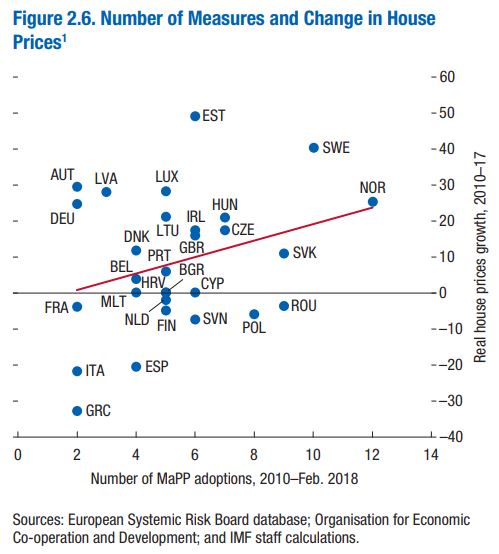
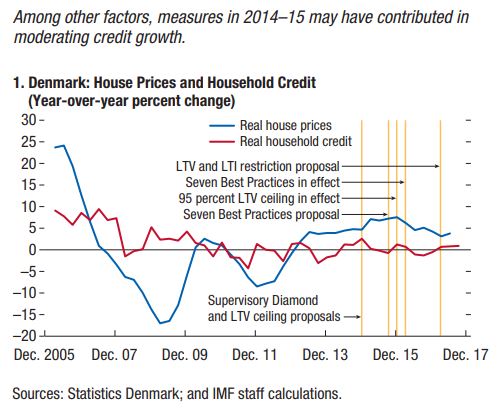
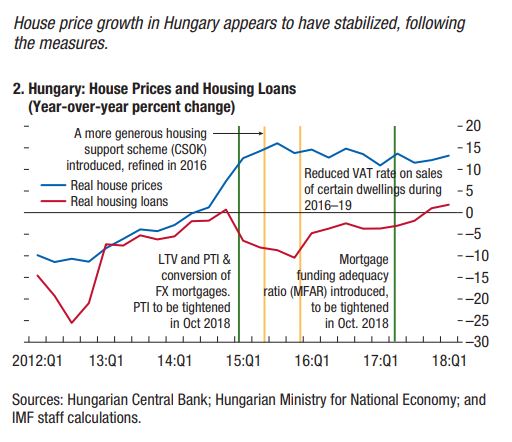
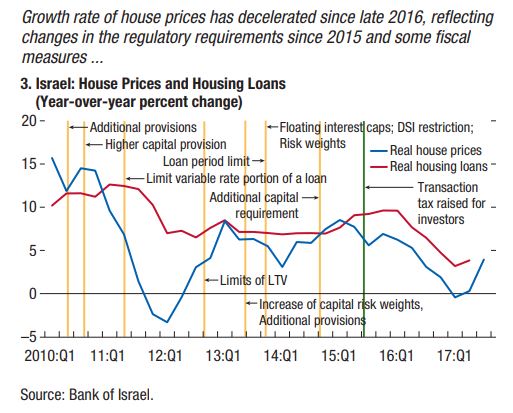
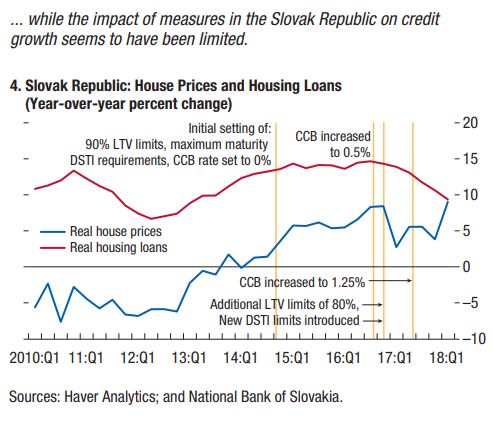
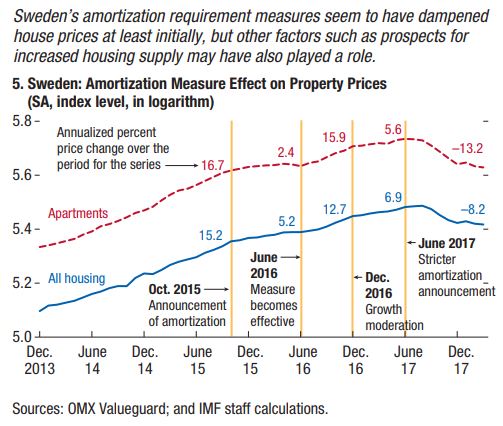
“This chapter documents the increasing use of macroprudential policies (MaPPs) in Europe in recent years to build financial resilience, contain general and sectoral credit growth, and limit house price increases. Considering these objectives and drawing from case studies, the chapter finds evidence that borrower-side measures, supported by lender-side measures, helped limit the share of riskier mortgages, thereby building resilience. Evidence is more mixed as to the ability of MaPPs to contain house price and overall credit growth against the backdrop of a still-accommodative monetary policy and other factors.
Macroprudential Measures in European Countries
The recent reacceleration in house prices has prompted the adoption of MaPPs in several European countries. Though credit and house price concerns are not yet generalized, house prices have increased substantially in several European countries over the past few years (…). In most of these countries, higher house prices have been accompanied by rising household debt (…) and rapid household credit growth (…).
To contain the buildup of systemic risks, especially in the residential housing market, many European countries have strengthened their MaPPs (…). While MaPPs have been
implemented across Europe, countries with larger postcrisis increases in house prices and household debt tended to adopt more MaPPs (…).The main objectives of the recently introduced MaPPs, as stated by country authorities, were improving financial stability, building financial resilience, and containing general and sectoral credit growth. Within these broader objectives, policies were generally focused on protecting borrowers, strengthening banking systems, and slowing down house price increases (…). The latter was an objective in most economies, but particularly in the Czech Republic, Estonia, Norway, and Sweden.
In some countries (Estonia, Norway, Switzerland), the relaxation of lending standards was a major concern. Constraining the rise in the share of loans denominated in foreign currency was a prominent goal in Hungary. The various capital buffers adopted beginning in 2013, in line with the EU Capital Requirements Directive (CRD IV), were aimed at containing not only housing sector imbalances, but also credit cycle swings.”
Continue reading here.

From the IMF’s latest Regional Economic Outlook report for Europe:
“This chapter documents the increasing use of macroprudential policies (MaPPs) in Europe in recent years to build financial resilience, contain general and sectoral credit growth, and limit house price increases. Considering these objectives and drawing from case studies, the chapter finds evidence that borrower-side measures, supported by lender-side measures, helped limit the share of riskier mortgages, thereby building resilience. Evidence is more mixed as to the ability of MaPPs to contain house price and overall credit growth against the backdrop of a still-accommodative monetary policy and other factors.
Posted by at 2:30 PM
Labels: Global Housing Watch
House Prices in Iceland
The IMF’s latest report on Iceland says that:
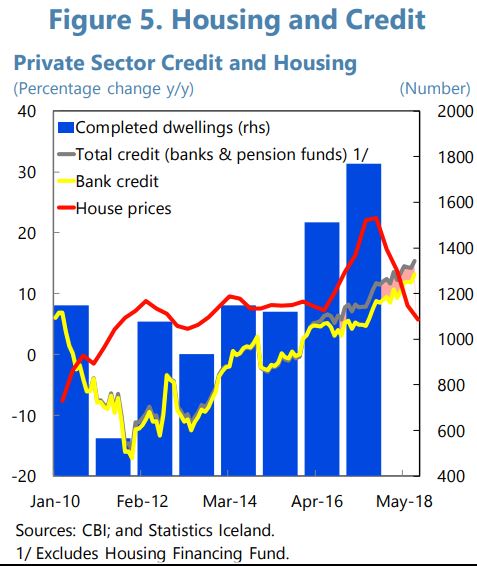
“The real estate markets have cooled. The rate of growth of housing prices fell from a peak of 24 percent y/y in July 2017 to 6 percent 12 months later, while that for commercial real estate slowed from 19 percent y/y to 15 percent. A robust supply response was key, although slowing tourism growth also helped—including by limiting private rental demand via Airbnb (see for instance Eliasson and Ragnarsson, 2018). Residential investment and commercial construction continue to expand briskly.”
Also, see a separate report on Inflation Targeting in Iceland–The Issue of Housing Costs here.
The IMF’s latest report on Iceland says that:
“The real estate markets have cooled. The rate of growth of housing prices fell from a peak of 24 percent y/y in July 2017 to 6 percent 12 months later, while that for commercial real estate slowed from 19 percent y/y to 15 percent. A robust supply response was key, although slowing tourism growth also helped—including by limiting private rental demand via Airbnb (see for instance Eliasson and Ragnarsson,
Posted by at 2:19 PM
Labels: Global Housing Watch
Subscribe to: Posts