



Sunday, March 27, 2011
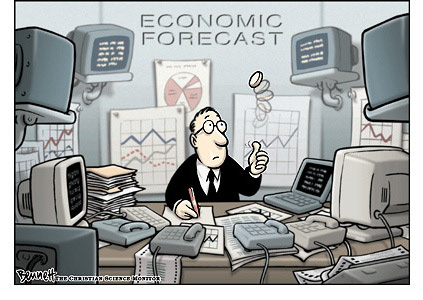
First, let’s shoot all the forecasters
From today’s New York Times — “The record of failure to predict recessions is virtually unblemished,” wrote IMF economist Prakash Loungani in one of many papers demonstrating the near-universal truth that economists’ predictions are least accurate when they are most needed. Read the rest of the New York Times excerpt of this new book on the dismal record of economic forecasting by Dan Gardner.
From today’s New York Times — “The record of failure to predict recessions is virtually unblemished,” wrote IMF economist Prakash Loungani in one of many papers demonstrating the near-universal truth that economists’ predictions are least accurate when they are most needed. Read the rest of the New York Times excerpt of this new book on the dismal record of economic forecasting by Dan Gardner.
Posted by at 1:41 PM
Labels: Forecasting Forum
Wednesday, March 23, 2011
Rising Oil Prices Highlight Need for Diversification
World oil prices are back above $100 a barrel, more than double levels two years ago, but increased diversification of energy supplies has given many economies greater resilience to price fluctuations. However, countries remain vulnerable to supply disruptions and extreme oil price volatility. To continue reading, see the IMF Survey piece on the rising oil prices.
World oil prices are back above $100 a barrel, more than double levels two years ago, but increased diversification of energy supplies has given many economies greater resilience to price fluctuations. However, countries remain vulnerable to supply disruptions and extreme oil price volatility. To continue reading, see the IMF Survey piece on the rising oil prices.
Posted by at 5:00 PM
Labels: Energy & Climate Change
Monday, February 28, 2011
Oil: The Once and Future Shock?
Sharp increases in oil prices are again provoking fears of the impact on oil-importing countries. Though major oil supply disruptions could still be very disruptive, the oil-importing economies over the years have developed some resilience to oil shocks. There is greater diversification in the sources in oil supply today compared to the 1990s. And diversification in sources of natural gas, an increasingly important source of energy, as been increasing steadily. My research on this topic, co-authored with Gail Cohen and Fred Joutz, is summarized here. And at a presentation I gave today at OPEC headquarters in Vienna, I also stressed other sources of resilience, namely the decreasing sensitivity of real GDP to oil prices and the increasing efficiency in the use of energy. In short, there are many factors that are pushing in the direction on increased “energy security”. But I was also politely—and accurately—reminded by my OPEC hosts that, from the perspective of energy producers, “security of demand is an integral part of energy security”. For energy-producing countries, “uncertainty about future oil demand—such as that created when oil consuming countries set ‘energy independence’ as their goal—makes producers unwilling to invest tens of billions of dollars for production capacity increases to meet potential future rises in demand.”
Sharp increases in oil prices are again provoking fears of the impact on oil-importing countries. Though major oil supply disruptions could still be very disruptive, the oil-importing economies over the years have developed some resilience to oil shocks. There is greater diversification in the sources in oil supply today compared to the 1990s. And diversification in sources of natural gas, an increasingly important source of energy, as been increasing steadily. My research on this topic,
Posted by at 6:42 PM
Labels: Energy & Climate Change
Tuesday, December 28, 2010
Hit #2. Research on the unemployment crisis also makes The Globalist Top Ten
The article—The Global Unemployment Crisis: Costs, Causes, Cures made it in the Globalist Research Center’s Top Ten Feautures of 2010. Also, see the full report on the unemployment crisis.
The article—The Global Unemployment Crisis: Costs, Causes, Cures made it in the Globalist Research Center’s Top Ten Feautures of 2010. Also, see the full report on the unemployment crisis.
Posted by at 1:39 AM
Labels: Inclusive Growth
Friday, December 24, 2010
Interview with Joe Stiglitz makes The Globalist’s Top Ten Features
Stiglitz predicts a financial crisis in five years. All the more reason to enjoy the moment. Merry X’Mas and a Happy New Year. Back in 2011.
Stiglitz predicts a financial crisis in five years. All the more reason to enjoy the moment. Merry X’Mas and a Happy New Year. Back in 2011.
Posted by at 8:56 PM
Labels: Profiles of Economists
Subscribe to: Posts