



Thursday, September 13, 2012
The Construction Sector: Reeling or Rolling?
sector is looking optimistic. In 2012, total construction spending is expected
to grow by 3 to 9 percent. And the future looks even brighter; total
construction is expected to go up by 6 to 10 percent per year in 2013-2017.
September 6, Ken Simonson, Chief Economist of the Associated General
Contractors, gave a presentation on the economic outlook for construction at an
event hosted by the National Economist Club.
construction sector? Simonson said that office, retail, and lodging
constructions are up due to remodeling. In addition, the production of shale
gas (67 percent increase in 2007-10), and the expansion of the Panama Canal are
driving new activity. Shale gas has both direct and indirect impacts on
construction. For example, the direct impacts include the construction of
access road, site preparation, storage pond, support structures, and pipes for
each well. The indirect impacts include local spending by drilling firms,
workers, royalty holders, among others.
construction in the United States? The expansion of the Panama Canal will
require an upgrade of the ports in the United States to accommodate larger
ships. The upgrade of ports includes investing
in dredging, piers, cranes, and access road. The upgrade will also lead to
possible bridge, tunnel, and highway improvements, resulting in possible
changes in inland distribution and manufacturing. Overall, private
nonresidential and residential spending are leading the way forward for the
construction sector.
According to Simonson, apartments and multi-family housing should boom. On
the other hand, single family housing is growing, but with an uncertain future.
He noted that the apartment vacancy rate is now at a 10-year low and rents are
high.
sector? “Construction added 0 jobs in 2 years, but unemployment is down,”
said Simonson. Basically, workers are leaving for other sectors, going back to school,
and retiring. Simonson presented a chart that showed the change in construction
employment by state in the United States. The map was half or less in green,
meaning jobs available, and half or more in red.
The economic outlook for the construction
sector is looking optimistic. In 2012, total construction spending is expected
to grow by 3 to 9 percent. And the future looks even brighter; total
construction is expected to go up by 6 to 10 percent per year in 2013-2017.
On
September 6, Ken Simonson, Chief Economist of the Associated General
Contractors, gave a presentation on the economic outlook for construction at an
event hosted by the National Economist Club. Read the full article…
Posted by at 3:34 PM
Labels: Forecasting Forum, Global Housing Watch
Monday, September 10, 2012
House Prices in Ireland
The new IMF report on Ireland says that “the correction in house prices, one of the largest in recent history, has continued. The decline in nominal residential property prices slowed to 14.4 percent y/y in June 2012. The index has halved since its peak in 2007, eclipsing recent U.K. and U.S. house price declines and comparable to the Japanese and Nordic experiences of the 1990s. As yet, clear signs of stabilization are limited to Dublin house prices (excluding apartments), which, after dropping by 55 percent, have been flat in H1 2012. Rural areas, in contrast, still show signs of oversupply.”
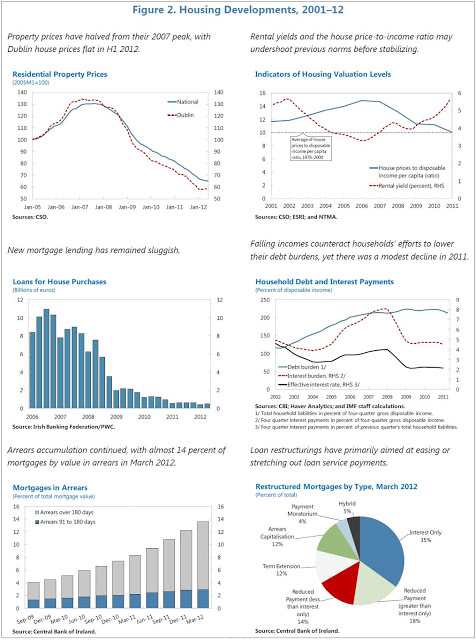
The new IMF report on Ireland says that “the correction in house prices, one of the largest in recent history, has continued. The decline in nominal residential property prices slowed to 14.4 percent y/y in June 2012. The index has halved since its peak in 2007, eclipsing recent U.K. and U.S. house price declines and comparable to the Japanese and Nordic experiences of the 1990s. As yet, clear signs of stabilization are limited to Dublin house prices (excluding apartments), which, after dropping by 55 percent,
Posted by at 4:51 PM
Labels: Global Housing Watch
Monday, September 3, 2012
Global House Price Watch

Roller Coaster
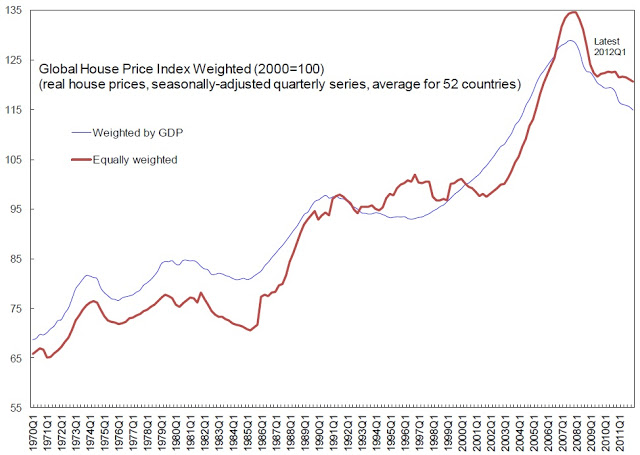
weighted average of price in 52 countries—shows no sign of an uptick. The
equally-weighted index moved sideways during the first quarter of 2012 and the
GDP-weighted index continued to decline (see Chart 1).
Chart 1. Global House Price Index
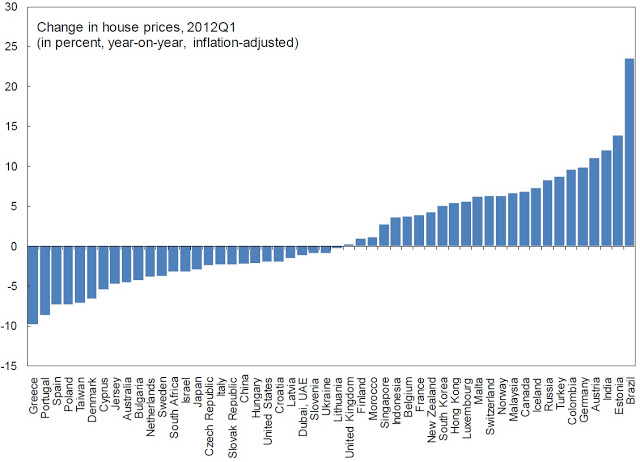
The global index continued to
mask very different developments across countries. House prices have fallen
over the past year in just over half of the countries and risen in the rest, in
Asian countries in particular (see Chart 2).
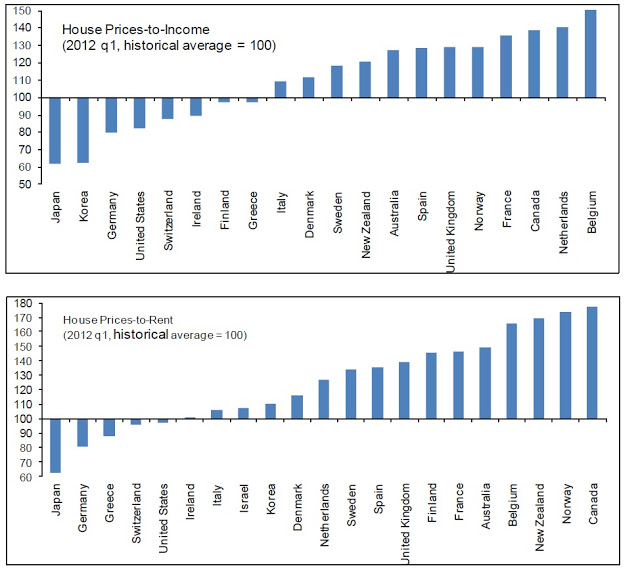
income and the ratio of house prices to rents are two indicators that give a
sense whether prices are likely to decline or rise. The price to income ratio
is the basic affordability measure for housing in a given area and the price to
rent ratio compares the total costs of homeownership vs. the cost of renting a
similar property. If these ratios are above their historical averages, economic
theory suggests that the house prices may decline in the future. The latest
data shows that both ratios continue to remain above—and in many cases well
above—their historical averages, signaling that there may potential for
corrections still to come (see Chart 3).
Relative to Incomes & Rents:
With Historical Averages
determinants of house prices, used in the working paper by Igan and Loungani explains
house price growth based on several short-run factors, such as growth in
incomes, asset prices, and population, and long-run-factors, such as the ratio
of house prices to incomes. The difference between house prices and those
predicted on the basis of these fundamental factors gives another indication of
whether prices may have more room to fall.
exercise show that in many countries the declines in house prices over the past
five years (the ‘actual’) are close to, or even exceed, what was predicted by
the model. But for many countries, house prices are still resisting the
predictions of the model (see Chart 4).
Chart 4. House Prices Changes Compared With Predictions from an Econometric Model

the United States
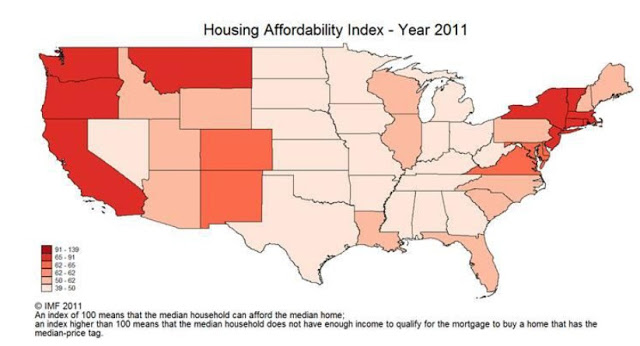
years, housing affordability improved in most U.S. states last year. In most
U.S. states, a family making the median income for the state could afford the
median house (Chart 5). There were still a few states, along the coasts, where
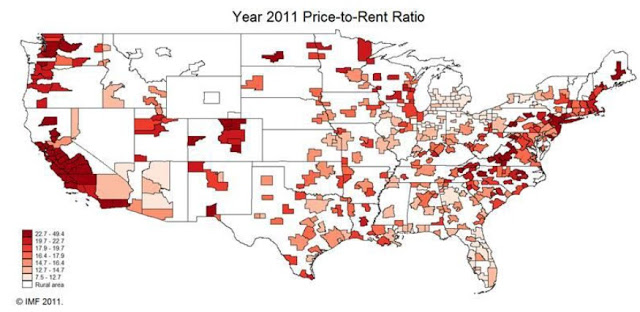
the median house still remained out of reach of the median household. A similar
picture emerges when looking at price-to-rent ratios by metropolitan areas:
house prices remained out of line with rents in some areas along the coasts
(see Chart 6).
studies
monitoring of economic conditions in countries (the so-called “Article IV”
reports), the IMF staff often provides an assessment of conditions in the
housing markets. Readers are encouraged to complement the broad-brush analysis
in this document with the country-focused assessment provided in those reports.
A list of some of the countries for which housing markets were described in
recent reports is given below.
|
Housing Markets in Recent IMF Staff Reports
|
Date of Report
|
|
|
Link to:
|
||
|
Discussion of housing markets
|
Full report (pages on which housing is discussed)
|
|
|
Germany
|
Jul-12
|
|
|
Mar-12
|
||
|
Feb-12
|
||
|
Feb-12
|
||
|
Mar-12
|
||
|
Aug-12
|
||
|
Jun-12
|
||
|
May-12
|
||
|
Aug-12
|
||

This document draws on “Global Housing Cycles”, an IMF Working Paper 12/217 by Deniz Igan and Prakash Loungani (http://www.imf.org/external/pubs/cat/longres.aspx?sk=26229.0). It updates a few of the charts from that paper. As with Working Papers, the views expressed in this document are those of the authors and do not necessarily represent those of the IMF or IMF policy.
The Global House Price
Roller Coaster
Our global index of house prices—a
weighted average of price in 52 countries—shows no sign of an uptick. Read the full article…
Posted by at 11:22 AM
Labels: Global Housing Watch
Monday, August 27, 2012
House Prices in Singapore

In Singapore, “indicators of housing affordability are mixed. House prices have risen more quickly than median incomes, especially for HDB resale housing. In addition, the tighter LtV ceilings raise the bar on qualifying for a housing loan. On the other hand, all-time low mortgage interest rates (about 70 percent of which are at floating rates, currently between 1⅓ percent and 2 percent) have reduced debt servicing costs,” according to a new IMF report on Singapore.
Moreover, it says “Following successive rounds of policy tightening, together with external factors, home prices have remained flat since end˗2011, while the volume of transactions has declined noticeably. In particular, the share of foreign buyers collapsed in Q1:2012 to 5½ percent as a result of new macroprudential measures targeting foreigners and weakening external investment sentiment, with buyers from China falling by nearly 50 percent. The more-than-proportionate decline in purchases by Mainland Chinese may reflect the impact of the economic slowdown in China. Transactions in the luxury market have also fallen. However, the share in total transactions of “shoe box” apartments (with an area of less than 50 square meters) doubled in Q1:2012 to close to 20 percent. While this may reflect the characteristics of new supply coming on-stream, demand for such housing is strong, possibly because of the reduced affordability of standard-size units.”
In Singapore, “indicators of housing affordability are mixed. House prices have risen more quickly than median incomes, especially for HDB resale housing. In addition, the tighter LtV ceilings raise the bar on qualifying for a housing loan. On the other hand, all-time low mortgage interest rates (about 70 percent of which are at floating rates, currently between 1⅓ percent and 2 percent) have reduced debt servicing costs,” according to a new IMF report on Singapore.
Moreover,
Posted by at 9:25 PM
Labels: Global Housing Watch
Sunday, August 12, 2012
Interview with IMF Fellow Olivier Coibion
 |
| Olivier Coibion |
Loungani: Congratulations on your selection as an IMF Fellow. Is this your first stint at a policy institution?
Coibion: Thanks, I’m thrilled to be here! I worked for a year at the CEA [U.S. Council of Economic Advisers] in 2000-01. It gave me an enduring sense of how economic theory and empirical methods can help address policy questions and make a difference in people’s lives. And because I happened to be there during the transition from the Clinton to the Bush administration, it was fascinating to see the change in style and personalities—and in the dress code. The suits got much more sober and I even had to start wearing a tie once the Bush administration was in place.
Loungani: Dress is casual at the IMF over the summer. You see the suits out in full force in the fall. What will you work on during your year here?
Coibion: I’ll continue some of my work on inequality. One project will look at links between inequality and financial crises, which folks at the IMF have also studied. I’ve also been studying the impact of monetary policy on inequality—who gains, who loses when the Fed changes its policy. This gets debated in policy circles a lot but not much in academia. Ron Paul says that expansionary monetary policies, or debasing the currency as he always puts it, raises income inequality; people on the left like Jamie Galbraith say the opposite.
Loungani: What do you find?
Coibion: We find that expansionary monetary policy has typically reduced U.S. inequality in the short run. This suggests that when the central bank can’t cut interest rates any more—when rates hit the so-called ‘zero lower bound’, as is the case at present—inequality will be higher than it would be otherwise. To avoid these additional increases in inequality at a time of crisis, the government should use other tools, such as targeted fiscal policies. I hope to do some more work on this while I’m here. More generally, I’ll be studying how best to sequence fiscal and monetary policies when the multipliers—the impacts of the policies on the economy—associated with each may vary with the state of the economy.
Loungani: Do you think the Fed has done enough to promote recovery?
Coibion: I think the zero lower bound [on interest rates] has certainly limited the size of their response. They would be lowering rates further if they could. But as the IMF’s latest review of the U.S. economy noted, the Fed still has a few options to further support economic activity, given the weak state of labor markets and given the significant downside risks that still exist.
Loungani: Do you think that to avoid hitting the zero lower bound in the future, central banks should raise the target rate of inflation?
Coibion: No, I don’t. A higher inflation rate also has economic costs. So raising the target inflation rate will confer the benefit that we’ll be less likely to hit the zero lower bound. But such episodes are rare. So the high benefits conferred on rare occasions have to be balanced against the small but frequent costs of having higher inflation. In some work I’ve done, it turns out that the costs consistently outweigh the benefits for inflation rates above 2%. So rather than raise the target rate of inflation to deal with future episodes like the Great Recession, I’d prefer the more aggressive use of temporary policies designed for precisely this kind of episode, such as additional quantitative easing or fiscal policy.
Olivier Coibion–Recent Publications:
- The Optimal Inflation Rate in New Keynesian Models: Should Central Banks Raise their Inflation Targets in Light of the ZLB?” (with Yuriy Gorodnichenko and Johannes Wieland), forthcoming in Review of Economic Studies.
- “Why are target interest rate changes so persistent?” (with Yuriy Gorodnichenko), forthcoming in American Economic Journal: Macroeconomics.
- “What Can Survey Forecasts Tell Us About Informational Rigidities?” (with Yuriy Gorodnichenko), 2012, Journal of Political Economy 120(1), 116-159.
- “One for Some or One for All? Taylor Rules and Interregional Heterogeneity” (with Daniel Goldstein), 2012, Journal of Money Credit and Banking 44(2:3), 401-432.
- “Are the Effects of Monetary Policy Shocks Big or Small?” 2012, American Economic Journal: Macroeconomics 4(2), 1-32.
- “Strategic Complementarity among Heterogeneous Price-Setters in an Estimated DSGE Model” (with Yuriy Gorodnichenko), 2011, The Review of Economics and Statistics 93(3), 920-940.
- “Monetary Policy, Trend Inflation, and the Great Moderation: An Alternative Interpretation” (with Yuriy Gorodnichenko), 2011, The American Economic Review 101(1), 341-370.
Olivier Coibion
Loungani: Congratulations on your selection as an IMF Fellow. Is this your first stint at a policy institution?
Coibion: Thanks, I’m thrilled to be here! I worked for a year at the CEA [U.S. Council of Economic Advisers] in 2000-01. It gave me an enduring sense of how economic theory and empirical methods can help address policy questions and make a difference in people’s lives. And because I happened to be there during the transition from the Clinton to the Bush administration,
Posted by at 7:31 PM
Labels: Profiles of Economists
Subscribe to: Posts