



Friday, January 10, 2014
House Prices in Uruguay
“The growth of house prices moderated in 2012,” says new IMF report on Uruguay.
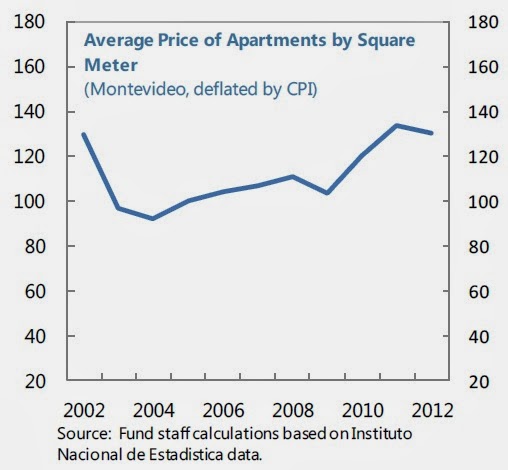
“The growth of house prices moderated in 2012,” says new IMF report on Uruguay.
The report points out that “most of the expansion in the real estate market in recent years had been concentrated in the urban luxury segment, and according to anecdotal evidence, has received heavy foreign investment (mainly from Argentina). The vast majority of real estate transactions are done in cash (household mortgages stood at 4 percent of GDP in July 2013, broadly unchanged from levels in recent years). Read the full article…
Posted by at 10:37 PM
Labels: Global Housing Watch
Thursday, January 9, 2014
Boom, Boom: Measuring the Economic Impact of the US Energy Revolution
- The Peterson Institute released a study today that concludes that “while substantial, the forecasted long-term economic benefits [of the unconventional energy boom] are more modest than in many other analyses.” The boom is expected “to transform a handful of specific industries and regional economies, but there is unlikely to be an energy-caused broad-based economic renaissance. The US economy … is too large and diverse to be driven by the energy supply changes alone.”
- At the recent American Economic Association meetings in Philadelphia, IHS/CERA presented their estimates of the economic impacts of the energy boom, which suggest much more substantial impacts.
The IMF’s estimates suggest modest impacts. Here’s a cheat sheet to the IMF’s analysis and here’s the full-blown study.

- The Peterson Institute released a study today that concludes that “while substantial, the forecasted long-term economic benefits [of the unconventional energy boom] are more modest than in many other analyses.” The boom is expected “to transform a handful of specific industries and regional economies, but there is unlikely to be an energy-caused broad-based economic renaissance. The US economy … is too large and diverse to be driven by the energy supply changes alone.”
Posted by at 1:37 AM
Labels: Energy & Climate Change
Wednesday, December 25, 2013
House Prices in Ireland
“House prices are rising nationally, with strong growth in Dublin and increases emerging elsewhere (…),” according to the latest IMF report on Ireland.
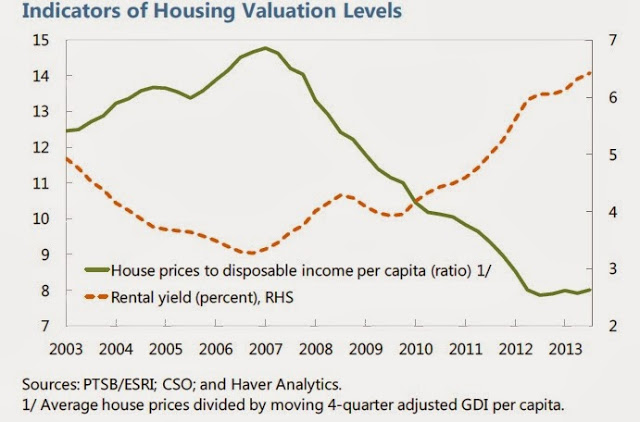
“House prices are rising nationally, with strong growth in Dublin and increases emerging elsewhere (…),” according to the latest IMF report on Ireland.
Posted by at 2:26 AM
Labels: Global Housing Watch
Saturday, December 21, 2013
Reforming Dual Labor Markets In Advanced Economies
Labor market duality has increased dramatically in many advanced countries in recent years. While duality has some positive aspects, microeconomic and cross-country studies suggest that an excessive reliance on “non-regular” employment has a negative impact on total factor productivity (TFP) and growth, according to Giovanni Ganelli. His excellent article summarizes recent research on this topic, and draws some policy implications for reforms aimed at reducing duality and creating more inclusive labor markets in advanced economies.
Labor market duality has increased dramatically in many advanced countries in recent years. While duality has some positive aspects, microeconomic and cross-country studies suggest that an excessive reliance on “non-regular” employment has a negative impact on total factor productivity (TFP) and growth, according to Giovanni Ganelli. His excellent article summarizes recent research on this topic, and draws some policy implications for reforms aimed at reducing duality and creating more inclusive labor markets in advanced economies.
Posted by at 1:47 PM
Labels: Inclusive Growth
Friday, December 6, 2013
The China Chill & the Shale Gale: The IMF’s Commodity Market Review
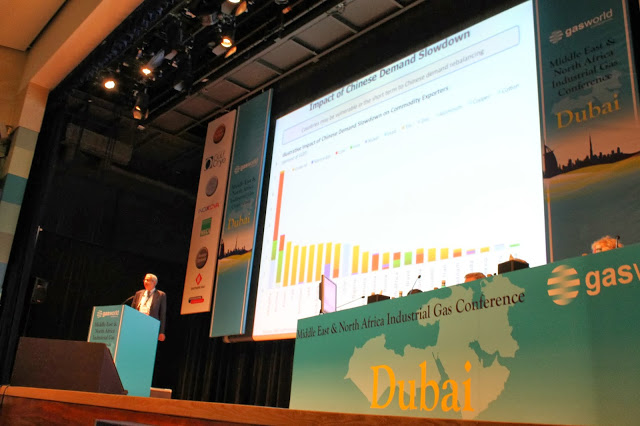
The latest IMF’s Commodity Review was presented at the MENA Industrial Gas Conference 2013. On my presentation, Rob Cockerill tweeted:
- “The message here is firstly that the advanced economies in the west, particularly the US and Europe, have to be very nimble in their policy making. Secondly, if countries who have benefited from China’s growth in the past fail to diversify, they will be vulnerable.”
- “Thirdly, don’t get carried away by the shale gale – the numbers do not translate into huge income gains in the US and therefore won’t have huge impact elsewhere. It might have huge impact for companies, but not countries.”
- “US incomes go up, by just a little over 1% after 12-13 years, there is very little additional employment generated from this, and domestic demand goes up by about 1.5% – we’re not talking about big changes in the US. Which means, we are not talking about big changes in the rest of the world either.”
- “We revise our forecast every three months, and what you can see here is that we have revised down our global forecast slightly, and we have also revised this down for 2014.”
- “This is due to some revisions within our outlook of developing and emerging economies. If you break down within the emerging markets, we’ve really marked down Russia, India and China, a little bit. The BRICs are areas where we are seeing softness, more than we did three months ago.”


The latest IMF’s Commodity Review was presented at the MENA Industrial Gas Conference 2013. On my presentation, Rob Cockerill tweeted:
- “The message here is firstly that the advanced economies in the west, particularly the US and Europe, have to be very nimble in their policy making. Secondly, if countries who have benefited from China’s growth in the past fail to diversify, they will be vulnerable.”
- “Thirdly,
Posted by at 1:39 PM
Labels: Energy & Climate Change
Subscribe to: Posts