



Saturday, March 15, 2014
House Prices in Malaysia
“House prices have increased rapidly, outpacing income and rental growth, along with strong demand for residential property loans, driven by a robust labor markets and falling lending rates. However, underwriting standards do not appear to have deteriorated, as evidenced by lower default rates by month on book for more recent vintages,” says the annual IMF economic report on Malaysia.
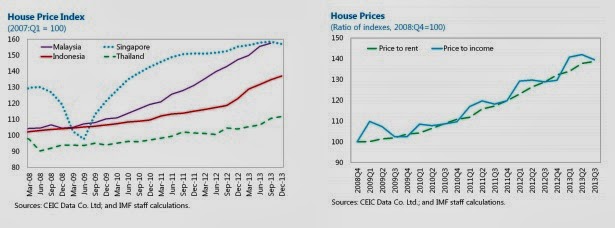
“House prices have increased rapidly, outpacing income and rental growth, along with strong demand for residential property loans, driven by a robust labor markets and falling lending rates. However, underwriting standards do not appear to have deteriorated, as evidenced by lower default rates by month on book for more recent vintages,” says the annual IMF economic report on Malaysia.
Posted by at 4:46 PM
Labels: Global Housing Watch
Thursday, March 13, 2014
Lipton Releases IMF Paper on Fiscal Policy and Inequality
IMF First Deputy Managing Director David Lipton released a new paper on fiscal policy and inequality, adding to the stock of IMF work on this issue. Here are links and a cheat sheet to the key papers:
1) Painful Medicine: This (non-wonkish) paper documented that fiscal consolidations not only lower aggregate incomes but have distributional consequences—wage incomes fall more than profits; and the long-term unemployed are affected more than short-term unemployed.
2) The Distributional Effects of Fiscal Consolidation: A wonkish version of the “Painful Medicine” article, with the additional result that, between 1978 and 2009, fiscal consolidations in advanced economies increased the Gini measure on income inequality.
3) Distributional Consequences of Fiscal Consolidation and the Role of Fiscal Policy: In addition to confirming the results in the previous papers, this paper brings in evidence from emerging markets. It also discusses how policies can be designed to mitigate the impacts of fiscal policy on inequality.
4) Who Let the Gini Out? A (non-wonkish) summary of some of the previous papers.
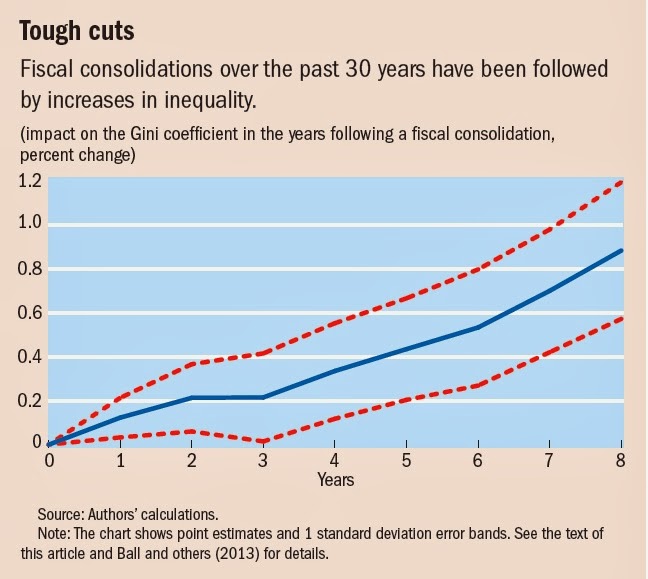
5) Fiscal Policy and Inequality: A key finding of the paper is that fiscal consolidations during the Great Recession did not lead to increases in inequality.
IMF First Deputy Managing Director David Lipton released a new paper on fiscal policy and inequality, adding to the stock of IMF work on this issue. Here are links and a cheat sheet to the key papers:
1) Painful Medicine: This (non-wonkish) paper documented that fiscal consolidations not only lower aggregate incomes but have distributional consequences—wage incomes fall more than profits; and the long-term unemployed are affected more than short-term unemployed.
Posted by at 5:49 PM
Labels: Inclusive Growth
Wednesday, March 12, 2014
House Prices in Belgium
House prices are overvalued by “5–15 percent” according to a new IMF report on the Belgium economy. The report says that “Risks of a sharp correction of real estate prices appear contained. Property prices have risen by 110 percent in real terms since 2000, and, unlike in other EU countries, continued to increase through the financial crisis. Overvaluation estimates range from 10–60 percent, but valuation estimates based on price-to-income and price-to-rent ratios often miss catch-up effects. A finer assessment (interest-adjusted affordability regression analysis) suggests overvaluation of 5–15 percent. In fact, absolute prices remain moderate by European comparison. High ownership rates (around 70 percent), coupled with persistent housing shortages, are likely to prevent a rapid price decline. Robust household balance sheets, the prevalence of fixed interest rate mortgages, and the recent tightening of capital requirements on mortgage lending should limit the impact of an interest rate and/or unemployment shocks on the quality of the mortgage portfolio. However, the prevalence of fixed-rate mortgages shifts the interest rate risk to banks.”
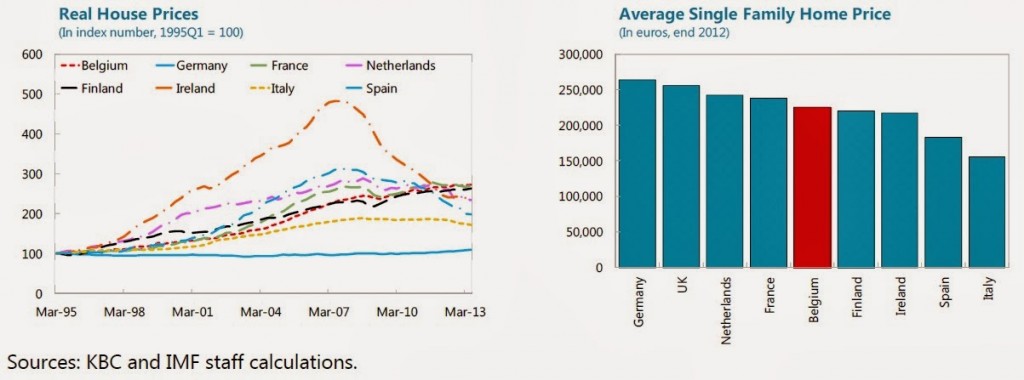
House prices are overvalued by “5–15 percent” according to a new IMF report on the Belgium economy. The report says that “Risks of a sharp correction of real estate prices appear contained. Property prices have risen by 110 percent in real terms since 2000, and, unlike in other EU countries, continued to increase through the financial crisis. Overvaluation estimates range from 10–60 percent, but valuation estimates based on price-to-income and price-to-rent ratios often miss catch-up effects.
Posted by at 5:02 PM
Labels: Global Housing Watch
Wednesday, February 26, 2014
The IMF on Inequality: New Ostry-Berg Paper on Redistribution
A new paper by Andrew Berg and Jonathan Ostry (along with Haris Tsangarides) adds to the growing stock on IMF work on inequality.
In the recent past, the IMF has released papers on the impacts of fiscal tightening on inequality — see a summary here and to the research on which it is based here and here.
The IMF has also looked at the impact of capital account liberalization on inequality — see this article and Vox post.
The Berg-Ostry paper showed that inequality lowers the duration of growth spells. The new paper makes the case that redistribution efforts to lower inequality are not harmful to growth.
A new paper by Andrew Berg and Jonathan Ostry (along with Haris Tsangarides) adds to the growing stock on IMF work on inequality.
In the recent past, the IMF has released papers on the impacts of fiscal tightening on inequality — see a summary here and to the research on which it is based here and here.
The IMF has also looked at the impact of capital account liberalization on inequality —
Posted by at 4:04 PM
Labels: Inclusive Growth
Thursday, February 20, 2014
House Prices in Spain
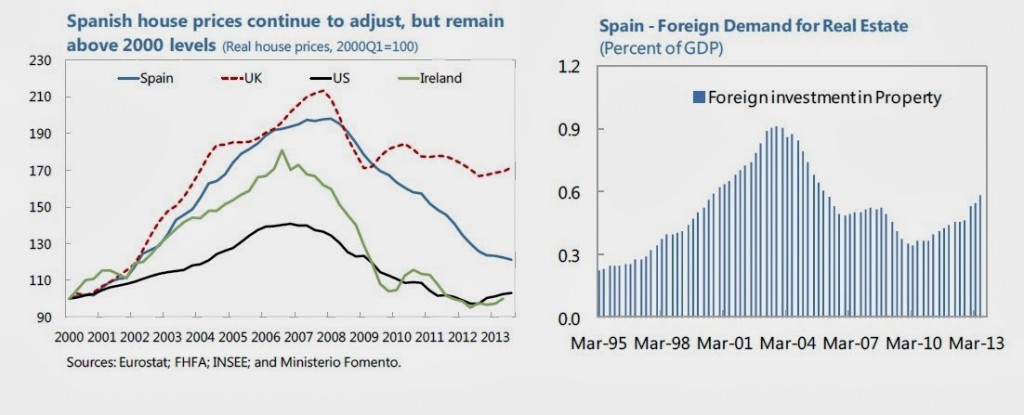
“Although house prices have started to stabilize in the most recent data, further declines are possible as the supply overhang is still large (the stock of vacant new houses equals four years of sales, and the population is falling). On the upside, foreign investor interest in Spanish property has increased noticeably in recent months,” according to a new report from the IMF.
Posted by at 8:25 PM
Labels: Global Housing Watch
Subscribe to: Posts