

Monday, March 20, 2017
Does Money Buy Happiness? Evidence from China
A new report by Richard Easterlin, a pioneer of the study of the link between income and happiness, looks into whether China’s income growth has made people happier. He writes: “In the past quarter century China’s real GDP per capita has multiplied over five times, an unprecedented feat.1 By 2012 virtually every urban household had, on average, a color TV, air conditioner, washing machine, and refrigerator. Almost nine in ten had a personal computer, and one in five, an automobile. Rural households lagged somewhat behind urban, but these same symptoms of affluence, which were virtually nonexistent in the countryside in 1990, had become quite common by 2012.2 In the face of such new-found plenitude, one would suppose that the population’s feelings of well-being would have enjoyed a similar multiplication. Yet, as will be discussed, well-being today is probably less than in 1990.” The full report is worth reading.
A new report by Richard Easterlin, a pioneer of the study of the link between income and happiness, looks into whether China’s income growth has made people happier. He writes: “In the past quarter century China’s real GDP per capita has multiplied over five times, an unprecedented feat.1 By 2012 virtually every urban household had, on average, a color TV, air conditioner, washing machine, and refrigerator. Almost nine in ten had a personal computer, and one in five,
Posted by at 9:04 AM
Labels: Inclusive Growth
Friday, March 17, 2017
House Prices in Belgium
IMF’s latest report on Belgium says:
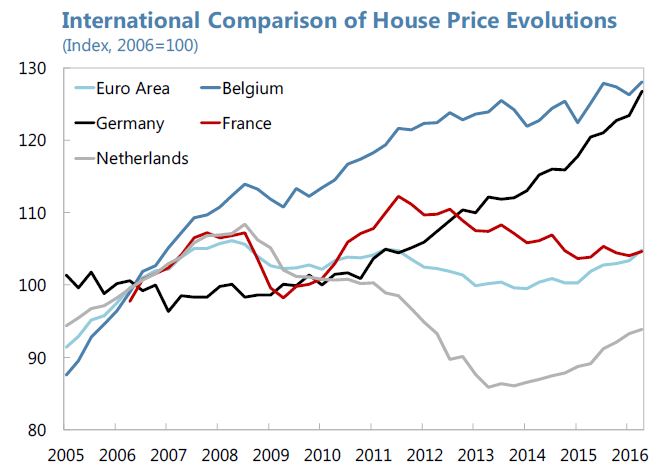
“Further macro-prudential actions may be needed to address pockets of vulnerability in the housing market. Concerns relate to the continued growth in house prices, combined with rising household indebtedness and significant shares of risky mortgage lending practices, as well as strong expansion in mortgage credit. Various overvaluation estimates are in the range of 0–20 percent. Policy actions could address these issues from various angles:
Direct remedies. In addition to the existing 5-percentage-point add-on to certain domestic mortgage risk weights, the NBB plans to impose additional capital buffers targeted at riskier loans, i.e. mortgage loans with loan-to-value (LTV) ratio higher than 80 percent, effective May 2017 (pending approval from the European authorities). Staff welcomed these measures and called for continued close monitoring of real estate market developments, including possible search-for-yield behavior in the housing market, and discussed possible further measures such as LTV or debt service to income (DSTI) limits to more directly target vulnerable borrowers.
Other buffers. An additional capital cushion, the capital conservation buffer, will also be raised by 2019 by eight banks deemed domestically systemically important, among which are the large mortgage lenders. Another buffer that could be deployed should strong credit growth persist is the counter-cyclical capital buffer, which is currently set to zero. On balance, staff considers this appropriate, in view of the various estimates of the credit gap of near zero6. Close monitoring is nevertheless warranted.”
IMF’s latest report on Belgium says:
“Further macro-prudential actions may be needed to address pockets of vulnerability in the housing market. Concerns relate to the continued growth in house prices, combined with rising household indebtedness and significant shares of risky mortgage lending practices, as well as strong expansion in mortgage credit. Various overvaluation estimates are in the range of 0–20 percent. Policy actions could address these issues from various angles:
Direct remedies.
Posted by at 5:28 PM
Labels: Global Housing Watch
Wednesday, March 15, 2017
OPEC’s Rebalancing Act
From iMFdirect by Rabah Arezki and Akito Matsumoto:
In November 2014, the Organization of Petroleum Exporting Countries (OPEC) decided to maintain output despite a perceived global glut of oil. The result was a steep decline in price.
Two years later, on November 30, 2016, the organization took a different tack and committed to a six-month, 1.2 million barrel a day (3.5 percent) reduction in OPEC crude oil output to 32.5 million barrels per day, effective in January 2017. The result was a small price increase and some price stability.
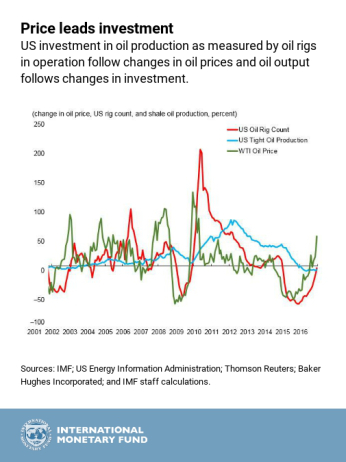
But the respite may be temporary, because the price increase is likely to stimulate other oil production that can come on line quickly. A recent sharp decline in prices because of higher than expected oil inventories in the United States underlines the temporary nature of the respite the OPEC agreement provides.
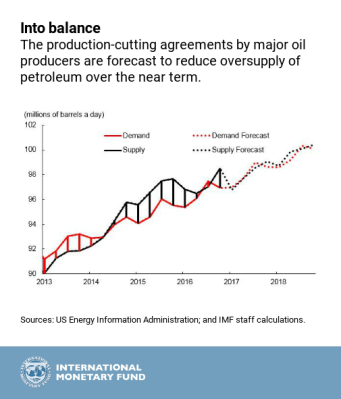
Continue reading here.
From iMFdirect by Rabah Arezki and Akito Matsumoto:
In November 2014, the Organization of Petroleum Exporting Countries (OPEC) decided to maintain output despite a perceived global glut of oil. The result was a steep decline in price.
Two years later, on November 30, 2016, the organization took a different tack and committed to a six-month, 1.2 million barrel a day (3.5 percent) reduction in OPEC crude oil output to 32.5 million barrels per day,
Posted by at 1:54 PM
Labels: Energy & Climate Change
IMF on the Decline in Labor Share of Income
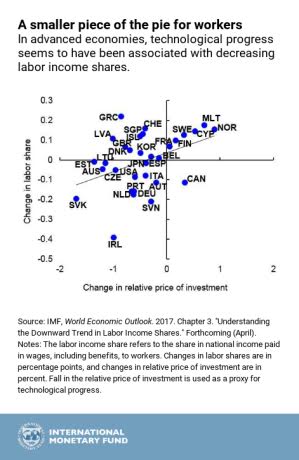
The IMF’s forthcoming World Economic Outlook will have a chapter on what drives the decline in the labor share of income in many countries around the world. Previewing the chapter (see figure above), IMF Managing Director Lagarde wrote that “trade and technological innovation have allowed countries to grow the economic pie and improve living standards, while lifting hundreds of millions of people out of poverty. Yet more could be done to mitigate the unwelcome side-effects seen in some places—including a rise in income inequality, job losses in shrinking sectors, and protracted economic and social problems across structurally weaker regions.”
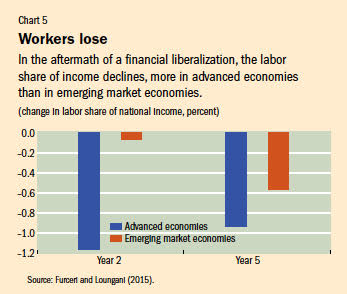
For earlier work on inequality and the decline in labor share of income, see Krugman’s post for a summary, this F&D article for a longer description or this working paper for the gory details.
The IMF’s forthcoming World Economic Outlook will have a chapter on what drives the decline in the labor share of income in many countries around the world. Previewing the chapter (see figure above), IMF Managing Director Lagarde wrote that “trade and technological innovation have allowed countries to grow the economic pie and improve living standards, while lifting hundreds of millions of people out of poverty. Yet more could be done to mitigate the unwelcome side-effects seen in some places—including a rise in income inequality,
Posted by at 7:27 AM
Labels: Inclusive Growth
Friday, March 10, 2017
Trade Integration in Latin America and the Caribbean
Below is the executive summary of a new IMF report:
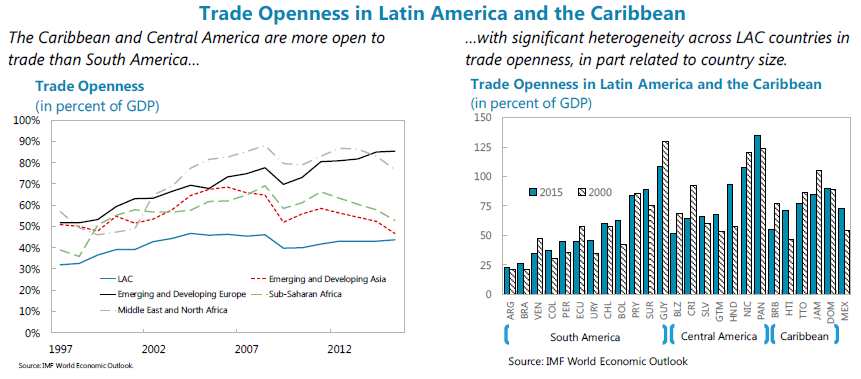
“This cluster report takes stock of and explores opportunities for trade integration in Latin America and the Caribbean (LAC). Drawing on a set of 12 analytical studies that will be issued as working papers, the report examines the determinants of trade, explores the potential to enhance LAC’s trade integration, and assesses the associated economic and social effects. To deepen understanding of the region’s policy options and trade strategies, the report also incorporates the views of LAC country authorities based on responses to a survey. This provides an opportunity to examine the alignment of recommendations based on the analytical findings with the region’s current trade policy priorities, with the caveat that the survey was conducted between late 2015 and mid-2016, prior to the most recent developments in the global trade landscape.
The report finds that LAC can reap important growth benefits from further trade integration. With trade integration below that of other regions, there is scope for LAC to increase trade as an engine of growth and help offset the weaker economic outlook without adversely affecting overall income inequality. While there is potential to enhance both inter- and intra-regional trade integration, renewed political momentum within LAC in support of greater trade openness could provide an important impetus to further intra-regional trade integration in particular. In this context, regional trade integration could be promoted through a regional trade agreement, convergence of trade rules and regulatory standards, and measures to support trade facilitation. Strategies to bolster the region’s inter-regional integration could be centered on unilateral liberalization as a complement to existing efforts to expand LAC’s network of trade agreements.
This report also emphasizes the importance of complementary policies. Continued regional efforts to strengthen infrastructure and human capital would be useful as part of a broad growth strategy. But they can also enhance trade integration, including by facilitating participation in global value chains which may offer new opportunities for technology transfer, and are critical to diversifying and upgrading the complexity of LAC’s exports. Finally, strengthened social safety nets can help lessen adjustment costs linked to further integration and promote an equitable distribution of gains from trade.”
Below is the executive summary of a new IMF report:
“This cluster report takes stock of and explores opportunities for trade integration in Latin America and the Caribbean (LAC). Drawing on a set of 12 analytical studies that will be issued as working papers, the report examines the determinants of trade, explores the potential to enhance LAC’s trade integration, and assesses the associated economic and social effects. To deepen understanding of the region’s policy options and trade strategies,
Posted by at 11:45 AM
Labels: Inclusive Growth
Subscribe to: Posts