



Tuesday, January 31, 2017
Okun’s Law and Phillips Curves in Asia
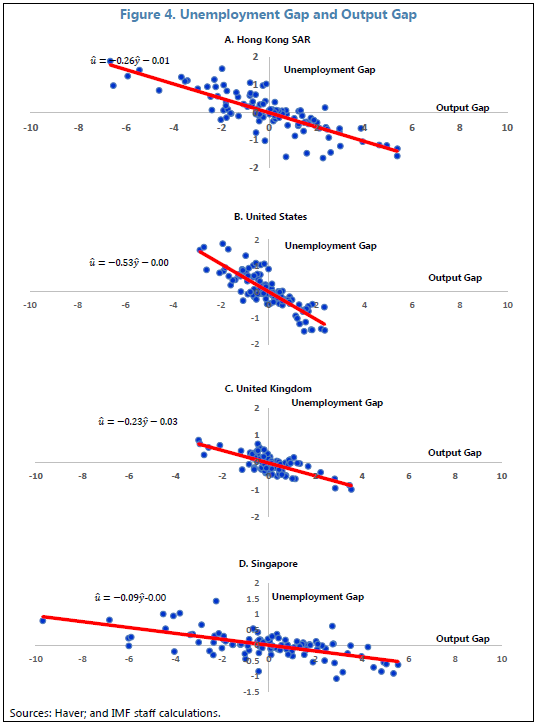
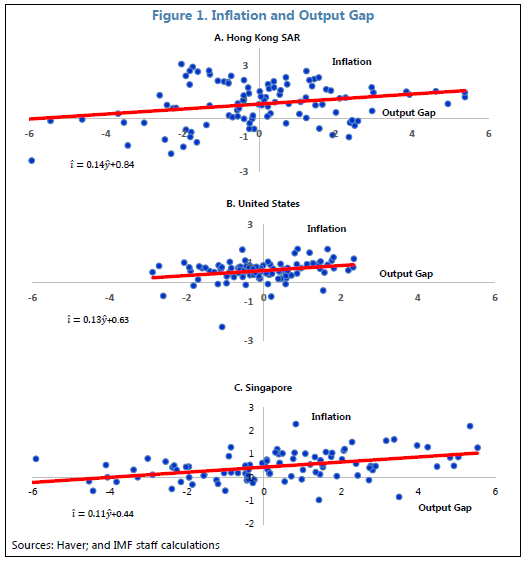
A nice paper comparing basic macroeconomic relationships in Hong Kong (SAR) and Singapore to those in the United States and the United Kingdom.
Continue reading here.
A nice paper comparing basic macroeconomic relationships in Hong Kong (SAR) and Singapore to those in the United States and the United Kingdom.
Continue reading here.
Posted by at 8:57 AM
Labels: Macro Demystified
Macroeconomic Structural Policies and Income Inequality in Low-Income Developing Countries
Below is the executive summary of a new IMF report:
“Despite strong growth over the past two decades, income inequality remains high in many low-income developing countries (LIDCs). As shown by earlier work, including by the IMF, high levels of inequality can impair both the future pace and the sustainability of growth and macroeconomic stability, thereby also limiting countries’ ability to reach the Sustainable Development Goals.
This note explores how policies and reforms aimed at boosting growth affect the extent of income inequality in LIDCs and how complementary policy measures can be used to offset adverse distributional effects of such reforms. It examines: (i) the distributional consequences of selective economic reforms and macro-structural policies that are generally considered to be growth-enhancing; (ii) the channels and mechanisms through which inequality is likely to be affected, given structural characteristics common to most LIDCs; and (iii) the scope for complementary policies to ensure that a reform package can boost growth without widening inequality. The study complements recent work on the inequality-growth trade-offs (including Ostry, Berg, and Tsangarides, 2014; and Organization for Economic Cooperation and Development (OECD), 2015), and by using a more granular model-based analysis to identify the mechanisms through which specific reforms affect growth and inequality.
The note identifies macro-distributional challenges that can be expected to confront LIDCs, given structural characteristics common to these economies. Specifically, the note examines how features such as high levels of informality, limited geographic or inter-sectoral labor mobility, large inter-sectoral productivity differences, lack of access to finance, and low levels of infrastructure can make growth-inequality trade-offs particularly challenging for these economies. The main focus is on identifying the key channels through which growth-oriented reforms can influence income distribution, rather than identifying the universe of reforms that could have adverse distributional effects. For illustrative purposes, the note zooms in on a set of macro-structural reforms that have been regarded as growth-promoting in LIDCs (see IMF, 2015a)—specifically, selected fiscal reforms (tax policy measures, higher public infrastructure investment); financial sector reforms; and reforms to the agricultural sector.
The findings confirm that these macro-structural policies can have important distributional consequences in LIDCs, with the impact dependent both on the design of reforms and on country-specific economic characteristics. Results from cross-country statistical analysis and detailed country-case studies suggest that: (i) the distributional impact of tax policies depends not only on the specific tax instruments chosen (with indirect taxes usually seen as being regressive and direct income taxation usually seen as progressive), but also on how the additional budgetary resources are deployed; (ii) better and more infrastructure investment can both boost growth and lower inequality levels; (iii) financial sector reforms can exacerbate inequality if financial access is limited to a small share of the population and labor mobility is constrained; and (iv) reforms that boost agricultural output can worsen income inequality in situations where the agricultural sector is large and productivity gains benefit mostly the rural better-off.
Accompanying measures can make reforms supportive of growth while limiting adverse distributional effects. Some reforms may boost growth and welfare for all with distributional consequences that may not be undesirable from an economic and/or social point of view. Other reforms can bring economic gains only to a few with distributional consequences that may be considered unwelcome by societies. While there is no one-size-fits-all recipe, the note explores how targeted policy interventions, implemented in conjunction with pro-growth reforms, can be deployed to contain any adverse distributional effects of the reform measures—recognizing that societal views on what constitutes an undesirable distributional outcome will differ from country to country. The analysis focuses on the macroeconomic mechanisms through which such interventions can contain or offset any adverse distributional impact of pro-growth reforms; the note does not examine how these interventions can best be implemented in the presence of weak domestic administrative capacity or political economy constraints. Some policy interventions cited, such as conditional cash transfers, can be challenging to administer in countries with weak capacity, while measures to enhance labor mobility, such as strengthening land ownership rights, can take time and be politically very difficult to implement.”
Below is the executive summary of a new IMF report:
“Despite strong growth over the past two decades, income inequality remains high in many low-income developing countries (LIDCs). As shown by earlier work, including by the IMF, high levels of inequality can impair both the future pace and the sustainability of growth and macroeconomic stability, thereby also limiting countries’ ability to reach the Sustainable Development Goals.
This note explores how policies and reforms aimed at boosting growth affect the extent of income inequality in LIDCs and how complementary policy measures can be used to offset adverse distributional effects of such reforms.
Posted by at 8:36 AM
Labels: Inclusive Growth
Monday, January 30, 2017
House Prices in Spain
“(…) the housing market just started to recover”, notes the IMF’s latest report on Spain.
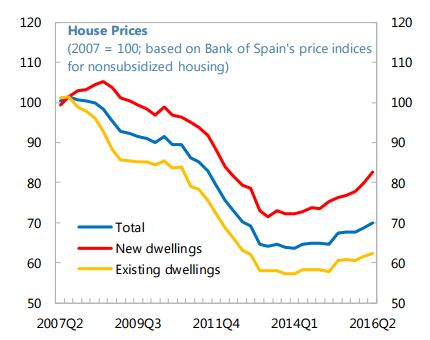
“(…) the housing market just started to recover”, notes the IMF’s latest report on Spain.
Posted by at 12:27 PM
Labels: Global Housing Watch
Where are Oil Prices Headed?
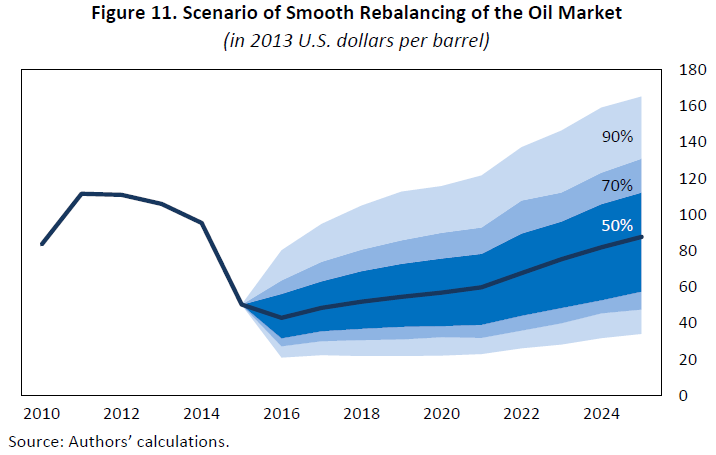
This paper by my IMF colleagues presents “a simple macroeconomic model of the oil market. The model incorporates features of oil supply such as depletion, endogenous oil exploration and extraction, and features of oil demand such as the increase in demand from emerging markets, usage efficiency, and endogenous demand responses. The model provides, inter alia, a useful analytical framework to explore the effects of: a change in world GDP growth; a change in the efficiency of oil usage; and a change in the supply of oil. The model shows that small shocks to oil supply or demand can result in large movements in the price of oil over time. It would not take a large shock for oil prices to return to significantly higher levels, and the long lags between oil price changes and the response of oil supply and demand to those changes can lead to cycles in oil prices in the future.”
Continue reading here.
This paper by my IMF colleagues presents “a simple macroeconomic model of the oil market. The model incorporates features of oil supply such as depletion, endogenous oil exploration and extraction, and features of oil demand such as the increase in demand from emerging markets, usage efficiency, and endogenous demand responses. The model provides, inter alia, a useful analytical framework to explore the effects of: a change in world GDP growth;
Posted by at 12:10 PM
Labels: Energy & Climate Change
Tuesday, January 24, 2017
House price measurement: Recent progress
From Global Housing Watch Newsletter: January 2017
This post is written by Niall O’Hanlon. Mr. O’Hanlon joined the IMF in 2015 as a senior economist in the Real Sector Division of the IMF’s Statistics Department. Prior to joining the IMF, Mr. O’Hanlon was Head of Prices Division at the Central Statistics Office Ireland (CSO). During his 14-year career at the CSO he introduced a number of new statistical products including the Residential Property Price Index (RPPI) and the Services Producer Price Index (SPPI).
More countries are now compiling house price indexes
Since the global financial crisis there has been significant progress internationally on the measurement of house prices. When the BIS first published its database of residential property price indexes in 2010, 37 countries were included. Today it covers 57 countries, including 18 of the G-20 countries and all of the EU member states.
A 2009 Report to the G-20 Finance Ministers on the Financial Crisis and Information Gaps identified data on the stock of dwellings, the associated price levels and their changes over time as critical ingredients for financial stability policy analysis. In 2013 the Handbook on Residential Property Price Indices (RPPIs) was published by Eurostat to provide guidance and identify best practices so as to help improve availability and cross-country comparability of house price indexes. These have been important milestones in the progress of house price measurement globally. The Global Housing Watch is also an important initiative in that it provides a platform for analysis of housing market developments worldwide.
Greater availability of indexes has helped policy makers monitor excessive house price growth and take a mix of monetary policy, micro prudential and macro prudential measures. Housing markets are receiving increasing attention and there are renewed concerns that rising prices may pose risks to some economies. For example, in November 2016, the European Systemic Risk Board issued warnings to eight EU countries on real estate vulnerabilities which pose significant systemic risks.
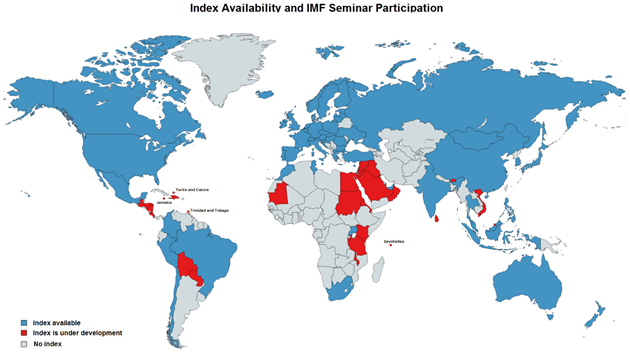
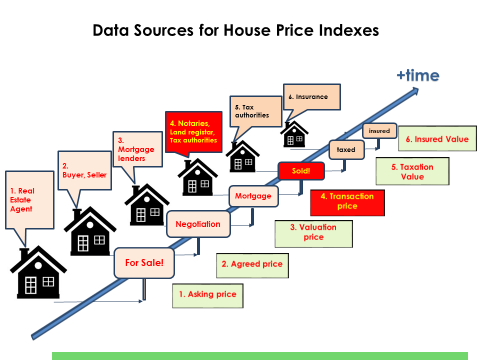
The map below shows that official indexes are available for 62 countries. The combined GDP of these countries accounts for around 90 percent of global GDP, making the coverage useful for multilateral surveillance. However, indexes are available for only about 30 percent of countries in the world (see map). So much more progress is needed to support policy needs in many countries. The IMF Statistics Department held its first seminar on house price index compilation in 2015. Since then, compilers from national statistical offices and central banks of 50 countries have participated. The seminars provide an overview of data sources and methods for compiling RPPIs, highlight the trade-offs involved in selecting a data source and address strategies for the longer-run development of data sources (see chart).
Data are key
The standard approach to compiling the consumer price index—comparing the prices of exactly the same products—cannot be employed since no two properties are exactly the same and we can only observe the price of property when it is transacted. Therefore, compilers must remove the impact of the changes in mix of properties sold (referred to as mix-adjustment) leaving a measure of “pure price change.” There are several techniques for mix-adjustment, varying in terms of sophistication and effectiveness. The more effective techniques require detailed information on the physical and locational characteristics of property (for example the property type and size, or characteristics of the neighborhood) as well as the transaction details (price and date).
Securing access to data is often the biggest challenge—particularly in low income countries with less developed administrative systems. The comprehensive data on property characteristics and locational attributes necessary for adequate mix-adjustment might be unavailable. Data limitations can also mean that indexes do not have full coverage of the market. For example, using only bank data will mean that compilers miss cash based transactions.
In response, compilers are looking beyond single administrative data sources towards combining different data sets to facilitate sophisticated mix-adjustment techniques. For example, the Central Statistics Office of Ireland recently switched from using mortgage data to a combination of taxation (transaction), building energy rating (physical characteristics) and census of population small area data (relative affluence or disadvantage of a neighborhood) to give a more complete and accurate picture of house price change. Compilers also are using big data sources, such as real estate web portals, for more timely and comprehensive data. Ultimately, the choice of source data will require trade-offs, in respect of comprehensiveness, coverage and timeliness.
House prices are key indicators of household wealth
House prices matter for macro prudential purposes, as well as for socio-demographics. Buying a house will be the biggest single spending decision many households make and that decision should be guided by good information on the rate of price change and how current prices compare to longer term trends. Progress also has been made in respect of other housing related social indicators that are emerging. For example, the OECD produces price-to-income and price-to-rent measures for selected countries. These indicators of long run over or undervaluation relative to long term averages help to provide a more complete picture of the developments in the housing market.
Housing market research, much of it by private sector index compilers, is increasingly concerned with measures of inequality and exclusion. For example, Zillow recently published a study on the widening gap between the bottom and top of the US housing market. More broadly there is interest in how house prices impact household balance sheets and, in turn, on consumption by households. Ownership by gender, age, cultural background or income also may add important policy dimensions.
For many countries the new challenge is to move beyond just compiling house price indexes and to address the need for a more complete picture of the housing market and its impact on society.
From Global Housing Watch Newsletter: January 2017
This post is written by Niall O’Hanlon. Mr. O’Hanlon joined the IMF in 2015 as a senior economist in the Real Sector Division of the IMF’s Statistics Department. Prior to joining the IMF, Mr. O’Hanlon was Head of Prices Division at the Central Statistics Office Ireland (CSO). During his 14-year career at the CSO he introduced a number of new statistical products including the Residential Property Price Index (RPPI) and the Services Producer Price Index (SPPI).
Posted by at 7:00 PM
Labels: Global Housing Watch
Subscribe to: Posts