



Tuesday, July 25, 2017
Inequality of Opportunity, Inequality of Income, and Long-term Growth
From a new IMF report:
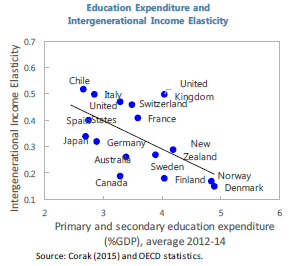
“Income inequality has increased in several euro area countries over the last few decades. We explore whether the relationship between income inequality and growth depends on equality of opportunity. This question is critical in the euro area where several countries exhibit higher levels of inequality of opportunities. Our econometric results confirm a robust negative effect of widening income disparities on growth in presence of high inequality of opportunity. Reducing income inequality can therefore accelerate growth in the euro area. Over the long-run, addressing the root causes of inequality of opportunity can make growth less sensitive to shifts in income distribution.”
Continue reading here.
From a new IMF report:
“Income inequality has increased in several euro area countries over the last few decades. We explore whether the relationship between income inequality and growth depends on equality of opportunity. This question is critical in the euro area where several countries exhibit higher levels of inequality of opportunities. Our econometric results confirm a robust negative effect of widening income disparities on growth in presence of high inequality of opportunity.
Posted by at 1:33 PM
Labels: Inclusive Growth
Monday, July 24, 2017
What Explains the Decline of the U.S. Labor Share of Income? An Analysis of State and Industry Level Data
From a new IMF Working Paper:
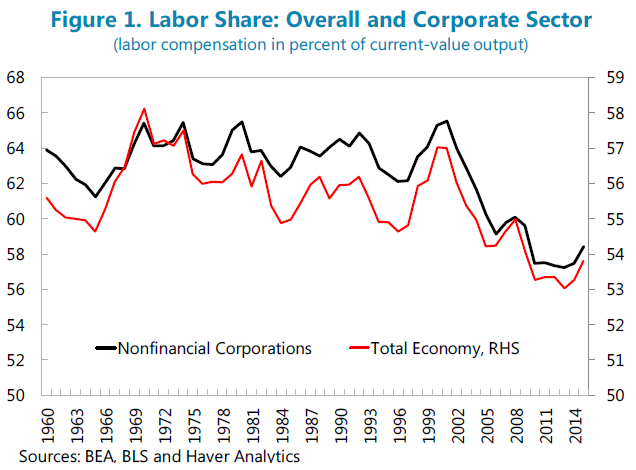
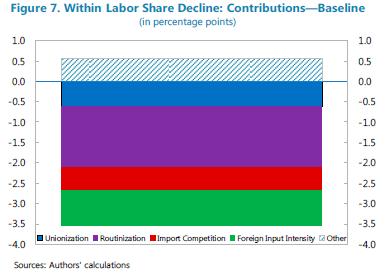
“The U.S. labor share of income has been on a secular downward trajectory since the beginning of the new millennium. Using data that are disaggregated across both state and industry, we show the decline in the labor share is broad-based but the extent of the fall varies greatly. Exploiting a new data set on the task characteristics of occupations, the U.S. input-output tables, and the Current Population Survey, we find that in addition to changes in labor institutions, technological change and different forms of trade integration lowered the labor share. In particular, the fall was largest, on average, in industries that saw: a high initial intensity of “routinizable” occupations; steep declines in unionization; a high level of competition from imports; and a high intensity of foreign input usage. Quantitatively, we find that the bulk of the effect comes from changes in technology that are linked to the automation of routine tasks, followed by trade globalization.”
Continue reading here.
From a new IMF Working Paper:
“The U.S. labor share of income has been on a secular downward trajectory since the beginning of the new millennium. Using data that are disaggregated across both state and industry, we show the decline in the labor share is broad-based but the extent of the fall varies greatly. Exploiting a new data set on the task characteristics of occupations,
Posted by at 1:20 PM
Labels: Inclusive Growth
Saturday, July 22, 2017
Forecasting: How to Map the Future Global Business
Me on BBC Radio, talking about forecasting (I come on at 4.25 for a couple of minutes and then at the end at 23.00).
Me on BBC Radio, talking about forecasting (I come on at 4.25 for a couple of minutes and then at the end at 23.00).
Posted by at 1:04 PM
Labels: Forecasting Forum
Friday, July 21, 2017
Housing View – July 21, 2017
On cross-country:
- Robert Shiller on Why Do Cities Become Unaffordable? – Project Syndicate
- House prices up by 4.0% in the euro area – Eurostat
On the US:
- Making the House a Home: The Stimulative Effect of Home Purchases on Consumption and Investment – NBER
- The Effect of Debt on Default and Consumption: Evidence from Housing Policy During the Great Recession – Harvard Joint Center for Housing Studies, Housing Perspectives
- • Not my problem: Growth spillovers from uncoordinated land use policy – Land Use Policy
- • A better way to solve the housing crisis — tax land, not development – Los Angeles Times
On other countries:
On cross-country:
- Robert Shiller on Why Do Cities Become Unaffordable? – Project Syndicate
- House prices up by 4.0% in the euro area – Eurostat
On the US:
- Making the House a Home: The Stimulative Effect of Home Purchases on Consumption and Investment – NBER
- The Effect of Debt on Default and Consumption: Evidence from Housing Policy During the Great Recession – Harvard Joint Center for Housing Studies,
Posted by at 5:00 AM
Labels: Global Housing Watch
Wednesday, July 19, 2017
Women Are Key for Future Growth: Evidence from Canada
From a new IMF Working Paper:
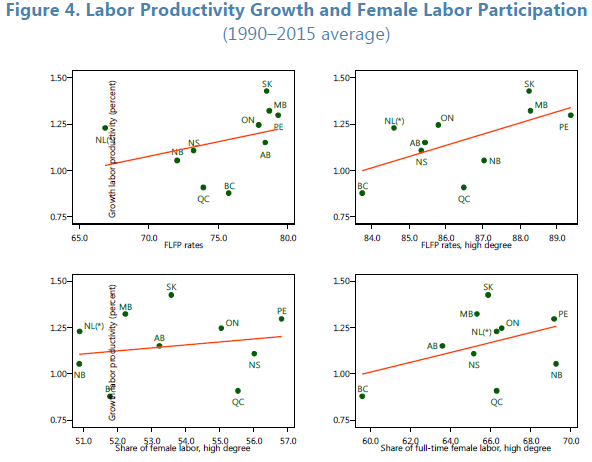
“How important are female workers for economic growth? This paper presents empirical evidence that an increase in female labor force participation is positively associated with labor productivity growth. Using panel data for 10 Canadian provinces over 1990–2015, we found that a 1 percentage point increase in the labor force participation among women with high educational attainment would raise Canada’s overall labor productivity growth by 0.2 to 0.3 percentage point a year. This suggests that if the current gap of 7 percentage points between male and female labor force participation with high educational attainment were eliminated, the level of real GDP could be about 4 percent higher today. The government has appropriately stepped up its efforts to improve gender equality, as part of its growth strategy. In particular, the government’s plan to expand access to affordable child care is a positive step. However, we argue that to maximize the policy outcome given a budget constraint, provision of subsidized child care—including publicly funded child care spaces—should be better targeted to working parents.”
Continue reading here.
From a new IMF Working Paper:
“How important are female workers for economic growth? This paper presents empirical evidence that an increase in female labor force participation is positively associated with labor productivity growth. Using panel data for 10 Canadian provinces over 1990–2015, we found that a 1 percentage point increase in the labor force participation among women with high educational attainment would raise Canada’s overall labor productivity growth by 0.2 to 0.3 percentage point a year.
Posted by at 6:43 PM
Labels: Inclusive Growth
Subscribe to: Posts