



Friday, October 6, 2017
Housing View – October 6, 2017
On cross-country:
- Finance and housing in Central and Eastern Europe – a demand-side approach – National Bank of Romania
- Affordable housing key for development and social equality, UN says on World Habitat Day – UN
- Quarterly Review of European Mortgage Markets Q2 2017 – European Covered Bond Council
- Hypostat 2017 – European Covered Bond Council
- Ownership rates in Europe – European Covered Bond Council
- Capital flows into European real estate are ‘developing not cooling’ – PropertyEU
On the US:
- The 2017 National Rental Housing Landscape – NYU Furman Center
- July 2017 Market Report: Almost Half of U.S. Homes Are Worth More Now Than Before the Bubble – Zillow
- 15 Favorites From Zillow Group Report on Consumer Housing Trends Report 2017 – Zillow
- A More Timely House Price Index – The Review of Economics and Statistics
- The real cause of the America’s housing bubble was foreign money – Financial Times
- The Negative (and Positive) Spillovers of Concentrated Foreclosure Activity in New York City – Harvard Joint Center for Housing Studies
- Overregulation Is the Main Block to Affordable Housing – Wall Street Journal
- Why Fall Should Be Hunting Season for Starter Home Buyers – Trulia
- Land-Use Regulations, Property Values, and Rents: Decomposing the Effects of the California Coastal Act – Federal Reserve Bank of Philadelphia
- Housing as a Safety Net – Urban Land Institute
- Housing as an Asset Class – Urban Land Institute
On other countries:
- [Canada] A novel approach to affordable housing in Canada – CMHC
- [Canada] Too Many Bedrooms, Not Enough Housing? – University of B.C.
- [China] China steps up battle against runaway property prices – Financial Times
- [Germany] Assessing Recent House Price Developments in Germany: An Overview – Monetary Policy, Financial Crises, and the Macroeconomy
- [Ireland] Irish House Price Report Q3 2017 – Daft.ie
- [Israel] A Housing Plunge Doesn’t Concern Israel’s Top Economic Adviser – Bloomberg
- [Macau] Macau’s amazing, incredible, soaring property prices – Global Property Guide
- [United Kingdom] Rent control could deepen the housing crisis in UK’s most expensive cities – Centre for Cities
- [United Kingdom] Britain’s Housing Crunch – Bloomberg

Photo by Aliis Sinisalu
On cross-country:
- Finance and housing in Central and Eastern Europe – a demand-side approach – National Bank of Romania
- Affordable housing key for development and social equality, UN says on World Habitat Day – UN
- Quarterly Review of European Mortgage Markets Q2 2017 – European Covered Bond Council
- Hypostat 2017 – European Covered Bond Council
- Ownership rates in Europe – European Covered Bond Council
- Capital flows into European real estate are ‘developing not cooling’
Posted by at 10:04 AM
Labels: Global Housing Watch
Thursday, October 5, 2017
IMF Fiscal Advice to Saudi Arabia
The IMF’s latest report states: “In staff’s view, the strong fiscal buffers, the availability of financing, and the current cyclical position of the economy mean that rapid fiscal consolidation is neither necessary nor desirable. Saudi Arabia has some fiscal space that can be used for a more gradual fiscal consolidation that balances the budget by 2022 rather than in 2019 …”. Read the report for the full background and context for the advice.
The IMF’s latest report states: “In staff’s view, the strong fiscal buffers, the availability of financing, and the current cyclical position of the economy mean that rapid fiscal consolidation is neither necessary nor desirable. Saudi Arabia has some fiscal space that can be used for a more gradual fiscal consolidation that balances the budget by 2022 rather than in 2019 …”. Read the report for the full background and context for the advice.
Posted by at 4:54 PM
Labels: Inclusive Growth
Tuesday, October 3, 2017
Who’s the fairest of them all? Ranking countries combining incomes and inequality
A new IMF working paper ranks countries combining data on average incomes and the extent of income inequality, and how much societies are assumed to dislike inequality (called ‘inequality aversion’). Hong Kong SAR is almost always at the top. The United States is second if societies are assumed not to care too about inequality. But it slides to number 24 if societies are assumed to dislike inequality a lot, with more equal societies like Norway, Canada, and New Zealand taking the higher ranks. (For wonks: see Appendix Table 1 of the working paper for hours of fun comparing countries.)
A new IMF working paper ranks countries combining data on average incomes and the extent of income inequality, and how much societies are assumed to dislike inequality (called ‘inequality aversion’). Hong Kong SAR is almost always at the top. The United States is second if societies are assumed not to care too about inequality. But it slides to number 24 if societies are assumed to dislike inequality a lot, with more equal societies like Norway,
Posted by at 2:27 PM
Labels: Inclusive Growth
Friday, September 29, 2017
Housing View – September 29, 2017
On cross-country:
- Will house prices continue to rise forever? – ING
- Q2 2017: Europe’s boom continues, but sharp slowdown in the Middle East, Latin America, New Zealand and some parts of Asia – Global Property Guide
- Chinese Money Is Still Leaking Into the World’s Housing Markets – Bloomberg
- UBS Global Real Estate Bubble Index – UBS
On the US:
- Anti-vagrancy laws are not the best way to reduce homelessness – Economist
- Flood Risk Belief Heterogeneity and Coastal Home Price Dynamics: Going Under Water? – NBER
- Apartment Demand for the Next 15 Years: Can We Meet the Need? – U.S. Department of Housing and Urban Development
- 2017 Global Real Estate Portal Report – Mike DelPrete
- Pending Home Sales Dive: Economists Miss the Boat by Over 2 Percentage Points! – MishTalk
- Land Use Regulation and Good Intentions – Journal of Land Use & Environmental Law
On other countries:
- [Canada] 2017 Housing Finance Symposium – CMHC
- [China] Chinese property developers’ shares hit by new house sales curbs – Financial Times
- [China] Chinese Developers Plunge After Officials Tighten Housing Curbs – Bloomberg
- [France] Housing Europe expresses concern about the housing strategy presented by the French government – Housing Europe
- [Sweden] House price responses to a national property tax reform – SSRN
- [United Kingdom] Priced Out? The affordability crisis in London – The Progressive Policy Think Tank
- [United States] Policy changes make landlords wary of the UK housing market – Global Property Guide
On cross-country:
- Will house prices continue to rise forever? – ING
- Q2 2017: Europe’s boom continues, but sharp slowdown in the Middle East, Latin America, New Zealand and some parts of Asia – Global Property Guide
- Chinese Money Is Still Leaking Into the World’s Housing Markets – Bloomberg
- UBS Global Real Estate Bubble Index – UBS
On the US:
- Anti-vagrancy laws are not the best way to reduce homelessness – Economist
- Flood Risk Belief Heterogeneity and Coastal Home Price Dynamics: Going Under Water?
Posted by at 11:18 AM
Labels: Global Housing Watch
Thursday, September 28, 2017
The Unequal Burden of Rising Temperatures: How Can Low-Income Countries Cope?
From a new IMF blog:
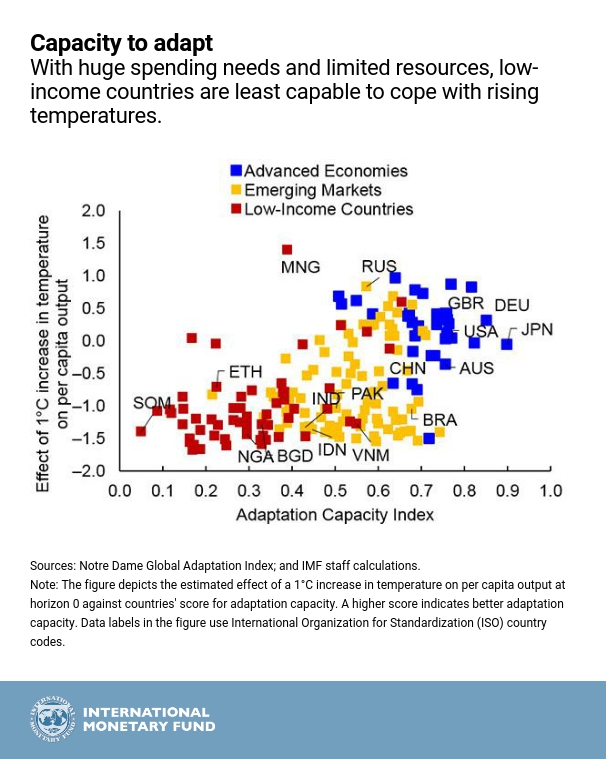
“The Earth’s warming affects countries very unequally. Even though low-income countries have contributed very little to greenhouse gas emissions, they would bear the brunt of the adverse consequences of rising temperatures, since they tend to be situated in some of the hottest parts of the Earth. ”
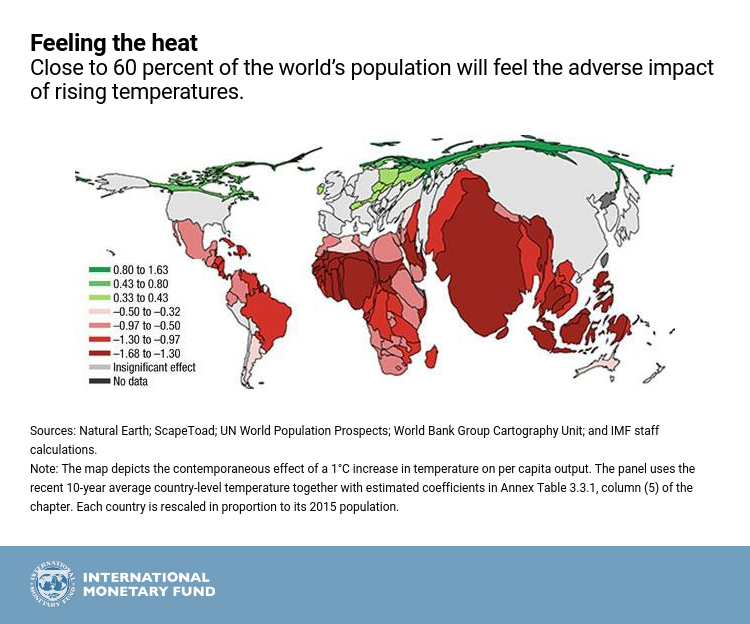
“The international community must play a key role in supporting low-income countries’ efforts to cope with climate change. Advanced and emerging market economies have contributed the lion’s share to actual and projected warming. Hence, helping low-income countries cope with its consequences is both a moral duty and sound global economic policy that helps offset countries’ failures to fully internalize the costs of greenhouse gas emissions.”
Continue reading here.
From a new IMF blog:
“The Earth’s warming affects countries very unequally. Even though low-income countries have contributed very little to greenhouse gas emissions, they would bear the brunt of the adverse consequences of rising temperatures, since they tend to be situated in some of the hottest parts of the Earth. ”
“The international community must play a key role in supporting low-income countries’ efforts to cope with climate change.
Posted by at 9:24 AM
Labels: Energy & Climate Change
Subscribe to: Posts