



Thursday, January 4, 2018
David Hendry on Why Forecasting Fails
The noted econometrician writes: “The intermittent failure of economic forecasts to ‘foresee’ the future reflects both imperfect knowledge and a non-stationary and evolving world that is far from ‘general equilibrium’ and closer to ‘general disequilibrium’.”
“[This has] disastrous consequences for dynamic stochastic general equilibrium (DSGE) systems, which transpire to be the least structural of all possible model forms as their derivation entails they are bound to ‘break down’ when the underlying distributions of economic variables shift. This serious problem is highlighted by Hendry and Muellbauer (2017) in their critique of the Bank of England quarterly econometric model (BEQEM–pronounced Beckem: […] a DSGE which, as in the film ‘Bend it Like Beckham’, bent in the Financial Crisis, but so much that it broke and had to be replaced.”
“Surprisingly, despite that abject failure, it was replaced by yet another DSGE (COMPASS: Central Organising Model for Projection Analysis and Scenario Simulation […]. Unfortunately, […] COMPASS had already failed to characterize data available before it was even developed. Persisting with such an approach introduces a triple whammy as:
a] the derivations sustaining DSGEs use an invalid mathematical basis;
b] imposing a so-called ‘equilibrium’ fails to take account of past shifts;
c] the DSGE approach assumes agents act in the same incorrect way as the modeller, so assumes agents have failed to learn that imperfect knowledge about location shifts forces revisions to their plans.”
“During a visit to LSE in 2009, Queen Elizabeth II asked Luis Garicano “why did no one see the credit crisis coming?” to which a part of his answer should have been that DSGE models dominated economic agencies and essentially ruled out such major financial crises by assuming away imperfect knowledge. Prakash Loungani (2001) argued “The record of failure to predict recessions is virtually unblemished.””
The article is available from the here.
The noted econometrician writes: “The intermittent failure of economic forecasts to ‘foresee’ the future reflects both imperfect knowledge and a non-stationary and evolving world that is far from ‘general equilibrium’ and closer to ‘general disequilibrium’.”
“[This has] disastrous consequences for dynamic stochastic general equilibrium (DSGE) systems, which transpire to be the least structural of all possible model forms as their derivation entails they are bound to ‘break down’ when the underlying distributions of economic variables shift.
Posted by at 10:33 AM
Labels: Forecasting Forum
The Rate of Return on Everything: 1870–2015
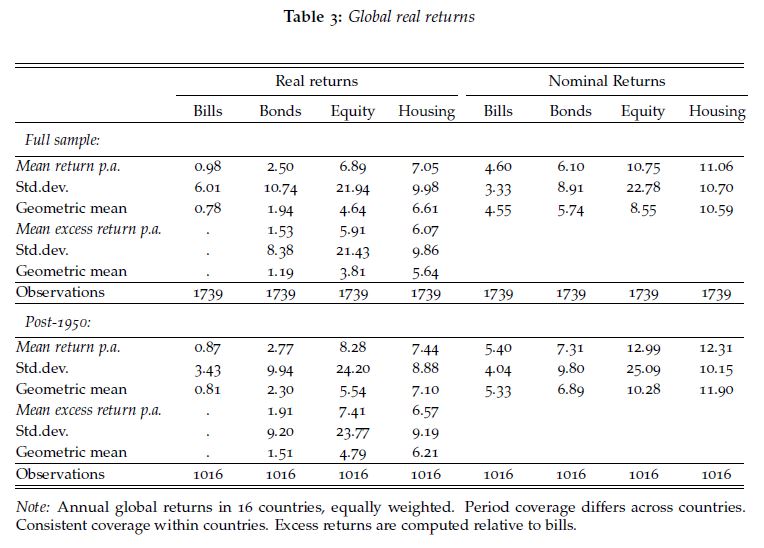
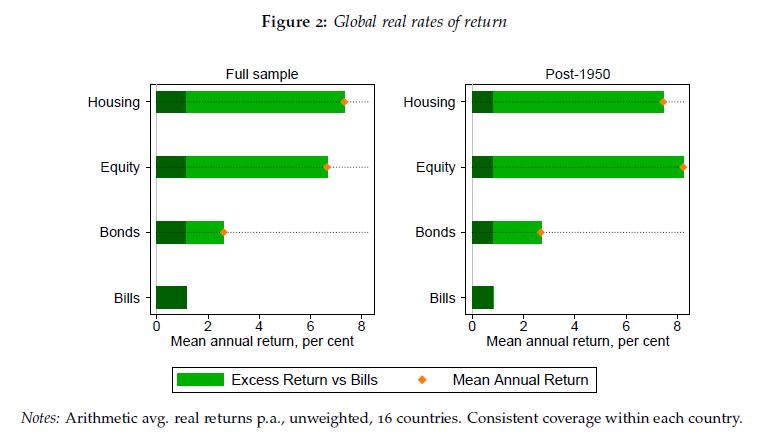
From a new paper by Oscar Jorda, Katharina Knoll, Dmitry Kuvshinov, Moritz Schularick, and Alan M. Taylor:
“This paper answers fundamental questions that have preoccupied modern economic thought since the 18th century. What is the aggregate real rate of return in the economy? Is it higher than the growth rate of the economy and, if so, by how much? Is there a tendency for returns to fall in the long-run? Which particular assets have the highest long-run returns? We answer these questions on the basis of a new and comprehensive dataset for all major asset classes, including—for the first time—total returns to the largest, but often ignored, component of household wealth, housing. The annual data on total returns for equity, housing, bonds, and bills cover 16 advanced economies from 1870 to 2015, and our new evidence reveals many new insights and puzzles.”
“This paper, perhaps for the first time, investigates the long history of asset returns for all the major categories of an economy’s investable wealth portfolio. Our investigation has confirmed many of the broad patterns that have occupied much research in economics and finance. The returns to risky assets, and risk premiums, have been high and stable over the past 150 years, and substantial diversification opportunities exist between risky asset classes, and across countries. Arguably the most surprising result of our study is that long run returns on housing and equity look remarkably similar. Yet while returns are comparable, residential real estate is less volatile on a national level, opening up new and interesting risk premium puzzles.”
From a new paper by Oscar Jorda, Katharina Knoll, Dmitry Kuvshinov, Moritz Schularick, and Alan M. Taylor:
“This paper answers fundamental questions that have preoccupied modern economic thought since the 18th century. What is the aggregate real rate of return in the economy? Is it higher than the growth rate of the economy and, if so, by how much? Is there a tendency for returns to fall in the long-run? Which particular assets have the highest long-run returns?
Posted by at 7:34 AM
Labels: Global Housing Watch
Friday, December 29, 2017
Housing View – December 29, 2017
On cross-country:
- Demographic Patterns of Reurbanisation and Housing in Metropolitan Regions in the US and Germany – Comparative Population Studies
On the US:
- A Shared Future: Data Democratization and Spatial Heterogeneity in the Housing Market – The Joint Center for Housing Studies
- LTV vs. LTI Constraints: When Did They Bind, and How Do They Interact? – University of Copenhagen
- Asymmetric effects of monetary policy in regional housing markets – Norges Bank
- Fannie and Freddie Continue in Limbo while Congress Looks for a Permanent Fix for the Housing Finance Market – Cato Institute
- Housing Disease and Public School Finances – NBER
- Investors Pile Into Suburban Rental Housing – Wall Street Journal
On other countries:
- [Singapore] Singapore authorities’ housing market warning may fall on deaf ears – Reuters

Photo by Aliis Sinisalu
On cross-country:
- Demographic Patterns of Reurbanisation and Housing in Metropolitan Regions in the US and Germany – Comparative Population Studies
On the US:
- A Shared Future: Data Democratization and Spatial Heterogeneity in the Housing Market – The Joint Center for Housing Studies
- LTV vs. LTI Constraints: When Did They Bind, and How Do They Interact? – University of Copenhagen
- Asymmetric effects of monetary policy in regional housing markets – Norges Bank
- Fannie and Freddie Continue in Limbo while Congress Looks for a Permanent Fix for the Housing Finance Market – Cato Institute
- Housing Disease and Public School Finances – NBER
- Investors Pile Into Suburban Rental Housing – Wall Street Journal
On other countries:
- [Singapore] Singapore authorities’
Posted by at 12:08 PM
Labels: Global Housing Watch
Wednesday, December 27, 2017
The Top 17 of ‘17

Here are the top 17 posts of 2017:
- Understanding Housing Supply: Views from Joseph Gyourko
- Inequality of Opportunity, Inequality of Income, and Long-term Growth
- Steve Malpezzi on Housing Markets
- Housing: From Immobile and Illiquid to Mobile and Liquid
- Decoupling of Emissions and GDP: Now you see it, now you don’t
- Workshop on Forecasting Issues in Developing Economies
- Housing Market in Africa: What We Do and Don’t Know
- Housing Construction: The Current State, Policy Implication, and the Future
- Stabilizing the System of Mortgage Finance in the United States
- The State of Housing Market in Africa
- Okun’s Law in Black and White
- Property Tax in Africa
- Cross-Country Spillovers of Fiscal Consolidations in the Euro Area
- Construction Sector: The World’s Next Productivity Story?
- Meeting EU Climate Pledges: Assessing Some Potential Policy Refinements
- IMF Executive Board Discusses Macroeconomic Prospects and Challenges in LIDCs
- Going for (Inclusive) Growth
Here are the top 17 posts of 2017:
Posted by at 11:31 AM
Labels: Uncategorized
Monday, December 25, 2017
Housing in Bolivia
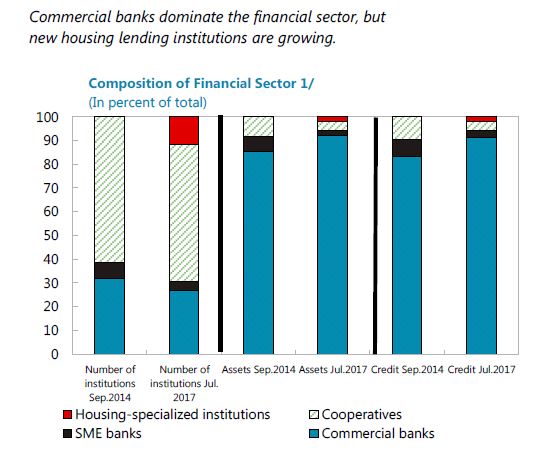
The IMF’s latest report on Bolivia says that:
“The FSL [Financial Services Law] has resulted in rapid credit growth directed to specific sectors and social housing (…) Housing lending should be closely monitored and the authorities should finalize and publish a housing price index. (…) More market-oriented mechanisms to improve financial access should be considered and the housing loan portfolio monitored closely.”
The IMF’s latest report on Bolivia says that:
“The FSL [Financial Services Law] has resulted in rapid credit growth directed to specific sectors and social housing (…) Housing lending should be closely monitored and the authorities should finalize and publish a housing price index. (…) More market-oriented mechanisms to improve financial access should be considered and the housing loan portfolio monitored closely.”
Posted by at 3:17 PM
Labels: Global Housing Watch
Subscribe to: Posts