



Thursday, January 25, 2018
A Narrative Database of Major Labor and Product Market Reforms in Advanced Economies
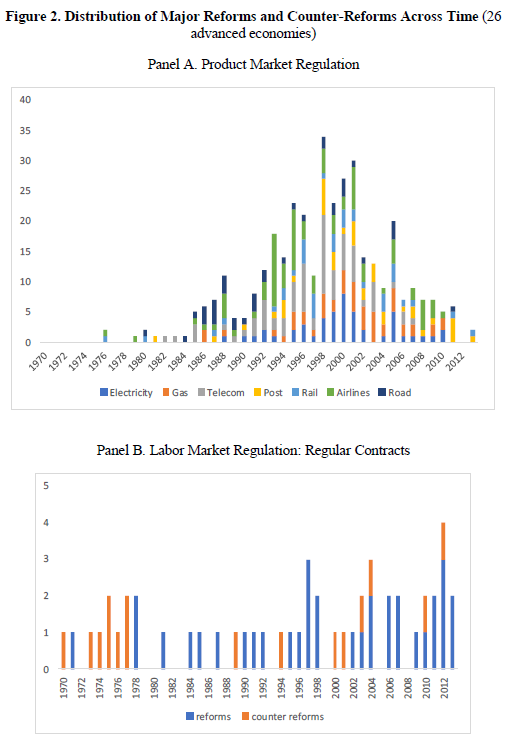
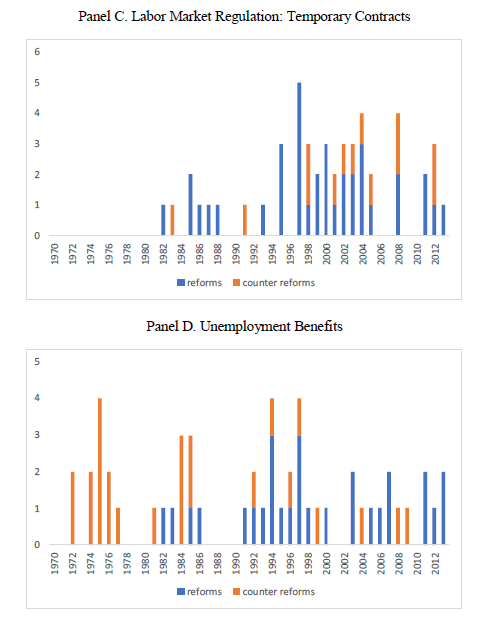
A new IMF working paper “describes a new database of major labor and product market reforms covering 26 advanced economies over the period 1970-2013. The focus is on large changes in product market regulation in seven individual network industries, employment protection legislation for regular and temporary workers, and the replacement rate and duration of unemployment benefits. The main advantage of this dataset is the precise identification of the nature and date of major reforms, which is valuable in many empirical applications. By contrast, the dataset does not attempt to measure and compare policy settings across countries, and as such is no substitute for other publicly available indicators produced, for example, by the ILO, the OECD or the World Bank. It should also be seen as work in progress, for researchers to build on and improve upon. Based on the dataset, major reforms appear to have been more frequent in product markets than in labor markets in the last decades, and were predominantly implemented during the 1990s and 2000s.”
Continue reading here.
A new IMF working paper “describes a new database of major labor and product market reforms covering 26 advanced economies over the period 1970-2013. The focus is on large changes in product market regulation in seven individual network industries, employment protection legislation for regular and temporary workers, and the replacement rate and duration of unemployment benefits. The main advantage of this dataset is the precise identification of the nature and date of major reforms,
Posted by at 5:28 PM
Labels: Inclusive Growth
Wednesday, January 24, 2018
FocusEconomics Announces 2017 Analyst Forecast Awards Winners
FocusEconomics announces the winners of our 2017 Analyst Forecast Awards. “The Awards recognize the most accurate forecasters for the main macroeconomic indicators across 87 countries and 29 commodity prices in 2016. Details of the awards and the list of winners are available at: www.focus-economics.com/awards.”

FocusEconomics announces the winners of our 2017 Analyst Forecast Awards. “The Awards recognize the most accurate forecasters for the main macroeconomic indicators across 87 countries and 29 commodity prices in 2016. Details of the awards and the list of winners are available at: www.focus-economics.com/awards.”
Posted by at 6:43 PM
Labels: Forecasting Forum
Household Credit, Global Financial Cycle, and Macroprudential Policies: Credit Register Evidence from an Emerging Country
From a new IMF working paper by Mircea Epure, Irina Mihai; Camelia Minoiu, and José-Luis Peydró:
“We analyze the effects of macroprudential policies on local bank credit cycles and interactions with international financial conditions. For identification, we exploit the comprehensive credit register containing all bank loans to individuals in Romania, a small open economy subject to external shocks, and the period 2004-2012, which covers a full boom-bust credit cycle when a wide range of macroprudential measures were deployed. Although household leverage is known to be a key driver of financial crises, to our knowledge this is the first paper that employs a household credit register to study leverage and macroprudential policies over a full economic cycle. Our results show that tighter macroprudential conditions are associated with a significant decline in household credit, with substantially stronger effects for foreign currency (FX) loans than for local currency loans. The effects on FX loans are higher for: (i) ex-ante riskier borrowers proxied by higher debt-service-toincome ratios and (ii) banks with greater exposure to foreign funding. Moreover, tighter macroprudential policy has stronger dampening effects on FX lending when global risk appetite is high and foreign monetary policy is expansionary. Finally, quantitative effects are in general larger for borrower rather than lender macroprudential policies.”
From a new IMF working paper by Mircea Epure, Irina Mihai; Camelia Minoiu, and José-Luis Peydró:
“We analyze the effects of macroprudential policies on local bank credit cycles and interactions with international financial conditions. For identification, we exploit the comprehensive credit register containing all bank loans to individuals in Romania, a small open economy subject to external shocks, and the period 2004-2012, which covers a full boom-bust credit cycle when a wide range of macroprudential measures were deployed.
Posted by at 5:05 PM
Labels: Global Housing Watch
The Effectiveness of Housing Market Policies in Hong Kong
From the IMF’s latest report on Hong Kong:
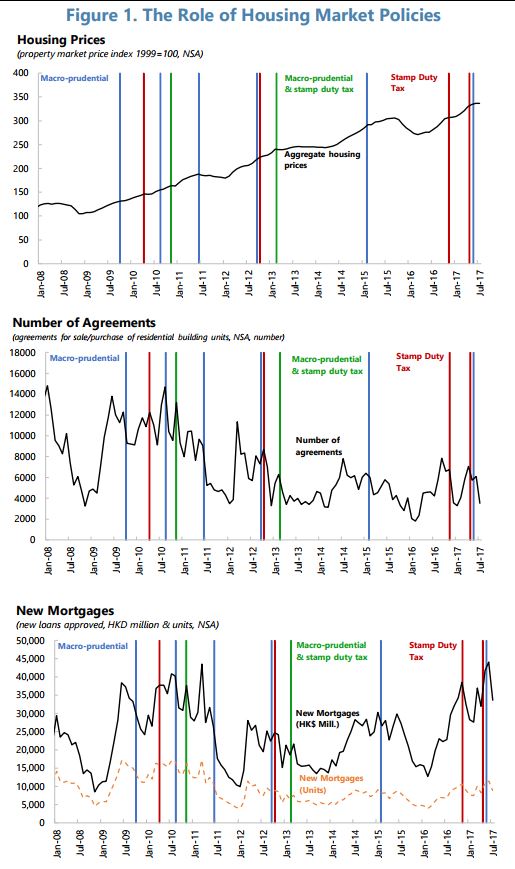
“During the last decade, Hong Kong SAR has experienced a large increase in house prices and credit, prompting the authorities to respond with several rounds of tightening macro-prudential rules and increasing stamp duty taxes. This chapter analyzes the effectiveness of these measures, and finds that they have helped reduce house price appreciation. The estimated impact of a 10 percent LTV tightening is a reduction of house prices of 4.8 percent over the next year. The estimated impact of a 1 percent increase in the ad valorem stamp duty tax is a reduction of house prices of 1.2 percent over the next year. Without these policies, house prices would have been 12.5 percent higher, and the mortgage credit-GDP ratio 15 percent higher.”
From the IMF’s latest report on Hong Kong:
“During the last decade, Hong Kong SAR has experienced a large increase in house prices and credit, prompting the authorities to respond with several rounds of tightening macro-prudential rules and increasing stamp duty taxes. This chapter analyzes the effectiveness of these measures, and finds that they have helped reduce house price appreciation. The estimated impact of a 10 percent LTV tightening is a reduction of house prices of 4.8 percent over the next year.
Posted by at 4:00 PM
Labels: Global Housing Watch
Inequality and Poverty across Generations in the European Union
From a new IMF Staff Discussion Note:
“Overall income inequality has remained broadly stable in the EU over the past decade but disparities in poverty and income inequality across generations have increased markedly. Developments and drivers of overall inequality are well documented but the generational dimension of inequality has received much less attention. In Europe, real disposable incomes of the young have fallen behind those of other generations. Also, the young are facing increasing risks of poverty relative to those faced by other generations.”
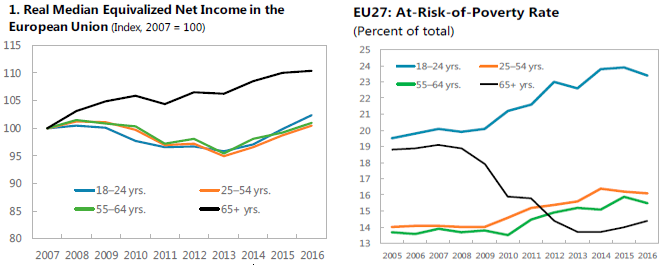
“High youth unemployment has been a major source of growing youth poverty. Unemployment disproportionately affects the young. Also, there is a strong association in the data between unemployment and youth poverty. Facilitating the integration of the young into the labor market is a crucial task facing policymakers. In this regard, market-based and meritocratic institutions in general can help mitigate inequality of opportunity, offering relatively larger benefits for the young.”
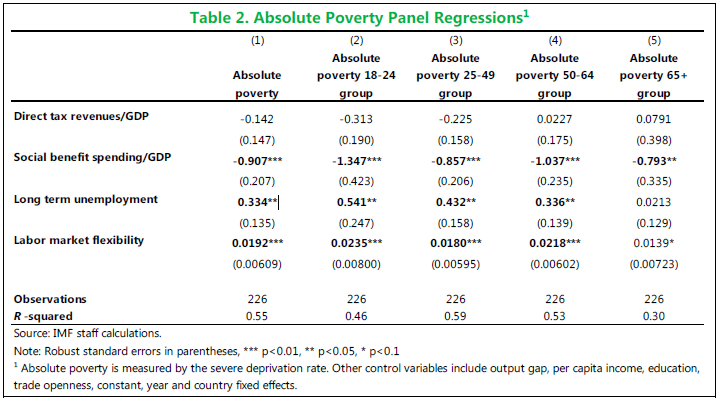
“Fiscal redistribution needs to be more inclusive to better tackle youth poverty. Social protection schemes have reduced old-age poverty but they have not prevented an increase in youth poverty following the global financial crisis. Reducing youth poverty is likely to require additional resources. However, for countries with an already high level of social spending and a heavy tax burden, as well as limited fiscal space, this may not be an option. In these countries, reducing youth poverty and inequality across generations in a fiscally-neutral way may require partially rebalancing fiscal redistribution to better protect the young, while continuing to protect minimum pension assistance schemes to avoid reversing the trend decline in old-age poverty.”
Continue reading here.
From a new IMF Staff Discussion Note:
“Overall income inequality has remained broadly stable in the EU over the past decade but disparities in poverty and income inequality across generations have increased markedly. Developments and drivers of overall inequality are well documented but the generational dimension of inequality has received much less attention. In Europe, real disposable incomes of the young have fallen behind those of other generations. Also, the young are facing increasing risks of poverty relative to those faced by other generations.”
Posted by at 10:36 AM
Labels: Inclusive Growth
Subscribe to: Posts