



Tuesday, May 1, 2018
Revisiting the 1990s Debate on Globalisation
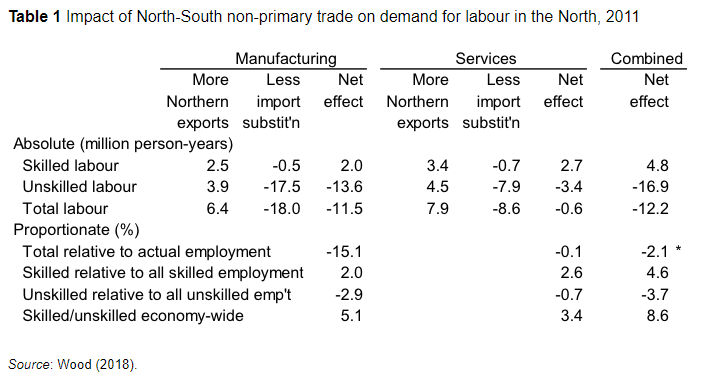
“Two decades ago, the economics profession concluded that trade with developing countries was not seriously hurting unskilled workers in developed countries.” A new post by Adrian Wood argues that “the debate from which that consensus emerged came to an end prematurely. Even now, the evidence does not permit any firm conclusion about the contribution of globalisation to the economic misfortunes of less-educated people in developed countries. Had there been less consensus among economists, more might have been done, sooner, to mitigate the social costs of globalisation.”
“Two decades ago, the economics profession concluded that trade with developing countries was not seriously hurting unskilled workers in developed countries.” A new post by Adrian Wood argues that “the debate from which that consensus emerged came to an end prematurely. Even now, the evidence does not permit any firm conclusion about the contribution of globalisation to the economic misfortunes of less-educated people in developed countries. Had there been less consensus among economists,
Posted by at 11:37 AM
Labels: Inclusive Growth
Inequality in US Life Expectancy
From a new post by Timothy Taylor:
“How much would you be willing to pay, in actual money, for an additional 30 years of life expectancy?”
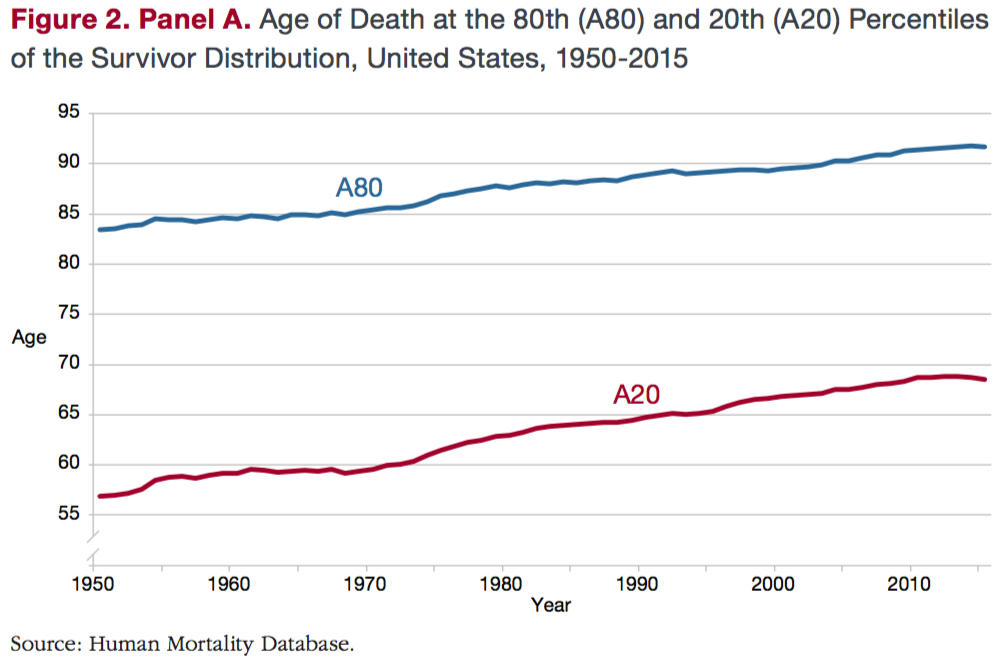
“Fuchs and Eggleston are especially focused on the inequality of life expectancy. So they look at where the age of death falls for the 20th and the 80 percentile of this distribution. Then they calculate how the age of death at these percentiles has evolved over time. It’s a little tricky to eyeball this result from the graph (and the authors provide more specific statistical meaures), but the inequality from 80th to 20th percentile diminished somewhat between about 1950 and 2000, but since then the degree of inequality hasn’t changed much.”
From a new post by Timothy Taylor:
“How much would you be willing to pay, in actual money, for an additional 30 years of life expectancy?”
“Fuchs and Eggleston are especially focused on the inequality of life expectancy. So they look at where the age of death falls for the 20th and the 80 percentile of this distribution. Then they calculate how the age of death at these percentiles has evolved over time.
Posted by at 11:36 AM
Labels: Inclusive Growth
Inequality and Poverty in Israel
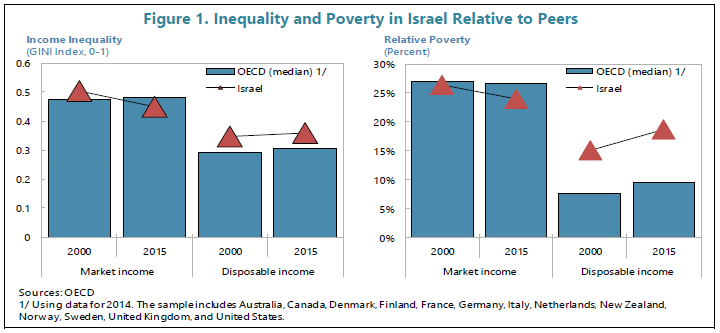
A new IMF country report says that “Poverty and income inequality are high in Israel compared with peers, being exacerbated by the lower labor participation and productivity of some population groups, such as the Israeli-Arab and Haredi populations and non-Haredi Jewish women. Israel’s low redistribution of income through the budget limits its impact on reducing poverty and inequality. Given the projected rise in the share of the Haredi, and, to a lesser extent Arab, populations in coming decades, addressing the structural issues behind their low participation and productivity is an urgent matter.”
A new IMF country report says that “Poverty and income inequality are high in Israel compared with peers, being exacerbated by the lower labor participation and productivity of some population groups, such as the Israeli-Arab and Haredi populations and non-Haredi Jewish women. Israel’s low redistribution of income through the budget limits its impact on reducing poverty and inequality. Given the projected rise in the share of the Haredi, and, to a lesser extent Arab,
Posted by at 11:06 AM
Labels: Inclusive Growth
Monday, April 30, 2018
Forecasting Forum – April 2018
New Blogs:
Global Economy: Good News for Now but Trade Tensions a Threat – IMF Blog by Maurice Obstfeld
Econometrics, Machine Learning, and Big Data – No Hesitations (Frank Diebold’s Blog)
2018’s Growing and Shrinking Economies – Focus Economics
A brief history of time series forecasting competitions – Hyndsight (Rob Hyndman’s Blog)
IJF special issue on “Forecasting for Social Good” – IIF Blog
Ghysels and Marcellino on Time-Series Forecasting – No Hesitations (Frank Diebold’s Blog)
What impact would a trade war between the U.S. and China have on their economies? – Focus Economics
What Information Does the Yield Curve Yield? – ECONOFACT
New Articles:
Forecasting US GNP growth: The role of uncertainty – Mawuli Segnon, Rangan Gupta, Stelios Bekiros, and Mark E. Wohar, Journal of Forecasting
Are macroeconomic density forecasts informative? – Michael P. Clements, International Journal of Forecasting
The role of accounting fundamentals and other information in analyst forecast errors – Danilo Monte‐Mor, Fernando Galdi, and Cristiano Costa, Journal of International Finance
What do professional forecasters actually predict? – Didier Nibbering, Richard Paap, and Michel van der Wel, International Journal of Forecasting
How well do economists forecast recessions? – Zidong An, Joao Jalles, and Prakash Loungani, International Finance
Evaluating the use of realtime data in forecasting output levels and recessionary events in the USA – Chrystalleni Aristidou, Kevin Lee, and Kalvinder Shields, Journal of the Royal Statistical Society

New Blogs:
Global Economy: Good News for Now but Trade Tensions a Threat – IMF Blog by Maurice Obstfeld
Econometrics, Machine Learning, and Big Data – No Hesitations (Frank Diebold’s Blog)
2018’s Growing and Shrinking Economies – Focus Economics
A brief history of time series forecasting competitions – Hyndsight (Rob Hyndman’s Blog)
IJF special issue on “Forecasting for Social Good” – IIF Blog
Ghysels and Marcellino on Time-Series Forecasting – No Hesitations (Frank Diebold’s Blog)
Posted by at 9:51 AM
Labels: Forecasting Forum



Subscribe to: Posts