



Friday, June 15, 2018
Optimal Monetary Policy For the Masses: the James Bullard and Larry Summers View
A new post by David Beckworth summarizes a new paper by James Bullard and Ricardo DiCecio:
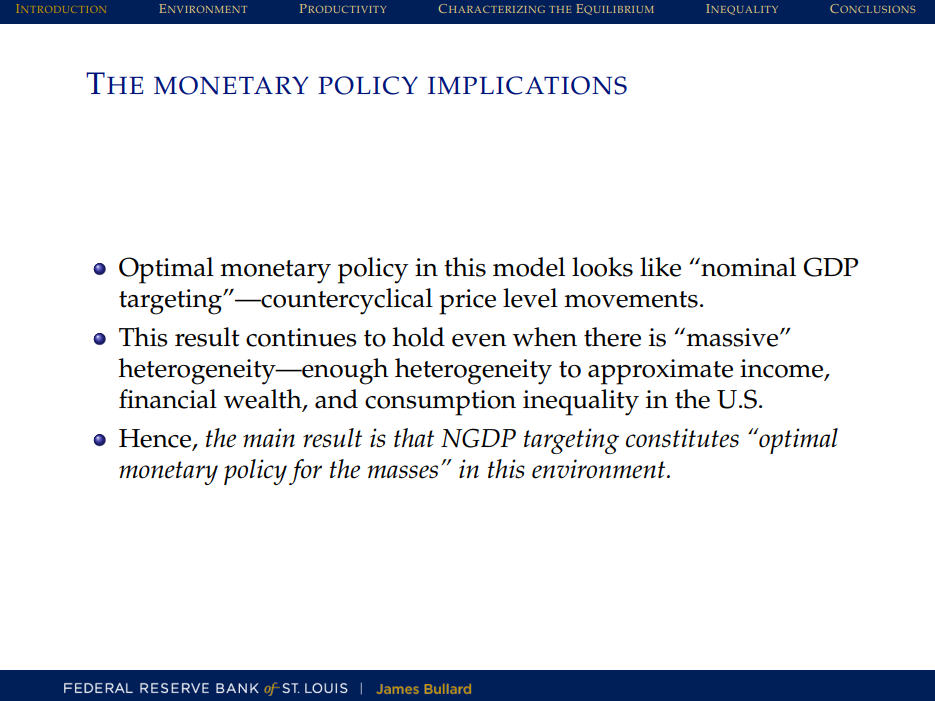
“This paper builds upon the risk-sharing view of NGDP targeting. The basic idea is that in a world of fixed-price nominal debt contracts (i.e. the real world), a NGDP level target provides better risk sharing among creditors and debtors against economic shocks than does a price stability target.
This is because a NGDP level target makes inflation countercyclical. During recessions, inflation rises and causes creditors to bear some of the unexpected pain by lowering the real debt payments they receive from debtors. During booms, inflation falls and allows creditors to share in some of the unexpected gain by increasing the real debt payments they receive from debtors. Debtors, in other words, bear less risk during recessions but also share unexpected gains during expansions.
NGDP level targeting, in other words, causes a fixed-price nominal debt world to look and feel a lot like an equity-world. In a similar spirit, some observers have called for a risk-sharing mortgages as a way to avoid another Great Recession. The point of this paper is that the same benefit that such risk-sharing mortgages would bring can be had by having a central bank target the growth path of NGDP.”
A new post by David Beckworth summarizes a new paper by James Bullard and Ricardo DiCecio:
“This paper builds upon the risk-sharing view of NGDP targeting. The basic idea is that in a world of fixed-price nominal debt contracts (i.e. the real world), a NGDP level target provides better risk sharing among creditors and debtors against economic shocks than does a price stability target.
This is because a NGDP level target makes inflation countercyclical.
Posted by at 10:32 AM
Labels: Inclusive Growth
Housing View – June 15, 2018
On cross-country:
- “Hot Property: the housing market in major cities” – Netherlands Bank
- Built on Sand? Global Housing Sector Showing Weakness – Continuum Economics
- The Dog that didn’t Bark: Social Housing in European Peripheries – Copenhagen Business School
On the US:
- Housing and expenditures: before, during, and after the bubble – Bureau of Labor Statistics
- Luxury Dorms Are Struggling to Fill Beds – Bloomberg
- Housing Sentiment Continues to Strengthen, but High Home Prices Complicate Consumer Purchase Confidence – Fannie Mae
- Developers are taking on residential building challenges by extending the concept of prefabricated housing to manufacture entire apartment buildings – New York Times
- Finding Common Ground on Rent Control – Terner Center for Housing Innovation
- Reported Mortgage Demand Falls to Three-Year Low, Fueling Lenders’ Negative Profit Margin Outlook – Fannie Mae
- Affordable Housing Is Your Spare Bedroom – New York Times
- Philadelphia Wants To Tax Housing Construction to Make Housing Cheaper – Reason
- Home Equity Lines of Credit Increase 14 Percent in Q1 2018 – ATTOM
On other countries:
- [Canada] ‘Growth coalition’ kept foreign money flowing into B.C. real estate, professor says – Globe and Mail
- [Canada] Uncertainty reigns, though Ford’s win may signal shift for Ontario housing policy – Globe and Mail
- [Canada] Foreign buying of Vancouver real estate—beware the siren call of sovereignty – Straight
- [Czech Republic] Czech central bank caps mortgage loans as property prices soar – Reuters

Photo by Aliis Sinisalu
On cross-country:
- “Hot Property: the housing market in major cities” – Netherlands Bank
- Built on Sand? Global Housing Sector Showing Weakness – Continuum Economics
- The Dog that didn’t Bark: Social Housing in European Peripheries – Copenhagen Business School
On the US:
- Housing and expenditures: before, during, and after the bubble – Bureau of Labor Statistics
- Luxury Dorms Are Struggling to Fill Beds – Bloomberg
- Housing Sentiment Continues to Strengthen,
Posted by at 5:00 AM
Labels: Global Housing Watch
Thursday, June 14, 2018
Bangladesh Reaches Middle Income Status
A new post by Timothy Taylor discusses Bangladesh’s growth, declined poverty, gender equity, and financial sector: “Bangladesh has over 160 million people, which makes it the eighth most populous country in the world (just behind Pakistan and Nigeria, just ahead of Russia, Mexico, and Japan). I can’t claim that I’ve been paying close attention to its economy, but I was nonetheless started to see that Bangladesh has shifted (in the World Bank’s classification) from being a “low-income” to a “middle-income” country.”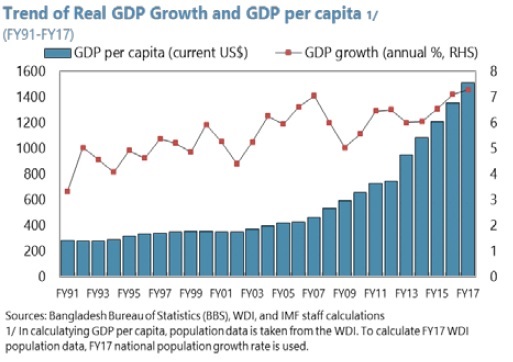
A new post by Timothy Taylor discusses Bangladesh’s growth, declined poverty, gender equity, and financial sector: “Bangladesh has over 160 million people, which makes it the eighth most populous country in the world (just behind Pakistan and Nigeria, just ahead of Russia, Mexico, and Japan). I can’t claim that I’ve been paying close attention to its economy, but I was nonetheless started to see that Bangladesh has shifted (in the World Bank’s classification) from being a “low-income”
Posted by at 10:02 AM
Labels: Inclusive Growth
Labor Market Implications of the Exposure to Routinization
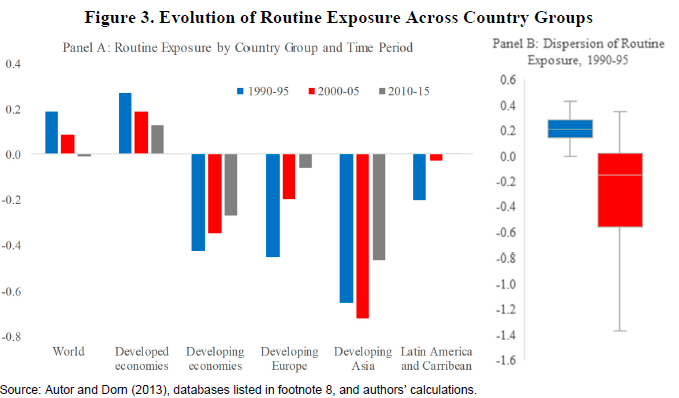
A new IMF working paper proposes “a measure of the exposure to routinization—that is, the risk of the displacement of labor by information technology—and assemble several facts that link the exposure to routinization with the prospects of polarization”, and finds that “(1) developing economies are significantly less exposed to routinization than their developed counterparts; (2) the initial exposure to routinization is a strong predictor of the long-run exposure; and (3) among countries with high initial exposures to routinization, polarization dynamics have been strong and subsequent exposures have fallen; while among those with low initial exposure, the globalization of trade and structural transformation have prevailed and routine exposures have risen.
A new IMF working paper proposes “a measure of the exposure to routinization—that is, the risk of the displacement of labor by information technology—and assemble several facts that link the exposure to routinization with the prospects of polarization”, and finds that “(1) developing economies are significantly less exposed to routinization than their developed counterparts; (2) the initial exposure to routinization is a strong predictor of the long-run exposure; and (3) among countries with high initial exposures to routinization,
Posted by at 9:47 AM
Labels: Inclusive Growth
Wednesday, June 13, 2018
IMF on Operationalizing Gender Issues
A new IMF report provides a thorough overview of practices and resources on operationalizing gender issues:
“Reducing gender gaps can have important economic benefits. Gender gaps remain significant on a global scale, both with respect to opportunities and outcomes. For example, gender-based legal restrictions in many parts of the world, as well as barriers in access to education, healthcare, and financial services, prevent women from fully participating in the economy. In turn, labor force participation rates are lower among women than men. Gender equality can play an important role in promoting economic stability by boosting economic productivity and growth, enhancing economic resilience, and reducing income inequality.
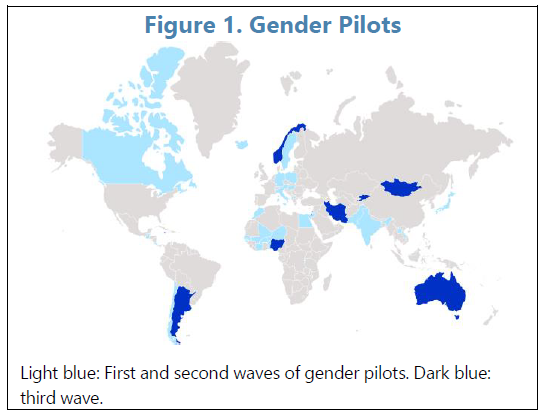
The Fund has begun operationalizing gender issues in its work. Staff has contributed to the economic literature through country-level and cross-country analytical studies, confirming the macro-criticality of gender issues in a broad set of circumstances. Gender issues are also increasingly becoming an integral part of capacity development though technical assistance and training. And in country work, two waves of gender pilots have been completed—encompassing both surveillance and Fund-supported programs and covering all regions of the world and all levels of income—and a third wave is under way.”
A new IMF report provides a thorough overview of practices and resources on operationalizing gender issues:
“Reducing gender gaps can have important economic benefits. Gender gaps remain significant on a global scale, both with respect to opportunities and outcomes. For example, gender-based legal restrictions in many parts of the world, as well as barriers in access to education, healthcare, and financial services, prevent women from fully participating in the economy. In turn,
Posted by at 3:48 PM
Labels: Inclusive Growth
Subscribe to: Posts